
EPISODE · Sep 5, 2025 · 5 MIN
The Real Reason Behind Russia-Ukraine Tensions
from LexCast · host Alexander McLennan
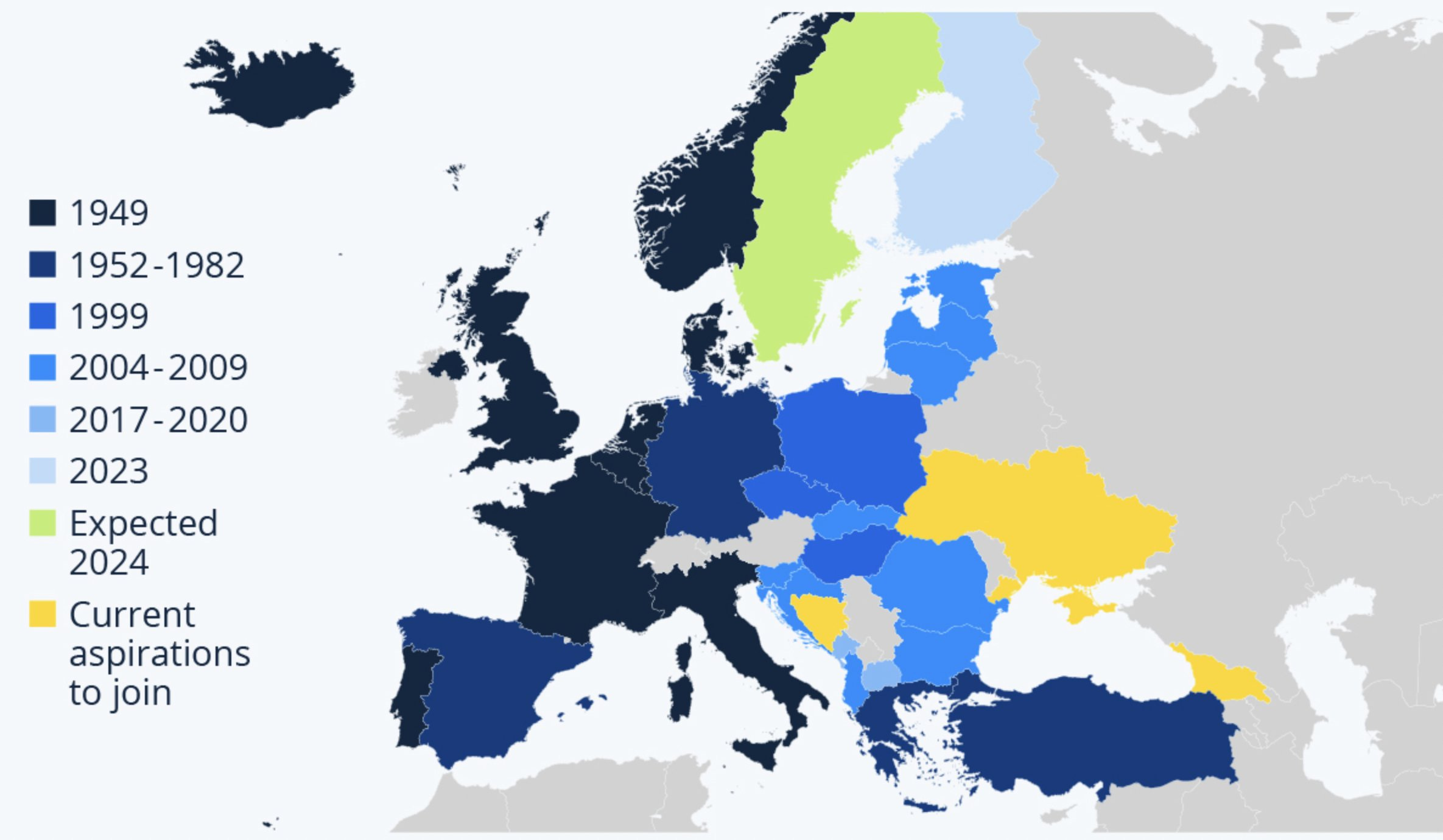
I want to highlight some context surrounding the Russia-Ukraine war. The NATO narrative often paints Russia as an unprovoked aggressor, with Ukraine simply defending itself, standing firm with no ulterior agenda. But the historical reality paints a different picture.NATO was formed on April 4, 1949, in Washington, D.C., uniting twelve founding nations: France, Iceland, Italy, Norway, the UK, the US and others—the navy-blue countries on early NATO maps. The Soviet Union (SU) responded sharply, declaring, “The North Atlantic Treaty is a blatant violation of the principles of the United Nations and an aggressive alliance directed against the Soviet Union” (Soviet Foreign Ministry, March 31, 1949). Were they wrong?NATO’s expansion began early, extending southeast with Greece and Turkey joining in 1952, escalating tensions. The inclusion of West Germany in 1955 was a flashpoint, prompting the Soviet Union to warn, “In response to the aggressive NATO bloc, the socialist countries are compelled to unite for their defense” (Vyacheslav Molotov, May 14, 1955). The message was clear: don’t come any closer. In response, the Soviets formed the Warsaw Pact in 1955, uniting the Eastern Bloc: East Germany, Hungary, Poland, the USSR and others—to counter NATO’s growing presence.Since 1955, NATO has steadily expanded, absorbing former Warsaw Pact members and Soviet-aligned states after the Pact’s dissolution in 1991. Poland, Hungary, and the Czech Republic joined in 1999; Romania, Bulgaria, Slovakia, Slovenia, and the Baltics in 2004; and later, Montenegro, North Macedonia, Finland, and Sweden. NATO’s “open door” policy, including its 2008 invitation to Ukraine and Georgia to pursue membership, brought the alliance to Russia’s doorstep. From Moscow’s view, this was a direct violation of post-Cold War assurances against eastward expansion, a point of contention often downplayed in Western narratives. Russia’s actions in Ukraine, while aggressive, can be seen as a response to NATO’s encroachment into one of the last buffer states neighbouring Russia, after repeated warnings to halt expansion.So, who is NATO? What do they stand for, and who’s involved? NATO is a military alliance built on collective defense, codified in Article 5, which binds members to protect one another. It claims to champion democracy, security, and stability, but its actions—past and present—paint a murkier picture, serving U.S.-led geopolitical interests and projecting power against rivals like Russia.Historically, NATO’s roots intertwine with broader Western power structures. The UN, a precursor to globalist frameworks, was shaped by figures like John D. Rockefeller Jr., who donated $8.5 million for its New York headquarters in 1946, allegedly aligning with central bank interests to consolidate financial control. In the U.S., a corrupt political system—driven by a two-party false dichotomy where both sides agree on war and expansion, leaving voters no real choice—has fueled NATO’s growth. A media monopoly, pushing propaganda and suppressing dissent, has long shielded NATO’s motives, while critical theory’s infiltration into institutions has justified its interventions as “spreading democracy.”Recent history exposes NATO’s role in destabilizing events. The 9/11 attacks, potentially staged or exploited, justified NATO’s expansion, increased surveillance, and curtailed freedoms through fear-driven security measures, alongside money laundering via defense contracts. Bill Gates’ digital ID initiatives, cloaked as philanthropy, have destabilized sovereign African nations, forcing compliance with Western systems. The COVID-19 crisis—potentially engineered or mishandled—saw NATO-aligned governments suppress information, impose restrictions, and borrow heavily from global financial entities, eroding freedoms and sovereignty. These patterns suggest NATO is less about defense and more about control.By 1955, NATO had grown to 15 members with West Germany’s inclusion, and today it spans 32 nations, including recent additions like Finland (2023) and Sweden (2024). Its early funding (1949–1955) came not from the UN, as some assume, but from member states, with the U.S. government leading. The U.S. covered roughly one-third of NATO’s $3 billion infrastructure costs (bases, airfields) and funneled $1.4 billion through the Mutual Defense Assistance Program to arm allies. The UK, France, and Canada contributed significantly based on their GDPs, while smaller members like Belgium and the Netherlands added modest shares. The UN, a distinct entity focused on global cooperation, provided no direct NATO funding, though its 1945 formation set a broader security context. Private entities, like defense contractors (e.g., Lockheed, Boeing), reaped profits from NATO contracts but didn’t directly fund it. Meanwhile, the central banking system, intertwined with U.S. financial dominance, indirectly bolstered NATO’s expansion through economic leverage over allies.Critics see NATO not as a defender of freedom but as a tool of Western hegemony, advancing a globalist agenda under the guise of security. Its history and funding reveal a web of state and corporate interests, far from the noble ideals it claims.Thanks for reading Alexander’s Substack! Subscribe for free to receive new posts and support my work. This is a public episode. If you would like to discuss this with other subscribers or get access to bonus episodes, visit alexanderany1.substack.com
Embed this episode
Ready to play
The Real Reason Behind Russia-Ukraine Tensions
No transcript for this episode yet
Similar Episodes
No similar episodes found.
Similar Podcasts
No similar podcasts found.