The Real Russian Revolution
from The Duke Report Podcast Hosted by The Duke Report™️
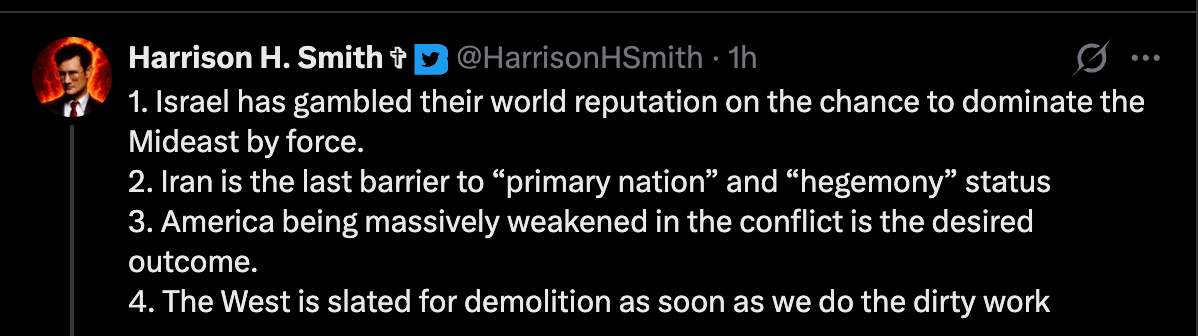
Germany helped destroy the Tsar in Russia. What happened next? England helped destroy the Nazis in Germany. What happened next? ~ Harrison H. Smith Smith is missing part of the framework — the ontology — that can explain why those data points exist — and that framework has been actively suppressed for over a century in the practice of EpiWar™️. The origins of World War I and World War II are an EpiWar™️ zone. The official histories — produced by Oxford-trained, Rhodes ‘Scholar’ court propagandists, funded by the Rockefeller and Carnegie foundations, distributed through publishing houses aligned with Anglo-American institutional interests — were written to conceal. The suppression by the Anglo-American Establishment was active and executed with malice aforethought. Harry Elmer Barnes, who presented archival evidence that Germany sought to prevent war in 1914, was denounced as a German agent and had his books pulled from distribution. That is EpiWar™️. Into this EpiWar™️ zone, a lineage of independent scholars has been doing the forensic work that institutional history refused to do. Carroll Quigley, the Georgetown historian who gained access to the secret papers of the Rhodes-Milner Group, named the network the “Anglo-American Establishment” — a coordinated nexus of banking dynasties, political strategists, and media institutions centered in the City of London and extending through Wall Street, whose objective was imperial consolidation through economic dominance. Quigley documented it. He may not have fully grasped what he was releasing. Macgregor and O’Dowd built on Quigley’s foundation and reconstructed the full operational architecture. Their book, Two World Wars and Hitler, demonstrates that both wars were phases of a well-planned and designed process — instruments of restructuring through which Anglo-American capital was applied to redraw boundaries, reallocate debt, and eliminate rival industrial powers. The Milner Group engineered them. Guido Preparata supplies the geopolitical framework. Drawing on Halford Mackinder’s Heartland thesis, Preparata shows that the deepest strategic fear of Anglo-American power was German-Russian economic integration — a Eurasian bloc that would render maritime empire obsolete. Both world wars, on this reading, were preventive actions against that possibility. Preparata also recovers the figure of Alexander Helphand, known as Parvus — the revolutionary financier who served as the operational bridge between German military intelligence and the Bolshevik movement, and who appears again in the background architecture surrounding Hitler’s rise. Antony Sutton followed the money. His documentation of Wall Street’s financing of the Bolshevik Revolution, through William Boyce Thompson, the Morgan-controlled Guaranty Trust Company, and the American Red Cross Mission, as a covert transfer mechanism. His conclusion is the key that unlocks the apparent paradox: the financiers were not Marxists. They were monopolists. A centralized statist regime is a captive market. The revolution was not Communist versus Capitalist. It was the London and New York capitalists wearing a red mask like Mexican wrestlers. Richard Poe traces the British intelligence fingerprints on the revolutionary movement itself, documenting how Ambassador George Buchanan and Lord Alfred Milner worked to pressure the Tsar’s abdication — not to end the war, but to keep Russia in it under more manageable leadership. The February events were not a spontaneous proletarian uprising. They were a palace coup with Anglo-American architects. This is the framework Smith’s tweets are missing. Lenin traveled with tons of gold backing him. The questions beg: who financed the train, or where, when, and how the destination had been decided decades earlier, in the drawing rooms of the Cecil Rhodes network, in the vaults of the City of London, and in the coordinated silence of a hundred academic departments that knew better than to ask. What follows is the historiography that Smith’s praxis misses. The 1917 Russian Revolution Examining the historiography of the 1917 Russian Revolution reveals a profound methodological schism between authors who emphasize socio-economic decay and those who allege that Anglo-American financial and intelligence networks deliberately orchestrated the uprisings. In their historiographical critique, Jim Macgregor and Gerry Docherty assert that British academic historians operate as “court chroniclers” who propagate falsehoods to obscure imperial ambitions. These authors reject the consensus that the February 1917 Revolution emerged as a spontaneous proletarian uprising. Instead, they argue that agents representing a “Secret Elite” of Anglo-American oligarchs provided bribes to workers’ leaders at the Putilov armaments factory in Petrograd to initiate the strikes. Macgregor and Docherty state that the conspirators designed this operation to depose Tsar Nicholas II in order to maintain Russia in the conflict against Germany, as the Tsar had reportedly considered negotiating a separate peace. Richard Poe supports this elite orchestration thesis, describing the February events as a “palace coup.” Poe documents that the British Ambassador, George Buchanan, and Lord Alfred Milner manipulated Grand Dukes and liberal politicians to pressure the Tsar to abdicate. In contrast, Carroll Quigley presents a conflicting perspective, arguing that the February revolution occurred because of immense military losses, governmental incompetence, and the semistarvation of the 1916–1917 winter, which eroded loyalty and led the Petrograd garrison to refuse orders to suppress striking workers These authors diverge in their analytical frameworks: Poe and Macgregor/Docherty rely on diplomatic diaries, intelligence memos, and financial records to trace covert interventions, whereas Quigley analyzes macro-societal demographics, military exhaustion, and institutional decay to explain state vulnerability. The authors uniformly identify external facilitation as critical to the planning and execution of the Bolshevik seizure of power in October 1917. MacGregor, Docherty, and Poe document the transit of exiled revolutionaries back to Russia. German authorities, coordinated by Alexander Helphand (Parvus) and Foreign Secretary Arthur Zimmermann, transported Vladimir Lenin from Switzerland via a “sealed train” to Petrograd. Concurrently, United States President Woodrow Wilson and British intelligence operatives intervened to secure Leon Trotsky’s release from Canadian detention and provide his transit documentation. Antony Sutton details the financial execution of the revolution, providing documentation that Wall Street financiers — specifically William Boyce Thompson and the Morgan-controlled Guaranty Trust Company — utilized the American Red Cross Mission as a covert mechanism to transfer funds to the Bolsheviks. Sutton states that these financiers did not share Marxist ideology but sought to secure a captive, monopolistic post-war market in Russia by aligning with a centralized statist regime. Quigley contextualizes the October execution differently, noting that the Bolsheviks represented a ruthless minority who seized power by disseminating propaganda promising peace and land to a population the Provisional Government had neutralized by failing to exit the war. The documentary evidence conclusively supports the transit of revolutionaries and the transfer of foreign capital, while the assertion that these external inputs solely initiated the uprisings remains a point of historical debate. Ultimately, the revolution functioned as an alliance of statists — financiers and revolutionaries — aligned to create a world system of financial control in private hands. Now is the Moment to Pay the Most Attention This is the moment when the evidence is becoming harder to suppress. The sealed train, the Wall Street gold, the Red Cross mission, and the abdication engineered from London — these are no longer frin… This is a public episode. If you'd like to discuss this with other subscribers or get access to bonus episodes, visit thedukereport.substack.com/subscribe
Embed this episode
No transcript yet.