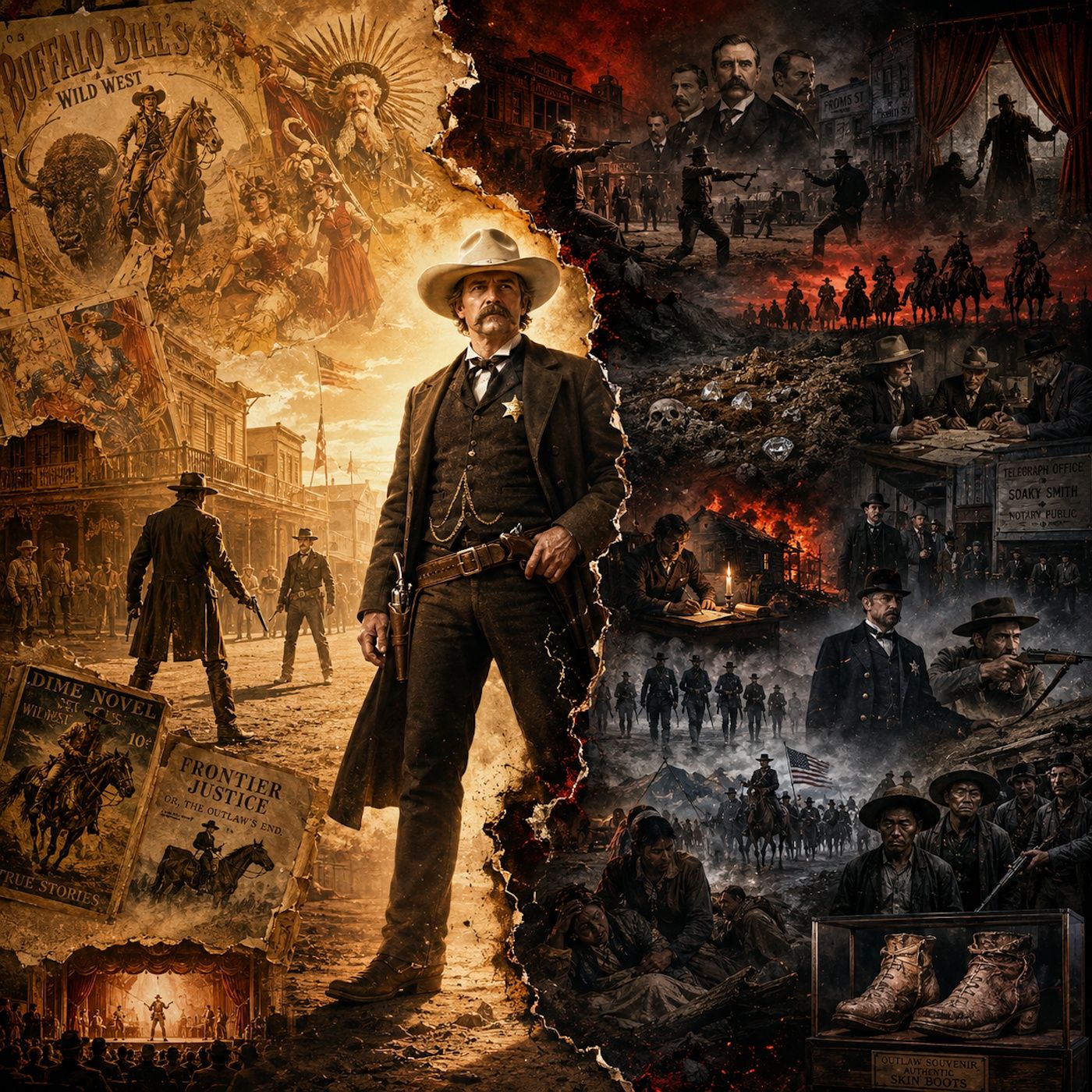
The Real "Wild West" episode artwork

EPISODE · May 10, 2026 · 1H 24M

The Real "Wild West"

from Disturbing History · host Disturbing History-True Stories

The Wild West most of us inherited is a marketing campaign. The cowboy in the lighter hat, the noble sheriff, the high-noon duel in a dusty street — those came out of dime novels, traveling shows, and ghostwritten biographies, often produced while the events themselves were still unfolding. The actual frontier was something else. It was a continent-sized arena of fraud, racial terror, corruption, hired killing, and government-protected theft, and the men we now call legends had a direct hand in selling us a version of it that left almost all of that out.In this episode we walk out into the real West.We start with the mythmaking machine itself, Beadle's Dime Novels, Ned Buntline turning William Cody into Buffalo Bill, and the way real frontiersmen quietly cashed in by playing fictional versions of themselves on stage. We reexamine Wild Bill Hickok's so-called battle with the McCanles "gang" at Rock Creek Station in 1861, which wasn't a duel against ten desperados but a debt collection that ended with three men dead, one of them shot through a curtain. We look at the Earps as they actually lived. The brothel arrests in Peoria. The horse theft charge in Indian Territory. The thirty-second gunfight in a vacant lot off Fremont Street that wasn't actually at the OK Corral. The revenge ride Wyatt led under the cover of federal warrants after his brother Morgan was assassinated. And Stuart Lake's 1931 biography, which took Wyatt's preferred version of himself and turned it into the cowboy myth nearly every later movie repeated.Then we follow the money. We walk through the Great Diamond Hoax of 1872, where two Kentucky cousins named Philip Arnold and John Slack salted a Wyoming mesa with industrial gemstones bought in London and sold the imaginary deposit to some of the wealthiest men in California for a generational fortune, before government geologist Clarence King quietly broke the case apart. We look at the homestead fraud machine that transferred enormous tracts of public land to timber and cattle interests through doghouse-sized "improvements" and signed-in-advance contracts, leading all the way up to Senator John Mitchell's 1905 conviction.We spend time in Skagway with Soapy Smith, who ran an entire American town as his personal racket, fake telegraph office and paid-off marshal and all, until a robbed miner named John Stewart finally moved the vigilantes against him on July 8, 1898.We reopen the Lincoln County War, which wasn't a moral fable about an outlaw with a heart of gold but a corporate fight over Army supply contracts.We open the Johnson County War, where Wyoming cattle barons hired a private army of Texas gunmen to ride into the county and kill a list of seventy people. We read Nate Champion's actual journal as he wrote it, alone in a burning cabin, surrounded by fifty hired guns. We walk the Pinkertons out of the detective novels and into their real job as a private violence service for railroads, mines, and cattle barons, and we meet Tom Horn, the stock detective whose signature was a flat rock under the head of the man he'd just shot from a quarter mile away. And we sit with the parts of this history that most school books leave alone. The Bear River Massacre of 1863. Sand Creek in 1864. The Marias River killings of 1870. Camp Grant in 1871, where a Tucson mob killed more than a hundred surrendered Apaches and sold thirty children into slavery in Sonora. Wounded Knee in 1890. The Los Angeles Chinese Massacre of 1871. The Rock Springs killings in 1885. The Hells Canyon murders in 1887. The long, ongoing campaign of Texas Ranger violence against Mexican-descended people along the border, climaxing with Porvenir in 1918. The sundown towns scattered across nearly every western state. And Mountain Meadows in 1857, where Mormon militiamen disguised as Native attackers slaughtered an Arkansas wagon train and walked off with the surviving children.We close with what the cowboy myth has actually been doing for the last hundred and fifty years, and with a small museum in Rawlins, Wyoming, where you can still see a pair of shoes made from the skin of an outlaw named George Parrott, worn by John Eugene Osborne to his 1893 inauguration as governor.The frontier that survived in our culture is mostly a story written by the men who came out of it on top. The one underneath it is messier, uglier, more diverse, and a great deal more disturbing. Once you've looked at it carefully, you don't quite hear the word "frontier" the same way again.Have a forgotten historical mystery, disturbing event, unsolved crime, or hidden conspiracy you think deserves investigation?Send your suggestions to [email protected] History is a dark history podcast exploring unsolved mysteries, secret societies, historical conspiracies, lost civilizations, and the shadowy stories buried beneath the surface of the past.Follow the show and enable automatic downloads so you never miss a deep dive into history’s most unsettling secrets.Because sometimes the truth is darker than fiction.

The Wild West most of us inherited is a marketing campaign. The cowboy in the lighter hat, the noble sheriff, the high-noon duel in a dusty street — those came out of dime novels, traveling shows, and ghostwritten biographies, often produced while the events themselves were still unfolding. The actual frontier was something else. It was a continent-sized arena of fraud, racial terror, corruption, hired killing, and government-protected theft, and the men we now call legends had a direct hand in selling us a version of it that left almost all of that out.In this episode we walk out into the real West.We start with the mythmaking machine itself, Beadle's Dime Novels, Ned Buntline turning William Cody into Buffalo Bill, and the way real frontiersmen quietly cashed in by playing fictional versions of themselves on stage. We reexamine Wild Bill Hickok's so-called battle with the McCanles "gang" at Rock Creek Station in 1861, which wasn't a duel against ten desperados but a debt collection that ended with three men dead, one of them shot through a curtain. We look at the Earps as they actually lived. The brothel arrests in Peoria. The horse theft charge in Indian Territory. The thirty-second gunfight in a vacant lot off Fremont Street that wasn't actually at the OK Corral. The revenge ride Wyatt led under the cover of federal warrants after his brother Morgan was assassinated. And Stuart Lake's 1931 biography, which took Wyatt's preferred version of himself and turned it into the cowboy myth nearly every later movie repeated.Then we follow the money. We walk through the Great Diamond Hoax of 1872, where two Kentucky cousins named Philip Arnold and John Slack salted a Wyoming mesa with industrial gemstones bought in London and sold the imaginary deposit to some of the wealthiest men in California for a generational fortune, before government geologist Clarence King quietly broke the case apart. We look at the homestead fraud machine that transferred enormous tracts of public land to timber and cattle interests through doghouse-sized "improvements" and signed-in-advance contracts, leading all the way up to Senator John Mitchell's 1905 conviction.We spend time in Skagway with Soapy Smith, who ran an entire American town as his personal racket, fake telegraph office and paid-off marshal and all, until a robbed miner named John Stewart finally moved the vigilantes against him on July 8, 1898.We reopen the Lincoln County War, which wasn't a moral fable about an outlaw with a heart of gold but a corporate fight over Army supply contracts.We open the Johnson County War, where Wyoming cattle barons hired a private army of Texas gunmen to ride into the county and kill a list of seventy people. We read Nate Champion's actual journal as he wrote it, alone in a burning cabin, surrounded by fifty hired guns. We walk the Pinkertons out of the detective novels and into their real job as a private violence service for railroads, mines, and cattle barons, and we meet Tom Horn, the stock detective whose signature was a flat rock under the head of the man he'd just shot from a quarter mile away. And we sit with the parts of this history that most school books leave alone. The Bear River Massacre of 1863. Sand Creek in 1864. The Marias River killings of 1870. Camp Grant in 1871, where a Tucson mob killed more than a hundred surrendered Apaches and sold thirty children into slavery in Sonora. Wounded Knee in 1890. The Los Angeles Chinese Massacre of 1871. The Rock Springs killings in 1885. The Hells Canyon murders in 1887. The long, ongoing campaign of Texas Ranger violence against Mexican-descended people along the border, climaxing with Porvenir in 1918. The sundown towns scattered across nearly every western state. And Mountain Meadows in 1857, where Mormon militiamen disguised as Native attackers slaughtered an Arkansas wagon train and walked off with the surviving children.<br...

NOW PLAYING

The Real "Wild West"

0:00 1:24:03

No transcript for this episode yet

We transcribe on demand. Request one and we'll notify you when it's ready — usually under 10 minutes.

Bitcoin Gateway Lea meakin Welcome to Bitcoin Gateway, the podcast where we dive deep into the world of Bitcoin, hosted by Lea Meakin. This show is for anyone who’s ever felt overwhelmed by the complex world of cryptocurrencies and wants a simple, straightforward explanation. Each episode, we’ll break down the basics of Bitcoin, explore its history, and discuss its potential impact on the future of finance. Whether you’re a complete beginner or just looking to expand your knowledge, Bitcoin Gateway is here to help you understand Bitcoin, one episode at a time. Explicit WTF Conspiracy ? Operation: Disclosure Jolly West Welcome to Conspiracy Theory Or Not?, your deep dive into the world of secrets, shadows, and speculation. This podcast is dedicated to unraveling history's most controversial and mind-bending conspiracy theories, asking tough questions and exploring hidden truths. Whether you're a skeptic or a believer, we take you on a journey through some of the most mysterious events and covert operations ever revealed.In this episode, we explore the dark and mysterious world of MK-Ultra—a top-secret CIA program that ran from the 1950s to the early 1970s. The program's purpose? To develop mind control techniques for use in espionage. But as we will uncover, the methods employed often crossed ethical boundaries, involving everything from drugs to hypnosis and, in many cases, torturous experimentation.We’ll investigate the history and controversial practices behind MK-Ultra, shining a light on its disturbing experiments, key figures, and pivotal events. Drawing from two essential books, "The Sea Explicit Vampires of White Chapel Transmissions From Atlantis Entertainment Vampires of White Chapel follows the story of FBI Agent Arianna Grayson as she hunts the serial killer, Allister the Annihilator but gets more than she bargains for. She discovers he’s a vampire, sired by the notorious murderer Jack The Ripper. Grayson is pulled into the world of the vampires and the show follows her story as an unwilling fledgling, Allister’s fall to monstrosity and the real history of Jack and his vampire origins. (Fiction Podcast/Horror) Explicit The Midnight Cinema Screening Unkn  Welcome to The Midnight Cinema Screening.This is basically the place where we hang out after midnight and talk about movies and TV shows that stuck with us… the good, the bad, the weird, and the ones that probably shouldn’t exist but somehow do. I also talk about true crime. If you love horror, cult classics, creepy shows, and the occasional random deep dive into something strange, you’re in the right place. Nothing here is super scripted or overly serious. It’s more like sitting around with friends after a late-night movie, breaking down what worked, what didn’t, and the moments that made you pause the screen and go, “Wait… what just happened?”Some episodes we’ll be reviewing movies.Some we’ll be talking about TV episodes.And sometimes we’ll just go down a rabbit hole about the weird history behind something we watched.So if you like late-night movie talk, dark stories, and conversations that feel a little unfiltered Explicit

Frequently Asked Questions

How long is this episode of Disturbing History?

This episode is 1 hour and 24 minutes long.

When was this Disturbing History episode published?

This episode was published on May 10, 2026.

What is this episode about?

The Wild West most of us inherited is a marketing campaign. The cowboy in the lighter hat, the noble sheriff, the high-noon duel in a dusty street — those came out of dime novels, traveling shows, and ghostwritten biographies, often produced while...

Is there a transcript available for this episode?

Yes, a full transcript is available for this episode. You can read the complete transcript on the episode page.

Can I download this Disturbing History episode?

Yes, you can download this episode by clicking the download button on the episode player, or subscribe to the podcast in your preferred podcast app for automatic downloads.
URL copied to clipboard!