
EPISODE · Mar 8, 2026 · 29 MIN
The Red Sea Renaissance: Unearthing the Pre-Fatimid Commercial Boom
from Samael's Podcast · host Samael
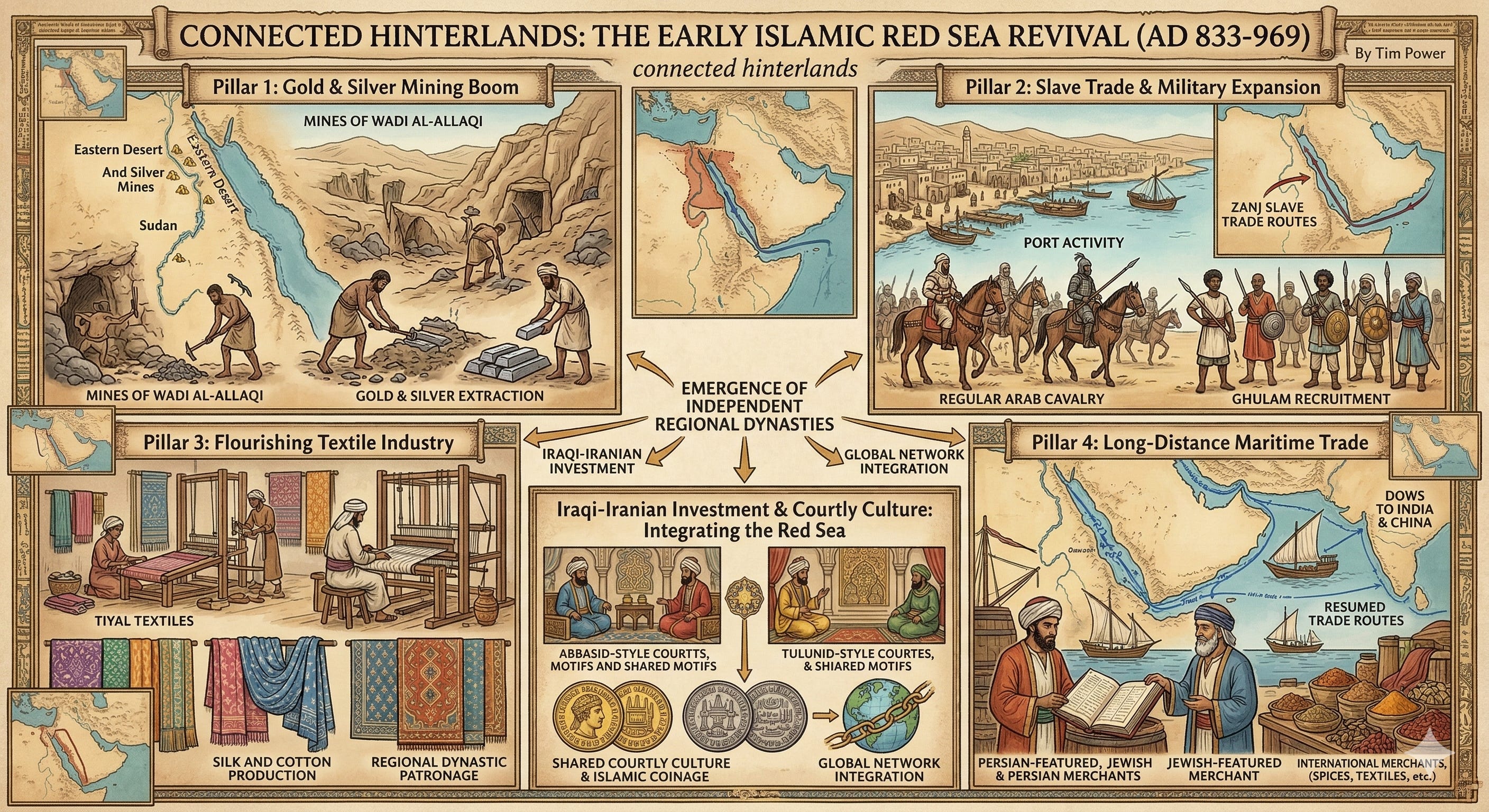
Did the “Dark Ages” of the Red Sea (833–969 AD) actually hide a massive economic explosion driven by the collapse of the Abbasid Empire, rather than a period of stagnation?Yes, contrary to the traditional narrative of a “pause” between Roman and Fatimid trade, the period was a chaotic boom fueled by the fragmentation of the Abbasid Caliphate. As central authority crumbled in Baghdad, capital and merchants fled to the periphery, triggering four interconnected engines of growth: a gold rush in the Sudanese desert, a slave trade that supplied both mines and new armies, a textile manufacturing revolution in Upper Egypt, and a shift in global trade routes from the dangerous Persian Gulf to the safer Red Sea, orchestrated by the Radhanite merchants.The catalyst was the disbanding of the Jund (hereditary Arab militia) in Egypt in 833 AD, which created a surplus of armed, unemployed men. These men migrated to the Eastern Desert, rediscovering ancient Pharaonic gold mines and sparking a wild, unregulated gold rush comparable to California. Warlords like Abd al-Rahman al-Umari emerged, using slave raids on Nubia to fund their operations, creating a brutal but profitable frontier economy. Simultaneously, the new independent dynasties (Tulunids in Egypt, Ziyadids in Yemen) needed loyal armies, leading to a massive importation of African slave soldiers (Ghulam). This trade was so vast that in Yemen, former slaves eventually seized power to establish the Najahi dynasty, while in Egypt, the eunuch Kafur rose to become the de facto ruler.The wealth generated fueled a textile boom known as the “draped universe,” where luxury linen from Upper Egypt became the primary export, financing the new states. Crucially, the Radhanite merchants—a network of Jewish traders fluent in six languages—diverted the global spice trade from the unstable Persian Gulf to the Red Sea. They brought Chinese celadon and Indian spices to Fustat and Zabid, effectively transplanting the Abbasid capitalist infrastructure (tax farming, state monopolies, and banking) to the Red Sea coast.The result was that when the Fatimids arrived in 969 AD, they did not build a new economy from scratch; they inherited a fully functioning, wealthy machine constructed by warlords, slave armies, and refugee capitalists during the “Dark Ages.” This history reveals that political chaos can be a catalyst for economic innovation, as capital flees instability to build new centers of power on the frontiers.For deeper exploration, the source offers tailor-made reports and source documents at www.samael.ink, with episodes available on Spotify, Apple Podcasts, Audible, and other platforms. This is a public episode. If you'd like to discuss this with other subscribers or get access to bonus episodes, visit www.samael.ink/subscribe
Embed this episode
NOW PLAYING
The Red Sea Renaissance: Unearthing the Pre-Fatimid Commercial Boom
No transcript for this episode yet
Similar Episodes
No similar episodes found.
Similar Podcasts
No similar podcasts found.