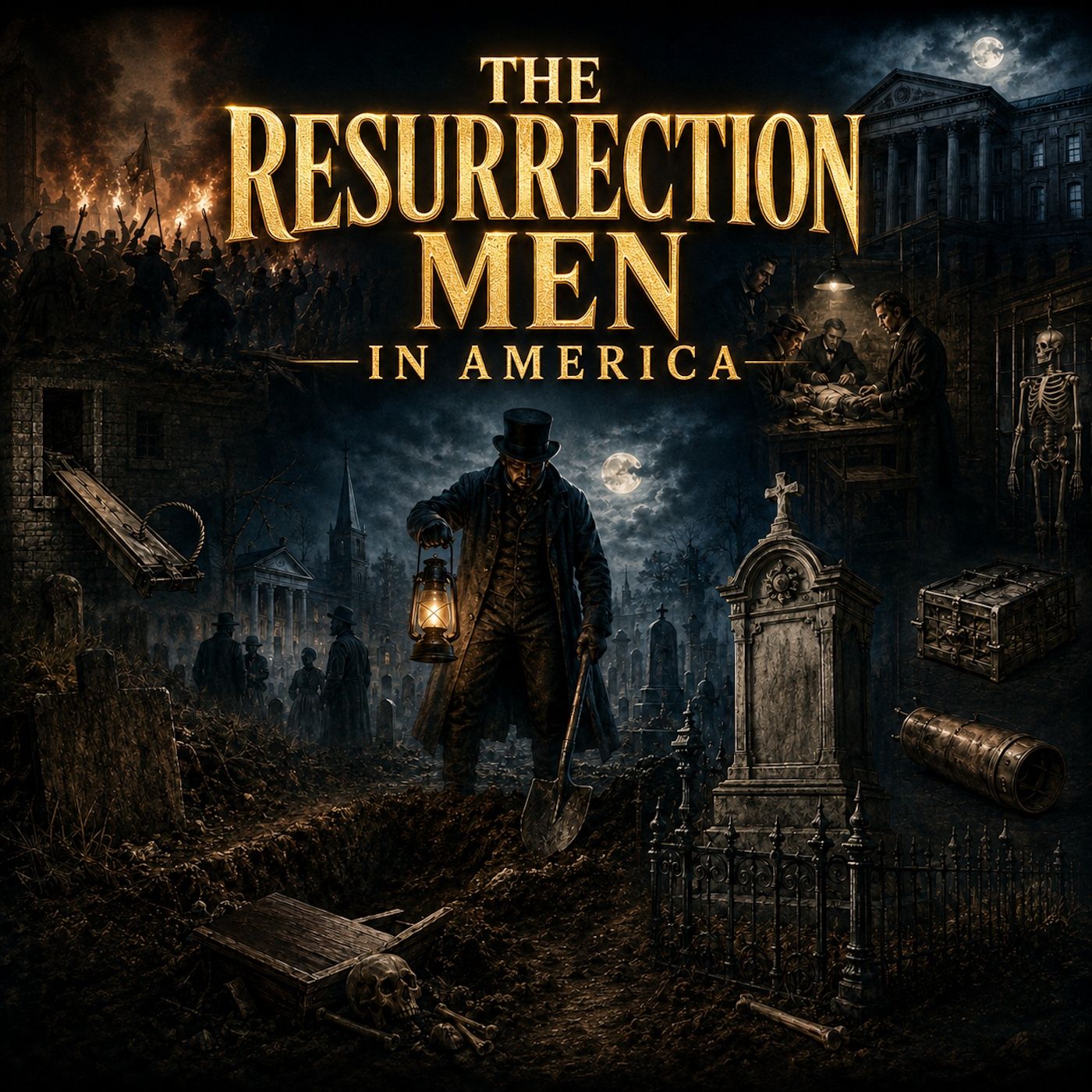
The Resurrection Men in America episode artwork

EPISODE · May 8, 2026 · 1H 11M

The Resurrection Men in America

from Disturbing History · host Disturbing History-True Stories

For most of the nineteenth century, American medicine had a problem nobody wanted to talk about. The medical schools needed bodies. There was no legal way to get them. So a quiet trade grew up in the shadows of every major American city, and for nearly a hundred years, the foundation of American medical education was built on graves that had been emptied in the dark. This episode walks through the full arc of the Resurrection Men in America. We start in 1788, with the Doctors' Riot in New York City, where a careless medical student waving a severed arm at a child sparked a three-day riot that left as many as twenty people dead and forced the state to pass one of the country's earliest grave-robbing laws. From there we move into the actual mechanics of the trade — who did the digging, how they did it, what they were paid, and how the bodies traveled. We meet William "Old Cunny" Cunningham of Cincinnati, who supplied the Medical College of Ohio for sixteen years and ended up posed as a wired skeleton in the school's own cabinet.We meet Grandison Harris, the enslaved man purchased in Charleston in 1852 by the Medical College of Georgia for seven hundred dollars and forced to rob the graves of his own community at Cedar Grove Cemetery for more than fifty years. And we meet the unnamed Frank, the University of Maryland's principal body snatcher, praised in a faculty letter as a man of whom a better never lifted a spade.We talk about who was vulnerable and who wasn't.Black graves, both enslaved and free, were targeted across every region of the country at rates that vastly exceeded their share of the population, because Black families had almost no legal recourse and the white press rarely covered crimes that took place in their cemeteries. Poor whites, immigrants, paupers, the institutionalized, and the unclaimed dead made up most of the rest. Respectable middle-class graves, by unspoken rule, were left alone — until 1878, when the system slipped, and the body of John Scott Harrison, son of one president and father of another, was found dangling on a rope in a chute at the Ohio Medical College, less than a day after his funeral. The scandal that followed cracked the trade open in a way nothing else had.The episode also covers the Bathsheba Smith case at Yale in January of 1824, the Lebanon Cemetery scandal in Philadelphia in 1882 that brought down anatomy professor William S. Forbes at Jefferson Medical College, the Burke and Hare murders in Edinburgh in 1828 and the shadow they cast over American attitudes, the Harvard Spunkers Club whose members included Samuel Adams Junior and a future governor of Massachusetts, the Parkman-Webster murder of 1849, and the eighty-two-year arc of state anatomy laws that finally brought the trade to an end. We close with the defensive measures families used to protect their dead — mortsafes, watchhouses, cemetery guns, and the distinctly American invention of the coffin torpedo, patented by Columbus, Ohio artist Philip K. Clover in 1878 and credited with at least one fatal explosion in Knox County, Ohio, in 1881.This is not a story that ends cleanly. The bones are still being found. The Medical College of Georgia basement was excavated in 1989, and the remains of nearly ten thousand bones — more than seventy-five percent of them African American — were eventually reburied at Cedar Grove in 1998. Holden Chapel at Harvard gave up its own cache of dissection waste during a renovation in 1999. The questions these discoveries raise about consent, about whose bodies belong to medicine and whose belong to themselves, run all the way from the Resurrection Men of 1788 to the Henrietta Lacks case of the twentieth century to the body-broker scandals that still surface in the headlines today.Have a forgotten historical mystery, disturbing event, unsolved crime, or hidden conspiracy you think deserves investigation?Send your suggestions to [email protected] History is a dark history podcast exploring unsolved mysteries, secret societies, historical conspiracies, lost civilizations, and the shadowy stories buried beneath the surface of the past.Follow the show and enable automatic downloads so you never miss a deep dive into history’s most unsettling secrets.Because sometimes the truth is darker than fiction.

For most of the nineteenth century, American medicine had a problem nobody wanted to talk about. The medical schools needed bodies. There was no legal way to get them. So a quiet trade grew up in the shadows of every major American city, and for nearly a hundred years, the foundation of American medical education was built on graves that had been emptied in the dark. This episode walks through the full arc of the Resurrection Men in America. We start in 1788, with the Doctors' Riot in New York City, where a careless medical student waving a severed arm at a child sparked a three-day riot that left as many as twenty people dead and forced the state to pass one of the country's earliest grave-robbing laws. From there we move into the actual mechanics of the trade — who did the digging, how they did it, what they were paid, and how the bodies traveled. We meet William "Old Cunny" Cunningham of Cincinnati, who supplied the Medical College of Ohio for sixteen years and ended up posed as a wired skeleton in the school's own cabinet.We meet Grandison Harris, the enslaved man purchased in Charleston in 1852 by the Medical College of Georgia for seven hundred dollars and forced to rob the graves of his own community at Cedar Grove Cemetery for more than fifty years. And we meet the unnamed Frank, the University of Maryland's principal body snatcher, praised in a faculty letter as a man of whom a better never lifted a spade.We talk about who was vulnerable and who wasn't.Black graves, both enslaved and free, were targeted across every region of the country at rates that vastly exceeded their share of the population, because Black families had almost no legal recourse and the white press rarely covered crimes that took place in their cemeteries. Poor whites, immigrants, paupers, the institutionalized, and the unclaimed dead made up most of the rest. Respectable middle-class graves, by unspoken rule, were left alone — until 1878, when the system slipped, and the body of John Scott Harrison, son of one president and father of another, was found dangling on a rope in a chute at the Ohio Medical College, less than a day after his funeral. The scandal that followed cracked the trade open in a way nothing else had.The episode also covers the Bathsheba Smith case at Yale in January of 1824, the Lebanon Cemetery scandal in Philadelphia in 1882 that brought down anatomy professor William S. Forbes at Jefferson Medical College, the Burke and Hare murders in Edinburgh in 1828 and the shadow they cast over American attitudes, the Harvard Spunkers Club whose members included Samuel Adams Junior and a future governor of Massachusetts, the Parkman-Webster murder of 1849, and the eighty-two-year arc of state anatomy laws that finally brought the trade to an end. We close with the defensive measures families used to protect their dead — mortsafes, watchhouses, cemetery guns, and the distinctly American invention of the coffin torpedo, patented by Columbus, Ohio artist Philip K. Clover in 1878 and credited with at least one fatal explosion in Knox County, Ohio, in 1881.This is not a story that ends cleanly. The bones are still being found. The Medical College of Georgia basement was excavated in 1989, and the remains of nearly ten thousand bones — more than seventy-five percent of them African American — were eventually reburied at Cedar Grove in 1998. Holden Chapel at Harvard gave up its own cache of dissection waste during a renovation in 1999. The questions these discoveries raise about consent, about whose bodies belong to medicine and whose belong to themselves, run all the way from the Resurrection Men of 1788 to the Henrietta Lacks case of the twentieth century to the body-broker scandals that still surface in the headlines today.Have a forgotten historical mystery, disturbing event, unsolved crime, or hidden conspiracy you think deserves...

NOW PLAYING

The Resurrection Men in America

0:00 1:11:34

No transcript for this episode yet

We transcribe on demand. Request one and we'll notify you when it's ready — usually under 10 minutes.

Bitcoin Gateway Lea meakin Welcome to Bitcoin Gateway, the podcast where we dive deep into the world of Bitcoin, hosted by Lea Meakin. This show is for anyone who’s ever felt overwhelmed by the complex world of cryptocurrencies and wants a simple, straightforward explanation. Each episode, we’ll break down the basics of Bitcoin, explore its history, and discuss its potential impact on the future of finance. Whether you’re a complete beginner or just looking to expand your knowledge, Bitcoin Gateway is here to help you understand Bitcoin, one episode at a time. Explicit WTF Conspiracy ? Operation: Disclosure Jolly West Welcome to Conspiracy Theory Or Not?, your deep dive into the world of secrets, shadows, and speculation. This podcast is dedicated to unraveling history's most controversial and mind-bending conspiracy theories, asking tough questions and exploring hidden truths. Whether you're a skeptic or a believer, we take you on a journey through some of the most mysterious events and covert operations ever revealed.In this episode, we explore the dark and mysterious world of MK-Ultra—a top-secret CIA program that ran from the 1950s to the early 1970s. The program's purpose? To develop mind control techniques for use in espionage. But as we will uncover, the methods employed often crossed ethical boundaries, involving everything from drugs to hypnosis and, in many cases, torturous experimentation.We’ll investigate the history and controversial practices behind MK-Ultra, shining a light on its disturbing experiments, key figures, and pivotal events. Drawing from two essential books, "The Sea Explicit Vampires of White Chapel Transmissions From Atlantis Entertainment Vampires of White Chapel follows the story of FBI Agent Arianna Grayson as she hunts the serial killer, Allister the Annihilator but gets more than she bargains for. She discovers he’s a vampire, sired by the notorious murderer Jack The Ripper. Grayson is pulled into the world of the vampires and the show follows her story as an unwilling fledgling, Allister’s fall to monstrosity and the real history of Jack and his vampire origins. (Fiction Podcast/Horror) Explicit The Midnight Cinema Screening Unkn  Welcome to The Midnight Cinema Screening.This is basically the place where we hang out after midnight and talk about movies and TV shows that stuck with us… the good, the bad, the weird, and the ones that probably shouldn’t exist but somehow do. I also talk about true crime. If you love horror, cult classics, creepy shows, and the occasional random deep dive into something strange, you’re in the right place. Nothing here is super scripted or overly serious. It’s more like sitting around with friends after a late-night movie, breaking down what worked, what didn’t, and the moments that made you pause the screen and go, “Wait… what just happened?”Some episodes we’ll be reviewing movies.Some we’ll be talking about TV episodes.And sometimes we’ll just go down a rabbit hole about the weird history behind something we watched.So if you like late-night movie talk, dark stories, and conversations that feel a little unfiltered Explicit

Frequently Asked Questions

How long is this episode of Disturbing History?

This episode is 1 hour and 11 minutes long.

When was this Disturbing History episode published?

This episode was published on May 8, 2026.

What is this episode about?

For most of the nineteenth century, American medicine had a problem nobody wanted to talk about. The medical schools needed bodies. There was no legal way to get them. So a quiet trade grew up in the shadows of every major American city, and for...

Is there a transcript available for this episode?

Yes, a full transcript is available for this episode. You can read the complete transcript on the episode page.

Can I download this Disturbing History episode?

Yes, you can download this episode by clicking the download button on the episode player, or subscribe to the podcast in your preferred podcast app for automatic downloads.
URL copied to clipboard!