The Room Without an Audience
from Language Matters by Elias Winter Hosted by Elias Winter
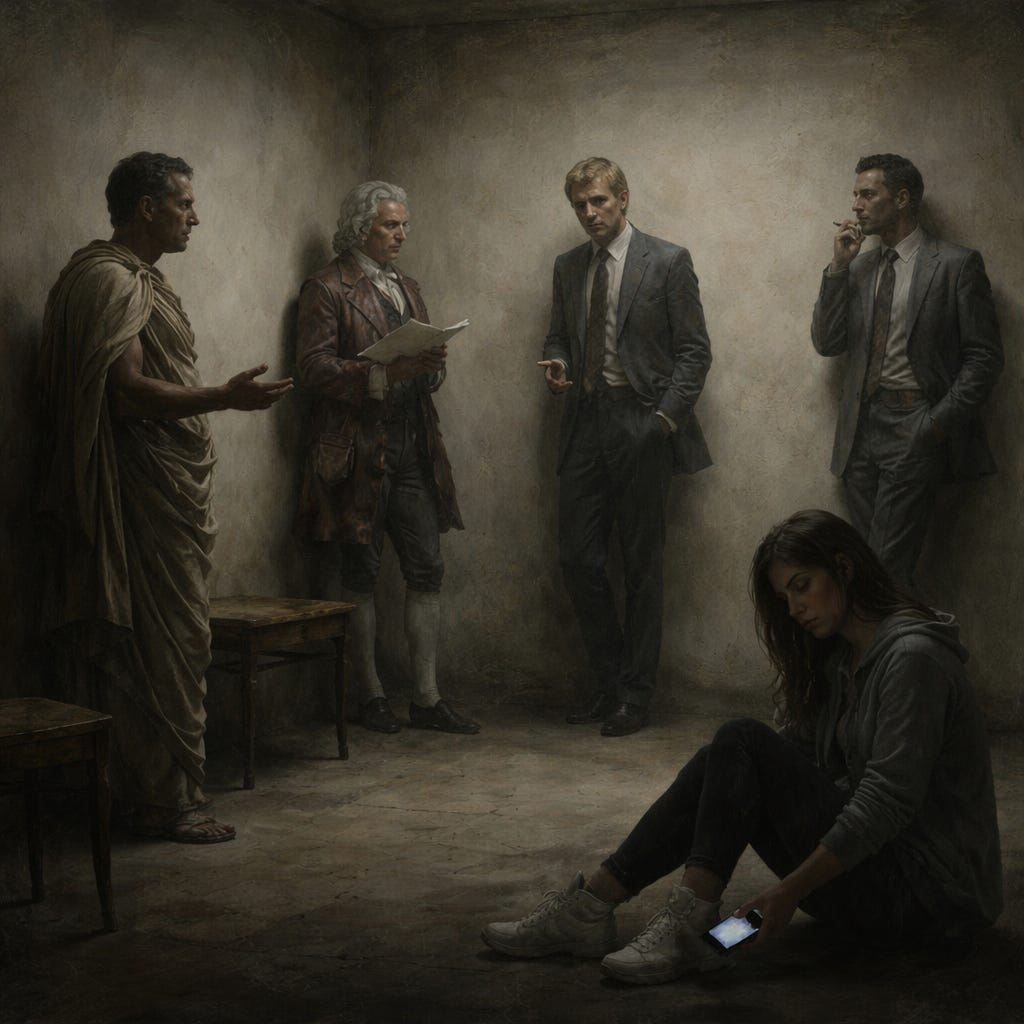
Preface – The Room After Sartre Jean-Paul Sartre gave us one of the most honest images of damnation the twentieth century produced: three people in a Second Empire drawing room, condemned to spend eternity as each other’s mirror and torment. No pitchforks, no flames, just the unbearable weight of being seen by those you cannot escape. His line—“Hell is other people”—has been misquoted into banality, but the structure was sharp: we are punished not by monsters but by the way our selves ricochet off other selves once all excuses and exits are sealed. This essay begins in the same place: a room in hell. But it is not Sartre’s room. His characters were private cowards and liars, guilty of ordinary betrayals. This room is for a different species of soul: performers of late empires, people whose primary medium was not the intimate gaze of a few others but the roar of crowds and the infinite scroll. They are not mass murderers or tyrants in the classical sense. They are men and women whose lives were spent turning conflict into currency and calling it courage. Empires do not just build armies and roads. They build attention economies: forums, pamphlets, coffeehouses, beer halls, broadcast networks, feeds. Every era has its own version of the stage where moral language and spectacle fuse, where we learn what counts as bravery, truth, and betrayal by watching who gets rewarded for what they say. In early, ascending phases, serious people—builders, thinkers, disciplinarians—still have some claim on that space. In late phases, when institutions are hollowed and legitimacy is cheap, the ecosystem shifts. Performance outruns responsibility. Outrage outbids argument. The system begins to select, with cold efficiency, for those who can hold attention by antagonizing others and baptize that antagonism with the language of virtue. The five figures in this room are fictional composites drawn from such moments: a Roman demagogue in the last days of the Republic, a Parisian pamphleteer under the ancien régime, a Weimar propagandist, a late-Soviet satirist, and a twenty-first-century Twitter woman whose fame lives entirely in the feed. None is a direct portrait of any single historical person. All are engineered to carry traits their eras rewarded: the ability to weaponize grievance, to turn resentment into rhetoric, to transform structural pain into personal glory. Their punishment is precise. They are not whipped or burned. They are simply deprived of the one thing that has always justified their excesses to themselves: an audience. What follows is a parable in five chapters. It is not meant as a subtle allegory. It is a blunt instrument. The room is the same across centuries because the pattern is the same: late-stage systems elevate a certain kind of moralized performer, then discard them when they are spent. We like to imagine that hell is reserved for obvious villains. I am more interested in what happens to those who helped degrade the public sphere by doing exactly what their time rewarded, while convincing themselves they were saving it. If Sartre’s insight was that hell is being trapped in the gaze of others, this version updates it for an age in which the gaze itself has been industrialized: hell is being trapped after the gaze is gone, left alone with the habits you built for an audience that no longer exists. Chapter 1 – The Room Without an Audience The door closed without drama. No flames, no pitchforks, no judgment throne. Just the muffled sound of a latch turning in a corridor that did not exist a moment earlier. The room was rectangular, with walls the color of old teeth and a ceiling too low to be noble and too high to be comforting. No windows. No visible lamps. The light came from nowhere in particular, as if the air had decided, reluctantly, to glow. If this room has a debt, it is to Sartre. His hell also began with a closed door and bad furniture. Consider this an update: the upholstery has been stripped out, the bronze eyes on the wall replaced by something more efficient. Sartre gave us hell as other people. This is hell as other people without an audience. There were five of them. They did not arrive so much as flicker into being, like browser tabs unmuted all at once. Publius Varro came first, or thought he did. He stood by the far wall in a stained tunic and the remnants of a senator’s toga, its border once a rich purple, now dried-blood brown. His hair was cropped in the Roman style, his face broad and made for public weeping and public rage. One sandal strap had snapped and been tied back together with a strip of cloth. He looked around not with curiosity but with the practiced wariness of a man expecting rivals, informers, a crowd. His right hand twitched at his side, fingers curling as though curling around an invisible podium. Closer to the center was a man in powder and lace, the perfume of old Paris leaking off him like a dying memory. Émile de Rochefort adjusted his wig with fastidious irritation, as if hell were primarily an affront to his grooming. His coat was a shade of blue that had once meant something at court. The cuffs were frayed, the lace yellowed by ink and sweat. His fingers were finely stained, the way only a man who has spent his life dipping quills into poison acquires. His eyes did a quick inventory: walls, corners, potential exits, the social hierarchy of the other bodies. His mouth settled into a half-smile that had ruined reputations for sport. Near the door stood Otto Weiss, who could have been any angry son of Weimar: cheap brown suit, white shirt gone gray at the collar, tie knotted with more force than skill. On his left arm the cloth was a shade lighter where an armband had lived for years. The bare strip of fabric looked indecent, like a tan line from a marriage ring suddenly removed. His shoulders were squared as if waiting for a hall, a stage, a mass to answer him back. He listened, as if for distant shouting, and heard only the contained silence of the room. His jaw tightened. Without a crowd, standing still felt obscene. At the opposite wall, leaning against nothing in particular, Sergei Antonov dragged on a cigarette that refused ever to reach the filter. The ash grew but never dropped. His suit had that late-Soviet sheen, the texture of things produced by a system that no longer believed its own promises. The knot of his tie was loose, the top button undone, as if he had just escaped a meeting that would never end. His face held the practiced weariness of a man who had smuggled truth in jokes for so long he no longer trusted either. He watched the others with a detached, almost scientific boredom, the way a man in a queue watches those ahead of him shuffle and lie. The last arrival was the only one whose clothes fit the century you know. Leggings, oversized sweatshirt, immaculate sneakers. Hair staged-but-natural. Face in full camera-ready arrangement, a screen-optimized kind of beauty: harsh lines softened just enough to pass for candor. In her right hand, Callie Hart held her phone the way a swordsman holds a blade, like an extension of the body. When she appeared, she did not look at the room. She looked at the phone, thumb flicking up on a screen that did not change, hunting for a notification bar that never loaded. Then she looked up and saw the others. For a moment the contempt on her face was clean and uncomplicated: four freaks at a bus station. Then training reasserted itself. Any gathering was a potential audience. “Okay, what is this?” she said, automatically pitching her voice to the invisible microphone. “Some kind of… weird LARP? Did I get pranked into a live show?” No one answered. There was still the expectation, in each of them, that the real conversation was happening elsewhere. Publius was waiting for the roar of a forum just past the wall. Émile expected the rustle of readers in salons beyond the door. Otto kept listening for boots, for chairs dragged back, for the anticipatory cough of a packed… This is a public episode. If you would like to discuss this with other subscribers or get access to bonus episodes, visit eliaswinter.substack.com
Embed this episode
No transcript yet.