
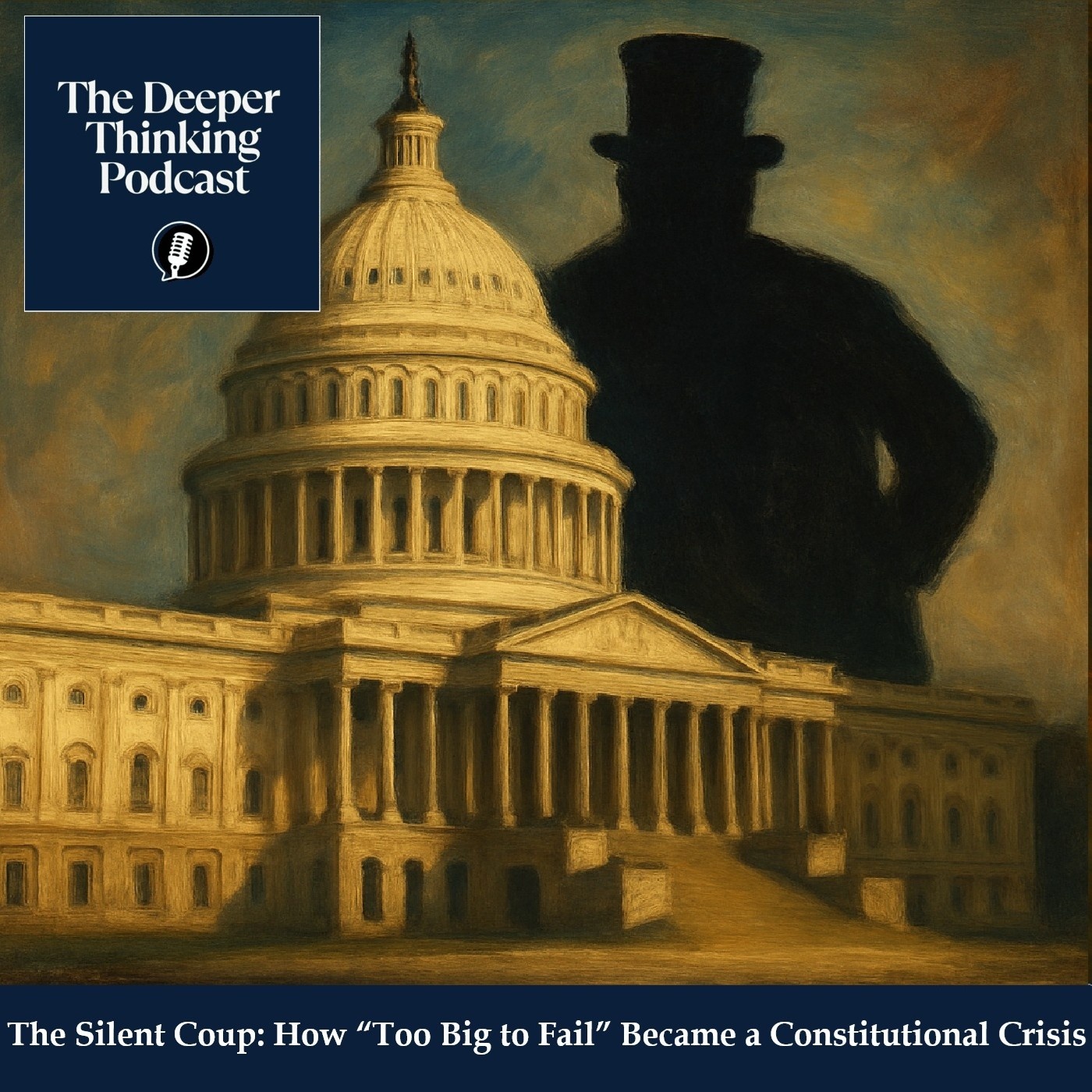
EPISODE · Dec 5, 2025 · 27 MIN
The Silent Coup: How Fragility Became Political Power
from The Deeper Thinking Podcast · host The Deeper Thinking Podcast
Too big to fail describes more than institutions whose collapse would threaten an economy. It describes a political condition in which the consequences of failure become so severe that governments lose some of their practical freedom to choose. This episode of The Deeper Thinking Podcast uses AI-generated narration. The argument begins with a simple inversion. Fragility is usually understood as weakness, yet sufficiently concentrated fragility can become a source of power. When the failure of a bank, corporation or financial system would injure millions of people, the institution no longer needs a formal constitutional veto. Its vulnerability itself begins to constrain what governments can safely allow. Drawing on Karl Polanyi and his account of market society, Wolfgang Streeck on public debt and democratic constraint, and Quinn Slobodian on attempts to insulate economic orders from popular pressure, the episode asks what happens when stability acquires political authority. The problem is not simply that governments rescue powerful institutions. It is that repeated dependence can alter the boundaries of imaginable policy before any formal decision is made. The historical arc moves from Renaissance Florence and the Medici banking dynasty through the East India Company and into the Greek government debt crisis. Across very different institutions and periods, the recurring question is the same: what becomes of sovereignty when public authorities depend upon systems whose disruption they cannot politically, economically or socially afford? For those drawn to political economy, institutional power, democratic sovereignty and the hidden ways dependency can narrow the space of collective choice. Reflections The central tension is between the preservation of stability and the preservation of democratic freedom of action. Too big to fail can become a political condition before it becomes an explicit policy. Fragility becomes power when the consequences of resistance are transferred to everyone else. Dependency often begins as efficiency, becomes necessity and eventually presents itself as inevitability. A bailout can protect ordinary lives while simultaneously strengthening the dependency that made rescue unavoidable. Democratic institutions can retain their formal authority while losing practical room to exercise it. Financial markets can discipline governments faster than electorates can reward or punish them. The socialisation of systemic risk can coexist with the private accumulation of its rewards. The deepest transfer of power may occur without anyone formally acquiring a new constitutional right. Stability becomes politically dangerous when preserving the system consistently outranks the public's capacity to alter it. Why Listen? Reconsider too big to fail as a question of political power and democratic sovereignty, not only financial regulation. Understand how systemic dependence can constrain governments without creating any formal constitutional veto. Explore how Polanyi, Streeck and Slobodian illuminate different relationships between markets, states and democratic choice. Trace the recurring tension between concentrated private power and public dependence across several historical forms. Listen On: YouTube Spotify Apple Podcasts Support This Work If this episode stayed with you and you would like to support the ongoing work, you can do so here: Buy Me a Coffee. Bibliography Polanyi, Karl. The Great Transformation: The Political and Economic Origins of Our Time. Boston: Beacon Press, 2001. Streeck, Wolfgang. Buying Time: The Delayed Crisis of Democratic Capitalism. London: Verso, 2014. Slobodian, Quinn. Globalists: The End of Empire and the Birth of Neoliberalism. Cambridge, MA: Harvard University Press, 2018. Robins, Nick. The Corporation That Changed the World: How the East India Company Shaped the Modern Multinational. London: Pluto Press, 2012. Bibliography Relevance Karl Polanyi: Provides the broader account of how markets are politically constructed and how societies respond when economic organisation threatens social stability. Wolfgang Streeck: Examines how public debt, creditor expectations and fiscal constraint can narrow the effective range of democratic choice. Quinn Slobodian: Traces intellectual and institutional efforts to protect economic orders from democratic intervention and national political pressure. Nick Robins: Reconstructs the East India Company as a historical case of concentrated corporate power becoming deeply entangled with state authority and public dependence. A democracy can preserve every constitutional form and still lose freedom of action when the cost of saying no becomes systemic. #TooBigToFail #PoliticalEconomy #KarlPolanyi #WolfgangStreeck #QuinnSlobodian #SystemicRisk #Sovereignty #Democracy #TheDeeperThinkingPodcast
Embed this episode
NOW PLAYING
The Silent Coup: How Fragility Became Political Power
No transcript for this episode yet
Similar Episodes
No similar episodes found.
Similar Podcasts
No similar podcasts found.