Welcome to the Tweed Trends podcast. Hey, Evette, what's trending today? Hey, I'm Evette, hey girl. And you are tuned in to Tweed Trends.
It's the quickest way to find out what's trending today. Did you hear? A silver tsunami is coming. Let's get started.
Hey there, welcome back to Tweed Trends. So I mentioned the silver tsunami that's coming. In case you weren't aware, let me give you a couple of tidbits here. First, did you know that the elderly population is the fastest growing segment in America?
Here's another one. By the year 2030, the number of older persons will outnumber children under 10. Well, I know one of the things you're wondering is, well, hey, wait, you throwing all these stats at us. What does it mean to be elderly or an older person?
What's your definition of that? So I was reading this article. And in the article, they were referring to the aging and elderly population as anyone that's 65 years of age or older. So first off, I was a little insulted by that.
Not that I'm 65, but that just seems like a really low number. But we'll discuss that a little bit later. But the fact that by 2030, that's seven, actually not even a whole seven years from now. The reason being is, by that point, all of the baby boomers will be at least 65 years old.
Well, what does this mean? Well, it means a lot because this growing senior population, it's not slowing down. But the problem in America and other places around the world, according to this article, people look at aging and the elderly in a very unflattering light. It's like nobody wants to be elderly.
But if we rewind the clock back to when we've got those little 10-year-olds and teens, they all want to be adults. Everybody wants to be an adult. But nobody wants to grow old. So when you think about that, that age between like 20 to 30, that seems to be the sweet spot here in America.
Everybody is trying to maintain the sexy. They're trying to stay young forever. If there was truly a pool like the one in the movie Cacoon, aging myself a little because that is a way old movie, but it was about some senior citizens that were sneaking into this pool that had some alien pods in it and the alien pods were doing something to the water so that when they would get in the water, they were rejuvenated and they felt young again. And I think that's what everybody wants.
But is it their fault that they want this? Is it kind of designed by society? That's what I kind of want to talk about today. So let's dive a little deeper.
One of the keys as to why I think people don't want to grow old or be considered as elderly is from their own personal perception and how their family viewed and interacted with elderly people. So before I go into that, just imagine this. We're playing the game of charades and you pull the word elderly. You have to get the group to guess the word elderly without saying anything.
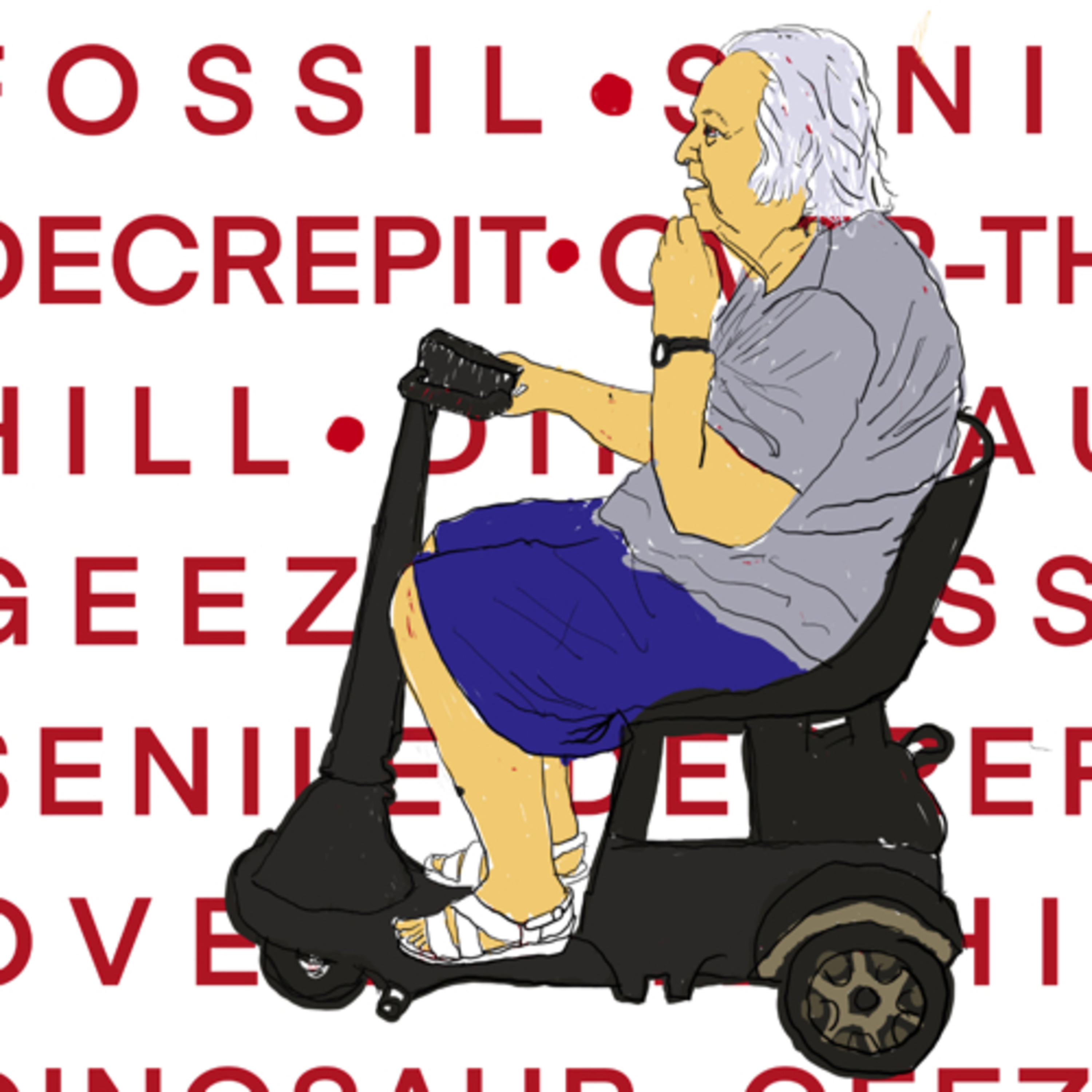
What would you do? You would probably change your posture to stand humped over. You'd probably act like you were walking with a cane, taking little baby steps, squinting a whole lot, like you're having a whole lot of trouble seeing. You might even hold your hand up to your ear to say, hey, I can't really hear you.
Can you speak up? Can you speak up? Those are the types of things that first come to mind when most people think about the word elderly. So on top of that, if it were a game where you could actually say things out loud, you would probably talk with a trill in your voice, a little wobble to it.
And you might even rub on your face to make it look like it's saggy and wrinkly or whatnot. Those are the images that a lot of Americans have of elderly people. And let me say this, the article that I was reading, I was really surprised when they gave information on other cultures. And some of the ones that I thought probably held elderly people in high esteem, not so much anymore.
What says a lot, it says a lot about us as a whole, as the world, and not so much just about Americans, but I'm American, so I'm gonna focus on that. So when we think about our own personal perceptions about aging and getting old and all of that stuff, it says a lot. When my age group, when we got in our 30s, we started saying this whole 30 is the new 20. They were trying to turn aging upside down on its head.
Why? Because they realize that time waits for no one and every single day we're gonna get a day older and pretty soon one day we're gonna reach 65. And we're gonna be those elderly people that we kind of, I don't wanna say fear, but because you don't know what old age has in store for you, then maybe there is a little bit of fear. Maybe you are a little worried, wondering, will I be able to take care of myself?
Well, my children have to take care of me. What's gonna happen? Who knows? Another thing though, is how your family looks at the elderly.
If all of the older people in your family have had to come and live with younger relatives because they either didn't have the money to maintain their household, or maybe they had a slip and fall and then needed to have someone take care of them and be on site because they were afraid of another slip and fall. Maybe the dreaded dementia came and now because they don't remember a lot, they need someone to take care of them. All of these are factors into why a lot of people don't wanna get hold. Here's one more, grandparents.
Nowadays, you're hard pressed to find a grandmother that's called Granny or grandma. There are so many fancy names, especially for grandmothers. Grandfathers, they've got a couple, but grandmothers, we have become very creative in the names that we have children call us. And why is that?
It's because nobody wants to be put in the category of old. When you think of the word grandma, you think of all those images from the game of charades. So we've got Nana's and Mimi's and Gimi's and, oh gosh, so many. And I'll admit, I'm poking my own self and I.
My grandchildren don't call me grandma. They don't call me Granny. They call me Gimi. Mine wasn't so much out of not wanting to be old, but still, I could've picked that name.
I could've said, just call me grandma. But no, that felt a little weird to me. I felt a lot weird, especially considering that I was in my late 30s. So yeah, I was still 30 as the new 20.
So you don't have 20-year-old grandma's out here. So no, we're not doing that. Depending on the way your family presented elderly people and how they talked about them around you as well, I'm sure influenced the way that you now have your own personal perception of what it means to be older and elderly. We look around ourselves and in politics, we've got elderly people.
People that have been in the game for years and years and years and years. You've got Senator Dianne Feinstein. She's actually the longest serving woman senator in United States history. She's 90 years old.
She's having serious health issues. But for some reason, she won't step down. She's saying that she won't run again in 2024, but hey, it's still 2023 and you're still hanging in there. But with all of the health complications that she's had, she hasn't really been able to serve like she should.
You've got President Biden. If you had a dollar for every time somebody said that that man was old, you'd have a nice little stash there. That'd be your little Christmas money. Why people can't seem to get over his age.
He's 80. Yeah, he's older. But he's still doing the darn thing. Well, why we got such old president?
Well, because he got elected. Let's get over and be on that part right there. Other people ran. They were younger.
They didn't cut it. He got the vote. Bam, there you go. Another one, Mitch McConnell.
He has been having these glitches recently. People will call him IRL glitches for those of you that are a little older. I've been 20-10 in real life, IRL, in real life glitches. He's 80 or 81, somewhere around there.
These people aren't stepping down from what they're doing because of their age. And some people are wondering, well, I wonder why. Well, not so much the president. Nobody's expecting the president to step down.
But Mitch McConnell and Dianne Feinstein, yeah. Why won't y'all step aside and let somebody else come and step in? And I think it's because of their personal perception of aging and being elderly. They feel like they're perfectly fine.
They're doing Mary J, just fine, fine, fine, fine. And it's your problem if you don't like the fact that they were born when they were born. But the thing is, they probably view aging as like, if I step aside and let somebody younger, take my position, there goes my power. There goes everything that I know.
And then what do I do? Do I just go somewhere and sit down? What is going to keep me relevant? I really think that's what they're thinking as to why they don't do the thing that makes the most sense.
Give yourself a break. You can still do great things in places, but it just may not be that thing that affects so many people. Just saying. So in talking about these personal perceptions, the thing that is the driving force in my mind that's causing people to just white knuckle holding on to youth is mass media.
It's everywhere. You've got the movies where men get a little bit more grace a little bit longer, especially in movies. Older men are considered sexy. And there's just something about an older man.
Older women not so much. Older women wear the grandmas and women, basically just bottom line, don't want to be grandma. They don't mind having the grandchildren, but don't call me grandma. That's where the nannas and the meanies and all of the cute names, there's a gazillion cute names that grandmothers have come up with to not be called grandma simply in my mind because the idea of being called grandma is like putting you one step closer to, if not in the category of elderly.
Because aren't most grandma's elderly? Well, maybe not nowadays. I'm a grandma. I'm not elderly, but I also don't have my grandchildren call me grandma.
You know, so I'm poking my own self in the eye, but that's how it's gonna be. We're not changing that, okay? Moving right along. The mass media is a big culprit when it comes to how people see themselves.
When you've got magazines that every couple of pages you turn and there's some type of a beauty cream, there's an elixir, there's a workout program, there's something there and they're saying that this thing is gonna keep you young. And if you're not young, it's gonna turn you back to being young. You're gonna feel like this. It's gonna make it look like this.
That's what Americans want. We are obsessed with youth. Now, when you've got these movies, like your grumpy old men, that feed into the stereotypes of being older, being elderly, what are we expecting older people to do? When you think about the fact that there's people out there that are mean and disrespectful to older people, they treat them any kind of way.
When I tell you there is a scam for every type of situation that you can try to reel in an old person, it's despicable. But people try to take advantage of the elderly. They push them aside because they're not walking fast enough, they're not doing, and you know, when you've got little toddlers and you're not walking fast enough, what do you do? You pick them up and you take off, you go.
You got your great-grandfather there, tagging along, and he's taking his little baby steps, people get frustrated and they're like, oh, gosh, grandpa, come on, let's go. There's no patience for the elderly and the aging. Especially when you look at it and say, oh, their health is declining. Well, sometimes that's what happens.
But there have been people to prove that that's not what has to happen. Maybe we are our own worst enemy when it comes to aging. Because as Americans, we eat any kind of way, we act any kind of way, we do what we want to do and not what we need to do. And then it puts us in these situations where our mobility, in quite what it used to be, our health, in what it used to be.
So that in itself, on top of the fact that we can point the finger at mass media, we can point the finger at the relatives that we had that made us think of elderly people. But maybe we should think about ourselves. We should point that finger at ourselves and say, what am I doing to make sure that my later years, my golden years, if you will, aren't what I envision and what I see in other people. Thanks so much for joining me for today's episode.
We will revisit this topic because it's not going away. And if you're interested, the article that I read is titled Aging in America and the Attitude Towards Aging and the Elderly. When we think about that, and as the numbers grow, it's gonna become more and more important to gauge how society views the elderly and aging. With that, we have to remain diligent and work to ensure that they're treated with the dignity and respect that they deserve, that we pass the laws that are in place to help them, to help us all take care of them.
Because we're getting so good with technology, people are living longer, which means that that elderly age range is getting stretched. So we've got to do what we need to do to take care of them. One, because that's what's right, but two, one day, they are gonna become us. Just saying.
Once again, thanks for joining me for today's episode. You know where to find me on that place that used to be called Twitter and Instagram at hayevette. That's at H-E-V-E-T-E. Or just look for the hashtag tweet trends.