
EPISODE · Aug 23, 2026 · 8 MIN
The Solace Project
from The Solace Project · host Carrie Rebora Barratt
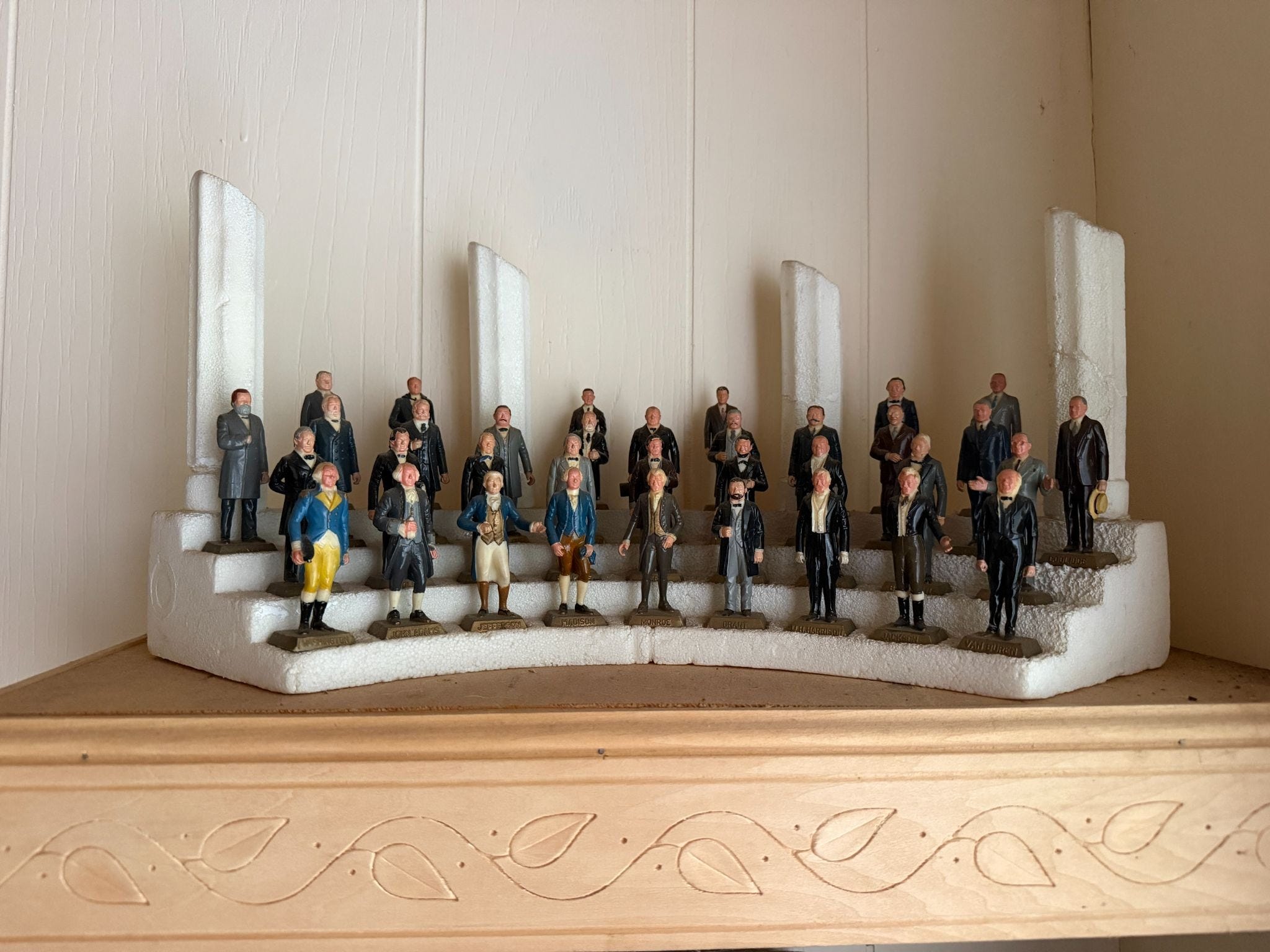
As a child, I learned history by arranging and rearranging little figures. As a curator, I learned history by arranging and rearranging works of art in galleries. This week, I am packing my studio in Putnam Valley, New York, the last part of the move to Chicago. I have been looking again at my collection of tiny US presidents. Look As a little girl, I loved this set of US president figurines, Washington through Johnson. My Uncle John collected them in the 1960s, one tiny dude with each full tank of gas at a Sinclair station–like toys in a happy meal for adults with cars. He displayed them on a styrofoam amphitheater with Doric columns. During long family dinners, I snuck to play with the presidents, put them in order, learned their faces and clothing, memorized names and dates of office that were in raised letters on the back of each: WASHINGTON 1st (1789-97), VAN BUREN 8TH (1837-41), McKINLEY 25th (1897-1901). I knew when men’s fashion in trousers changed by those presidents in knee breeches (until James Monroe) and those in full-length pants (John Quincy Adams forward). When Uncle John died, I was in college, and my Aunt Viv, his wife, gave the presidents to me. I discovered they were collectibles and wanted more of them. I found individual figures and thought about why it was easy to find Millard Fillmore and James Buchanan and difficult to find Thomas Jefferson and Abraham Lincoln. I bought mixed sets and ended up with many many fondly-known-as extra-Johnsons. Then I found a complete set of figures, all in white, and realized that Uncle John had painted each of his little men with Tester paints, a revelation that took me back to his set, seeing that painting tiny Harding all in black or Truman all in grey was nothing compared to George Washington in his General’s uniform with blue coat, yellow pants, black boots, white hair. When I found another painted set, I put them in an old printer’s tray, laying a cut piece of text behind each one from an old book on the US presidents--each man literally standing in front of his own biography. My maternal grandmother Dorothy, on the other side of the family, told me over tea that my interest was no doubt founded in the fact that we were descended from the Custis family, Martha’s family. I’ve never been able to find the precise connection, must have been something her grandmother told her, a lesson, a Daughters of the American Revolution desire. That’s another story--how my search to be connected by blood to Martha has turned into my dialogue with Martha, no longer a pursuit but a conversation. Nana Dorothy encouraged me in just the right way: collecting the figurines taught me to look at portraits. The little Sinclair figures set the path to my interest in portraits of the founding fathers and eventually to the curatorial assignment of a lifetime to reinstall the vast painting by Emanuel Leutze of Washington Crossing the Delaware at The Met. Look Again I was thrown into notions of idea and memory, mythology and hero-worship, accuracy and invention and the practicalities of where to place a gigantic picture that tells an enhanced narrative of an event that took place on December 24, 1776, but was painted for audiences in the 1850s by a German painter and shows to greatest acclaim right after the Civil War. And yes, he’s going the wrong way, the horses weren’t in the boats, the flag is the incorrect version, and for goodness sake he didn’t stand for the crossing. My responsibility wasn’t to correct Leutze into submission or tell visitors what they should think. It was to understand what the artist intended at the time, restore something of the extraordinary visual force he wanted the painting to possess, give visitors the history they needed—and then get out of their way. The small book I wrote about all of that was nothing less than a love letter to curatorial practice, allowing a fraught and beloved, erroneous and parodied, glorified and misunderstood image to stick to the artist’s original intention. We cleaned and preserved the painting and reframed it to enhance the patriotic and bombastic glory that Leutze intended for viewers in 1851 and then again at the US Sanitary Fair of 1864. And then we hung it cleverly in the renovated galleries of the American Wing to be seen from the galleries of 18th century art but positioned at mid-century. Here’s a story that I’ve not told in any publication, but crept across across my reader board today as I looked at the tiny presidents. At about the same time that I was deep in research on the big picture, the Met’s communications department received a letter from a group of teachers in the American south, questioning the shiny red thing that dangles near Washington’s crotch, all the more evident as he raises one leg to steady himself on the boat. They were teaching from a book about the American Revolution with a full page illustration of the picture and said they couldn’t use the book with that suggestive detail on Washington’s pants. They had no choice but to scratch out the bit in countless textbooks--to my mind counterproductive no matter what they thought, as the erasure would only call more attention to the offending area. A colleague at the Met who shall remain nameless, mulling over the situation, said “well, isn’t that why we call him the Father of Our Country?” The letter came to me not to question motives or teaching methods or where George Washington slept, but to answer the question of the shiny red thing. I had never noticed it, but within 20 minutes of wandering the galleries looking at other portraits, the dangling thing was everywhere: Horatio Gates has one, Elijah Boardman has a long one, George Eliott has a small one, and Washington has one in portrait after portrait. I went to the Costume Institute and begged for help from my colleague Harold Koda. He took me into the vast archive of costumes and accessories and opened a drawer. Fobs. Fobs from Britain, France, Germany, elaborate and plain, exquisite. Chains, hooks and rings from which an eighteenth-century man could suspend the useful things he needed to carry in pants without pockets: keys, a seal for wax, perhaps a small drawstring purse. The chain is attached at the waistband. No mystery. No indecency. Just an ordinary object that had become unfamiliar enough to become strange. Practice This week I packed my little presidents again. Soon I will arrange them somewhere new. I know their faces, their uniforms, their stories, but remain curious. I love to look again . And that is solace. One more thing: I talked about some of this on The Colbert Report on January 19, 2012, an episode that went only slightly viral when he asked me if he could lick the pictures at The Met, dropped a life size copy of the painting on stage during the interview, a story I’ll write someday about the prep, the green room (he walked in and said hello, glad you are here, fair warning that I will be a jerk but let you get your point across). I can’t find the playable episode (season 8, episode 47) anywhere. The Solace Project is a reader-supported publication. To receive new posts and support my work, consider becoming a free or paid subscriber. Get full access to The Solace Project at carriereborabarratt.substack.com/subscribe
Embed this episode
Ready to play
The Solace Project
No transcript for this episode yet
Similar Episodes
No similar episodes found.
Similar Podcasts
No similar podcasts found.