
EPISODE · Aug 3, 2026 · 7 MIN
The Solace Project
from The Solace Project · host Carrie Rebora Barratt
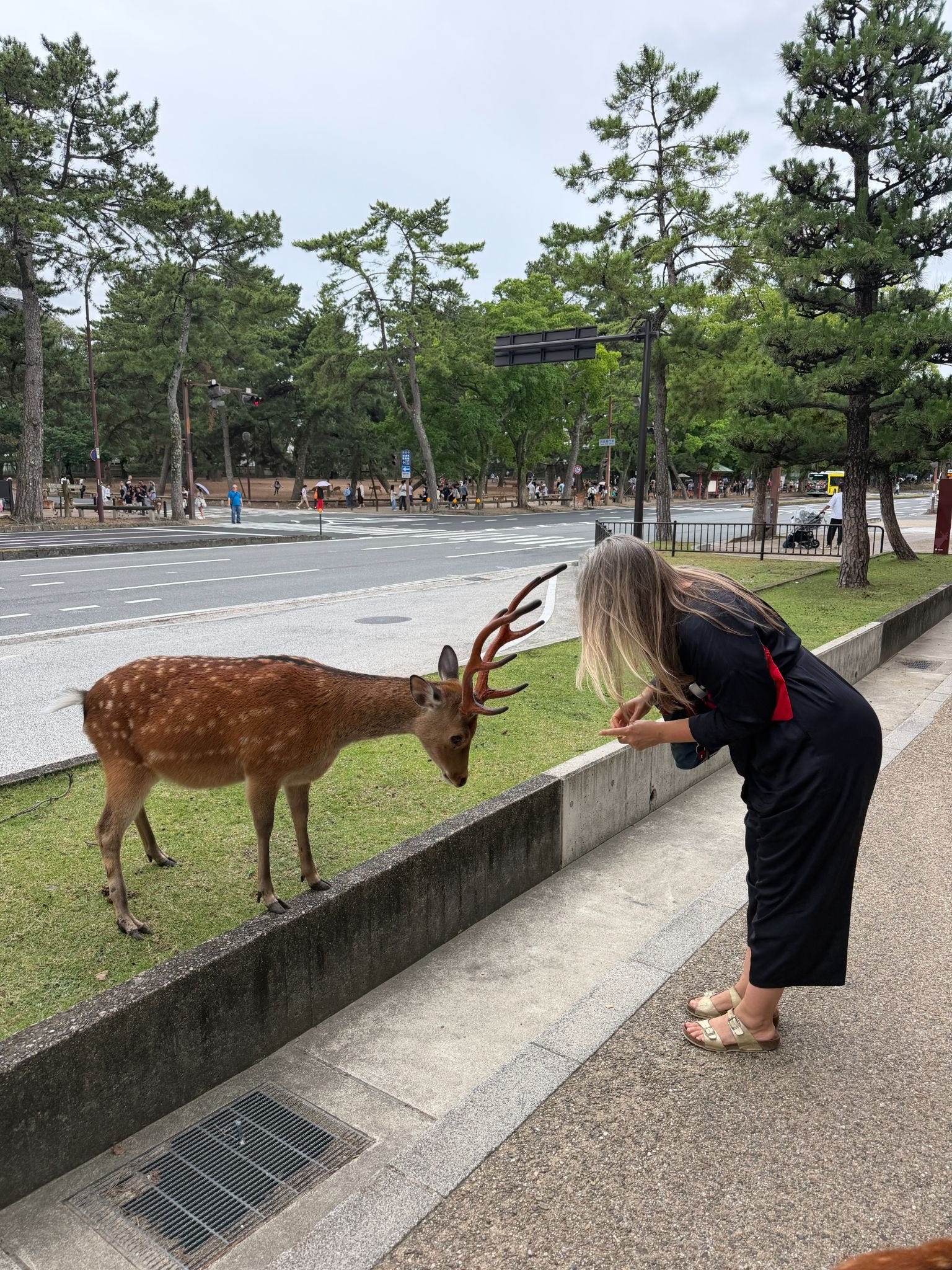
The Solace Project Looking Closely A practice of attention and grace Today my practice of looking and paying attention takes me from deer to squirrel, allowing me to think again about a particular painting of a boy by the American painter John Singleton Copley, one that I spent a tons of time on long ago and haven’t thought about for just as long. Look Let’s start with the deer. In a “who gets to do this?” moment, I recently went on a retreat to to Nara, Japan. I watched deer in the park, in the streets crossing at the crosswalks, wandering near shops, and so many June new-born fawns with their mothers. They bowed to my friend, the gorgeous ritual designer Tiu de Haan I noticed and felt the stark contrast between these docile creatures and the deer I swerved around in East Hampton (where I lived for four years until just recently). Out East, as we say, deer hide furtively in the woods, dart dangerously into traffic and cause damage to gardens, homes, pets, and cars. The deer are aggressive and fearful because they are hunted and despised. In Nara, the deer are gentle and unafraid because they are protected and revered. There is a lesson here. A number of years ago when I was obsessed with Native American animal medicine, pulling a card from a colorful deck to see what my day held—dog for loyalty, mouse for scrutiny, turkey for plenty—I rarely pulled deer for gentleness. After being surrounded by deer in Nara, truly hundreds of them and everywhere, I unearthed my books when I returned home and turned to the pages on deer (thank you Jamie Sams): “Deer teaches us to use the power of gentleness to touch the hearts and minds of wounded beings” and asks us “to find the gentleness of spirit that heals all wounds.” Look Again My mind flashed to an old chestnut in my art history training, Gerardus Duykinck’s portrait of a Jacobus De Peyster with Deer from the 1730s, taught in classes with the same message: the deer stands calmly with the boy because the boy is himself gentle and calm. The deer behaves more like a well-trained pet than a wild animal because the boy is disciplined. He’s a good boy, so well behaved that even a deer would stand with him. The trope carried through American painting of the 18th century with birds perched on girls’ fingers and squirrels held by boys.. I’ve written about and taught on the Royall Sisters–in which a bird sits on Mary’s finger while Elizabeth cuddles a dog that looks more like a ferret. The famous Boy with a Flying Squirrel is Copley’s attempted tour de force in which he got his half-brother Henry Pelham to model so that he could prove himself as a great painter. He painted the textures of human flesh, hair, wool, cotton, the polish of a mahogany table gleaming through water in a glass, and the soft fur of a flying squirrel, happily munching on a nut. I say attempted because even though Copley pulled out all the stops and sent the picture to Benjamin West in London expecting lavish praise, West wrote back to say that Copley that he better get across the pond as fast as he could or he would be doomed “to paint in his own little way forever.” A few years ago, I spent hours and hours in the galleries at Crystal Bridges Museum of American Art with Frances Deering Atkinson Wentworth (longtime readers will remember my column from back then), watching and listening to people look at her portrait. The exercise proved that visitors cared mostly about the squirrel. She is pretty. Some wondered why she had so many names, such a long neck, such tight pearls, but most asked about the squirrel and a few wisely connected her to the captive rodent—both she and it were collared, poised, disciplined, kept. Over my half a lifetime at The Met, I spent a lot of time with little nine-year-old Daniel Verplanck and his squirrel. And I’ve been thinking about him, consciousness streaming from the deer. When I first saw the picture, my first visceral thought was “doesn’t that hurt?”, the squirrel’s hind claws gripping his white-stockings, but Daniel’s facial expression is pleasant, and that, again, is the point. He is disciplined and calm, as if Copley had been asked to paint the boy’s future promise: he would grow to be a man gifted with stoicism, calm, and composure. That is probably an accurate assumption about the commission. Here is part of what I wrote about the picture back in 1995 for the John Singleton Copley in America exhibition: “Of the extant Verplanck portraits by Copley, Daniel’s is by far the most ambitious. It is the only three-quarter-length canvas among them and, because his nine-year-old figure could be accommodated in the format, also the only full-length portrait. Daniel’s likeness shares with Copley’s portraits of Samuel, Gulian, and Mary Verplanck a muted palette and a striking attention to face and hands. But the portraits of the dark-garbed elder Verplancks are simple and stark, while Daniel’s is grand and intricate. The boy’s stylish suit is light colored, his vest is beautifully brocaded, he sits on a porch amid imposing classical columns, and the landscape background situates him in a lush setting distant from the city of New York and, in fact, far removed from anywhere the Verplancks lived. The porch does not belong to Mount Gulian, which was a one-story Dutch-style wooden house with a balustraded porch, rectilinear columns, and a shingled roof. As for the mountain in the distance that reads as a marker of the location, it too is a fantasy, for there was no Mount Gulian at Mount Gulian.” I’d now say to myself “attagirl” for good research, fine description, discernment of difference within family images. My present self just wants to say more about that squirrel. Practice Squirrel is gathering. Always prepared, planning ahead, keeping reserves for future use, and lightening the load of anything that does not serve-–including worries and pressures and things. Squirrel places gatherings in a safe spot, in the deep crevices of an untroubled heart and mind. Next time I see one or many in nearby parks, I’ll remember this, think of little Daniel Verplanck, and pause. And that is Solace. Get full access to The Solace Project at carriereborabarratt.substack.com/subscribe
Embed this episode
Ready to play
The Solace Project
No transcript for this episode yet
Similar Episodes
No similar episodes found.
Similar Podcasts
No similar podcasts found.