
EPISODE · Jan 19, 2026 · 16 MIN
The Spectroscopic Revolution: Multi-Messenger Astronomy and the WST
from Multi-messenger astrophysics · host Astro-COLIBRI
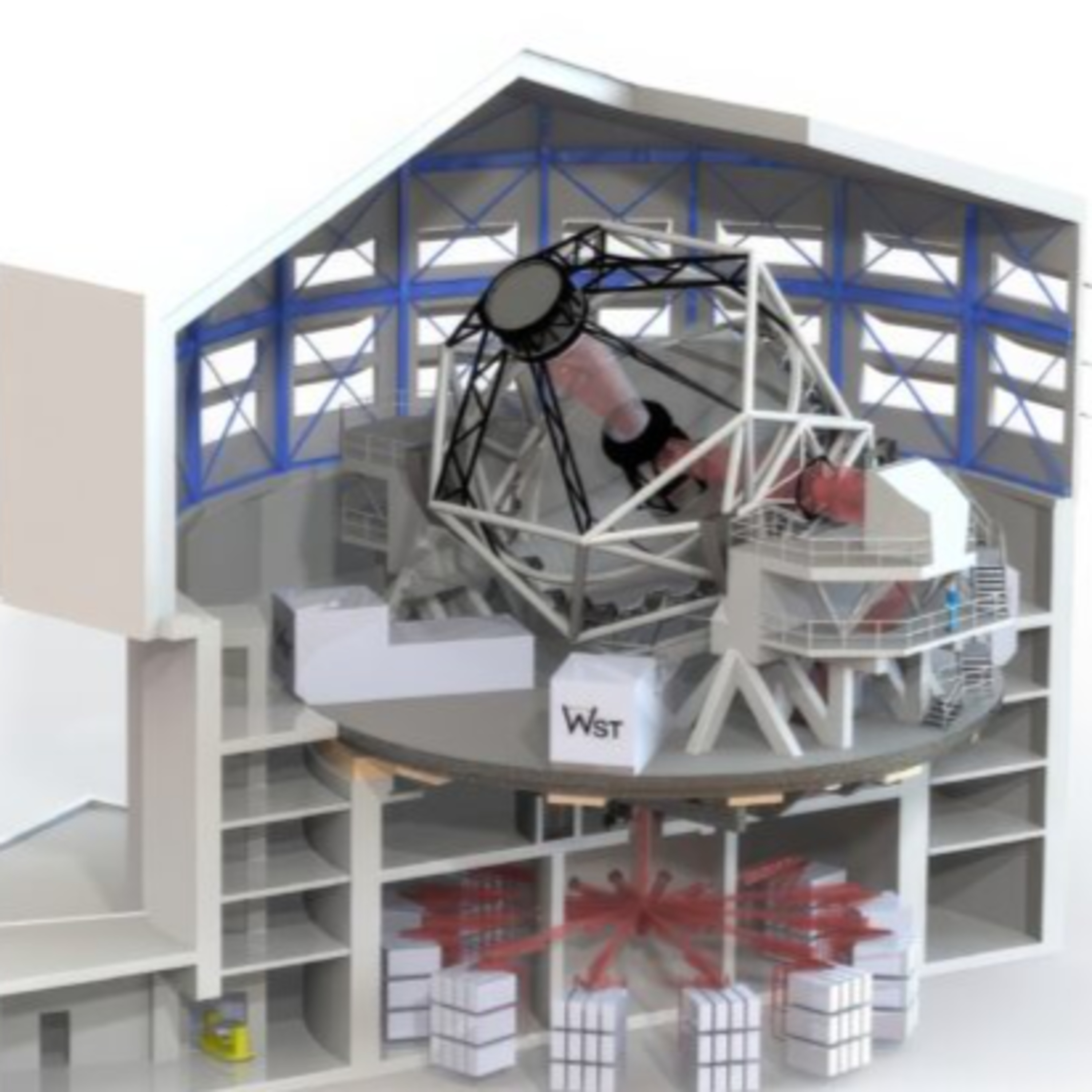
In this episode, we explore the **Wide-field Spectroscopic Telescope (WST)**, a proposed 12-meter class facility that aims to revolutionize our understanding of the cosmos in the 2030s and 2040s. While imaging surveys like LSST and Euclid provide a "video" of the sky, the WST provides the physical "voice" needed to interpret those images through high-speed, massive-scale spectroscopy.**Key Topics Covered:*** **The Technological Leap:** Discover how the WST’s unique design allows for **simultaneous Multi-Object Spectroscopy (MOS) and Integral Field Spectroscopy (IFS)**, featuring a 12-meter aperture and a massive 3.1 square degree field of view.* **The "Spectroscopic Alert" Era:** How the WST will close the gap between millions of nightly photometric alerts and our limited capacity to follow them up, turning spectroscopy into a primary discovery tool for supernovae, exocomets, and binary black holes.* **Mapping the Milky Way:** Learn how "chemical tagging" will allow astronomers to reconstruct the history of our galaxy by analyzing the chemical fingerprints of millions of stars.* **Cosmology and the Cosmic Web:** Exploring the "Dark Universe," from measuring the mass of neutrinos to charting the expansion of the universe using the 3D topology of the Lyman-alpha forest.* **Multi-Messenger Synergies:** How the WST will work alongside gravitational wave detectors (LISA, Einstein Telescope) and neutrino observatories (IceCube-Gen2) to pinpoint the most violent events in the universe.**Featured Reference:**1. **Mainieri, V., Anderson, R. I., Brinchmann, J., et al. (2024). *The Wide-field Spectroscopic Telescope (WST) Science White Paper*.** This foundational document provides a comprehensive overview of the facility's **12-meter aperture**, its unique simultaneous **Multi-Object Spectroscopy (MOS) and Integral Field Spectroscopy (IFS)** capabilities, and its broad science cases ranging from cosmology to Galactic archaeology.2. **Melo, A., Sanchez-Saez, P., Ivanov, V. D., et al. (2025). *Spectroscopic Alerts for the Time-Domain Era*.** This article introduces the paradigm-shifting concept of **"Spectroscopic Alerts,"** which are real-time notifications triggered by physical changes in a source's spectrum, allowing the WST to act as a primary **discovery instrument** for transient phenomena.3. **Schüssler, F., Bisero, S., Cornejo, B., et al. (2026). *Multi-Messenger Studies with High-Energy Neutrinos and Gamma Rays: The WST Opportunity*.** This reference highlights the WST's role in **multi-messenger astrophysics**, specifically its ability to rapidly survey large sky areas to classify the electromagnetic counterparts of **high-energy neutrinos** and very-high-energy **gamma rays**.Acknowledements: Podcast prepared with Google/NotebookLM. Illustration credits: G.Gausachs/WST
Embed this episode
Ready to play
The Spectroscopic Revolution: Multi-Messenger Astronomy and the WST
No transcript for this episode yet
Similar Episodes
No similar episodes found.
Similar Podcasts
No similar podcasts found.