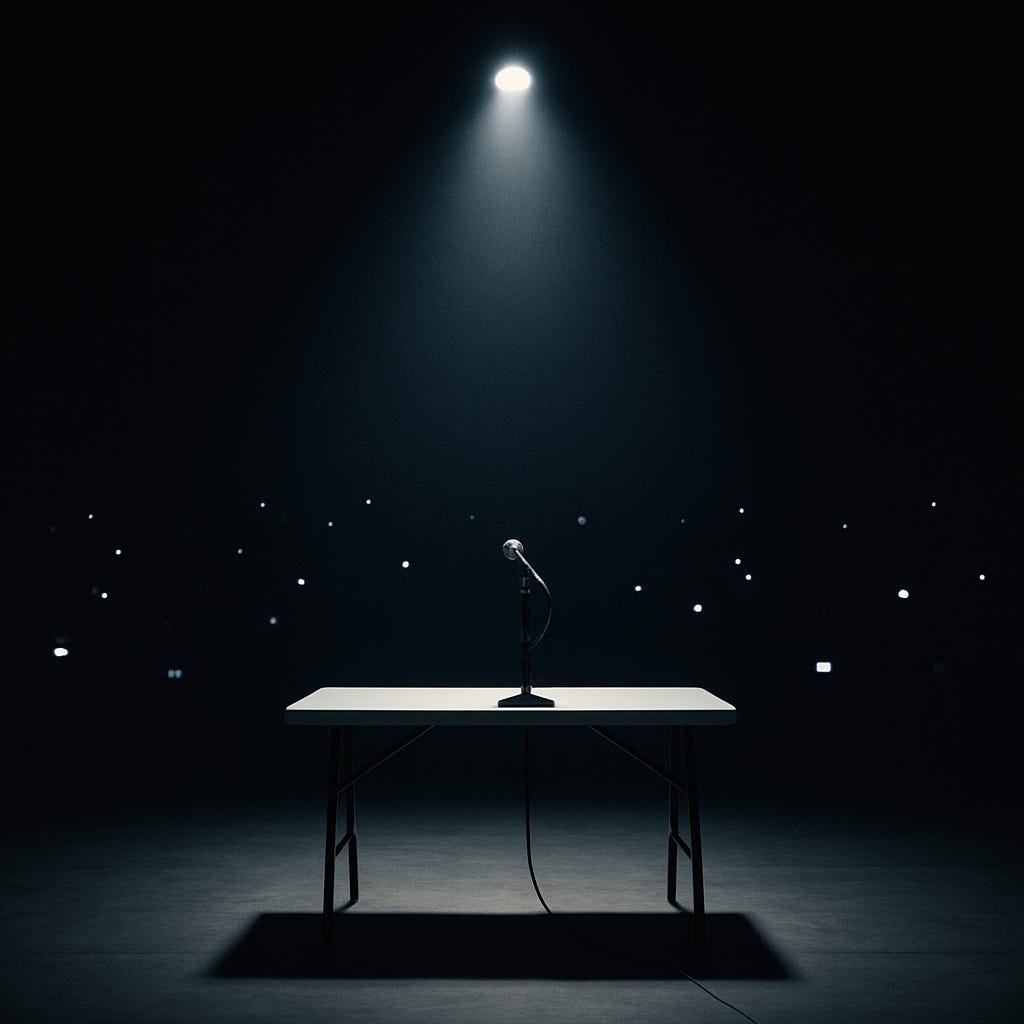
The Stage and the Void
from Language Matters by Elias Winter Hosted by Elias Winter
Chapter 1: A Country Performed There is a particular kind of table that has become one of America’s most common civic architectures. It is not a kitchen table. Not a council table. Not a table where bread is broken or decisions are made in the presence of consequence. It is a studio table—clean, lit, engineered—built for confrontation that is safe enough to repeat tomorrow. Behind it sits a person with a microphone, a camera, a monitor, and a practiced face. The room is small. The voice is large. The certainty is absolute. And the audience is nowhere. The country now experiences itself through these tables. The set design varies. Sometimes it’s a sleek podcast studio with wood paneling and leather chairs, made to feel like seriousness. Sometimes it’s a streamer’s bedroom with neon lights and a shelf of books never opened, made to feel like authenticity. Sometimes it’s a split screen: faces in boxes, each one a performer, each one framed like a sovereign kingdom, each one speaking to an absence. The strange part is not that these people exist. Every era produces talkers. The strange part is that we have begun to treat the talk as if it were governance, as if the commentary were the thing itself. We don’t merely consume interpretations of reality; we consume reality as interpretation. This is not the old world of persuasion. It is not even the old world of propaganda. It is something more intimate and more corrosive: a society that has outsourced its sense-making to performers who make their living by keeping the audience inside a feeling. The feeling changes by tribe. On one side it is dread and disgust. On another, it is grievance and triumph. On another, it is irony as anesthesia—laughter that keeps you from screaming. But the structure is the same: a constant stream of interpretation engineered to hold attention, and attention that becomes mistaken for participation. The nation has become a stage where everyone is watching everyone else watch. I can tell you exactly what this looks like in the body, because it has happened to me, and it has happened to almost everyone I know. You open a feed for a moment—just to check. You tell yourself you’re being responsible, staying informed. You watch one clip. Then another. The voice says what you already feared. Or what you already hoped. It gives shape to a formless anxiety. It names an enemy. It offers a diagnosis. It offers a plot. It offers a villain. It offers the relief of certainty. And then, before you realize it, you have spent an hour in a room you did not choose, inside a nervous system you no longer control. When you close the app, nothing is resolved. The world is not clearer. You are not wiser. But you are hotter. More suspicious. More reactive. Less capable of patience. Less capable of love. You have become a better customer of more of the same. This is the first signature of the new public square: it does not produce clarity. It produces compulsion. And it would be easy—cheap, satisfying—to say the problem is simply the performers. That they are shallow, vain, or corrupt. Sometimes they are. Often they are. But that is not the root. The root is that a civilizational hunger has found a market. People are anxious, lonely, unmoored, and starved of meaning that is anchored in reality rather than narrative. The stage did not invent this hunger. It merely discovered how to monetize it. Look at the ambient backdrop we now accept as normal. A country whose news arrives like weather alerts: this incident, that shooting, this scandal, that war, this disaster, this court decision, this collapse, this betrayal, this “unprecedented” thing that becomes precedent within a week. The details change; the atmosphere does not. The air carries instability. The public mood is a permanent halfway state between boredom and panic, sadness and rage, fatigue and readiness. In a healthier world, there would be stabilizers—institutions, leaders, rituals, shared sources of truth—that could metabolize shock and return the collective nervous system to baseline. But baseline is now contested. Everyone is afraid to be the one who speaks calmly, because calm looks like complicity, or weakness, or irrelevance. Silence looks like surrender. Qualification looks like betrayal. Nuance looks like cowardice. And in a market where attention is the currency, the only unforgivable sin is to be ignored. So nobody stabilizes. Not the platforms, which profit from arousal. Not the pundit class, which lives on escalation. Not the politicians, who have learned that governance is slower than theater and less rewarding than provocation. Not the audience, who has learned that outrage is a form of participation that doesn’t require responsibility. Instead, everyone adds oil. And oil is abundant because it is cheap: anger costs nothing to produce, and it pays immediately. This is what makes the stage so dangerous. It turns the real anxieties of a wounded society into an industrial feedstock. Rage becomes fuel. Conspiracy becomes product. Tribal belonging becomes retention. Every day’s “existential threat” becomes tomorrow’s forgotten content, replaced by a new existential threat before the nervous system can recover. The result is not mobilization in the noble sense. It is mobilization as capture. To mobilize today is not primarily to persuade. It is to seize attention, harden identity, and then point that identity toward a target. It is to keep the audience inside a storyline where leaving feels like treason. It is to replace thought with loyalty. It is to turn politics into fandom, and fandom into a substitute for community. The performers talk as if they are building movements. Often they are. But movements without embodied relationships rot. They become crowds. Crowds become mobs. Mobs become markets. And markets reward whatever keeps the crowd inside the trance. That trance is what I mean when I say the country is being performed. Performance is not merely acting. It is a mode of existence where the primary relationship is not to truth or reality, but to audience response. The performer does not ask, “Is this true?” first. The performer asks, “Will this land?” “Will this spike?” “Will this spread?” “Will this keep them?” And to be fair, many of them no longer even ask those questions consciously. The system asks them. The metrics ask them. The platform asks them. Their payroll asks them. Their audience asks them. And because the audience is not a room of faces, it is a set of numbers, the performer is freed from a constraint that has governed human speech for most of history: the immediate presence of other human beings. Faces regulate. Bodies regulate. A room regulates. A family dinner regulates. A village regulates. Even a hostile crowd regulates, because you can feel when you are losing them, when you are lying, when you are becoming absurd. The camera is different. The camera grants you sovereignty without resistance. It allows you to build a world in which you are always the center, always correct, always wronged, always heroic, always necessary. This is why the internet produces not just commentators but miniature sovereigns—each one a leader of a fictional nation composed of subscribers. Each one surrounded by loyalists who defend them as if defending the self. Each one fighting rival sovereigns in petty wars that look, from the outside, like a soap opera. Betrayals, feuds, schisms, purges, reconciliations—drama that mimics politics while functioning as entertainment. The audience watches the war between leaders who have no obligation to bear the consequences of the war they incite. And still: not all of them are garbage. There are genuinely serious minds on these platforms. There are historians who speak with discipline and depth. There are comedians who tell the truth sideways and expose the sickness by refusing to dress it up as moral urgency. There are people who stabilize by giving context, by refusing the existential frame, by speaking like adults. But excep… This is a public episode. If you would like to discuss this with other subscribers or get access to bonus episodes, visit eliaswinter.substack.com
Embed this episode
No transcript yet.