
EPISODE · Feb 21, 2026 · 53 MIN
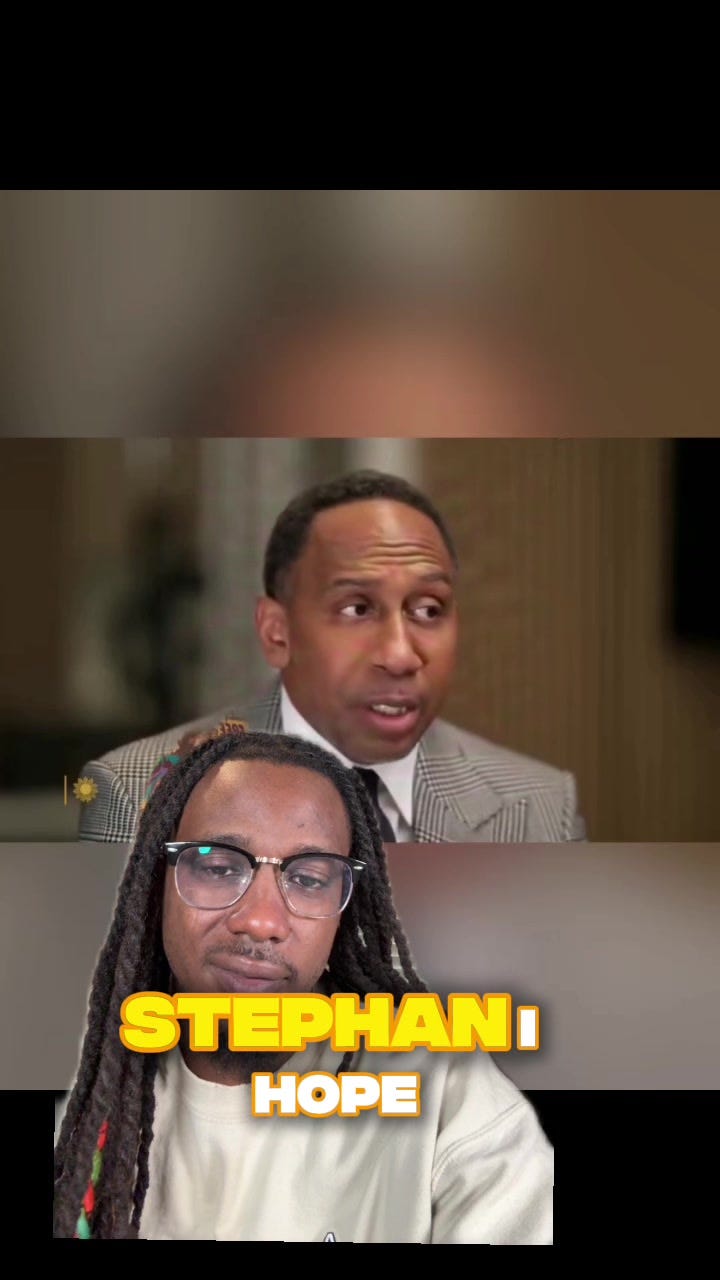
The Stephen A. Smith Fallacy: Why "I Don't See Racism" is a Luxury Black People Can't Afford
from Education is Elevation · host The Conscious Lee
Research Over Mesearch is a reader-supported publication. To receive new posts and support my work, consider becoming a free or paid subscriber.Thank you Seneca Dunmore, Shirley Figueroa, Dalai Mama 💗, Tung no, Jayme Hightower, and many others for tuning into my live video! Join me for my next live video in the app.It’s February 21st, and we are in the middle of the 100th celebration of Black History Month. It’s a time for reflection, for education, and for holding a mirror up to the nation to see where we truly stand. In today’s session of “Research Over Me,” we have to tackle a lot. We have to move past the superficial takes and dig into the material reality of what it means to be Black in America in 2026.We started with a tragedy that didn’t trend. A white father in Texas shot and killed his daughter over an argument about Donald Trump. The media machine didn’t spin this into a narrative about white violence or white supremacy. Why? Because the framework of individualism protects whiteness, while Black people are always held collectively accountable for the actions of one. This single event is a gateway into understanding the concepts we need to break down today: Racial Literacy, the performative politics of potential presidential candidates, and the vital importance of centering Black women.Let’s get into it.The Stephen A. Smith Conundrum: Racial Illiteracy and the Pursuit of PowerStephen A. Smith is floating the idea of running for president in 2028. And in doing so, he is giving us a masterclass in what happens when bourgeois aspiration meets racial illiteracy.In the clip we analyzed, Smith argues that he wouldn’t be worried about racism if he ran for president. He posits that a “vast majority of Americans judge you on the content of your individual character” and that racism isn’t “as prevalent as someone on the left would like us to believe.” He suggests white Americans are too worried about their own suffering to be concerned with holding Black people back.This is a dangerous and ahistorical take. It’s a textbook example of weaponizing “individualism” to deny systemic reality.* The Material Reality vs. The Symbolic: Smith wants us to believe racism is fading, but the evidence screams otherwise. We are witnessing the erasure of landmark legislation—Affirmative Action, Roe v. Wade, and the gutting of the Civil Rights Act. The Supreme Court has legalized racial profiling under the guise of immigration enforcement. We see it in the story of Dr. Linda Davis, a Black educator in Savannah, Georgia, who was killed as collateral damage in an ICE chase—a story that received a fraction of the coverage of others because Black women’s humanity is perpetually marginalized.* The Good Negro Fallacy: Smith’s positioning is a classic play for white approval. By downplaying racism, he signals to a white moderate/conservative audience that he is a “rational,” “articulate” Black man who won’t make them feel guilty. He trades in the fallacy that logic and emotion are mutually exclusive, painting those who acknowledge the pain of racism as hysterical, while he remains the clear-thinking “free thinker.”* The COINTELPRO Connection: We have to connect the dots. The same 77 million people who voted for Trump are the ones quoting Dr. King’s “content of character” line. Yet, the current administration’s first “file release” wasn’t about Epstein; it was the COINTELPRO files on Dr. King, designed to smear and delegitimize him by sensationalizing his private life. They are actively erasing the legacy of the only Black man with a national holiday. So, when Smith says racism isn’t prevalent, he is actively insulting our intelligence and ignoring the war on Black history.This isn’t about being “emotional.” This is about having the racial literacy to read the situation. If you can’t see that the policies of this administration are designed to disproportionately harm Black people, you are either illiterate or lying. The Trust Black Women Roundtable: Generations Clashing in Good FaithSwitching gears, we have to talk about the incredible, viral moment from the SisterSong “Trust Black Women” roundtable featuring Clifton Powell, my brother Joseph Irvin, and others.A clip of Clifton and Joseph engaging in a tense, passionate exchange has been circulating, and as expected, the internet is reacting with a severe lack of nuance.* What Actually Happened: This was an intergenerational conversation about Black men’s accountability to Black women. Clifton Powell, speaking from his experience as an older Black man, spoke about not knowing what he didn’t know for much of his life, and the challenge of unlearning toxic behaviors later in life. Joseph Irvin, representing a younger generation, pushed back on the idea that a lack of knowledge is an excuse, especially after decades of partnership and procreation. He challenged the notion of “weaponized incompetence”—using past trauma as a shield to avoid present-day accountability.* The Homophobic Response: Immediately, the comments section filled with vitriol questioning Joseph Irvin’s “right” to speak on women because of his perceived sexuality. This reveals a profound gender illiteracy. The idea that only heterosexual men can advocate for or have a stake in the well-being of Black women is a fallacy rooted in patriarchy. It conflates sexuality with gender and assumes that the only valid relationship between men and women is a sexual or romantic one. Gay Black men have mothers, sisters, friends, and colleagues. They are just as implicated in and affected by sexism and patriarchy as straight men.* The Core Message: As David Daniels perfectly articulated, “Trusting Black women is not believing that all black women are always telling the truth, but believing that all black women deserve to be heard.” The conversation wasn’t about perfection; it was about intention. It was about Black men creating a space where Black women feel safe to be vulnerable, to be angry, and to be heard without us immediately getting defensive or “ready to play football,” as another panelist, Luke James, so eloquently put it.This conversation was a beautiful, messy, and necessary brick in the foundation of building real trust. To reduce it to a salacious clip is to miss the entire point.ConclusionWe are living in a moment of reconfiguration. We see the future slave era being drafted through policies like the Laken Riley Act, which funnels money to ICE at the expense of social services, and through the legalized terrorizing of Black and brown communities.We must be racially literate. We must be gender literate. We must reject the siren song of “individualism” that only serves to protect the powerful. And we must, as Black men, do the work to show up for Black women, not just when they are our mothers or partners, but because their liberation is central to all of our power.Education is elevation.Research Over Mesearch is a reader-supported publication. To receive new posts and support my work, consider becoming a free or paid subscriber.5 KEY TAKEAWAYS* Individualism is a White Privilege Tool: When a white person commits a violent act, it’s framed as an isolated incident. When a Black person does, it’s often framed as a reflection on the entire race. This double standard is a core component of systemic racism.* Racial Literacy vs. Illiteracy: Racial literacy is the ability to read, write, and interpret situations involving race and power. Stephen A. Smith’s denial of racism’s prevalence is a prime example of racial illiteracy, which often serves to protect the status quo and appeal to white moderate sensibilities.* Symbolic vs. Material Racism: We must look beyond the “symbolic” (a racist slur, a monkey video) and focus on the “material” (policy rollbacks like Affirmative Action, funding ICE over education, Black women losing jobs at disproportionate rates). Material racism has tangible consequences on our lives, safety, and economic stability.* Gender Illiteracy & The “Trust Black Women” Conversation: Critiques of the SisterSong roundtable exposed a deep gender illiteracy. Reducing a necessary conversation about Black male accountability to a clash of personalities or dismissing a gay Black man’s contribution reveals a failure to understand that patriarchy and sexism are systems we all participate in, regardless of our sexuality.* Policy is the Proof: The prevalence of racism isn’t measured by our feelings, but by policy. From the gutting of the Voting Rights Act to the Supreme Court’s sanctioning of racial profiling, the law is actively being shaped to create a racial hierarchy. Denying this is denying reality. This is a public episode. If you'd like to discuss this with other subscribers or get access to bonus episodes, visit theconsciouslee.substack.com/subscribe
Embed this episode
NOW PLAYING
The Stephen A. Smith Fallacy: Why "I Don't See Racism" is a Luxury Black People Can't Afford
No transcript for this episode yet
Similar Episodes
No similar episodes found.
Similar Podcasts
No similar podcasts found.