
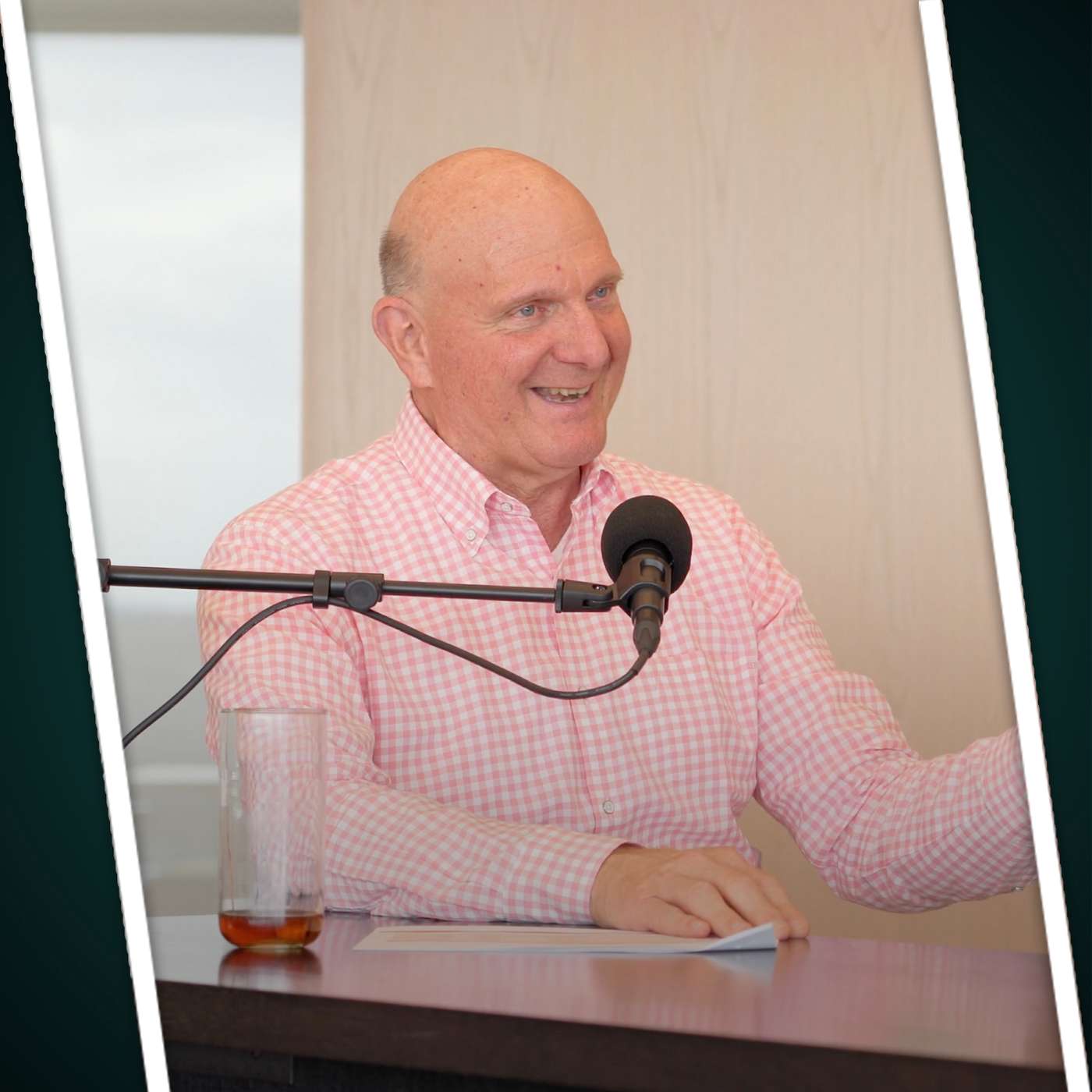
All right, so David, Steve gave us the signed Clipper's Jersey with the name acquired on it. There's only one Jersey. What are we going to do about this? Oh, so cool.
Should we rock, paper, scissors for it? What? You know what? No, no, no.
You keep it. There's no Seattle basketball team. Oh. Keep it there.
Up. All right. All right. It'll go in the acquired museum north.
Perfect. All right. Let's do it. Let's do it.
Who got the truth? Is it you? Is it you? Is it you?
Who got the truth now? Is it you? Is it you? Is it you?
Is it you? Get it down. Say it straight. Another story on the way.
Who got the truth? Welcome to episode one of the summer 2025 season of acquired the podcast about great companies and the stories and playbooks behind them. I'm Ben Gilbert. I'm David Resinbal.
And we are your hosts. Steve Balmer is among other things, arguably the very best investor of the last 20 years. It sounds a little funny to frame it that way, but here are the numbers. In 2014, when Steve left Microsoft, his net worth was $20 billion, almost entirely comprised of Microsoft stock.
Today, 11 years later, it is a staggering $130 billion, according to Forbes. It is incredibly rare to reach this stratospheric level when you are a not the founder of the company and be no longer CEO or even employed by the company. And all of this comes from just one investment decision. Just keep holding substantially all of his Microsoft stock.
Incredible. We chat about it with him in the conversation to come. Now, as most of you know, we did a big two part Microsoft series last year on the history of the company up through and Steve transitioned the CEO role to Satya Nadella. Steve listened to those episodes and he had some thoughts that he wanted to share with his recollection of how things went down, you know, things like what made Microsoft so fabulously successful, what his missteps were as CEO.
We wanted to share that as a recorded conversation with all of you. So we set up our cameras and our bikes at his office, his philanthropy office, Balmer Group in Bellevue, Washington, and we pressed record. So we'll go into everything from the Mrs. on mobile search, social, the huge wins in Enterprise and cloud.
Steve also reflects on his business lessons learned. He goes into why he stepped down as CEO when he did. And he talks about his relationship with Bill Gates over the years. And of course, we had to talk with him a little bit about the Clippers and of course new arena that Steve built and personally owns to.
Yeah, into a dome. Incredible place. A cathedral of basketball as Steve would put it. Listeners, if you want to know every time an episode drops, check out our email list.
It's the only place where we will share a hint of what our next episode will be. We'll share episode corrections, updates and little tidbits that we learned from all of you about previous episodes. Come join the Slack to talk about this with us and the whole acquired community that is acquired.fm slash slack and the email list is acquired.fm slash email. If you want more acquired between our monthly episodes, check out ACQ2.
We just released one with Zach Parrey, the co-founder and CEO of Plaid. We've got some banger ACQ2 episodes coming up. Yes, we do. So with that, this show is not investment advice.
David and I may have investments in the companies we discuss. And the show is for informational entertainment purposes only onto our conversation with Steve Ballmer. Well, Steve, first of all, I noticed you prepared some printed materials here for us. Listeners should know we didn't ask for this in any way, but at 10 p.m.
last night, you sent us a PowerPoint death and said, I made you some slides. Sorry, I got here so late. And David and I are looking at each other like we didn't ask you to prepare for this. Thank you for the materials.
Oh, it's just some stuff that I've used kind of with thoughts about our businesses work. And I kind of think of this as a time to reflect on things I've learned primarily at Microsoft, but also with the Clippers about business. I figured I'll send them to you and their PowerPoint. You make a few different templates.
Always a cheerleader. Always. I think we're cheerleaders actually in the PowerPoint deck. Great.
Well, Steve, speaking of reflecting, we sit here today. Microsoft is the most valuable company in the world, almost three and a half trillion dollars in market cap. And I think everybody would agree it's an enterprise company. And that's largely thanks to you.
It's reasonable to call you the founder of Microsoft's enterprise business. That is not a narrative that is often discussed. And we wanted to ask you, how do you feel about the fact that it basically defines the business today? Yeah, interesting.
Very kind. Fathering something. I feel good about that. And I think there's a lot of truth to that.
Of course, there are many fathers to the enterprise business at Microsoft. And I feel good and bad about it because the truth is Microsoft started out as a consumer company. And we built a very important consumer business. That success translated into the opening to go build an enterprise business.
And one of my regrets is we lost the consumer muscle along the way. Because I think the ability to be ultra ultra. I mean, we're great company. Microsoft's great company.
But to have both of those muscles totally firing, if I'd been able to sustain that consumer muscle. And I had some ideas about why that didn't happen. But the enterprise muscle? Mooi macho.
Not very big and very strong. And I'm very proud of that. And the fact that it's also funny when you say consumer enterprise. What does it mean really to say enterprise?
Sometimes it can sound just like back end stuff. And the truth of the matter is Microsoft Office slash M365, whatever exactly it's called today is super important. It was the foundation for having permission to be in the enterprise. And yet it's a product that sits right there in front of users.
So the question is, do you think about users or consumer? And do you think about enterprise? Or do you think about IT? And then there's developers that span both.
And that's kind of my mental model. Do you have products that appeal to consumers that IT can handle and a platform that lets developers build around those and based around those whether they're building for users, users and IT? Or in some instances, just for IT people. Because there's a lot of tools that are just for IT people.
Well, to contextualize all this, we want to go back almost all the way to the beginning. Right around the time you joined Microsoft and talk about Microsoft's relationship with IBM. Before the IBM PC and before DOS. Can you catch listeners up who weren't around at that time?
What was IBM in that era? I think you called it to us and when we were talking for research, the sun, the moon and the stars. Yeah, I did. I think.
Well, it's 1980. When I get here, when the company started, obviously, 1975. And there were IBM computers. Oh, yeah, and a couple others.
But literally people would say there's IBM and the bunch. And the bunch was Burrows, UNIVAC, NCR, Control Data and Honeywell. But they were just a bunch. IBM and IBM did the mainframe and it did the software and it did the service.
It did everything in computing, everything, everything. And then you had this little upstart try again called Digital Equipment. Very important in our story because Dave Cutler, who was kind of the father of NT, Windows NT, he came from Digital Equipment. And they were fighting.
They were scrappy. They were many computers. So smaller than a room, but definitely bigger than a PC, if you will. And all the initial Microsoft software was developed actually on deck computers, Digital Equipment equals deck.
And deck had a nice business, but it was a lot smaller than IBM. If IBM breathed, that was the direction the computer industry would go. And IBM was the subject of an antitrust lawsuit, shockingly, in 1969. That didn't actually get settled, I think, to shortly after I got here in the term of Reagan.
So 11 years, they'd been living because they were that big and bad and mighty. And what was the result of that antitrust action? What did they have to do? I don't remember.
It may be when they had to unbundle. In fact, I think it was when they had to unbundle the operating system from the mainframe hardware. So people could build IBM compatible mainframes. And then one day, shortly after I got here, some guys from IBM called and they said, hey, can we come see you?
And you're going to have to sign an agreement that says, you can use nothing. We tell you anything you tell us. We can use. And so these guys showed up and they told us after we signed their agreement that they wanted to build a PC and they were hoping to get the operating system and some of our language software for it.
They were coming to you for the language software. No, they came to us for the operating system. Now, why? You'd say we weren't in the operating system business.
We had a card called the CPM softcard or the softcard for the Apple II. It was a card that plugged into an Apple II that ran CPM, not our operating system. You're killed all digital research with the name of the company, but we had licensed it to put on this card that plugged in the Apple II. And somehow IBM thought they could license CPM even though it wasn't our product.
They thought they could license it from us. And we said, no, no, no, but you can license our language software. But there are these guys down in Pacific Grove, California, and Bill called Gary killed all and said, there's some guys. They want to talk to you.
They're important. And Gary, they went down there and they didn't sign the non-disclosure agreement. And in the meantime, there was a company here in Seattle called the Alachompute products that had a little CPM clone. And so the licensing of Microsoft DOS, which didn't even exist when IBM approached you about licensing some things, is the single greatest business deal in history.
The licensing of that software. We've had some other episodes. Well, I just think you look $3.5 trillion later at Microsoft's market cap. It was pretty good.
It was pretty good. It was a company that happened to be here in town. Paul Allen and I went down there and met with a founder who later came to work with Microsoft, getting Tim Patterson. And we offered him, I think we paid $45,000 or $49,000 for this operating system.
Because we told IBM, no, no, we can take care of it. There was kind of a famous meeting amongst me and Paul and Bill and this guy, Kazahiko Nishi, who ran our kind of affiliate in Japan where we were talking about this. And there was a lot of, let's just say, four letter words thrown around. Scroom, scroom, five letters.
But you get the dress. Scroom, scroom, let's just go get this operating system. Scroom, we can do this. Let's go.
That was kind of the theme. Kaz was kind of a cowboy. Yeah. We went, we sold it to him half of what we paid for it.
We can do this 10, 20 times, 20 times 21,000, 400,000 against 50,000 we paid for it. Pretty good deal. So, yeah. It was a little better than that.
Talk us through the structure and how you guys thought about this. Yeah. You did not make a lot of money directly from this deal. No, we did not.
We remember the key thing was we didn't charge for the operating system on an ongoing basis. We charged for it one time. If you got a new version, we charged another time. We did the same thing for basic and everything else because at the time, you could think we were like a substitute for an R&D department, which means we were fixed price.
It was only, I don't know, four or five years later that we actually switched to licensing per unit as opposed to just fixed fee. Here it is. Pest once and we're done. But the ultimate thing that you guys negotiated was a non-exclusive deal.
You could sell this operating system and your language interpreters, but also mainly the operating system to other manufacturers. This is IBM we're talking about here. But IBM wanted this. Okay.
So we were experimenting with a different approach. They'd said, look, instead of us building everything in all of the custom, we want to use some industry standard parts components because that'll let us be more agile, et cetera. So they didn't come in loathe any of this. They knew that was our business.
They know that was digital research's business. And they wanted to use an Intel part versus their own proprietary part. They didn't ask Intel to do them a custom part either. The notion was we'll move fast.
We'll get away from the IBM bureaucracy by taking this approach. I wouldn't say that was the hardest convincing, if you will, in the story. But what ended up happening after all these years, and I imagine it only took a few years to see it, play out, was IBM sold a ton of IBM PCs. And DOS was the obvious thing on that.
And then everybody else adopted DOS because all the application makers, all the software vendors were targeting DOS as the platform. And so Microsoft sort of accrued a huge amount of benefit. You became the point of integration. Yeah, in the old world, IBM would have accrued that sort of platform benefit.
Did they see the- They were selling a lot of computers and making profit also. They would have been making more profit than we were at the time, just the way pricing worked. There was a little twisty in here, though. I should throw at you if you're curious.
These things had something called the BIOS, basic input output system, which was the lowest layer. So firmware, sort of first level software, built into the hardware. And IBM had its own BIOS. And some applications became BIOS dependent.
And so then the question is, who was going to do an IBM compatible BIOS? We weren't going to get into that game. We didn't want to have that intellectual property, other arguments, but there were people then that was important. It was a big company.
Compact became the big company. I don't remember whether they wrote their own- I think they had the new- I think they had the new- I think they had the new- I don't remember. They made it more simple. I don't remember.
I didn't think like which of the computers was possible. And they came to me, and they didn't make it much better. I don't remember that I think. And they came to me.
I had no idea how much they had done this because it's a bit different. I can't believe this download. I can't say that I've had that. I'm not sure.
I'm not sure. Just*. I'm sure. I don't really say that.
I'm sure they were probably too late. I'm sure I have a lot ofauntable processing tools. I can't do that in- But, you know, my head is. I was just asking you, what, actually?
I don't know. I didn't know. was custom. So really, I would say we, a few other companies, we say we, we defined what a modern software business looked like.
And the notion that there could be lots of developers and there were some, but it's not like we think today, oh, there was developers doing lots of standard applications. No. And there was no licensing model, no business model, no, no, nothing. Visical quiz around.
So it would have been counterintuitive or required too many mental hops to think, were IBM, wait, are we giving away the future by allowing someone to distribute a wide operating system that ends up being the target that everyone standardizes on, which eventually, you know, created all of modern Microsoft. Exactly. And it just, you sort of can't blame them because there was nothing to build off of. But yeah, one of the things my little PowerPoint here says is luck is important in the creation of great companies.
It is. And a lot of people, you know, sort of say we're masters of the universe. We figure everything out and we never have any luck. And it's because we're so talented.
Sure, they're talented people and hardworking people. But most people have a little luck in their story. And this, this was our big luck. Clearly.
But when you were negotiating this, signing it, and then this first couple of years before the clone market really took off, like, do you think that this could happen? No, I can't remember what year it would have been. But Andy Grove, who was running Intel at the time said, yeah, pretty soon we'll be selling 100 million PCs a year. I know sometime in the 80s, I don't think I might even been in the 90s and Bill and I laughed and said, ah, that's not going to happen.
We invested big time. And if it did happen, we said that's great. We're not going to under invest. But we thought, ah, he's crazy.
This market will never grow like that. I would say we classically under forecast. That was kind of our tendency. So the deal gets signed with IBM.
You end up shipping DOS. It goes on the IBM PC. It's selling like gangbusters. When did you start to realize?
Whoa, what we have here is actually leverage over the ecosystem. We actually are becoming the important layer that ties this whole computing world together with the operating system. I think by the mid to late 80s, I mean, you make it sound very strong. No, we didn't feel very strong.
There was IBM man. IBM was still the sun, the moon and the stars. That didn't change. You know, I would say we didn't drop that theory.
Well, well, into the 2000s, into the 2000s, you know, Lotus notes was coming for us. And that was mid 90s and beyond. But maybe, maybe you could say, but we were in an enterprise company. If you looked at the enterprise, the enterprise was still IBM.
IBM, we used to say we had to hang on to IBM that if we ever let go, they might trample us. We called them the bear. You had to stay on. And of course, graphical user interface, it's kind of coming out of Xerox park at the time and Apple's doing their thing.
And we start, that's another disruption could blow everything up. So I would say no sense of confidence about controlling the ecosystem well into the 90s before I think any of that, or at least for me. When did you start to feel like we're getting out from under the thumb of IBM and maybe walk us through a little bit, the OS two windows world. So we've been staying with IBM.
They decided they wanted to build something that was sort of their operating system and sort of not. This is 8283. We and they would collectively build part of it. We would be able to license it to others.
They would build a value add layer that was a database in the 32 70 emulator. Crazy to say now, we were going to work on the operating system and what was called presentation manager called at the graphical user interface. And they were going to have rights equivalent to ownership in the code. We wrote this sounds so convoluted.
It was so convoluted. Man, there was a time when I made 16 trips to the East Coast in 16 weeks, most of them to South Florida, a couple of them to New York, leave on the red eye, the Delta dash flight at around 11, get into Atlanta around five, get the flight to West Palm Beach at about seven, get in and be able to be at a meeting at nine o'clock at IBM and then work all day, catch the seven o'clock flight home, be here about 10, 30 or 11, 24 hours down and back because you're building something together. Remember, there's no real email at the time. We were literally shipping disks back and forth.
And then they decided they were going to do the presentation manager piece in England. So there were also been a lot of flights to England. So we were trying to, and then Texas is where the database and in communication. Sounds like Boeing.
You know, we call it, it was the joint development agreement and it was the price of staying involved with IBM. And it was convoluted. And we did then keep for speed of action, we kept going on Windows, which we had started for listeners, everything we're talking about is OS two, operating system. Oh, I was always to extend an addition or something which had their windows was like your plan B.
It was like your side. No, Windows was our plan. And then they wanted to do this new operating system and we convinced them you got to have a graphical user interface. And we tried to sell them windows and they were resisting.
Okay. So it almost seems like you're humoring IBM at this point with, yeah, let's do us two together. We really think the windows. Hey, humor.
It's more than I would say, you know, my job was managing by then system software. So I'd windows I'd ship when I'd been the development manager for Windows one Oh, the great videos of you from the windows 1.0 launch. That's the sales side. I actually managed the engineers.
Yeah, because the guy was doing it wasn't being successful. And we had to ship the thing. And so that's when I learned some about engineering management from the engineers, basically, had to teach me to be effective. We're trying to keep with OS two bills very frustrated with IBM.
I'm frustrated, but I know my job is to ride the bear. And so bills pushing windows hard, but we still suspected always to could be the winner because it came from IBM. But we couldn't just like stop for three or four years. We couldn't make the mistake that we sort of made in the thing that became Vista Vista.
So we kept going with windows. We kept going with OS two and then May 1990. They come along and shoot us. I was out running with my wife IBM shot you.
Yeah, they divorced us. They threw us out. I thought the story was you all windows was getting gathering strength and you all thought like, you know, maybe we can step out from the little brother. No, no, no, no, no, they had a new leader by then.
I got him Jim Canavino. And he was getting frustrated with us because we were still selling windows. We were still promoting windows. And they, I mean, look, this was our first antitrust problem.
I don't know if you guys know this is the FTC at the time, but we and IBM were working to divide the market because we had done some positioning. What's windows good for what's always too good for we and IBM had done that because and then they said, no, you guys are colluding. And that's when we first got attention from antitrust. This is even before the processor licensing issue.
Yeah, that came with the DOJ. This was an FTC case and they started it in basically 90 just as we were getting, I think, maybe 89 as we were getting our divorce. My wife and I were remodeling our house. We were living in a condo.
We stopped on a run user restroom or something. I pick up the Wall Street Journal and I read that IBM's divorce. All right, listeners, now is a great time to tell you about a longtime friend of the show. Vanta AI has scrambled the whole security picture.
It used to be that you prove that you were secure once a year on audit or a static PDF. Then everyone would not and you're done. But in an AI first world, that doesn't hold up anymore. Yep, your risk surface changes every week now.
Vendor turns on an AI feature or someone writes in a new model without telling it and your posture is different than it was last week, let alone at your last audit. Vanta's own research found that around 70% of companies have this quote unquote shadow AI running with no security review at all. Right. And that's where Vanta comes in.
They're the leading agent trust platform, meaning they've built the thing that closes the gap. And the way that they close that gap is Vanta agent. Think of it as a GRC engineer. That's governance risk and compliance, except that it's software and it doesn't sleep.
It finds the issues, drafts, the fixes and cuts the time that you'd spend on vendor assessments in half. In half, which is exactly why more than 16,000 companies today run on Vanta. Companies like Ramp, Cursor and Snowflake all stay audit ready and catch the risks that crop up between audits across every vendor, every AI tool, the whole environment. And that's the real value.
Trust has to be continuous now, which is why Vanta automates your security, your compliance and the work to earn and prove trust. We're huge fans of Vanta over here and literally hundreds of acquired listeners have become Vanta customers at their companies over the years. So you can get $1,000 off of Vanta at vanta.com slash acquired. That's v-a-n-t-a.com slash acquired for $1,000 off.
And just tell them that Ben and David sent you. I pick up the Wall Street Journal and I read that I be on Stavorsicus. And so what does that mean? Walking away from a less-cave operation?
Huh. Basically they kicks you out. Take Microsoft outside. We're taking OS2 in-house.
Exactly. Exactly. And so you're sitting there. Windows isn't powerful, Windows.
Yeah. Windows is this fledgling kind of idea. We still had something called the 640k barrier. You couldn't speak to more than 640k of memory.
We didn't break the 640k barrier until I think Windows 3.1, which I want to say was 91 or 92. So you're on this run. You see IBM is divorcing us. You don't really have confidence in Windows yet.
What are you feeling and what do you think the past is possible? Oh, Mr. Wizard! Whoa, shoot.
Oh my God. We were so... We were so you could say energized. You're like scared also works.
It's like, oh my God. Now we have to confront the bear. You're already like a billion dollar business at this point. By 92, you end 92 at 2.8 billion in revenue.
Now IBM, it's still... But you're still a Pipsqueak. We're still Pipsqueak to IBM. And remember, we have no enterprise presence.
And IBM has all dominant enterprise presence. So who's using Windows and how are you selling to them at this point? Interesting. Single copies, some hobbyists and end users.
Somebody who says, hey, I really want to use a spreadsheet and a lot of users in enterprises. So it wasn't going through IT. You'd have a user that would buy a PC on the expense account probably for the department, buy a copy of Windows, buy a copy of Excel, like at an egghead software, because the software retails at the time, and bring them in and use them. And then IT started to get nervous about that.
We knew most of the copies, not most, but many of the copies were winding up in businesses. What the hell? IBM's going to stomp us like a bug. You just took as a given assumption that IBM wants to stamp out this happening.
It's going to happen. So we want a future. We've got a play with them. Yeah, that's why we were, quote, writing the bear the whole time because they'd stomp us out and they divorce us in 90.
And then we say, oh my God. Okay, so at this point, your business, even though it's, you know, billion plus scale, it's selling to retailers to sell software copies of software, DOS, Windows, languages, and that does. DOS was always sold to... Oh, yeah.
Yeah, not always. But so much the lion's share, it's worth saying, it was only sold, because you needed a BIOS. Remember, you needed a BIOS. So you had to have the hardware vendor build the BIOS into the machine, basically.
So you've got that, the OEM business, which was the biggest part of the business. Yeah. And then we had this retail business. And there was no notion of enterprise license.
Yeah, you've got no CIO relationships, no enterprise agreement, no... We had a couple CIO relationships. The Air Force was the first big Windows customer. Your first enterprise customer was government?
Our first big Windows customer, at least as I remember it, was the US Air Force. And they were buying single copies of Windows. You know, when you say government, there's really two governments in this country. There's government and there's the military.
And the military is a much more disciplined, advanced user of IT. They're just better. They're more professionally run than most parts of government. So yeah, it was the Air Force.
So you got like a little bit, but we had like one or two customers just to prove we could actually serve big customers. As we understand it, you kind of had this realization at this point once the divorce happens, well, I'm going to go figure out how to do what IBM does. Like you personally... And to put a finer point on it, the thing that we said in our episode, and I'm curious if it's true or not, is this was not Bill's Passion area.
And you sort of raised your hand and said, I'll go figure out enterprise sales. Oh, yeah. That's for sure true. Bill's Passion, Bill had passion in a lot of places.
But you'd say the apps group and what Windows could deliver to the apps quite appropriately. I'd say that's where a lot of Bill's brain cycles went. I'd also hired Dave Cutler. Dave Cutler had been the architect of the VMS operating system for digital equipment.
We had to awesome Windows and when we were talking to Cutler about coming here, he says, I don't want to work any toy operating systems. And I had to say to Dave, good thing, because we have a toy operating system. But Dave is the key to getting us there. We said, look, you got to build an operating system whose API looks like Windows and whose user interface looks like Windows.
So developers can be familiar with it right now. Yeah, and you might make some changes because you have to, but it's got to be a robust operating system. It's got to have a secure kernel. It's got to have all of these things.
The product set that you had wasn't really enterprise grade yet. No, we got a joint development agreement, a joint agreement on land manager where the company called 3com. It wasn't all our stuff. We had a development agreement with a company called Cybase to do the SQL database because we're trying to figure out all these pieces IBM would have.
And we didn't have any of that. An operating system alone is not going to do it. You need all these other components. And if you wanted to have backend infrastructure, we started scrambling on that in the 80s.
So we had all these infrastructure pieces that we had to build if we wanted to sell to, I'll say business customers. We weren't even thinking about it when you say enterprises. Sometimes people think very large companies, but we couldn't sell the companies of 20 people without some of this stuff or 50 people. You talk a lot now about this sort of management concept of building muscle.
Is this where this came from? Like that you should always be, you use the phrase in the weight room building muscle ahead of what you need. Were you in bill thinking this way in the 80s of like, hey, we need to be building up this muscle across all parts of computing and business computing. Well, Paul Allen, I mean, Paul is the key.
Paul is the one who said, Bill said, we're never going to be a hardware company. And when the Altair came out, the first real sort of microprocessor based computer, Paul says, okay, let's write all the software that these things will ever need. So Bill and I had a lot of the execution around that. But that was the push.
So and Paul was cracking on me in the early 80s to start building an app screw. Come on, Steve, come on. It's not just systems. We need to have applications also.
Any code that executes on a microprocessor, we should have a player in that. And there was a Visicalx spreadsheet, come on, it's the word processor, come on, come on, let's get the talent, let's get going. And you know, we were doing mostly college hiring at the time. And so, you know, okay.
And then we met this guy, Simone, who had been at Xerox Park, Charles Simone, exactly. And he came, we met him through a mutual friend at three comp corporation who had been at park. And he really was the first leader of the apps business. But we licensed, I mean, look, we worked with other people the way IBM worked with us, right?
We went to Cybase and three com and let's work together. It wasn't exactly a JDA joint development agreement. But you know, we worked with those guys. The way IBM worked, I mean, look, the analogy now is a little bit Microsoft working with OpenAI.
You know, when the big company works with the new company, how does that all play over time? But you know, I took over system software in 84. So that's when we're starting all this stuff. And you could say I was a little bit more enterprisey.
So yeah, I'm looking at your chart here that you made for us. You've got 92 to 98 titled lift off. And that's after the era where you talk about enterprise start. And you have your role switching from your role as OS division in the previous era to sales.
The lift off there, though, is mostly on windows and applications. The lift off isn't really enterprise. I mean, look, it was not until the late 2000s. People would say that you guys might find this funny or maybe even know it.
Customers say you're not an enterprise company. You're not an enterprise company. As late as when? Oh, late 2000s.
Really? Absolutely. Absolutely. You're not enterprise grade.
You're not enterprise ready. Oh, I heard that so much. In 2005. Yeah.
You had Oracle out there. Remember, there were still mainframes and many computers and those things were enterprise ready. IBM had product still. You didn't have enterprise support.
Our licensing, we had to evolve in the early 90s. And then again, in the late 90s. No, we didn't have those things. So no, we weren't an enterprise software company.
That's what we said. It was the late 2000s. Certainly it wasn't before 2005. It wasn't the beginning of my tenure.
We were still trying to prove that we were an enterprise company. And now I just find it cuckoo that all Microsoft is characterized as an enterprise company, which I'm not. I mean, I think it's more complicated than that, but I'm not going to say that that's not the primary muscle for sure it is. But I mean, the company, I mean, I was hell bent and determined to prove we were an enterprise company.
Why was that? Why did you feel like this? Let's call it 92.93.94. Why did you feel like it's so important for us to attack that market?
Easy, because that's where IBM could put it squish just like a bug. If we couldn't sell our stuff to businesses, only to consumers, we knew that by then. We'd only get so far because enterprises wanted some features and enterprise don't like, okay, you can go to computer land and buy a few copies. And the consumer market, I mean, we're pre-mobile, right?
So like, pre-mobile, the consumer market, pre-internet, yeah, is big, but like, it's nowhere near IBM's market in the enterprise market by revenue, no, for sure not. So we've talked a lot about the products. Let's talk about the go-to-market motion and this sort of invention of the enterprise agreement. What are the key pillars that you sort of came up with for the enterprise agreement and why did they exist?
Okay. Our first sort of software pricing packaging model for the enterprise was not the enterprise agreement. First, it was, you know, we sold two disks. Second, we came up with this notion of what we called select licensing and you could make your own copies and you just report how many copies you sold.
And that's right with the challenges here. You tell us how many copies and just pay us what you did, the enterprise honor system. Astonishing. And that's of Windows, that's of office.
That's of Windows typically by then came with the hardware. So you're mostly using the OEM channel? For Windows, yeah, okay. Yeah, even to this day, you know, upgrades and stuff are sold direct enterprises, but you know, basic computer that comes to an enterprise would have the operating system license to the OEM.
And so we run, you can call it the honor system, but we just couldn't make people like buy disks from us or CDs from enterprises didn't like that. So we had this thing called select and select had two problems with it. Number one, very hard to copy the software you print. And number two problem, we were selling upgrades and new licenses and upgrades were like less than half the price of new licenses.
So what does that mean? The company was headed to a world where its revenue was half of its existing revenue. Unless you're growing new customers, new logos, and flip. So it was a real problem looking thing.
And Bill and I, we'd always dream this thing where you get some recurring revenue. And then we came up and say, okay, well, why don't we just do a license that you didn't have to count the number of licenses you printed, just the number of computers made like simpler. And we said, instead of doing say a new license and then God knows when we would sell you another upgrade or whatever, we'll do something that just says, hey, look, you sign up for three years, you pay us, you know, per machine, and you just pay us the same amount of money each year for three years. And it spiraled us, Jimmy, up the price of the upgrade.
Yeah. So we saw the upgrade problem and we solved the difficulty of administration problem and that was the enterprise agreement. And was it from the beginning of you get everything? No, that was a special enterprise agreement.
So you got all the upgrades during that three year period to the product you licensed, but you were still picking and choosing Oh, I want to excel. Oh, I want to serve. You could serve encouraging you to buy office. Yep.
But we also had this all you can eat license. I can't remember what we call that. But basically that I think you kind of the number of employees and you could use any of our software for anybody. So we just tried to go simpler and simpler and simpler in the administration, recurring revenue that didn't decline over time.
And you know, sort of as much as you wanted to eat the upgrades, everything. We did want essentially what you have now, which is recurring services business, but we didn't have the cloud. We weren't delivering things. But we're already on that path.
I think we started the energizer. You guys mentioned what we do with energizer, which is where we wanted to run their IT department. Right. We were the pilot customer for this concept.
Yeah, they were the first customer. I talked them into it. And this is beyond the enterprise agreement. This is where we actually want to run their stuff because we did want to get to this recurring revenue thing.
And David was referring to this concept earlier. We talked about it a lot on our Microsoft episode and then our epic episode, this sort of genius idea of you will get included in your license a whole bunch of software, even if you're not ready to use it yet. So if at any point you're considering buying this different software package from this other vendor who's a, they just make this one thing, when they look in their paperwork and they're like, Oh, wait, actually we get that from Microsoft for free as a part of our thing. We're doing let's just do that.
As long as you're developing a lot of software every year, you can sort of indefinitely just make more and more and more stuff so that your customers don't need to look elsewhere as they expand their software needs. How did that come about? Let's start with office. When we created office, that bill really drove that in a great way.
We're selling Excel word PowerPoint and then we put these things together and people would complain. And we didn't always sell office because people say our customers are users don't use Excel. So we don't want Excel included. Okay, we had a licensing option for you, but it became easier and easier.
People then departments, departments always and we're in running IT at the time still now. So we did sell you things that you might not be using, but also if you're trying to, you know, depart the departments, we already got it all for you. You may want something different than this department, but you know, we got it all for you. That was an attractive thing for people.
And, you know, there's an insurance aspect that I learned that I T people really want. They want peace of mind. That's part of what it means to be an enterprise. I want to make sure everything's secure.
I want to make sure that everything is well managed. I want to make sure everything is well paid for. I want to make sure there's somebody to call if things go wrong. I want to make sure I bought everything.
I don't want to look bad because either I paid too much or, you know, I have holes in what I bought for people. So I view this and I might I probably evolved my view to this over time. When you sell the enterprise, you have to provide peace of mind, which is kind of like an insurance policy. So buying more than you might be using or some users are using.
It's an insurance policy. And software has zero marginal cost and zero distribution cost. And so we're happy to make a few more disks if you need them. But we weren't even mailing this because we had the enterprise agreement in place.
So at a certain point along the way, you get to, well, I want to say the Holy Trinity, but I think they're more than three pieces of this. But the real killer suite in enterprises, which is Windows, Windows Server, Active Directory, Exchange, Office, and all of these pieces of software, all work in orchestration to run your enterprise, your users, they do their email on Outlook, which is part of Office, which runs on Windows, which uses Exchange, which uses Active Directory, which uses Server, this equals server, all these things. How long did it take to get to that point? And what went into where, I mean, to my mind, that's when the enterprise is firing on all cylinders here.
Okay, so that really comes with email boom. An email boom is late 90s slash beginning of 2000s. Because email is sort of the cart that pulled the whole, no, it's the local motive. Enterprises wanted email.
Yeah, when Accenture became a company we started a joint venture called Avinade to help do essentially the Holy Trinity to help install, because you had, we needed support infrastructure and partners who knew how to set up the servers, provision, email, put all that in, we needed partners and we didn't have enough capacity. And that's why we started this thing, Avinade, which is a big, big company at this stage, with Accenture. And that was in the 2000s. I went on the board of Accenture.
But all this to say, the way you could kind of pitch an enterprise is rather than any of these other value propositions, David, listen off a whole bunch of software, you could say, you guys want some email, right? We have the most reliable, robust way for your enterprise to adopt email and it's going to come with all this other great stuff. And everything was nicely integrated. Because remember, you needed Active Directory to manage, you know, file shares to manage printers.
I mean, it was used for a lot of different things. So it really did all kind of come together as kind of the integrated proposition. Like you said, you guys, you guys sort of made fun of the notion that we called all that stuff the back offices. If that was the business.
No, no, no, it's so wrong. So wrong. But that is a single that builders didn't care about this. Oh, completely not I wanted it to call it the back office because you needed to buy the office and the back office.
And the user, the consumer saw the office and the back office was the things that were in, you know, kind of the server rooms slash data centers with a lot of more server rooms. It's the same thing these days, but cloudized. All right. So as we were preparing for this, there was, there's a bunch of big questions that we just desperately want your take on.
A big one is around one of your most iconic moments. 1999, the developers, developers, developers speech. I probably watched this clip 20, 30 times almost everyone listening has seen this clip. What is missing from this clip is all the context around Microsoft and what's going on in the world at this time and what you need to accomplish as a leader of this company.
Help us set that stage and then understand why you went on stage that way. Remember, by this time, we're not through our IBM competition and we got Linux competition now on the docket because Linux is competing with Windows Server Linux is competing with Windows. And there's a thing called open office, open source software for office is competing with office. So we have all these things going on.
We haven't beat Lotus notes yet and getting to trust. We have antitrust issues, of course, by then the culmination of the DOJ suit is happening within 12 months at this moment. Correct. But I mean, it's clear in all these competitions, the thing you need is third parties that reinforce what you've got, add value around what you've got.
And I could say run on your platform, but I'll come to that later if you want to what a platform is and isn't if you want to do that, it's kind of interesting. Yeah, particularly since everything's called the platform these days. But anyway, so you're taking a side here, give us your definition of a platform. You could call it anything that is extensible.
And it's the extensibility that, quote, makes it a platform because you're going to get people to extend the value you add. The question is, and the reason that's important is applications are platforms too, not just developer platforms. And people say that they might mean Azure, AWS, or in the old days, Windows or Windows Server or Unix, then Linux. Yes, those are platforms, you extend them.
But you also extend office. You add value partners plug in, they write applications, they use the file formats. All of this stuff is platform. And part of the issue, I think, for Microsoft is if you see yourself as just a platform company, a platforms need apps.
You want to have the top first party app that runs on your platform. Otherwise your platform can't get good. Office was the best first party app on Windows. And that's how things get good.
Outlook was the best first party app on exchange. There were other clients at one point, by the way. So you really do want extensibility in your apps in addition to your quote platform. You want to make sure you own first party app in addition to quote platform.
And I think you can get stuck in the mud if you say, we're just a platform company. And I think we got it into our corporate mindset that we were quote a platform company far more than I ever intended. I mean, there were people telling me in the later in the mid to late 2000s, well, we're, we can't do that. We're a platform company.
I said, yes, we can do that. And by 2010, I was just frustrated with myself and my inability to get people out of the we're just a platform company. And I think to this day, you have to think app with platform. You have to think extensibility of the app and the quote platform.
And I think we got caught on that. Maybe I got caught on it for a while. And I certainly got caught in my inability to tell people what the company needed to do because people had such a culture then of saying we're a platform company, we're a platform. And so now I go back to developers, developers, developers, I'm trying to tell people at that time that third party's really mattered.
And you got different opinions inside Microsoft. And what event was this at a developer conference? I think it's for external developers. And you know, who's Windows number one client?
Is it office or is it all developers? Yes, the Windows team, it's all developers. You ask the office team, come on, you got to do for us what we need to do. You have to be able to communicate that you really care about developers who are not your own, that you really want these things.
Because they may think, oh, it's all about running Microsoft Office. And we just had to tell people, we want you, we want you, we want you. And I think we got caught in thinking it's all about third parties and not also about our first party apps. And that's why you say are you a, the word consumer sounds like, unserious.
Are you for users and for enterprises? Which really means IT departments? Or are you for users and not IT departments? And do you allow both all aspects of what you do to be extended by developers?
That's the frame I believe in. We had some issues over the course of where we went in the 2000s, we can talk about that if you want to. But go back to 99. Come on, we need you guys on Windows.
IBM's still selling always to Linux is right there on the horizon. It's it's coming like a freight train is the web starting to enter your psyche at all. That's part of that, right? We're trying to get people to write for Windows server.
Good point. We're trying to get them to extend Active X controls. I think this is the hey, that's game, right? We're the part of the browser.
So we were trying to get our browser to be a platform, a unique platform. Sorry, embrace and extend. I think is what we said. Well, embrace the internet and we'll extend with these active X controls.
We need developers to do active X. We need them to do Windows Server. We're just sort of getting ready on.net. And you know, I have my own kind of wild style.
Really? Really? How do you end a speech? You tell people you love them that you want them?
That's sort of the call to action. And that's where I think they're developers thing came. I mean, before that one, there was a different video that people sort of characterize. I love this company.
No, there was my Windows video on a few of your scenes. Oh, yeah. Yeah. Isn't that a parody?
Don't people misunderstand? It was for fun. It was just a fun thing. It was not a real speech.
And it was for internal consumption where you're saying, no, for sales. There's low, low price. Yeah. I mean, there's a lot of little nuances in there.