
EPISODE · Jul 31, 2026 · 6 MIN
The Story of Money: The Matter of Monopoly
from Vīta Brevis, Wit Artefāctōrum Ætērna Podcast · host Ash Stuart ✅
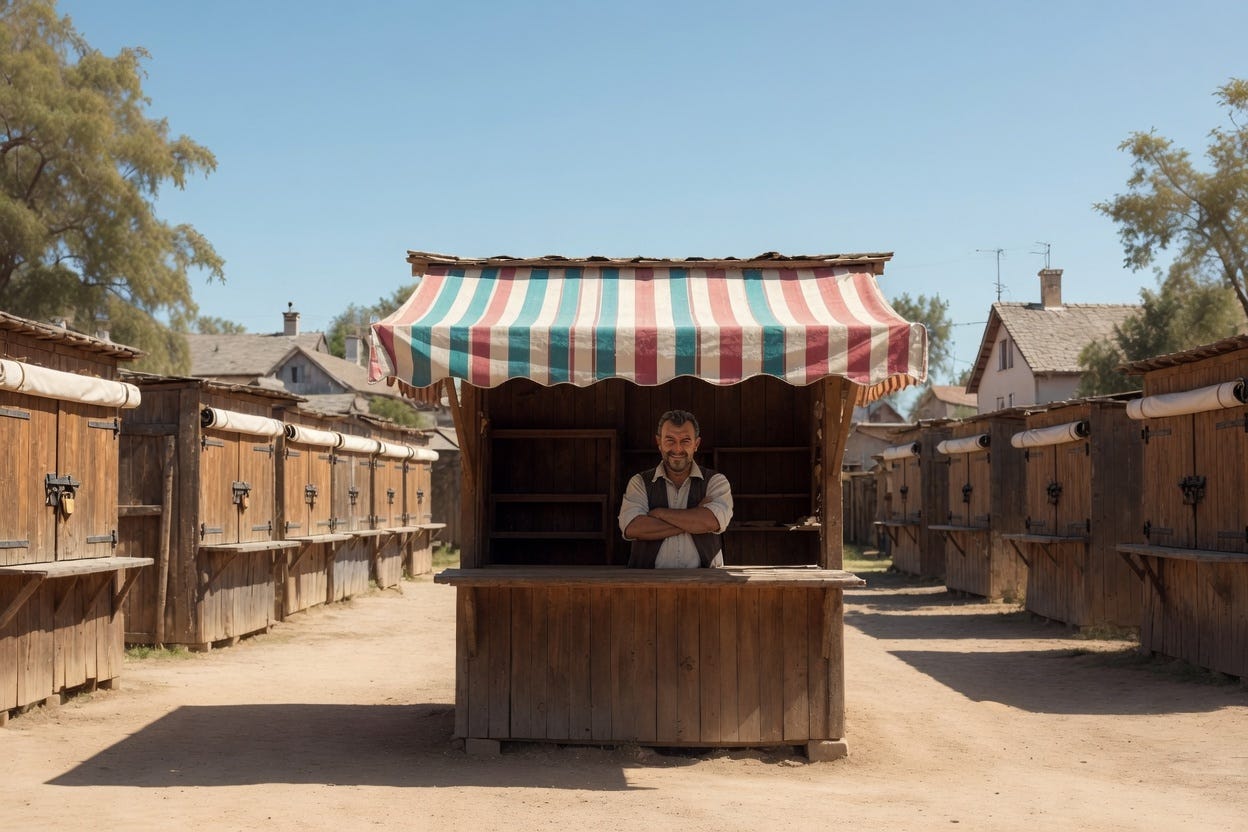
Back in Episode 022 while on the topic of mercantilism, we touched upon the idea of cartels - a small band of merchants grouping together for market abuse and unfair advantage. Let’s take it a notch up.Let’s first go back to where we left our fictional friends way back in Episode 003 when discussing price. Back then, at the idyllic townsquare market, Brenda and Irene strolling around, on inquiring the price of a sack of grain, get quoted 8 and 10 copper coins by Steve and Bryan. They may have been surprised by the difference in price, maybe they first thought of shopping around a bit more. Maybe they were happy to pay either price, the lower for obvious reasons, the higher for the less obvious reasons I explored back in that piece.A fortnight later, when Brenda and Irene are both out again, they only find Steve. And this time he’s charging them 15 copper coins! When they grumble, he’s like take it or leave it (with a look of it’s my way or the highway!)So Few For So ManySo what’s going on here then eh? Maybe by undercutting the other seller, he gained an edge and the other seller moved shop to the next town. Maybe the other seller found a better market to sell his goods at a better price anyways. Or some other set of circumstances.But right over here, potential buyers are left with only one choice of seller. Intentionally or not, Steve has a monopoly.In the much more complex world of modern commerce, there could be a myriad other factors that lead to monopolies, although underhanded measures like deliberate undercutting (charging lower while taking a profit cut until bleeding your rivals out), can and do occur. To extend the phenomenon we discussed in the mercantilism episode, where a few sellers got for themselves an unfair advantage by using the corrupt and coercive arm of the State to block newcomers, and thus formed an oligopoly, taking that process to its ultimate end is what leads to monopoly - “a few sellers only” to “only one seller”.Sole Seller or Sold Soul?We have all likely seen and dealt with monopolies in our lives. We might even use the word ‘monopolize’ in non-commercial contexts. But let’s look at its repercussions in the wider context here.We saw back in the price episode that in a functioning market price is not purely in the hands of the seller, but subject to a bunch of other factors, including what other sellers are offering. Now, obviously, some such constraints are weakened, and the sole seller can charge higher prices without restraint - and thus even distort the market equilibrium I touched upon back there.Alongside that, in line with the newly found take-it-or-leave-it nonchalance of the seller -- I mean if the potential buyer has nowhere else to go..., the seller doesn’t have to bother so much about the quality of their goods, again leading to worse outcomes for the buyers and the economy as a whole.It’s also important to note that the monopolist seller, such as Steve here, might not even be a bad person, but the whole incentive structured is so skewed to enable such undesirable behavior - whether on an individual or an institutional level.So what is the answer to this? We all perhaps instinctively know the answer, but from an economic angle I’ll elaborate on the matter in the next episode.Furthermore there are some services that can, in many cases, not be provided by the market, and falls into the arms of the state to deliver. The obvious ones are defense, justice, what we call public infrastructure and indeed the apparatus of the state itself - which is by definition, within a sovereign realm, a monopoly. (Oh you don’t like this army? Go subscribe to that army down the road, they do Tuesdays half price!)And then there are often politicians who, fairly or unfairly, denouncing a particular industry for abusing its powers, ask for the state to take over. (”Bro, I had too much to drink last night, I have a hangover.” “Here, have this Bourbon, it’ll cure you of your hangover.” )So given what we have seen so far, that monopolies can lead to undesirable outcomes, how is it that some services are widely to understood to be best dealt with by the state - say for example the trains (Anyone tried the coffee in a State-run train?) For then they are still a monopoly? How can we justify those politicians’ argument purporting to solve the problem of market abuse by, well, erecting a monopoly?What is the metaphoric price -- for the state could hide the actual marketprice by routing the production costs via taxes, we are willing to pay in terms of lower quality and less choice? Or can we find a balance where we can, via partnerships and collaboration, harness the best abilities of both the state and the market?Article written by Ash StuartImages, video, voice narration and some footnotes generated by AINothing in this presentation constitutes as advice - financial, investment or otherFurther Reading & Reference* The Watermellon Sellers - hilarious video depicting how a monopoly can form - watch on mute This is a public episode. If you would like to discuss this with other subscribers or get access to bonus episodes, visit ashstuart.substack.com
Embed this episode
Ready to play
The Story of Money: The Matter of Monopoly
No transcript for this episode yet
Similar Episodes
No similar episodes found.
Similar Podcasts
No similar podcasts found.