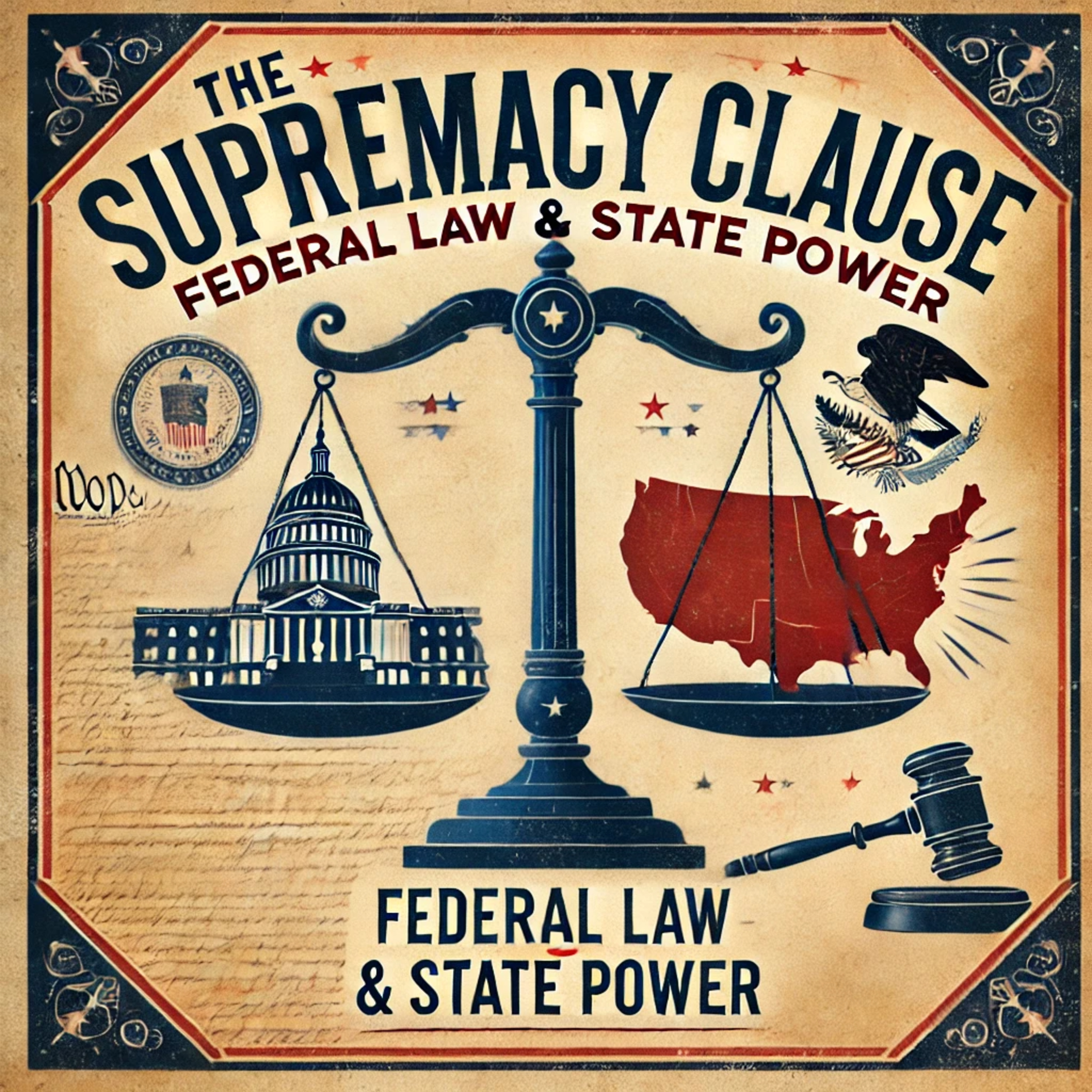
The Supremacy Clause episode artwork

EPISODE · Nov 8, 2024 · 18 MIN

The Supremacy Clause

from Law School · host The Law School of America

The Supremacy Clause Source: Excerpts from "The Supremacy Clause: A Law School Lecture" Main Themes: Federal Supremacy: The Supremacy Clause (Article VI, Clause 2) establishes the Constitution, federal laws made pursuant to it, and treaties as the "supreme Law of the Land," overriding any conflicting state laws. Federalism and State Sovereignty: While affirming federal supremacy, the Supremacy Clause operates within a framework of federalism, recognizing the reserved powers of states under the Tenth Amendment. Conflict Resolution: The Supremacy Clause provides a mechanism for resolving legal disputes between state and federal laws through the doctrine of preemption. Judicial Interpretation: Landmark Supreme Court cases have shaped the interpretation and application of the Supremacy Clause, defining the boundaries between federal and state authority. Most Important Ideas/Facts: Three Types of Supreme Federal Law: The Constitution: The foundational document, superseding any state action that contradicts it. Federal Laws: Laws enacted by Congress "in pursuance" of the Constitution, overriding conflicting state legislation. Treaties: Ratified agreements with foreign nations, holding equal standing with federal laws and preempting state laws. State Judges Bound: The Supremacy Clause explicitly binds state judges to uphold federal law, ensuring consistent application across state court systems. “Judges in every State shall be bound thereby, anything in the Constitution or Laws of any State to the Contrary notwithstanding." Preemption Doctrine: The Supremacy Clause gives rise to the preemption doctrine, which determines when federal law overrides state law. This includes: Express Preemption: Congress explicitly states its intent to preempt state law. Implied Preemption: Field Preemption: Federal law is so comprehensive that it leaves no room for state regulation. Conflict Preemption: Compliance with both federal and state law is impossible (direct conflict) or state law hinders federal objectives (obstacle preemption). Landmark Cases: McCulloch v. Maryland (1819): Established the principle of implied powers and barred states from taxing federal institutions. Gibbons v. Ogden (1824): Upheld federal supremacy in regulating interstate commerce. Arizona v. United States (2012): Reaffirmed federal preemption in the area of immigration law. Anti-Commandeering Doctrine: Limits federal power by prohibiting the federal government from forcing states to enact or enforce federal regulations. Limitations of the Supremacy Clause: Federalism Considerations: The Tenth Amendment reserves powers to states, allowing state laws to operate where there is no direct conflict or preemption. Presumption Against Preemption: Courts tend to favor state law in areas traditionally regulated by states, unless Congress clearly intended preemption. Concurrent Jurisdiction: Federal and state laws can coexist in many areas, permitting states to enforce their own laws and exceed federal requirements as long as there is no conflict. Quotes: "This Constitution, and the Laws of the United States which shall be made in Pursuance thereof; and all Treaties made, or which shall be made, under the Authority of the United States, shall be the supreme Law of the Land." "Judges in every State shall be bound thereby, anything in the Constitution or Laws of any State to the Contrary notwithstanding." "[The Supremacy Clause] was essential to addressing these issues, creating a mechanism through which federal laws, including treaties and constitutional provisions, would bind states and local governments." Conclusion: The Supremacy Clause is a cornerstone of the American legal system, ensuring the consistent application of federal law and resolving conflicts between state and federal authority. Understanding the Supremacy Clause is essential for grasping the dynamics of American federalism and the balance of power between the federal government and the states.

The Supremacy Clause Source: Excerpts from "The Supremacy Clause: A Law School Lecture" Main Themes: Federal Supremacy: The Supremacy Clause (Article VI, Clause 2) establishes the Constitution, federal laws made pursuant to it, and treaties as the "supreme Law of the Land," overriding any conflicting state laws. Federalism and State Sovereignty: While affirming federal supremacy, the Supremacy Clause operates within a framework of federalism, recognizing the reserved powers of states under the Tenth Amendment. Conflict Resolution: The Supremacy Clause provides a mechanism for resolving legal disputes between state and federal laws through the doctrine of preemption. Judicial Interpretation: Landmark Supreme Court cases have shaped the interpretation and application of the Supremacy Clause, defining the boundaries between federal and state authority. Most Important Ideas/Facts: Three Types of Supreme Federal Law: The Constitution: The foundational document, superseding any state action that contradicts it. Federal Laws: Laws enacted by Congress "in pursuance" of the Constitution, overriding conflicting state legislation. Treaties: Ratified agreements with foreign nations, holding equal standing with federal laws and preempting state laws. State Judges Bound: The Supremacy Clause explicitly binds state judges to uphold federal law, ensuring consistent application across state court systems. “Judges in every State shall be bound thereby, anything in the Constitution or Laws of any State to the Contrary notwithstanding." Preemption Doctrine: The Supremacy Clause gives rise to the preemption doctrine, which determines when federal law overrides state law. This includes: Express Preemption: Congress explicitly states its intent to preempt state law. Implied Preemption: Field Preemption: Federal law is so comprehensive that it leaves no room for state regulation. Conflict Preemption: Compliance with both federal and state law is impossible (direct conflict) or state law hinders federal objectives (obstacle preemption). Landmark Cases: McCulloch v. Maryland (1819): Established the principle of implied powers and barred states from taxing federal institutions. Gibbons v. Ogden (1824): Upheld federal supremacy in regulating interstate commerce. Arizona v. United States (2012): Reaffirmed federal preemption in the area of immigration law. Anti-Commandeering Doctrine: Limits federal power by prohibiting the federal government from forcing states to enact or enforce federal regulations. Limitations of the Supremacy Clause: Federalism Considerations: The Tenth Amendment reserves powers to states, allowing state laws to operate where there is no direct conflict or preemption. Presumption Against Preemption: Courts tend to favor state law in areas traditionally regulated by states, unless Congress clearly intended preemption. Concurrent Jurisdiction: Federal and state laws can coexist in many areas, permitting states to enforce their own laws and exceed federal requirements as long as there is no conflict. Quotes: "This Constitution, and the Laws of the United States which shall be made in Pursuance thereof; and all Treaties made, or which shall be made, under the Authority of the United States, shall be the supreme Law of the Land." "Judges in every State shall be bound thereby, anything in the Constitution or Laws of any State to the Contrary notwithstanding." "[The Supremacy Clause] was essential to addressing these issues, creating a mechanism through which federal laws, including treaties and constitutional provisions, would bind states and local governments." Conclusion: The Supremacy Clause is a cornerstone of the American legal system, ensuring the consistent application of federal law and resolving conflicts between state and federal authority. Understanding the Supremacy Clause is essential for grasping the dynamics of American federalism and the balance of power between the federal government and the states.

NOW PLAYING

The Supremacy Clause

0:00 18:37

No transcript for this episode yet

We transcribe on demand. Request one and we'll notify you when it's ready — usually under 10 minutes.

The Small Business Startup School – Business Notes | Financial Literacy | Retail Psychology – For Professionals & Entrepreneurs The Small Business Startup School Inc. Starting or buying a small business? While personal circumstances may vary, business patterns remain timeless. On The Small Business Startup School, we explore strategies, insights, and practical solutions to help entrepreneurs confidently navigate their journey.Hosted by Ola Williams—a retail entrepreneur, fintech founder, and financial coach with over two decades of experience—this podcast marries financial awareness and retail psychology with optimism to deliver actionable takeaways.Join us to learn, grow, and connect as we uncover the keys to business success.Let’s continue to learn together and be encouraged to keep on connecting! The 48 Laws of Power by Robert Greene (Full Audiobook) Robert Greene Amoral, cunning, ruthless, and instructive, this multi-million-copy New York Times bestseller is the definitive manual for anyone interested in gaining, observing, or defending against ultimate control – from the author of The Laws of Human Nature.In the book that People magazine proclaimed “beguiling” and “fascinating,” Robert Greene and Joost Elffers have distilled three thousand years of the history of power into 48 essential laws by drawing from the philosophies of Machiavelli, Sun Tzu, and Carl Von Clausewitz and also from the lives of figures ranging from Henry Kissinger to P.T. Barnum.Some laws teach the need for prudence (“Law 1: Never Outshine the Master”), others teach the value of confidence (“Law 28: Enter Action with Boldness”), and many recommend absolute self-preservation (“Law 15: Crush Your Enemy Totally”). Every law, though, has one thing in common: an interest in t Guardians Of Innocence Guardians Of Innocence Guardians of Innocence is a powerful and informative podcast designed to equip parents, teachers, and communities with the knowledge and tools needed to protect children from the growing threat of trafficking. Each episode dives deep into the tactics traffickers use to target vulnerable children—both online and in real life—and provides actionable advice on how to recognize the warning signs.Through expert interviews with cyber safety professionals, law enforcement, and survivors, we uncover the latest grooming methods, share real-world stories, and empower listeners to become vigilant guardians of innocence in their own families and communities.Guardians of Innocence is more than just a podcast; it’s a call to action to safeguard our children, raise awareness, and foster a united front against trafficking.Listen. Learn. Protect. The Laura Ingraham Show Laura Ingraham The most-watched woman in the history of cable news brings her no-holds-barred political and cultural commentary to podcasting with The Laura Ingraham Show. A bestselling author, breast cancer survivor, and mother of three internationally adopted children, Laura was the most listened-to woman in talk radio before launching her own podcast. A trailblazer across media platforms, she brings a unique perspective to this twice-weekly show, drawing on her experience as a white-collar criminal defense litigator and a Supreme Court law clerk.New episodes drop twice a week—delivering the clarity, courage, and common sense America needs.

Frequently Asked Questions

How long is this episode of Law School?

This episode is 18 minutes long.

When was this Law School episode published?

This episode was published on November 8, 2024.

What is this episode about?

The Supremacy Clause Source: Excerpts from "The Supremacy Clause: A Law School Lecture" Main Themes: Federal Supremacy: The Supremacy Clause (Article VI, Clause 2) establishes the Constitution, federal laws made pursuant to it, and treaties as the...

Can I download this Law School episode?

Yes, you can download this episode by clicking the download button on the episode player, or subscribe to the podcast in your preferred podcast app for automatic downloads.
URL copied to clipboard!