The Surprising Complexity of Finding Known Vulnerabilities (god2025) episode artwork

EPISODE · Nov 26, 2025 · 23 MIN

The Surprising Complexity of Finding Known Vulnerabilities (god2025)

from Chaos Computer Club - recent events feed (low quality) · host Dustin Born, Matthias Göhring

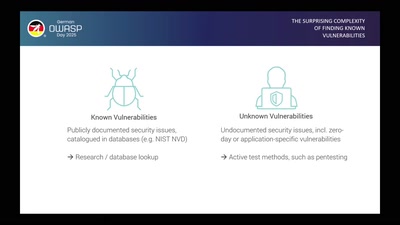
With the increasing reliance on third-party software components, ensuring their security against known vulnerabilities has become a daily challenge for individuals and organizations. Despite the availability of a variety of tools and databases, we found all of them fall short when applied to real-world scenarios - raising questions about their effectiveness, generalizability, and practical utility. Starting from our perspective as penetration testers, we identified three main problems with existing solutions in vulnerability identification: Accuracy and completeness of results - Many tools exhibit limited precision and recall, often depending on a single data source (e.g. NVD) and overlooking critical indicators such as known exploits or patch history. Rigid input requirements - Most solutions enforce strict formatting constraints (e.g., requiring exact CPEs), creating usability and reliability issues when dealing with diverse or incomplete data. Lack of usable outputs - The inability to meaningfully export or integrate results into broader workflows hampers both manual and automated security processes. In order to solve these challenges, we developed the open-source tool search_vulns. It leverages information from multiple data sources and uses text comparison techniques and CPEs in combination to increase accuracy in software identification. Due to this approach, it can even automatically generate CPEs that have yet to be published. Together with its custom logic for version comparison, this further enhances the quality of results. Finally, search_vulns provides a fine-granular export of results in different formats. In conclusion, this talk aims to simplify the surprising complexity of finding known vulnerabilities in software. To do so, we discuss common challenges in mapping software names to CPEs, e.g. for product rebrandings, single-version vulnerabilities and yet to be published software versions. In addition, we present an approach using multiple data sources in combination to enrich CVE data with information on known exploits, likelihood of exploitability (EPSS) and other data sources. Finally, we present search_vulns as open-source tool. Licensed to the public under https://creativecommons.org/licenses/by-sa/4.0/ about this event: https://c3voc.de

With the increasing reliance on third-party software components, ensuring their security against known vulnerabilities has become a daily challenge for individuals and organizations. Despite the availability of a variety of tools and databases, we found all of them fall short when applied to real-world scenarios - raising questions about their effectiveness, generalizability, and practical utility. Starting from our perspective as penetration testers, we identified three main problems with existing solutions in vulnerability identification: Accuracy and completeness of results - Many tools exhibit limited precision and recall, often depending on a single data source (e.g. NVD) and overlooking critical indicators such as known exploits or patch history. Rigid input requirements - Most solutions enforce strict formatting constraints (e.g., requiring exact CPEs), creating usability and reliability issues when dealing with diverse or incomplete data. Lack of usable outputs - The inability to meaningfully export or integrate results into broader workflows hampers both manual and automated security processes. In order to solve these challenges, we developed the open-source tool search_vulns. It leverages information from multiple data sources and uses text comparison techniques and CPEs in combination to increase accuracy in software identification. Due to this approach, it can even automatically generate CPEs that have yet to be published. Together with its custom logic for version comparison, this further enhances the quality of results. Finally, search_vulns provides a fine-granular export of results in different formats. In conclusion, this talk aims to simplify the surprising complexity of finding known vulnerabilities in software. To do so, we discuss common challenges in mapping software names to CPEs, e.g. for product rebrandings, single-version vulnerabilities and yet to be published software versions. In addition, we present an approach using multiple data sources in combination to enrich CVE data with information on known exploits, likelihood of exploitability (EPSS) and other data sources. Finally, we present search_vulns as open-source tool. Licensed to the public under https://creativecommons.org/licenses/by-sa/4.0/ about this event: https://c3voc.de

NOW PLAYING

The Surprising Complexity of Finding Known Vulnerabilities (god2025)

0:00 23:35

No transcript for this episode yet

We transcribe on demand. Request one and we'll notify you when it's ready — usually under 10 minutes.

LIGHTS, CAMERA, SMILE! Creatives Club Media Lights, Camera, Smile, is a podcast for anyone with a dream to share something with the world, out of the overflow of themselves - be it their mind, their heart, their personalities, and much more. Each of us are alive in this moment in time, with an innate ability to have ideas and create various things to benefit both ourselves and the people around us for a reason, and here, you will find the encouragement, the inspiration, and the motivation to do just that. Hosted by Cicily, founder of Creatives Club, she dives into various topics surrounding creativity and business. Exploring entrepreneurship for creatives in a corporate reality, sharing tips and tricks in a media centered company, answering questions regarding what a creative actually is are just a few of the things discussed on this podcast. Be encouraged to create for yourself as Cicily gets vulnerable by pivoting the camera to herself for the first time.To submit questions for Cicily to answer, or have her address certain t The PFN Cincinnati Bengals Podcast Pro Football Network The PFN Cincinnati Bengals Podcast is where you can stay up-to-date with the latest news and analysis on the Cincinnati Bengals! Our hosts, industry experts Jay Morrison and Dallas Robinson, provide weekly coverage of all the latest rumors and updates about the Bengals. Don’t forget to follow the show to receive new episodes directly in your podcast feed and leave a rating and review to let us know your thoughts. Piramidi Club The Bitcoin Butcher La Migliore Pizza di Firenze 🎙️Truth and Testimony the Broadcast Ray Gauthier & Adrian Scott This Podcast discusses and teaches the word of God. You will hear about world news and how it relates to bible prophecy. You will also hear interviews and testimonies from men and women of God who have devoted their lives to serving Yeshua (Jesus). Hosted by Ray Gauthier and Adrian Scott. These two long term broadcast colleagues have joined forces once again to provide you the highest quality in broadcast excellence, all for the glory of Yahweh: the God of all creation!You can see most of the podcasts uploaded here at our Youtube Channel.https://www.youtube.com/@truthandtestimonythebroadcast

Frequently Asked Questions

How long is this episode of Chaos Computer Club - recent events feed (low quality)?

This episode is 23 minutes long.

When was this Chaos Computer Club - recent events feed (low quality) episode published?

This episode was published on November 26, 2025.

What is this episode about?

With the increasing reliance on third-party software components, ensuring their security against known vulnerabilities has become a daily challenge for individuals and organizations. Despite the availability of a variety of tools and databases, we...

Can I download this Chaos Computer Club - recent events feed (low quality) episode?

Yes, you can download this episode by clicking the download button on the episode player, or subscribe to the podcast in your preferred podcast app for automatic downloads.
URL copied to clipboard!