
EPISODE · Jun 11, 2026 · 4 MIN
The Surprising Link Between Stretching and Artery Health
from Healthy 50 Plus Podcast · host Dmitri Konash
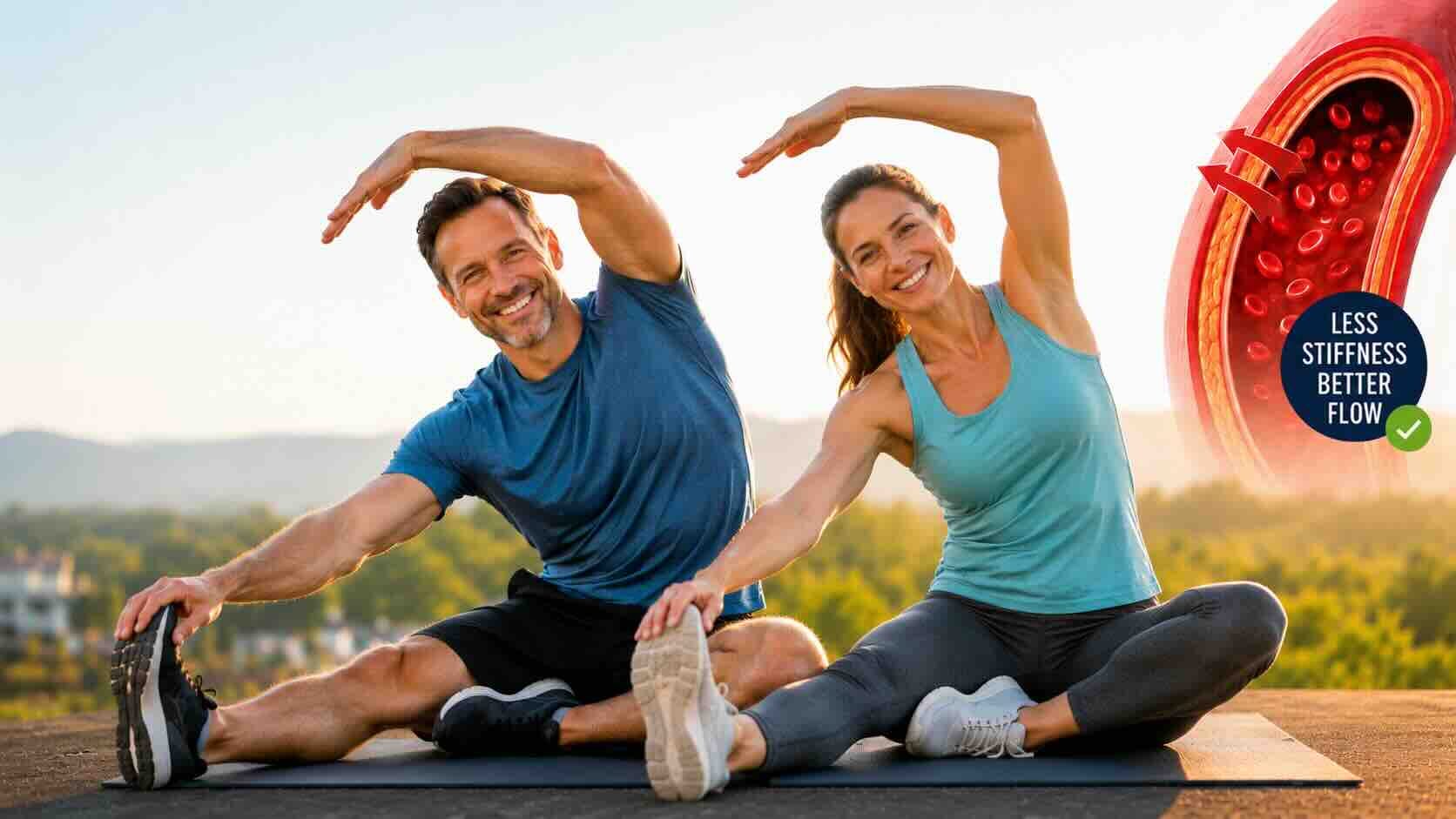
This is a compressed version of the original post published on our website. Most people think stretching is only about flexibility.You stretch to loosen tight muscles.You stretch after sitting too long.You stretch before or after exercise.But research suggests that regular stretching may do more than help you move better.A study from Japan found that 4 weeks of regular static stretching reduced arterial stiffness in middle-aged men.This matters because arterial stiffness is one of the signs of vascular aging. As we get older, our arteries can gradually lose elasticity. When arteries become stiffer, the heart may need to work harder to pump blood through the body.The simple message is this:Stretching may not only help your muscles feel younger. It may also help your arteries stay more flexible. ❤️What Is Arterial Stiffness? 🫀Healthy arteries are elastic.They expand when the heart pumps blood and then gently recoil. This helps blood flow smoothly through the body.Think of your arteries like a flexible garden hose.✅ A soft hose allows water to flow smoothly.❌ A stiff hose creates more pressure and resistance.The same idea applies inside the body.When arteries become stiffer, blood flow may become less efficient. Arterial stiffness is also linked with aging and cardiovascular risk.This does not mean stretching is a treatment for high blood pressure or heart disease.But it does suggest that stretching can be a useful part of a heart-healthy lifestyle — alongside walking, breathing exercises, strength training, good sleep, and healthy nutrition.What Did the Study Find? 🔬The study looked at healthy middle-aged men.One group performed regular static stretching for 4 weeks.Another group continued their usual lifestyle.The stretching group performed supervised stretches for major muscle groups.After 4 weeks, they showed two important changes:✅ Better flexibility✅ Lower arterial stiffnessIn simple terms:The people who stretched regularly became more flexible — and their arteries appeared to become more flexible too.This is the key idea.Stretching is usually seen as a muscle habit. But the body is connected.When you stretch muscles, you also affect surrounding tissues, circulation, blood vessels, and possibly the nervous system.That may explain why gentle stretching can feel calming and restorative — not just physically, but mentally too.Why Could Stretching Help Blood Vessels? 🤔Researchers are still studying the exact mechanisms, but there are a few likely explanations.1. Stretching may stimulate blood vessels 🩸When you stretch a muscle, you also stretch nearby tissues and small blood vessels.This gentle stimulation may help blood vessels adapt and function better over time.2. Stretching may improve circulation 🌿Stretching can increase local blood flow and reduce muscle tension.Better movement, less stiffness, and improved circulation may all support healthier vascular function.3. Stretching may calm the nervous system 😌Slow stretching often encourages slower breathing and relaxation.This may help the body move away from “fight or flight” mode and into a calmer state.That matters because stress can influence heart rate, blood pressure, sleep, and recovery.This is why stretching before bed or after a stressful day can feel so useful.It sends a simple signal to your body:Slow down. Breathe. Relax. Recover.3 Practical Ways to Use This Research 🌞You do not need to copy the exact study protocol to benefit from the idea.The goal is to turn stretching into a simple habit you can repeat.1. Build a 10-Minute Daily Stretching Routine 🧘♂️Start small.You do not need advanced yoga.You do not need perfect flexibility.You do not need a gym.A simple 10-minute routine is enough to begin.Focus on large muscle groups:🦵 Calves🦵 Hamstrings🦵 Hip flexors🦵 Quadriceps🧍 Chest and shoulders🧘 Lower backHold each stretch for 20–30 seconds.The stretch should feel comfortable. You should feel mild tension, not pain.A simple routine could include:Calf stretch — 30 seconds each sideHamstring stretch — 30 seconds each sideHip flexor stretch — 30 seconds each sideChest-opening stretch — 60 secondsLower back stretch — 60 secondsNeck and shoulder stretch — 60 secondsMove slowly.Do not bounce.Do not force the position.The goal is not to become extremely flexible.The goal is to give your body a daily dose of gentle movement, circulation, and relaxation.2. Combine Stretching With Slow Breathing 🫁Stretching becomes even more useful when you pair it with calm breathing.During each stretch, try this:Inhale gently through your nose.Exhale slowly.Relax your shoulders.Let your jaw soften.A simple rhythm is:Inhale for 4 seconds.Exhale for 6 seconds.This longer exhale may help your body settle into a calmer state.You can use this combination:🌞 In the morning💻 During a work break🚶 After walking🌙 Before sleep📱 Before checking blood pressureThis is where BreathNow app can fit naturally into your routine.BreathNow includes guided breathing exercises and follow-along wellness videos that can help you turn stretching into a structured relaxation habit.For example:🧘 7–10 minutes of stretching🫁 3 minutes of slow breathing in BreathNow❤️ Then track how your heart rate, HRV, or blood pressure trends respond over timeThis helps you move from guessing to learning.You may notice that stretching plus slow breathing helps you feel calmer, sleep better, or recover faster after stress.3. Track Your Response and Find What Works 📲❤️Everyone responds differently.Some people feel best after stretching.Some respond better to walking.Others benefit most from slow breathing or simple isometric exercises like wall sits, planks, or handgrip training.The best routine is the one that works for your body — and the one you can repeat.BreathNow can help because it connects daily habits with cardiovascular signals.You can use it to track:✅ Blood pressure trends✅ Heart rate✅ HRV✅ Stress-related changes✅ How you feel before and after different activitiesYou can also explore follow-along videos for breathing, relaxation, stretching, walking, and simple exercises. This is a public episode. If you would like to discuss this with other subscribers or get access to bonus episodes, visit strongover60.substack.com
Embed this episode
NOW PLAYING
The Surprising Link Between Stretching and Artery Health
No transcript for this episode yet
Similar Episodes
No similar episodes found.
Similar Podcasts
No similar podcasts found.