
Wait, you're listening to RadioLab from WNYC. This is RadioLab. I'm Jadabum Rod. Today, a little something different.
I was invited to give a TED talk a few months ago. It's out today. It's sort of a personal talk for me. It's about my life as a journalist.
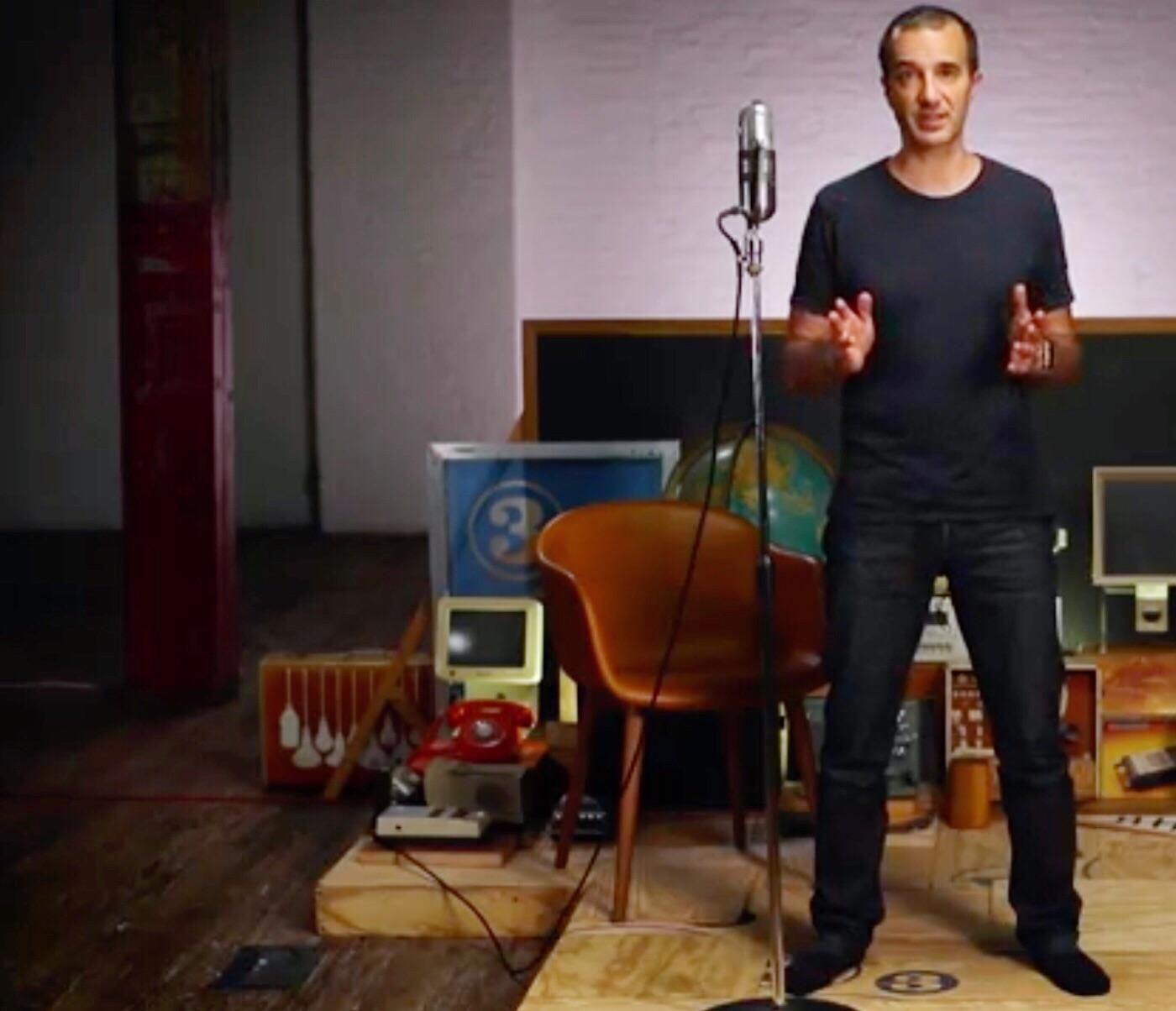
I also think it helps explain a little bit of the journey that RadioLab has been on for the last decade or so. I want to play the audio of that talk here in the podcast. I mean, obviously it is a video in its native format, and you should definitely check out the video because, you know, with COVID, there was no TED conference this year, which actually meant, for me, I got to work with this amazing video artist, a friend of mine, Mac Primo, and we sort of reimagined the entire form of a TED talk in that video. Super is incredible.
So you should watch the talk. In the meantime, I'm going to listen to it here because I think it says something about how I personally and how we as a show are trying to kind of approach this complicated moment. So here it is. I want to tell you about my search for purpose as a journalist and how Dolly Parton helped me figure it out.
So I've been telling audio stories for about 20 years, first on the radio and then in the podcast. And when I started the RadioShow RadioLab in 2002, here was the quintessential story move we would do. We'd bring on somebody. It's one of the most hypnotic and spellbinding spectacles in nature because, have to keep in mind, it is absolutely silent.
Like this guy, a mathematician, Steve Strogats, and he would paint a picture. Picture it. There's a riverbank in Thailand in the remote part of the jungle. You're in a canoe, slipping down the river.
There's no sound of anything, maybe the occasional, you know, exotic jungle bird or something. So you're in this imaginary canoe with Steve and in the air all around you are millions of fireflies. And what you see is sort of a randomized starry night effect because all the fireflies are blinking at different rates. Which is what you'd expect.
But, according to Steve, in this one place, for reasons no scientist can fully explain. Whoop. Whoop. Whoop.
With thousands of lights on and then off, all in sync. Now it's around this time that I would generally bring in the beautiful music as I just did and you'd start to get that warm feeling. A feeling that we know from science kind of localizes in your head and chest and spreads through your body. I was a feeling of wonder.
From 2002 to 2010, I did hundreds of these stories. Sciencey, neuro-sciencey, very heady brainy stories that would always resolve into that feeling of wonder. And it began to see that as my job to lead people to moments of wonder. What that sounded like was?
Wow. Wow. Wow. That's amazing.
Wow. Wow. But I began to get kind of tired of these stories. I mean, partially as the repetition, I remember there was a day I was sitting at the computer making the sound of a neuron.
You know, it takes some white noise, chop it up, very easy sound to make. I remember to thinking, I have made this sound 25 times. But it was more than that. It was a familiar path to these stories.
You walk the path of truth, which is made of science, and you get to wonder. Now, I love science. Don't get me wrong. My parents, immigrated from a war-torn country, came to America, and science for them was more their identity than anything else.
And I inherited that from them. But there was something about that simple movement from science to wonder that just started to feel wrong to me. Like, is that the only path a story can take? Around 2012, I ran into a bunch of different stories that made me think, no.
One story in particular where we interviewed a guy who described chemical weapons being used against him and his fellow villagers in the mountains of Laos. Western scientists went there, measured for chemical weapons, didn't find any. We interviewed the man about this. He said the scientists were wrong.
We said what they tested. He said, I don't care. I know what happened to me. And we went back and forth and back and forth and make a long story short.
The interview ended in tears. I felt horrible. Like hammering at a scientific truth when someone has suffered. That wasn't going to heal anything.
And maybe I was relying too much on science to find the truth. And it really did feel at that moment that there were a lot of truths in the room and we were only looking at one of them. But I got to get better at this. So for the next eight years, I committed myself to doing stories where you heard truths collide.
We get stories about the politics of consent. You heard the perspective of survivors and perpetrators who have narratives about race. How black men are systematically eliminated from juries and yet the rules that try and prevent that and only make things worse. Stories about counter-terrorism, wantonimo detainees.
Stories where everything is disputed. All you can do is struggle to try and make sense. And the struggle kind of became the point. I began to think maybe that's my job.
To lead people to moments of struggle. And here's what that sounded like. But I say, I like, I know. Well, so like, I mean, you know, that sigh right there.
I wanted to hear that sound in every single story because that sound is kind of our current moment, right? We live in a world where truth is no longer just a set of facts to be captured. It's become a process. It's gone from being a noun to being a verb.
But how do you end that story? Like what literally kept happening is we'd be telling a story, cruising along two viewpoints in conflict, you get to the end and it's just like, no, let me see. Do I say the end? Oh my God.
How do you end that story? You can't just like happily ever after it because that doesn't feel real. At the same time, if you just leave people in that stuck place, like why did I just listen to that? Like it felt like there had to be another move there.
It had to be a way beyond the struggle. And this is what brings me the dolly or St. Dolly is we like to call her in the South. I want to tell you about one little glimmer of an epiphany that I had doing a nine part series called Dolly Parton's America last year.
It was a bit of a departure for me, but I just had this intuition that Dolly could help me figure out this ending problem. And here was the basic intuition. You go to a dolly concert. You see men and trucker hats standing next to the men in drag.
Democrat standing next to the republic. Women holding hands, every different kind of person smashed together. All of these people that we are told should hate each other are there singing together. She somehow carved out this unique space in America.
I wanted to know how does she do that? So I interviewed Dolly 12 times, two separate continents. She started every interview this way. Ask me whatever you ask me.
I'm gonna tell you what I want to hear. She is undeniably a force of nature. But the problem that I ran into is that I had chosen a conceit for this series that my soul had trouble with. Dolly sings a lot about the South.
If you go through her discography, you will hear song after song about Tennessee. Tennessee. Tennessee. Tennessee Mountain Home, Tennessee Mountain Memories.
Now I grew up in Tennessee. And I felt no nostalgia for that place. I was the scrawny Arab kid who came from the place that invented suicide bombing. I spent a lot of time in my room.
When I left, Nashville, I left. I remember being in Dollywood, standing in front of a replica, replica of her Tennessee Mountain Home. People all around me were crying. This is a set.
Why are you crying? I couldn't understand why they were so emotional, especially given my relationship to the South. And I started to honestly have panic attacks about. Am I not the right person for this project?
But then, twist of fate, we meet this guy, Brian Seaver, Dolly's nephew in Bodyguard, and on a whim, he drives producer Shima Oliaiina out of Dollywood, round the backside of the mountains, up the mountains 20 minutes, down a narrow dirt road through giant wooden gates to look right out of Game of Thrones, and into the actual Tennessee Mountain Home. But the real place, how the real Tennessee Mountain Home. And I'm going to score this part with Wagner because you understand, in Tennessee lore, this is like hallowed ground, the Tennessee Mountain Home. So I remember standing there on the grass, next to the pigeon river, butterflies doing looped loops in the air, and I had my own moment of wonder.
Dolly's Tennessee Mountain Home looks exactly like my dad's home in the mountains of Lebanon. Her house looks just like the place that he left. And that simple bit of layering led me to have a conversation with him that I'd never had before about the pain he felt leaving his home and how he hears that in Dolly's music. Then I had a conversation with Dolly where she described her songs as migration music.
Even that classic song, Tennessee Mountain Home, if you listen to it. It's about trying to capture a moment that you know is already gone. But if you can paint it vividly, maybe you can freeze it in place almost like in resin, trapped between past and present. That is the immigrant experience.
And that simple thought led me to a million conversations, started talking to musicologists about country music as a whole. This genre that I've always felt so having nothing to do with where I came from is actually made up of instruments and musical styles that came directly from the Middle East. In fact, there were trade routes that ran from what is now Lebanon right up into the mountains of East Tennessee. I can honestly say standing there looking at her home was the first time I felt like I'm a Tennessean.
That is honestly true. And this wasn't a one time thing. I mean, over and over again, she would force me beyond the simple categories I had constructed for the world. I remember talking with her about her seven year partnership with Porter Wagner.
In 1967, she joins his band. He is the biggest thing in country music. She is a backup singer and nobody. Within a short time, she gets huge.
He gets jealous. And then purses her for $3 million when she tries to leave. Now it would be really easy to see Porter Wagner as like a tight classic patriarchal jackass trying to hold her back. But anytime I would suggest that to her, like, come on.
This is a guy. I mean, you see it in the video, Steve. He's got his arm around you. There's a power thing happening for sure.
Well, it's more complicated than that. It's just, I mean, just think about it. He had had this show for years. He had, he didn't need me to have his hit show.
He wasn't expecting me to be all that I was either. I was a serious entertainer. He didn't know that. I mean, he didn't know how many dreams I had.
In fact, you kept telling me, don't bring your stupid way of seeing the world into my story because that's not what it was. Yeah, there was power. But that's not all there was. You can't summarize this.
All right, just to zoom out. What do I make of this? Well, I think there's something in here that's a clue, a way forward. As journalists, we love difference.
We love to fetishize difference. But increasingly in this confusing world, we need to be the bridge between those differences. But how do you do that? I think for me now, the answer is simple.
You interrogate those differences. You hold them for as long as you can until, like up on that mountain, something happens. Something reveals itself. So I cannot end indifference.
It's got to end in revelation. And coming back from that trip on the mountain, a friend of mine gave me a book that gave this whole idea a name. In psychotherapy, there's this idea called the third, which essentially goes like this. Typically, we think of ourselves as these autonomous units.
I do something to you. You do something to me. But according to this theory, when two people come together and really commit to seeing each other in that mutual act of recognition, they actually make something new, a new entity that is their relationship. You can think of Dolly's concerts as sort of a cultural third space, the way she sees all the different parts of her audience, the way they see her creates the spiritual architecture of that space.
And I think now that is my calling. But as a journalist, as a storyteller, as just an American living in a country struggling to hold, every story I tell has got to find the third. That place where the things we hold is different, resolve themselves into something new. Thank you.
So there it is. You can watch the video version of that at TED.com. The audio was also shared on TED Talks Daily where they post a new idea every weekday. As I mentioned, the video is worth checking out.
It was shot, edited, and animated in three very long days by an incredible video artist, Mac Primo. His daughter, Frida, was the grip, the Dolly Grip, which does not refer to Dolly Parton. It refers to the technical term for somebody who operates a camera or something. I don't really know.
I just work in audio, but she was the only crew on the set. And together, they put together a really cool video, which you can see at TED.com. Definitely check it out. Anyhow, don't go away.
I have one more thing to talk to you about after the break. This is Enric Romero from the Buretteau in the Florida, Texas. The real world is supported in part by the offered Peace Loan Foundation, enhancing political understanding of science and technology in the modern world. More information about Sloan at www.sloan.org.
Hi, Lulu here, and this episode is sponsored by BetterHelp. May is Mental Health Awareness Month, and as someone who reports on mental health, who likes talking to people about their mental health, and what they look to in science, in the natural world, in faith, in friendship, wherever it may be to help guide them through the rough patches of life, I just wanted to take a moment to say what seems to help people, turn corners, find relief, get out of ruts, and even flourish is having someone with you. As much as we can feel private about our mental health struggles, you do not have to go it alone. So this may, why not treat your mental health to a buddy?
And who better to talk to than a fully licensed mental health therapist with over 30,000 therapists available, better help has someone you can talk to available at pretty much any time that's convenient for you at the push-up button, and because finding the help you need often depends on the therapist's client vibe, arrest, assured, who better help you can switch providers at any time. Remember, truly, your mental health matters and you don't have to go it alone. Find the support you need any time with BetterHelp. Sign up and get 10% off at betterhelp.com.
That's radiolab. That's better. H-E-L-P dot com slash radio lab. Radio lab is supported by ADIO, the AICRM for modern businesses.
Close deals twice as fast. Prep for calls and minutes. Effortlessly spin up handoff breeds that used to take hours. Get pipeline intelligence without building a single dashboard.
How? Ask ADIO. ADIO is the AICRM that keeps teams ahead of the pack. It connects to your email, calendar, calls, product and billing data and more, creating a complete picture of your entire business.
While others are waiting through multiple tools to find information, teams are using ADIO to service insights and get answers on their go-to-market data instantly. Powered by universal context, ADIO's intelligence layer, ADIO searches updates and creates across your data to accelerate your workflow. Ask more from your CRM. Ask ADIO.
Try ADIO for free by going to ADIO dot com slash radiolab. That's ATTI0 dot com slash radio lab. Each story you hear on planet money starts with a question. What happens if we refund tariffs?
Why are groceries so expensive? At NPR, we stand for your right to be curious because the forces shaping our world can be hard to see. Follow NPR's planet money wherever you get your podcasts and start seeing how the economy really works. Hey, it's Jad again.
This is radio lab. So, okay, what you just heard was my story. That's how I think about my journalism. And in many ways, it is the story of how radio lab has evolved over the years.
You guys have heard the show evolve. We have been doing it for 17 years. Crazy to say out loud, but 17 years. And if you've been listening for some of that time, you've heard us do a million stories, stumble sometimes, grow from it, but always strive to do our most ambitious work.
Right now, I feel like that is something we all as journalists have to commit to. This is the moment to do the best work of our lives. And that is what we're trying to do here and we need your help in order to do it. And let me make one thing clear.
This show is not just me. There's an entire team now of people who work alongside me, Sar Kari, racial, queusic, Bethel Hopte, Betka Bresler, who makes the trains run on time here. Molly Webster, Tracy Hunt, Simon Adler, doing reporting on COVID, Nina Simone, Facebook, and Amy McEwen with the story of that octopus at the bottom of the ocean, Matt Keelty bringing the cat's list of sentences, Ariane Wack mixing every single piece of dialogue that you hear, Sorin Dilling, Pat Susie Lottif, the other other Lottif, David Gable making sure the bills get paid, bills for studio space, equipment, research, fact-checking. In other words, making the show requires a lot of people and it is not cheap and that is where we turn to you.
We need your support. RadioLab is listener, sport, and we know. We definitely know times are tough right now. But if you are in a position to give, a position to stand up and declare the things that you want to protect, we hope you will choose us and we hope you will make a donation.
That is directly how we pay for the work that we do here. Please visit RadioLab.org or text the word RadioLab, no spaces, to the number 70101. That is RadioLab to 70101. We will text you right back with a link where you can make a very fast, very easy donation in support of this show.
Thank you so much. We will be back next week with a new episode. I'm Jad Abumran signing off.