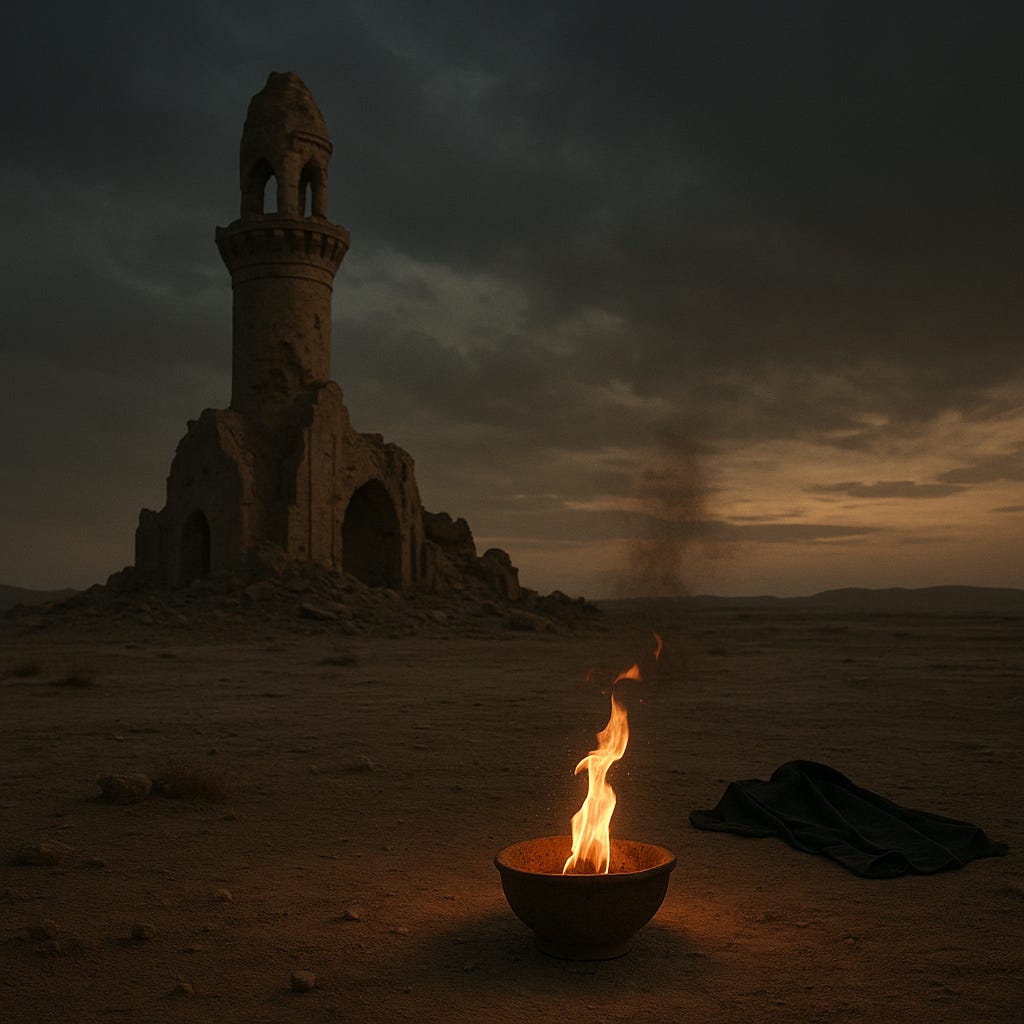
The Twin Reckonings
from Language Matters by Elias Winter Hosted by Elias Winter
Part I: The Fire That Preceded the Book Zarathustra’s empire, the flame of Ahura Mazda, and the quiet echo of a people who remembered too much. Before the Book arrived, there was Fire. Not metaphor, not symbol—actual fire. Sacred. Tended. Whispered to by priests who believed light was not just energy but ethics. In the ancient Iranian imagination, the world was not random. It was a battleground of truth and lie, flame and shadow, Ahura Mazda and Angra Mainyu. This was not optimism. It was a theology of vigilance. You didn’t get paradise for free. You held it off, minute by minute, in the shape of your speech, your choices, your posture toward truth. And then came the Book. Not the Avesta—the other Book. The one brought by men who prayed in Arabic and carried swords, not censers. It came not as conversation but conquest. The Arab-Muslim armies of the 7th century didn't ask Persia if it wished to change gods. They arrived as empires do—claiming revelation, delivering ultimatum. And Persia broke. But here is the part no conqueror understands: Persia never forgets. It absorbs. It bleeds, yes, but while it bleeds, it listens—and then rewrites the story in its own grammar. The Zoroastrian empire fell, but the Zoroastrian impulse—the moralization of history, the centrality of light, the dualism of meaning and lie—was not destroyed. It was transmuted. Planted like a seed in the clay of Shiism, mysticism, resistance. The fire never died. It changed names. And so began the long, haunted marriage between Islam and Iran—not of equals, not of strangers, but of two visions of the divine too proud to bow to each other. Part II: The Empire That Mourned Of Abbasids in silk, martyrs in mud, and the wound that became a religion. Islam has many faces. In Damascus, it wore marble. In Baghdad, mathematics. But in Iran, it wore black. Not immediately. Not at first. When the Abbasids overthrew the Umayyads in 750 CE, they leaned on Persian bureaucrats and poets to stabilize their caliphate. Arabic was the tongue of power, but Persian was the hand that held the pen. Names like al-Farabi, Avicenna, and Rumi emerged—not as Arabs, but as Iranians writing within the empire that had swallowed them. And still, something deeper stirred. A restlessness. A memory. A whisper under the minaret. You see, Iran did not forget what it was like to be conquered. And it did not believe in the stories told by the victors. The caliphate spoke of unity, but unity meant submission. It preached justice, but justice came from men who ruled in palaces far from the graves of their enemies. So the Iranian heart turned elsewhere. It found, in the tragedy of Karbala, a mirror. It found in Husayn—the grandson of the Prophet, slaughtered in the desert by a caliph’s army—the figure of ultimate betrayal. The innocent killed by the powerful. The light extinguished by politics. And suddenly, Islam was no longer the faith of the victor. It was the religion of the wronged. This was not Sunni Islam. This was not the Islam of caliphs and legal codes. This was Shiism—and Iran saw itself in its blood. Shiism is not theology. It is memory turned into ritual. It is history that refuses closure. It is the scream of the mother of martyrs echoing across centuries. And for a people who had once been Zoroastrians, who had seen their temples burned and their language subordinated, this faith felt familiar. It did not ask them to forget. It gave them permission to mourn. To be Shia in the Iranian soul was to say: We remember. Not just the fall of the Prophet’s family. But the fall of their own. This was not Islam as submission. This was Islam as defiance. This was the wound that became a doctrine. Part III: The Crown That Made Faith a Flag The Safavid gamble, the invention of a Shia state, and the empire built from forced remembrance. There are moments in history when faith is not inherited—it is enforced. In 1501, Shah Ismail rose from the mists of war and prophecy, declaring Iran not just an empire, but a Shia empire. It was a decision so brutal, so total, that it rewrote the genetic code of a civilization. Before Ismail, Iran was mostly Sunni. After him, it bled itself into Shiism. Entire cities were converted at sword-point. Sunni scholars were exiled. Rituals once whispered underground were paraded through the streets. What had been a wound became a weapon—sanctified, codified, state-approved. Why? Because the Safavids needed a border sharper than geography. The Ottomans to the west were Sunni. The Mughals to the east were Sunni. Persia needed a theological firewall. And it found it in the blood of Karbala. But this was not love. It was strategy. Shiism, once the faith of the persecuted, was conscripted by the crown. Martyrdom was monetized. Lamentation was legislated. The Ashura procession became both spectacle and surveillance. And yet—something strange happened. What was meant to serve the state began to undermine it. For in Shiism, the state is never holy. The Imam is always in occultation—absent, hidden, unjustly denied. The king, no matter how devout, is always suspect. The true sovereign is elsewhere. Beyond time. Beyond approval. So the very doctrine used to unify Iran carried within it a theology of resistance. The Shah crowned himself with a faith that did not believe in kings. The Safavid empire survived for over two centuries. But beneath its palaces, the sermons continued. They spoke not of loyalty, but of betrayal. Not of obedience, but of grief. A faith that had once mourned a single martyr now remembered millions. It remembered the fire, the conquest, the lie of unity. And it refused to forget. This is the paradox at the heart of Iran: a nation forced into a faith that taught it never to trust the ones who rule. Part IV: The Man Who Believed in Nations Mosaddegh, the oil, the lie, and the moment Iran chose law over loyalty—and was punished for it. Before the veil. Before the cassette tapes. Before theology became handcuffs—there was a man in a suit. Mohammad Mosaddegh did not come from the mosque. He came from the archive. He spoke the language of law, not lineage. His hands were unbloodied, his mind Western-trained, his loyalty Persian and real. He believed that a nation could stand without a master. That its oil could serve its people. That its voice did not need translation by empire. In 1951, he did the unthinkable: he nationalized Iran’s oil. It should have been a moment of pride. A return of sovereignty. A declaration that the age of foreign looting was over. Instead, it became a death sentence. Because when a small nation touches its chains and dares to say mine—the empires gather. Britain fumed. America smiled the smile of a banker sharpening a knife. The CIA named the operation Ajax, as if cleansing history were a matter of soap. In 1953, they overthrew him. The newspapers called it necessary. The diplomats called it strategy. But the people knew what it was: betrayal. Not by Mosaddegh—but of him. Of themselves. Of the possibility of a Persian democracy free of both crown and turban. The Shah returned. This time more obedient. More armed. More afraid. And the Iranian soul fractured. Mosaddegh had offered law. The West answered with tanks. He had offered independence. The clergy, watching from the sidelines, offered vengeance. This is the wound that made the Islamic Revolution possible. When the people saw the scholar cast aside, the judge mocked, the constitution shredded—they turned not to ballots, but to banners. Not to reason, but to ritual. Not to Mosaddegh, but to Husayn. And when Khomeini came, they were ready. Not because they wanted a theocracy. But because they had seen what happened to the last man who spoke of freedom without a god behind him. Part V: The Veil and the Machine The Shah, the mosque, the exile in Paris, and the revolution that prayed with clenched fists. Modernity came to Iran like a thief in uniform. In the 20th century, the Pahlavi dynasty rose with polished boots and broken mirrors. Reza Shah—and later his son—looked westward a… This is a public episode. If you would like to discuss this with other subscribers or get access to bonus episodes, visit eliaswinter.substack.com
Embed this episode
No transcript yet.