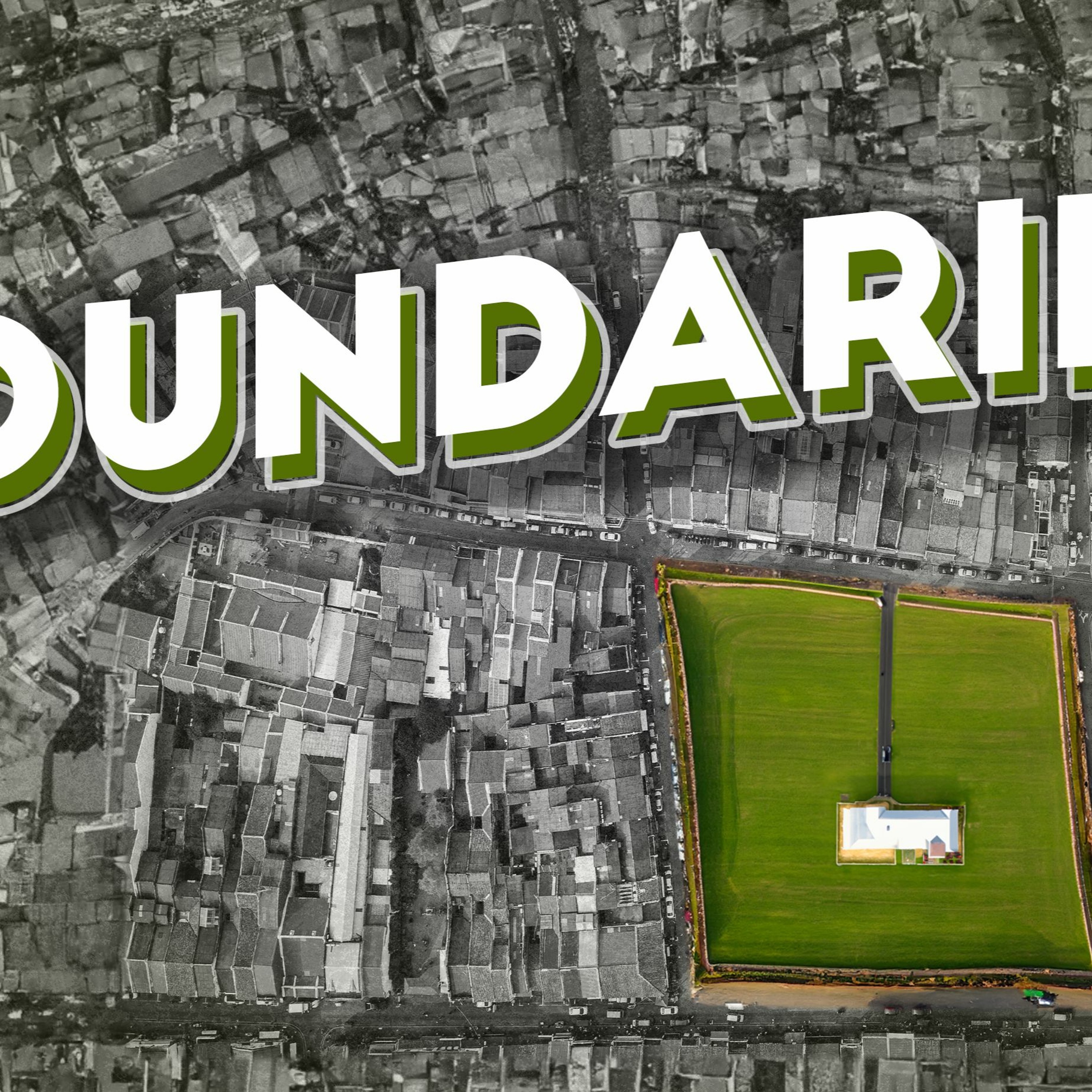
If you were here last week, we kicked off our new sermon series. Boundaries, I shared with you what I thought at the time with a pretty good and private metaphor that all of us, the need that all of us have for our boundaries in our lives. The metaphor was what I told you that my neighbors in our little cult of secular refer to as the DMZ. You might remember it.
It's the strip of yard that exists between where my fence kind of stands that I put up on my property line or inside of my property line because that's where you set up a fence, right? And where my neighbor, who some years later put his fence up, he put his on his side of the property line. And so here's a picture of, we looked at it last week. What's kind of resulted?
This strip of no man's a ville, right? This awkward area, he didn't tie into my fence. I didn't tie into his. And instead, what we've got is this, what my neighbor's called the military zone, the militarized zone.
As I said last week, where poor boundaries exists, where clear delineation of responsibilities that boundaries bring, where their absent, chaos reigns. You can see that in the DMZ a little bit. It's chaos in there. Nobody knows who it is.
So nobody takes any responsibility for it. I mean, I think it is. He thinks it's mine, right? Nobody fertilizes it, nobody mows it.
And I acknowledge you, I acknowledge you, I thought privately last week, I can't clean up my sins. As you can tell by the latter, that's there. The DMC, because it's kind of a no man's land, there's no accurate boundaries drawn. It's become for me over the years a repository for things that I don't know what to do with.
I came clean about those things last week. And I did so because I was fairly certain that my neighbor did not watch online. Turns out, I was wrong. I kind of guess that might have been the case.
When on Monday morning, I noticed that some of the chickens that he has, which he used to keep on a coop on the other side of his yard, were suddenly just roaming free range in the DMZ area. Became more personal to me when at 449 on Tuesday morning, his rooster, which has now been relocated to the DMZ, began to cock cock cock doodle doodle doodle, right under my bedroom window. So Tuesday night, when I got home from work, full of the spirit of God as you are as a pastor, when you've been at that church all day, when I got home, and I saw him out there just scattering chicken feed in the DMZ, to all of his foul friends, I went outside to say, hey neighbor, it's up with the chickens. And he said, well, I was listening to your sermon on Sunday.
And I figured since you feel like you can just dump anything in the DMZ, why should not? And it was right at that moment, as I was kind of frustrated, where I looked down, and I noticed that several of his pigeons, I mean chickens, they had dropped their eggs right on the side of my fence, on my kind of side of the fence anyway. Now, here's the thing, I didn't realize, and the maturity level of this is low, I'll acknowledge, and it's about to get lower, right? But his eggs, those eggs, let me correct that, those eggs were on my property.
And so I said to him, well, I guess, since these eggs are clearly on my property, these are my eggs now. I didn't realize how important eggs are to all of you chicken people. Because he got really upset when I claimed those eggs. He said, no, they're my chickens, so they're my eggs.
You said on Sunday, nobody knows whose property there is. Anyway, and so we argued back and forth about this for a longer than I'm proud of, when suddenly he proposed a solution. Remember he said in May when you did a talk on turning the other cheek? And immediately I thought to myself, man, this guy, how much does this guy have on me all these years?
He goes, if you remember, you introduced a concept to your congregation called, or a concept, called the Power Slap League. I don't know if anybody remembers that. The Power Slap League, and I was showing you how, you know, Dana White from the UFC has created the Power Slap League, where your goal is to open hand slap somebody and see how hard you can slap them. And he said, I propose, go get your noodle out of the shed, that you hold behind your back, and you show everybody how to do it.
Let's just slap this out. Now, not one to back down. And frankly, I'm considerably bigger than he is. I thought to myself, all right, fine.
So I went and got my noodle, and I held it behind my back. This kid hit me so hard in the face. I thought, Joe was going to find me passed out, knocked out in the DMZ later in the afternoon. I gathered myself.
Now I was mad before, now I'm really upset. Gathered myself together and said, that hurt. I said, but fine, my turn. And he looked and said, now you were right.
Forget it. It's only an egg. Walk away. Last week, I left you with a question to wrestle with, and it was this, to examine the places in your life where there is chaos.
By the way, that's a joke. Just nobody going home, I never heard your fighting out with John in the DMZ. But this is what happens when there is no boundaries, where there are no boundaries in our lives. Chaos reigns.
It could be relationally, which is what we're going to touch on today and probably next week. It could be another place as to where there are not good boundaries, financially, emotionally, physically. I told you to go home and ask yourself a question. Do I actually have a chaos problem in these areas where I'm just kind of underwater?
Or do I actually have a boundary problem? What we looked at last week is that God is not a God of chaos. He is a God of order. And that order is kept because God is a God of boundaries.
We saw a week's, and that God has hardwired into creation itself boundaries, and that they are there, not because he is an angry God holding out on us, but because he is a loving God, and they exist for our good. Boundaries, good, godly boundaries aren't punitive. They exist for our good and our health and our freedom. Last week, we spent some time looking at the proofs and evidences of all of those truths and the scriptures.
Now, many of us in the room. Many of us. We struggle with boundaries. Really, we struggle maybe the most with emotional or really relational boundaries, because as followers of Jesus, many of us who have decided that he is who he said he is, and we want to walk in his ways, we long to follow what the Apostle Paul referred to one time as the law of Christ, to love God with all of our hearts and souls and minds and strength and to love our neighbors ourselves.
Because we are to love others. Heck, we're even to love our enemies the way Christ loved us, the way Jesus served us. Maybe, maybe even lay our lives down for another. And because that's the Jesus that we're trying to model our lives after, oftentimes, we struggle with having boundaries in relationships.
Even to the point of sometimes even wondering, is it even a Christian concept to put boundaries in place? And my answer to you is a resounding yes. If you have no relational boundaries in your life, your life is going to be filled with relational chaos. My answer is yes, not based only on what we discovered last week, regarding how God used boundaries in creation and in our purpose for good.
But today, I want to go even further and show you how God himself through time and history, including a look at Jesus, how he lived, that even for Jesus relational boundaries exists. So let me get started in the book of Genesis, this first book in the Bible, right? This book of Origins. It tells us that in creation after God had moved from chaos, where the spirit was just hovering over the waters, where God moves creation from chaos and disorder to what is ultimately described as the Garden of Eden.
There, prior to the fall of man, before sin enters the garden, and enters man, God is as close to man as God can be, no relational distance between God and his creation. Quote, according to Genesis chapter 3, then the man and his wife heard the sound of the Lord God as he walked in the garden in the cool of the day. God is just walking around. And that closeness, that intimacy, that proximity to God was afforded to man because of man's sinless state, his sinless nature.
There had been no violation of any boundaries, no trespasses. And therefore, because there were no violations of boundaries, there was no distance in the relationship, and there were no consequences related to any trespass because it not existed. Most of you know the story though, there was only one boundary for a man in the garden. Adam and Eve had great freedom.
It was afforded to them to do anything, really, except for one thing, right? You could pretty much go anywhere, you can eat anything, you can rule over everything, just don't do this one thing. Quote, you are free to eat from any tree of the garden, you must not eat from the tree of the knowledge of good and evil. For when you eat from it, you will certainly die.
There was a boundary given to Adam. It was essentially a boundary that would provide him with freedom. He understood where he could go and what he could do. He wasn't worried about where he was going to step or what he was going to eat.
The boundary was for man to be responsible for what man was given to be responsible for, kind of his backyard, right? And not to assume responsibility for something somebody else was responsible for. In this case, for what God was responsible for, which was determining what is good and what is evil. And the boundary, of course, as I read you, had a significant consequence attached to it, not only physical death, not only physical death, but distance, access to God as a result of this trespass, this boundary violation, diminished.
So the Lord God banished him from the Garden of Eden to work the ground from which he had been taken. After he drove the man out, he placed on the east side of the Garden of Eden, because that's now where we are, right? So we are removed from the presence of God as a result of that trespass. And a pattern begins to become established in the scriptures.
Man and boundaries between God and man and boundaries begins to get established, one that you're going to see throughout the entirety of scripture. As I mentioned last week in preparation for this series, I'm going to be highlighting for you a couple of key source books. One is the classic work on boundaries, creatively titled Boundaries by John Maxwell and John Townsend. It has sold 4 million copies.
And another more recent book, which has got some fascinating material in it by Lisa Terkers called Good Boundaries and Good Bies. That's a better title. And in her book, she does a great job of pointing this pattern out. This pattern that she's identified regarding boundaries was access, responsibility, consequences, access, responsibility, consequences.
In the Garden, great access to God is a Ford. And man had responsibilities to uphold. They didn't uphold the responsibilities. And the consequences came into play.
Those consequences included the diminishment of access. God never abandons his people, but he's no longer walking with them. I haven't spotted God walking through Chester recently. He's not walking with them in the cool of the Garden anymore.
And we talked about this last week. As time goes by, east of Eden, chaos continues to grow. Sin is metastasizing in the world. Even seeing the lifespan of the people, right?
In the second generation of human beings, Adam and Eve's son, Cain, he murders his brother, Abel. And anybody know what the consequences were for Cain for that trespass? Here they are from his own words. My punishment is more than I can bear.
Today you are driving me from the land. And I will be hidden from your presence. Trespass, violation, results in reduced access, distance. In fact, things get so bad.
Fast forward to the seventh generation, a guy named LeMec. He now has two wives. I want you to remember the intimacy in which God created Adam and Eve for them to share. Now this guy LeMec, he no longer just shares intimacy with one woman.
He's collecting them like charms. We know that because the two names of those women in Hebrew, they translate to ornament and shadow. This is what's going on by the seventh generation. This is what man is beginning to do to women.
Sin is rapidly increasing. LeMec actually brags to his two eyes that he thought were his possessions. I have killed a man for wounding me, a young man for injuring me. It became like a bragadocious thing now.
What you see in the scriptures is, as you study the metastasizing of sin, what you begin to see is two things. The first is this growing distance of God. Some theologians actually equate this to what you see at the end of the Old Testament in the book of Malachi, the last prophet. After God's words to Malachi, God doesn't speak to human beings for over 400 years.
You see distance and you see boundaries. Because this function grows so to do the boundaries that God is placing on his people, not to punish them. God is not creating boundaries to punish man, but for their good. But the boundaries grow.
You know this from one in the garden to Moses gets 10. By the time Malachi is on the scene, it's grown to over 600. Some of you know the arc of the Old Testament story, right in the height in some sense of the distance when God decided to reestablish his relationship with man. He did so through a man named Abraham, and it chosen people he would father.
And the people would eventually become a nation. And those nations had very distinct boundaries in terms of where they went, what they ate, how they dressed. And because of their increased access to God, now this chosen people of God now has an increased access to God. He was present with them.
Initially, if you know the story of the Old Testament, initially God was with his people in something called the tabernacle. It was kind of a portable temple. And then in the temple in Israel itself. And because of that access to God that they had that other nations didn't, the people of that nation had increased responsibilities placed upon the by God.
And as a result, when they violated those things, there were subsequent consequences for those boundary violations. You see this over and over and over and over. I'll give you just a couple of them. Here's the prophet Jeremiah, God speaking through the prophet.
But I gave them this command, obey me, and I'll be your God and you'll be my people. Walk in obedience to all I command you. That may go well with you. Boundaries, consequence.
From the prophet Isaiah, if you were willing and obedient, you will eat good things in a land. But if you resist and rebel, you'll be devoured by the sword for the mouth of the Lord has spoken. Access, responsibility, boundaries, consequences. You can see it in the design of the temple.
I think Lisa Turkers does a great job of this. The place where God's presence dwells in Jerusalem, right? Boundaries exist from court to court, from the outside of the temple to the inside of the temple. The innermost place, right, where God's presence dwelled was a place in the temple called the holy of holies.
As access grew, as you were permitted to move court to court, your responsibilities as you moved closer to God increased and so did the consequences. The closer you got to the holy of holies, the more responsibilities you bore. The more that was placed on you. The temple, for example, if you know it, the temple had an outer court, it's called the court of the Gentiles.
You didn't even need to be Jewish to be in the court of the Gentiles. But the innermost place in the temple, the holy of holies, right? Only the high priest of Israel could go in there, and it was only on one day a year on the day of atonement to offer a sacrifice of atonement, for all of the sins of all of the people for that year. The high priest of Israel, he had to come from a certain family line.
He had of all of these ritual disciplines that he was required to undergo, even down to his specificity, his ceremony, his ceremony, his dress when he entered the place. Special clothes were worn just for the annual occasion that the priest then, when he made atonement for the sins, was to ceremony, fold them, so that they'd be ready again for next year. The consequence for entering into the holy of holies of getting that kind of access to God, without living up to the responsibilities of the access, they were as severe as the access was supreme. There's a lot of extra-biblical material that says, when a high priest went into the holy, he would actually have a rope tied to his leg.
Casey died in there. Access, responsibilities, boundaries, and consequences. What's the point? Well, let me ask you a question.
Who do you give innermost access to? Who gets to be really, really near and close in terms of your time, your money, your heart, your emotional energy, your physical capacities? Does everybody, does everybody, this is a serious question, does everybody just get equal access? Does everybody just get whatever they want in regards to relationships with you?
Nobody has any differing expectations. You expect the same thing, and if everybody that enters your life, do you have any boundaries for anybody, anywhere, or is your life a free-for-all, specifically, relationally? One of the talks from last year, as I was working on this, I realized, one of the talks I gave last year had to do with boundaries, and I think it's what had so many of you come to me and ask, well, aren't there any boundaries, right? I talked about the power of relationships and the power that relationships hold in our lives, and the writers of the scripture recognized, the relationships of your lives have the power to literally change you.
You're with us this summer, right? We looked at what we called one of the wisdom books in the Bible, the book of Proverbs, written by what is commonly cited as the wisest man to have ever lived Solomon, writing to his son. And to his son, he lays out specific relational boundaries. Let me show you a couple.
I think they're interesting. Walk with the wise Solomon told his son, and you'll become wise for a companion of fools suffers harm. Before you draw people into the inner circle where you're literally walking with them, you want to be wise. Notice Solomon did not say you study to get wise, you read to get rise, you go to the right schools to get wise, you go to the right universities to get wise.
No, no, he's saying, son, listen, I'm telling you, there's something that will have more impact on your life than any of those other things. Watch who you walk with. If you're here when I give this sermon, there's actually now medical proof that your brain actually changes based on who you spend time with in your life. That's how powerful relationships were.
A companion of fools doesn't just, he doesn't just say you become a fool, he says you suffer harm, you will be impacted. In fact, again, 700 BC, this written, Solomon doubles down on it to his son because he knows it's that important, he loves his kid. Do not make friends with a hot temper person, do not associate with one easily angered, or what? You may learn their ways and get yourself inspired.
Set the boundary now. Before you get into the mess, right, you go, how do I get out of this? When you see that this is true in somebody's life, you create a little boundary and say, okay, access to me is going to be limited because of the way you live your life. Now some of you may say, well, that seems a little judgmental, kind of old testament, don't you think, John?
True, I can see why you say that, but here's what Paul said in the New Testament, do not be misled, bad company corrupts, good character. In other words, don't be fooled, don't think it's not gonna matter. Don't be the kind of person who doesn't matter, who I lay in, it doesn't matter, I'll just be good friends with everybody, everybody is welcome. I think this is why I haven't been to Laura's home, actually, she's been following these principles over many years.
I'm just gonna lay anybody in. Paul says you're kidding yourself. And it's not just behavioral, the science teaches, it's changing you. In fact, you actually see this concept that he played out in the life of Jesus.
Jesus has levels of proximity, that he affords different people, those who were close and those who were closer. He was, he excludes no one, but he was a friend of sinners, tax collectors and prostitutes loved him. But there were only 72 men that he sent out to be his representatives, and only 12 were disciples, that he formed, right, that he walked with in his ways. And then of those disciples, there was only three, Peter, James, and John, that he took to pray with him on the night he was crucified.
Proximity in relationships matters. You have to watch who you bring close, it's going to impact your life. This is why, as it's been said, there are square dances, and then there are row dances, and then there are slow dances. It is a proximity issue.
Pick your partners wisely. But is there a way, I'm in a relationship, as I said last week, if you're not in one dysfunctional relationship, you look around every relationship, you're in a new one, everyone is functional, you might be the dysfunctional person that's unaware of all of the dysfunction you're causing, and everybody else's relationship, right? Is there a way to determine those boundaries? And the answer is yes, based on that model, access responsibility consequences.
I'm going to draw you a little picture here that's helped me understand it this week. I emailed you in the email this week, I called it the universal functional, crazy relational matrix. You have two axes here, right? This is going to be your responsibility access.
This is how responsible people are, right? If we ever can see this, this is how responsible you are from a 10, right, nine, eight. You get it, right? And we'll have our zero here.
And this is going to be the access, access, try saying that, right? So you're going to have one, two, out to 10 here. Now, based on the scriptures, there is a certain amount of people, right? I don't know what number you want to call it, but let's just call it, for example, people that have a responsibility level of three.
You don't want to grant them very much access at all. The scriptures, I mean, it's not like you're going to exclude them, but you're going to understand who they are, right? There's all kinds of verses on this. We just read some of the proverbs, right?
These are the fools that we talked about this summer. The bad company that corrupts, the hot tempered, Paul wrote to Silas. He said, have nothing to do with people that store up division. Paul said, stay away from people who are involved in the fruitless deeds of the dark.
There's a level of people where you just go, you know, it's not that I'm not going to love that person, but I am not going to allow that person access to all of my emotional energy, my heart, my finances, and all the rest, right? But what there is, when a relationship is balanced correctly, is there is a relationship, direct relationship, a one-to-one correlation between responsibility and access? Responsibility and access. Let me give you an example, right?
Say you are, say kind of on the span of people in your lives, right? There's somebody that you're giving kind of five level access. They're kind of in the middle of your heart and your time and whatever you want to make this, right? But they function at a four level, right?
So they would be here, right? Their line is going to be here. And so you see this area right here? That's the DMZ.
That's the chaos, right? That's the area where you go, huh? This is kind of a little bit like this function junction in here. Now, stick with me.
What happens, and a lot of us have this going on, and sometimes it's because we're born into these relationships, right, or we marry into these relationships? Some of us are giving 10 level access, right, to people with four level responsibilities with that access, right? And so what is that level of dysfunction? It's massive.
We got all this pain in our lives. It's always a mess with them, right? They're always just making a mess of your life your time. Now, I'm not, you know, this is actually an interesting one, right, all this space up here.
This is like the people that you want to move. You want to give more access to. These are the people that you meet. This is like the staff at Mendum Hills, right?
I didn't mean me. I mean, I'm not just like, the staff here is so amazing in my relationship with them. I grow in confidence with them all the time. I'm always giving them more access.
I check in on them less and less. Like, they're just amazing, wonderful people. These are the people that are up here above this relational line, right, that are showing you. Let me act.
Let me into your life. Let me closer to you, right? This. This is the places where you're going, huh.
This is a mess. Now, here's how I know you know this. Betz, would you hand me my phone right there? I'm going to take my pin card off here.
You've got to hand it to the front of me. I'm going to read you this number, right? 4129, 2194, 1257, 9219. And my access code is 1492.
That's when Columbus sailed the ocean blue. So I can remember it. So you all have my. Sue just looked at me like this.
I love you all. I want you to know that. And I love all of you watching online, too. That is not my debit card, nor is that my pin code.
The only person that has my debit card and my pin code is my wife, right? Why? Because she's proven over time that she has the most responsibility in terms of our relationship, right? She's it.
Now, are there other people that could have it? Well, not here, but maybe. Like, you know, my kids, some of them, could probably have access to it. You're aware of how this works, right?
But the fact is, I wouldn't read it online. I wouldn't just give it out to everyone in the room today. Let me ask you a question. Does the fact that I won't read that out loud?
The fact that I won't give you my debit card and pin card to defend you? No. You wouldn't expect it, right? Does it make me un-Christian?
Oh, what kind of Jesus following you? You won't give everybody your pin code? Guess you don't trust the Lord, brother? Is it make me, you know, mean-spirited selfish?
No. See, here's what you know already in certain areas of your life, right? You know that if I give that access out, all of my money, it gives access to all of my money. What's going to happen if I give that to the wrong person?
They're going to take my money. And I am going to become what? Broke. Bankrupt, right?
Here's why. You understand it with financial capacity. Access ties to capacity. I have lit all of us.
You are not God. You have limited capacities in every area of your life. If I just give out my pin code and my debit card to everybody, I don't have unlimited access to money. I'm going to wind up broke.
If I don't protect it, I'm going to have a big problem. So what do I have to do? What do I have to do in all areas of my life? I have to do what I do with my pin code, right?
See, you have to understand. You are not God. You have limited access. You have to protect that access.
I don't give out my bank records. I don't give out my tax returns. I don't give out my Social Security number. Why?
You don't either. You set boundaries. You limit access. You create distance.
So you know how to do this with your bank account. You protect your money. Here's the thing about money. If you really want to follow this, that's interesting.
I was thinking about it this morning. I can go get more money. I can get a second job, right? In fact, if you were to steal my access to my accounts, I could go all capital one and say, hey, my card got hacked.
And capital one would likely put the money back in my account. What about your time? Can you make any more time? Anybody going to put that back?
What about your energy? What about your heart? How about your heart? You haven't likely more than once, right?
Because you've got a dysfunction junction in your life. How about your heart getting trampled on? How many of us have given our hearts away have not protected our hearts? Remember what Solomon said to us on above all else.
Protect guard your heart. We guard our pin codes. You would see how you'd never give your pin code away. But your heart, like anybody, can just have access to it.
But you want to get one. Nobody's coming to give you a second one. Don't you understand that you have only so much emotional and spiritual and mental and physical and financial capacity? And when we just give them away and let everybody have free access to it day after day and you constantly live in these crazy zones, right?
With no boundaries, dysfunction junction, and you're wondering, oh, I'm so tall. Why am I so tall? Why am I so upset? Why am I so angry?
The cure? Pin codes. Boundaries. Nobody thinks I'm selfish to have a pin code on my debit card.
None of you do. None of you said boy. What a jerk. You get it.
I have limited funds. I need to protect them. The reason I have a pin code, right? It's not hurting you.
I don't put a pin card. I don't put a boundary on my finances because I'm trying to hurt you. You see that? This is not about hurting anybody.
The boundary is not about hurting you or a relationship. The boundary on my pin code is to protect me and ultimately to protect our relationship because if you take all my money, it's going to suffer. Boundaries are for our good. They are life-giving and sustaining.
That's why God is a God of boundaries. Same with us. If and when we get ourselves in relationships, we're giving ten level access to our limited capacities and we're giving it to people who have demonstrated over and over four level responsibility, you're not setting boundaries on them to hurt them, right? See, a lot of times we screw this up.
We're like, oh, this guy. This guy is a level four. So I'm going to put a boundary on him and try to get him to a level ten. I'm going to show him and get himself set that he'll move.
That's not the right way to think about this. These boundaries are not about others. They're about us. Good and godly stewardship of our resources, not just our finances, our time, our energy, our feelings, our emotions, our efforts, our hearts, boundaries, right?
Our protecting and stewarding what God has given us to be used for God in the building of his kingdom and our lives and in our homes and in our towns and in our workplaces. Many times, right? We're not placing boundaries on others. Many times, especially in our relationships, just like with a good budget, we need to put a boundary on ourselves.
I have to stop doing that. Now we're going to pick this up next week, but we're going to see what God and what we need begin to replicate in our own lives are not just good boundaries because we're good stewards, but boundaries whose violations carry consequences. And those consequences, especially when relational boundaries are violated, likely mean reduced access in criminal distance and why? Ultimately for the good of the relationship to get it out of the crazy zone and back into a place of balance.
I think this is cool stuff as I was studying it this week. I'm like, it's pretty cool. It gives me a sense of hope, a little bit of a sense of freedom, right? When I see how God uses boundaries in creation and in purpose and in relationships, I see how he uses them to bring order out of chaos in the world and he encourages us to use them to bring order of chaos in our lives.
When I consider these things and what it might mean for my life to master the art of boundaries, to give my best yes to the things that deserve my yes and to learn to put boundaries on things that need boundaries, how life-giving they are. It made me think about Jesus and what he said. He said, why? He said he came.
It's interesting. Jesus said I came that they might have life and they might have it abundantly, not chaotically. I did not come that you would have chaos reign in your life. I came that you would have life and you'd have it abundantly.
And then I thought back to the example of Jesus and how in the New Testament do you know he's referred to the New Testament often as our high priest, especially by the author of the book Hebrews in the New Testament. We talked about the high priest and access a minute ago, right? Check this out. The writer of Hebrews wrote that for this reason Jesus had to be made like them, like us, fully human in every way, in order that he might become a merciful and faithful high priest in service to God and that he might make a tome for the sins of the people.
He goes on to explain this more clearly. He goes, he did not enter by means of the blood of goats and calves, but he entered the most holy place once and for all by his own blood, thus obtaining eternal redemption. Friends, I want you to think about this. This was exciting for me when I thought about it.
It's our high priest who made a tome for us, not with the blood of a lamb and an annual ritual, but the high priest who makes a tome for us before God, eternally, forever, once and for all, he goes in with his own blood, not the sacrificial blood of a lamb or a goat. He goes in as the lamb of God. Think about what Jesus did. He fulfilled all of the responsibilities given to him by the Father.
He was a ten on the chart. He lived a perfect life. But because we've failed over and over again in time, in space and throughout history, to fulfill most if not all of the responsibilities we were given. It should have been our access to God that was limited and cut off.
It should have been our access to God that was denied. That would have been right and just. But instead the consequences do all of the boundaries we've broken are placed by God willingly on the sun. And for one moment in time, think about it.
For one moment in time, the distance from God are boundary crossing. That's what sin is at its heart. It's our boundary crossing. Crossing the boundaries laid out by God.
All of those consequences and separation from God that was due us is placed on Jesus at the cross. And at the moment of greatest distance, he cries out, my God, my God. Why have you forsaken me? Because experiencing all the distance from God are repeated boundary crossing was due, taking the consequences of our sin even unto death.
But here's what history proves. The first hand record of multitudes of eyewitnesses, they write three days later, Jesus our high priest stood up in his grave and he took off those high priestly garments, his burial clothes. And he didn't just leave them on the ground. No, he folded them just as the priest did year after year.
And he placed them back down where he lay. And he walked out of the cave, the most holy of places, because once and for all, the sin of all mankind, the trespasses and transgressions of all of mankind for all have of time had been atone for once and for all. And he did that, the one with unlimited capacity. He did that so that you and I of limited capacity might have life and we might have it abundantly.
And I think our hope and our prayer should be that we steward with good boundaries, the one and only life that he's given us, that we steward it well, our hearts, our minds, our time, our finances, our emotions, that we steward them well and faithfully. Let's stand and close in song.