
EPISODE · May 27, 2026 · 58 MIN
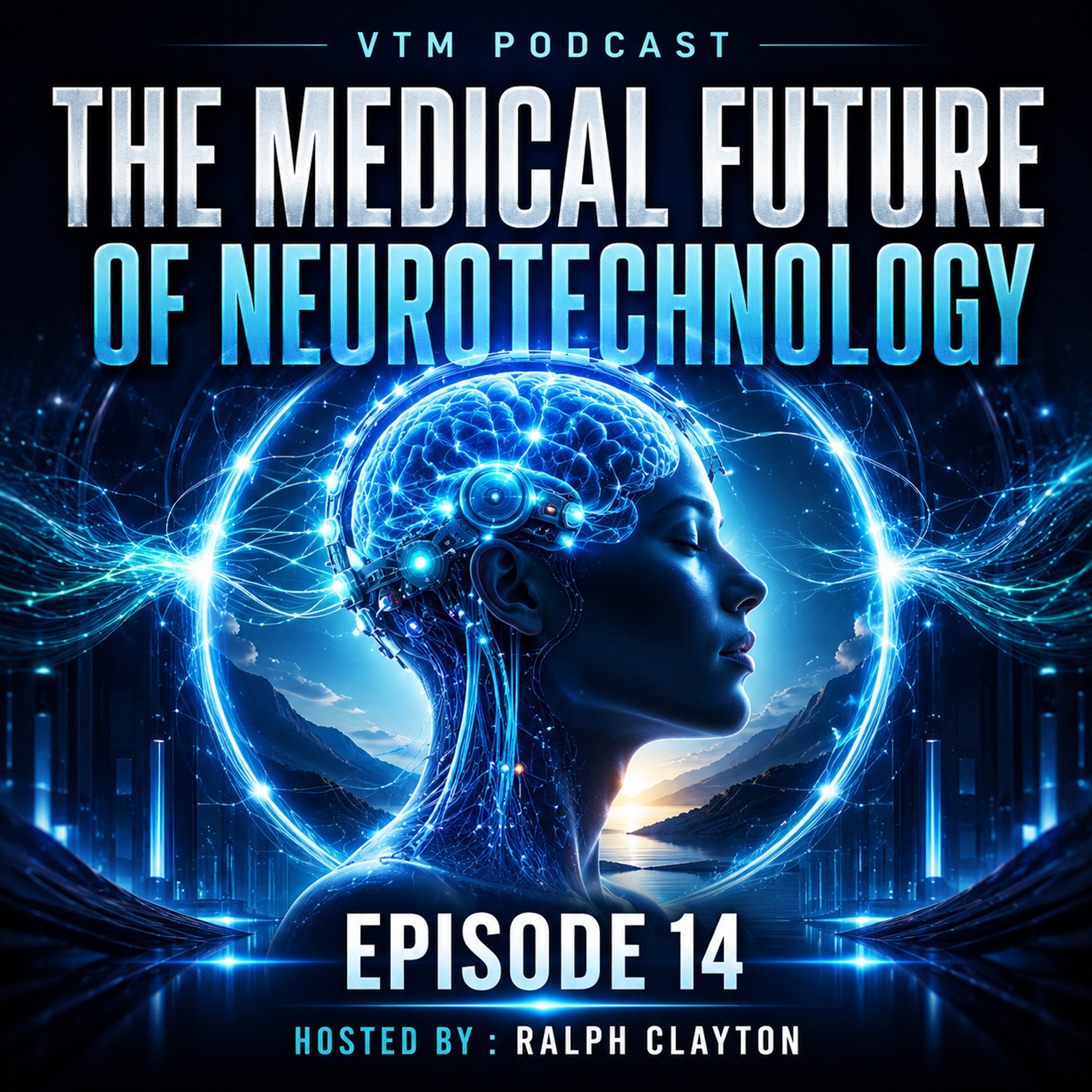
The VTM Podcast - Episode 14 - Neurotechnology and A.I.
from The VTM Podcast by Dr. Ralph Clayton · host Dr. Ralph Clayton
In this episode of VTM Podcast.Ralph Clayton explores one of the most misunderstood frontiers in modern science: neurotechnology. But this is not the science-fiction version of the story. This episode is not about mind uploading, digital immortality, or copying the human soul into a machine. It is about the quieter, more serious, and far more medically important future already taking shape in hospitals, rehabilitation labs, prosthetics clinics, neurosurgery units, and computational neuroscience.Episode 14 examines the real medical future of neurotechnology: brain-computer interfaces, closed-loop neurostimulation, neuroprosthetics, brain organoids, digital twins, neuromorphic twins, and AI-supported personalized treatment. These systems are not designed to replace the human brain. They are designed to listen to it, understand it, support it, and when possible, help repair broken loops in the nervous system.The central theme of the episode is restoration, not escape.Ralph breaks down how brain-computer interfaces can create new pathways between neural intention and external action, helping people with paralysis, ALS, spinal cord injury, stroke damage, or locked-in syndrome regain forms of movement, communication, and interaction. He explains why the future of BCIs is moving beyond simple one-way decoding toward closed-loop systems that can read, interpret, act, measure the effect, and adapt in real time.The episode also explores the growing importance of closed-loop neurostimulation, where medical devices respond to the nervous system dynamically rather than delivering fixed stimulation blindly. These systems may help treat conditions such as Parkinson’s disease, epilepsy, tremor, chronic pain, depression, stroke recovery, and other neurological or psychiatric disorders by detecting abnormal neural patterns and responding only when needed.Ralph also examines the promise of modern neuroprosthetics: artificial limbs and assistive systems that do more than move mechanically. The next frontier is restoring meaningful sensory feedback, improving embodiment, and allowing prosthetic devices to become part of a person’s action system rather than remaining external tools.The episode then turns to digital twins and neuromorphic twins, explaining how patient-specific computational models may help clinicians simulate, personalize, and optimize treatment before or during intervention. These models are not copies of a person’s mind. They are practical medical tools that may help predict how stimulation interacts with nerves, how a prosthetic interface should be tuned, or how a patient’s unique nervous system may respond to therapy.Brain organoids are also discussed as powerful but ethically sensitive research models. Ralph explains why organoids are not tiny conscious brains or miniature people, but lab-grown structures that can help scientists study human neurodevelopment, disease mechanisms, drug responses, and neural tissue behavior in ways that animal models cannot always capture.Throughout the episode, Ralph challenges the public obsession with mind uploading and argues that the real lesson of modern neurotechnology is almost the opposite: the brain is not a file, the mind is not a simple program, and the person is not a dataset. The nervous system is living, embodied, adaptive, chemical, electrical, biological, and deeply individual.This episode also addresses the ethical and clinical stakes of the field. As neurotechnology becomes more adaptive and AI-driven, questions of agency, consent, explainability, cybersecurity, neural data ownership, device reliability, access, and patient control become central. A technology that interacts directly with movement, speech, sensation, mood, memory, or identity cannot be governed like ordinary consumer software.The future of neurotechnology will depend not only on what engineers can build, but on what medicine can justify.Rather than presenting neurotechnology as fantasy or fear, Episode 14 offers a grounded framework for understanding the field through five layers: sensing, decoding, modeling, intervention, and adaptation. The most powerful future systems will connect these layers into medical loops that can support real patients in real lives.The promise is not immortality in a server.It is a hand that moves.A voice that returns.A seizure that stops.A tremor that quiets.A body that learns again.And a patient who gains back one more piece of the world.For more from Ralph Clayton, explore the VTM book on Amazon: https://www.amazon.com/dp/B0GQBX5MYZAudiobookhttps://www.audible.com/pd/B0H2KCQ99YYou can also visit Ralph’s official website here: https://ralphclayton.uk/Also you can support the show and get some merch!https://the-eterra-cycle-shop.fourthwall.com/
Embed this episode
What this episode covers
**(Here is a short Apple Podcasts description:)** VTM Podcast explores the medical future of neurotechnology beyond the hype of mind uploading. Ralph Clayton breaks down brain-computer interfaces, closed-loop neurostimulation, neuroprosthetics, digital twins, brain organoids, and AI-driven treatment as tools for restoring movement, speech, sensation, stability, and human agency.
NOW PLAYING
The VTM Podcast - Episode 14 - Neurotechnology and A.I.
No transcript for this episode yet
Similar Episodes
No similar episodes found.
Similar Podcasts
No similar podcasts found.