
EPISODE · Jun 10, 2026 · 48 MIN
The VTM Podcast - Episode 16 - De-extinction and gene resurrection tech.
from The VTM Podcast by Dr. Ralph Clayton · host Dr. Ralph Clayton
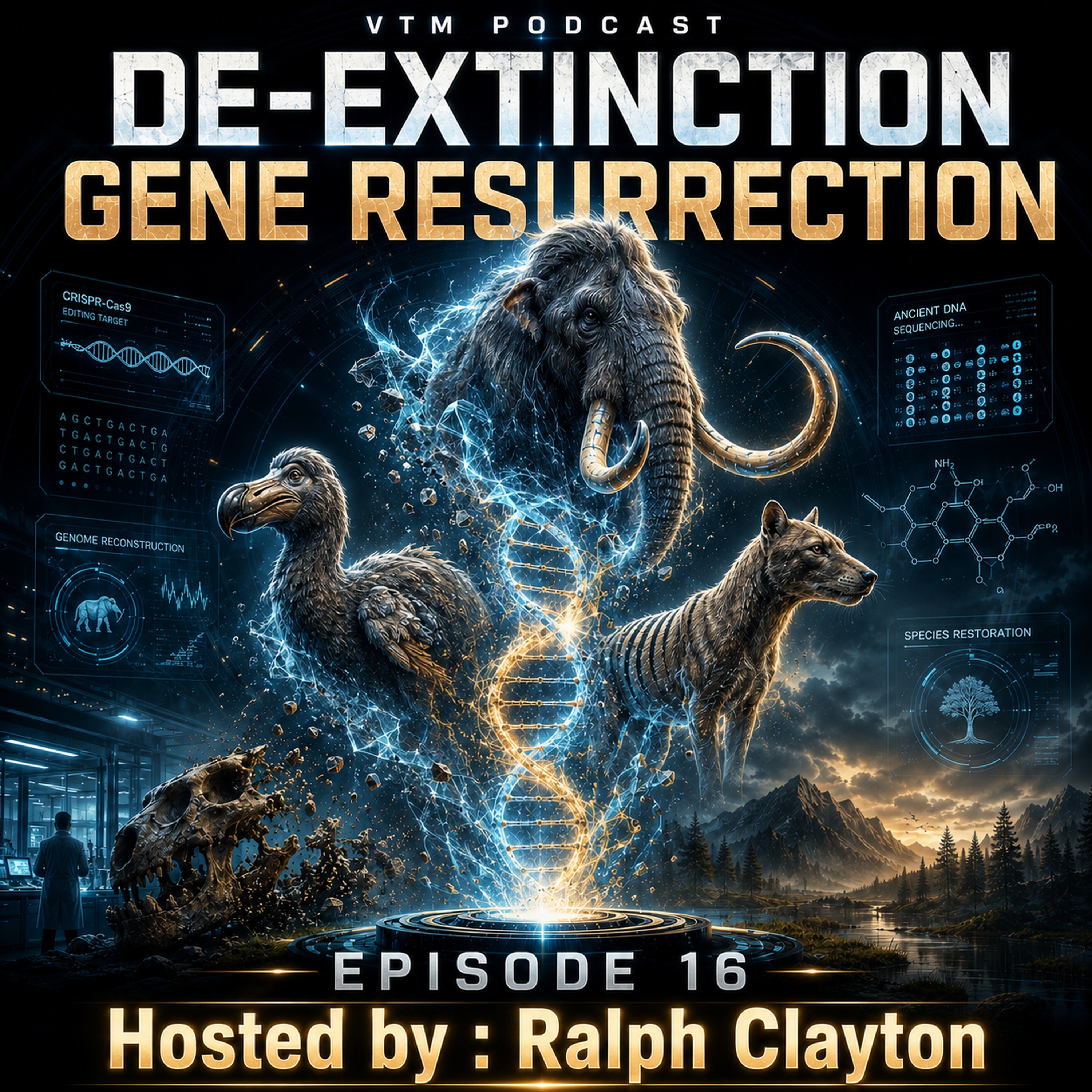
In this episode of VTM Podcast.Ralph Clayton explores one of the most fascinating and morally complicated frontiers in modern biology: de-extinction and gene resurrection.For most of human history, extinction meant finality. When the last member of a species died, that lineage disappeared from the living world forever. The bones might remain. The stories might remain. The museum specimens might remain. But the living creature was gone, and no human hand could open that door again.Now, in 2026, that certainty is being tested.Ancient DNA is being recovered from bones, teeth, feathers, hair, ice, caves, sediments, museum collections, and fragments of vanished life. Extinct genomes are being reconstructed. Living relatives are being compared with lost ancestors. Gene-editing tools are becoming sharper. Synthetic biology is becoming more ambitious. And a new scientific frontier has moved from speculation into serious debate: the possibility of recovering lost traits, reviving vanished biology, helping endangered species, and perhaps one day creating living animals that resemble species the Earth has already lost.But this is not Jurassic Park. There are no perfect dinosaurs waiting inside amber. There is no simple cloning chamber that reverses death. There is no button that brings back the mammoth, the dodo, the thylacine, or the passenger pigeon exactly as they once were.The real science is more difficult, more limited, and more interesting.Ralph breaks down the difference between true resurrection and biological reconstruction. A mammoth-like elephant would not be the same thing as a Pleistocene mammoth. A bird engineered with dodo-like traits would not simply be the original dodo returned from extinction. A wolf edited to express ancient traits would raise the question of whether we have restored a lost species or created a modern proxy carrying fragments of extinct biology.This episode asks the central question at the heart of de-extinction: what does it actually mean to bring something back?The discussion moves through the major icons of de-extinction: the woolly mammoth, preserved in permafrost and genetically close to living elephants; the dodo, whose recovery would require solving difficult problems in bird reproductive biology; and the thylacine, the Tasmanian tiger, whose recent extinction still carries the emotional weight of human guilt, photography, film, and memory.But Episode 16 also goes beyond headline species. Ralph explains why gene resurrection may become more important than spectacle. Scientists may not need to recreate entire animals to recover lost biological value. Ancient genes, proteins, immune traits, enzymes, and adaptations may help researchers understand evolution, disease resistance, climate resilience, metabolism, and conservation biology. In this sense, the dead may return not as animals, but as knowledge.The episode also explores one of the most practical uses of this science: genetic rescue. Many endangered species are not extinct yet, but their populations have become genetically narrow. Museum specimens and older remains may preserve lost diversity from before population collapse. If scientists can safely identify and reintroduce useful variants, gene resurrection could help living species survive instead of merely trying to rebuild lost ones.That may be the moral center of the field: not bringing back ghosts, but defending the living before they become ghosts.Ralph also confronts the ethical dangers. De-extinction could become a distraction from conservation. It could make the public believe extinction is reversible, when in reality a proxy animal cannot restore the original population, the lost generations, the old ecosystem, or the wild world that shaped the species. It could turn living experimental animals into symbols, products, or proof-of-concept organisms before their welfare is fully protected.A creature created through de-extinction would still be a living being. It could suffer. It could fail to thrive. It could be isolated, exploited, displayed, or misunderstood. That means animal welfare, ecological humility, public honesty, Indigenous and local community involvement, and long-term monitoring must be central from the beginning.Episode 16 also examines the ecological question: even if science can create a proxy species, where should it live? The world that formed the mammoth, the thylacine, or the passenger pigeon is not the same world we inhabit now. Climate has changed. Habitats have changed. Disease landscapes have changed. Human land use has changed. Ecosystems are not museum rooms where extinct creatures can simply be placed back on display. They are living networks, and networks answer back.The episode argues for a mature view of de-extinction: ambitious, but not arrogant; hopeful, but not gullible; scientifically bold, but morally restrained. Some doors should remain closed, especially when it comes to extinct human relatives such as Neanderthals. Science is not weakened by restraint. It is made more civilized.At its deepest level, this episode is about responsibility. The same species that caused so many extinctions is now developing tools to reach backward into the genetic ruins. That power can become repair, or it can become another form of domination. The old mistake was thinking nature was ours to consume. The new mistake would be thinking nature is ours to rebuild however we please.VTM Podcast Episode 16 is a serious, cinematic, and morally charged exploration of ancient DNA, synthetic biology, conservation genomics, extinct species, proxy organisms, animal welfare, and the uneasy frontier between grief, guilt, hope, and ambition.The future is not saved by bringing back ghosts.It is saved by refusing to create themFor more from Ralph Clayton, explore the VTM book on Amazon: https://www.amazon.com/dp/B0GQBX5MYZAudiobookhttps://www.audible.com/pd/B0H2KCQ99YYou can also visit Ralph’s official website here: https://ralphclayton.uk/Also you can support the show and get some merch!https://the-eterra-cycle-shop.fourthwall.com/
Embed this episode
What this episode covers
In this episode of VTM Podcast, Ralph Clayton explores one of the most fascinating and morally complicated frontiers in modern biology: de-extinction and gene resurrection. For most of human history, extinction meant finality. When the last member of a species died, that lineage disappeared from the living world forever. The bones might remain. The stories might remain. The museum specimens might remain. But the living creature was gone, and no human hand could open that door again. Now, in 2026, that certainty is being tested.
NOW PLAYING
The VTM Podcast - Episode 16 - De-extinction and gene resurrection tech.
No transcript for this episode yet
Similar Episodes
No similar episodes found.
Similar Podcasts
No similar podcasts found.