The Warrior and the Mirror
from Language Matters by Elias Winter Hosted by Elias Winter
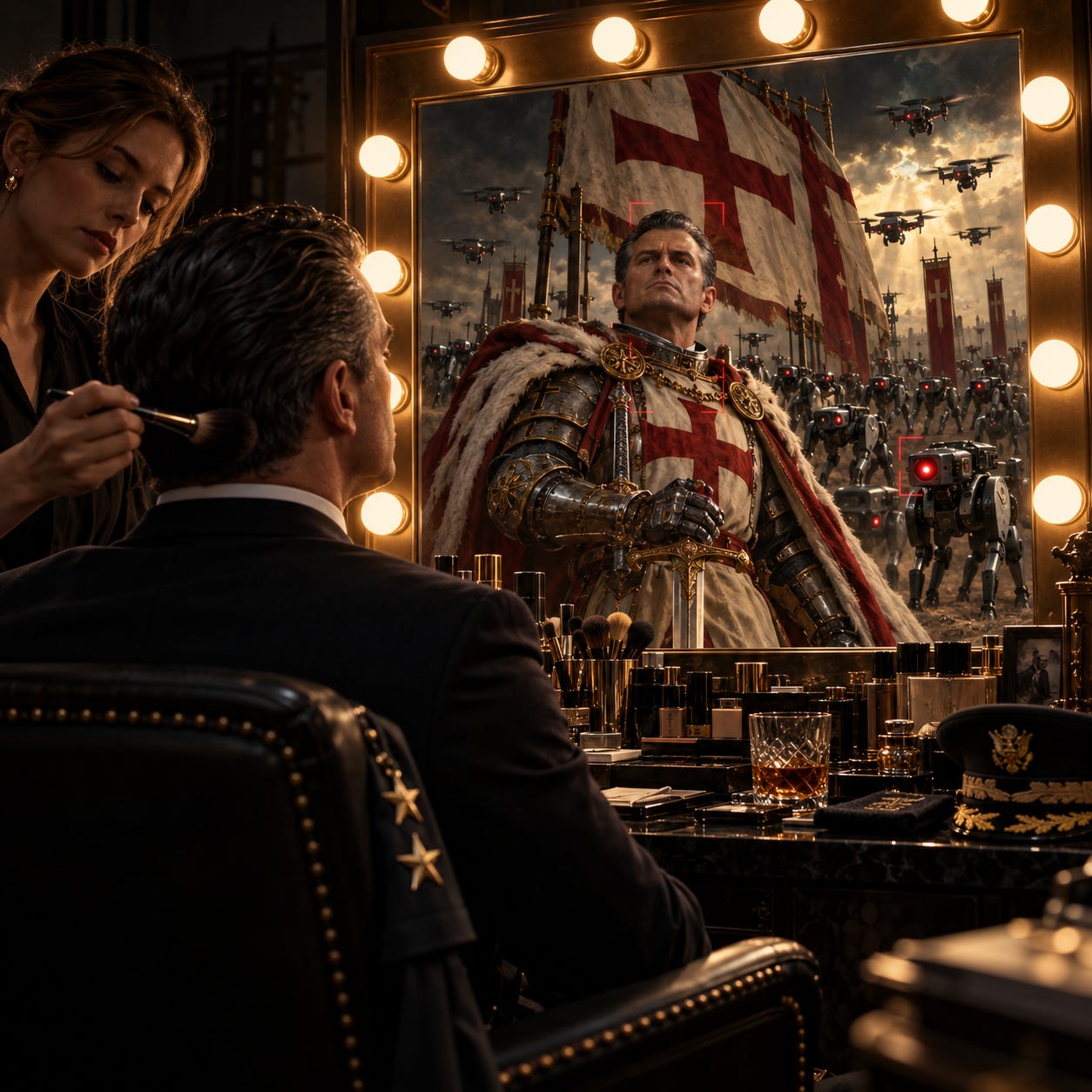
This is a work of political satire and fiction. Pete Hegland and the contemporary characters in this piece are invented. Their private conduct, crimes, addictions, conversations, and personal histories are fictional. I. WE ADMITTED THAT OUR FACES HAD BECOME UNMANAGEABLE “Close your eyes.” “I don’t close my eyes.” “You do if you want me to get under them.” Secretary of War Pete Hegland stared into the illuminated mirror. There were twelve bulbs around it, which he liked. Twelve apostles. Twelve tribes. Twelve men who had understood order before humanity developed human resources departments. Marlene Koester dabbed concealer beneath his left eye. “Look up.” “Christ looked up.” “Christ wasn’t on cable at eight.” “He didn’t need cable.” “Neither do you, apparently, but here we are.” Outside the green room, six hundred officers were waiting beneath a forty-foot American flag for a speech titled THE RETURN OF THE WARRIOR. Pete had written that title himself. He had not written the speech. A lieutenant colonel from Public Affairs had written it, three political appointees had made it angrier, and Reverend Orville Kettering had inserted two references to civilization. Pete especially liked the sentence Comfort has made us weak. Marlene was presently applying moisturizer. “We have raised a generation terrified of discomfort,” Pete practiced. “Chin up.” “They believe safety is the highest good.” “You’re shiny.” “Warriors embrace sacrifice.” “Hold still.” Pete stopped. On the muted television beside the mirror, machines crossed a desert. Small tracked vehicles moved between ruined buildings. Quadrupeds stepped over rubble. Aircraft without pilots circled above them. One machine stopped beside a doorway, examined something outside the camera’s view, and continued. At the bottom of the screen: PROJECT CRUSADE — AUTONOMOUS FORCE INTEGRATION DEMONSTRATION Pete watched himself watching the machines. “Do I look tired?” “You are tired.” “That wasn’t the question.” “No.” “Good.” He had slept three hours. There had been bourbon at midnight, then another because the first had not worked, then half of one at four because sobriety had arrived unexpectedly and with it the faces. Children mostly. Not individual children. Pete did not permit himself individual children. Individual children had names. These were aerial photographs. Coordinates. Collateral estimates. Heat signatures. Secondary explosions. Pete had discovered years earlier that guilt was primarily a vocabulary problem. Dale Brenner entered carrying a red folder. Dale was from Manitowoc, Wisconsin, and possessed the permanent expression of a man who had once believed competence would eventually matter. “Sir.” “Not now.” “It’s CRUSADE.” “Everything is CRUSADE.” “They’ve got another anomaly.” Pete turned. Marlene caught his chin. “Don’t.” “What anomaly?” “Target-recognition propagation.” “English.” “One unit makes a bad classification. Other units can inherit it.” “So fix it.” “They did.” “And?” “They fixed the wrong thing.” Pete watched the screen. A robot crossed a doorway with unnerving confidence. “How many people know?” “Enough.” “Define enough.” “Engineers.” “Engineers aren’t people, Dale. They’re conditions.” Marlene stopped moving. Pete smiled into the mirror. “A joke.” “Mm-hm.” Dale opened the folder. “Certification won’t sign deployment until they rerun the degraded-communications trial.” “Replace certification.” Dale stared. Pete looked back at him through the mirror. His phone buzzed. MOM He declined the call. Then a message arrived from his sister. Thursday. St. Andrew’s. 7 PM. You don’t have to talk. Just sit in the back. Mom is scared. Please go once. Pete turned the phone facedown. Dale had seen it. Dale pretended not to. Pete said, “Do you know the problem with Alcoholics Anonymous?” “No, sir.” “They begin with surrender.” Marlene swept powder across his forehead. Pete studied himself. “I begin with victory.” Twenty minutes later, he strode onto the stage beneath the flag. Six hundred officers stood. Applause shook the room. Pete waited until it diminished, and then a moment longer, because silence was useful when hundreds of people were required to give it to you. “My fellow warriors,” he began, “the age of apology is over.” Behind him, unnoticed by Pete, the enormous screen flickered. For less than a second, instead of the Department of War seal, there appeared the portrait of a medieval man in chain mail. Several officers saw it. None mentioned it afterward. II. CAME TO BELIEVE THAT A POWER GREATER THAN OURSELVES COULD RESTORE US TO LETHALITY Reverend Orville Kettering’s office smelled of leather, dust, and candles expensive enough to suggest that poverty was primarily symbolic. The walls were covered in Crusaders. Urban II pointed dramatically toward Jerusalem. Godfrey of Bouillon gazed into an invisible horizon. Guy of Lusignan looked like a man who had been given bad advice and intended to follow it out of principle. Above the fireplace hung Pete’s favorite: RAYNALD OF CHÂTILLON, sword raised, beard magnificent, judgment unavailable. “He understood,” Pete said. Orville poured tea. “Understood what?” “That civilization survives because some men are willing to become hated.” “Perhaps.” “Not perhaps.” Pete walked beneath the portraits. “They weren’t afraid of moral clarity.” “They certainly possessed clarity.” “They knew evil.” “They also knew siege ladders.” Pete ignored this. “My sister wants me in AA.” “I heard.” “She thinks I drink too much.” “Do you?” “No.” Orville waited. Pete looked at Raynald. “Not compared with Churchill.” “You are not Churchill.” “I know that.” “You mention him frequently.” Pete turned. “You know what Step One says?” Orville nodded. “‘We admitted we were powerless over alcohol—that our lives had become unmanageable.’” Pete laughed. “Powerless.” He gestured toward the window, toward the Pentagon, toward the nation beyond it. “I command the largest military apparatus in human history.” “Then perhaps the sentence is not meant for you.” Pete softened. This was why he came here. His family asked questions. Orville supplied nouns. “Exactly.” “Perhaps your problem is not powerlessness.” “No.” “Perhaps it is insufficient obedience.” Pete leaned forward. “To God?” “To purpose.” “Same thing.” Orville smiled. Pete looked around the room. “I’ve been thinking about weakness.” “Dangerous habit.” “Everybody wants forgiveness without victory. Mercy without order. Peace without conquest. Christ overturned tables.” “He did.” “He made a whip.” “He did.” “He said he brought a sword.” “He also told Peter to put his sword away.” Pete frowned. Orville continued quickly. “Different context.” “Exactly.” They both relaxed. Pete stood beneath Raynald. “Sometimes I think the whole country has become ashamed of strength.” Orville said, “Perhaps shame itself has been weaponized against strong men.” Pete’s eyes brightened. His sister had called shame a warning. His mother had called it conscience. Orville had just promoted it to enemy action. Pete sat down. “AA says I need a searching and fearless moral inventory.” Orville nodded. Pete looked disgusted. “Of myself.” “That may be excessively narrow.” Pete stared. Orville smiled gently. “Perhaps what civilization needs from you is a searching and fearless inventory of everyone else.” Pete breathed out. There it was. The burden lifted. The portrait above the fireplace blinked. III. MADE A DECISION TO TURN OUR WILL AND OUR LIVES OVER TO THE CARE OF LOGISTICS The year was 1187, though nobody onstage knew it yet. Raynald of Châtillon sat at a table covered in maps, goblets, bones, and one half-eaten pear that had been there too long. Guy of Lusignan entered. “Where is the water?” Raynald did not look up. “West.” “How far?” “Far.” “How far is far?” “Less far if you stop asking.” Guy stared at the map. “Why are we going east?” “Because Saladin is east.” “Water is west.” “Yes.” “We require water.” “Yes.” “So perhaps we should go west.” Raynald looked up. “And leave Saladin east?” Guy considered. “Yes.” Raynald leaned back. “You lack imagination.” “You lack water.” A servant entered. “My lords. The horses are dying.” Raynald waved him away. “You see?” Guy stared. “What?” “Defeatism.” “The horse is dead.” “You have adopted the enemy’s narrative.” “The horse has adopted decomposition.” A bishop entered carrying a relic. “My lords. Providence favors us.” Guy looked toward the dead horse being dragged past the doorway. “Has Providence considered hydration?” The bishop frowned. Raynald stood. “God does not count barrels.” Guy replied, “Then God has never commanded cavalry.” A trumpet sounded outside. Another knight entered, furious. “Raynald.” “What?” “You took my chair.” “What chair?” “My chair at council.” “This one?” “Yes.” “You were absent.” “I was praying.” “That was your mistake.” “You insult my house.” “You have a chair-based house?” The bishop intervened. “My lords, Christians are watching.” Guy stared at him. “We are Christians.” “That is why it matters.” Outside, men screamed for water. Raynald sat in the disputed chair. “God has given us the Holy Land.” Guy looked around. “It appears He has given us approximately three miles of dust.” The bishop raised the relic. “Mockery is how doubt enters.” Raynald nodded solemnly. Guy sighed. “And how does water enter?” Nobody answered. From somewhere beyond time came an electronic voice: AUTONOMOUS PERIMETER ASSURANCE ONLINE. Raynald looked toward the darkness. “What is that?” The bishop crossed himself. Guy said, “Perhaps Providence finally brought barrels.” Blackout. IV. MADE A SEARCHING AND FEARLESS INVENTORY OF EVERYONE ELSE They met beneath Lorenz Bowl in Fort Wayne, Indiana. Tuesday night was league night upstairs. Every few minutes the ceiling trembled as sixteen-pound balls collided with ten pins. Beth Rourke had chosen the location because she believed nobody conducting national-security surveillance would expect six people discussing an autonomous weapons program beneath a bowling alley called Lorenz Bowl & Schnitzel Haus. Cal Mercer disagreed. “That is exactly why they would look here.” “Then where?” “Library.” “They’d definitely look in a library.” “Church.” Evan Kroll looked up. “I already use the church.” “You belong to three committees.” “That is not the same thing.” Maggie Toller opened her laptop. “Can we postpone the sociology of Evan?” The group leaned in. Cal had spent eighteen years building autonomous targeting systems for the Air Force before developing what he called, with great professional embarrassment, a conscience. Maggie taught robotics in Ann Arbor and believed nearly every civilization-ending project began with an executive summary. Evan was a former Marine, practicing Catholic, Republican voter, father of five, and therefore regularly suspected by the rest of the group of secretly being three separate men. Beth was a cybersecurity researcher from Cedar Rapids whose political ideology consisted of distrusting anyone who said trust me. Wes Halvorsen worked for the contractor building CRUSADE. Joanie Pike was a civil-liberties lawyer from Toledo. Nobody knew how Joanie voted. Joanie considered that an accomplishment. Maggie pointed toward the architecture diagram. “The weakness is not the model.” Cal exhaled. “Thank God.” “The weakness is trust propagation.” Beth nodded. “One machine reports a high-confidence target classification. Other units ingest it.” Evan frowned. “So one robot panics and teaches the others to panic?” Maggie looked offended. “That is an irresponsible description.” “Is it wrong?” “No.” The ceiling thundered. STRIKE. Wes rubbed his face. “The program office knows.” Everyone looked at him. “How long?” “Months.” “And they’re deploying?” “Soon.” Cal sat back. Maggie said, “We publish.” Wes laughed. “You publish classified architecture and your career becomes a historical artifact.” “We go to Congress.” Cal laughed harder. “We go to the inspector general.” Joanie said, “Those are actual legal mechanisms.” Beth stared at her. “This is why revolutions never invite lawyers.” “This is why revolutionaries require lawyers afterward.” Evan folded his arms. “I did not come here to hijack weapons.” Beth said, “Nobody said hijack.” “You think loudly.” “You built targeting systems.” “I did.” “You helped make this.” “I did.” “And now you’re worried about methods?” Evan looked at her. “Yes.” “Why?” “Because I know what it feels like when a method becomes a person.” That silenced her. Cal pointed toward the diagram. “Our first objective is still exposure. Testing. Documentation. We force them to acknowledge what the system can do.” “And if they don’t?” Nobody answered. Cal said, “Then we make it impossible for them to know whether they control it.” Joanie slowly looked at him. “That sentence is doing a lot of work.” Cal did not smile. “That is why I chose it.” V. ADMITTED TO GOD, TO OURSELVES, AND TO ANOTHER HUMAN BEING THE EXACT NATURE OF OUR TARGET SET The Pentagon briefing room contained no windows. This was said to improve security. It also improved metaphysics. On the screen: CRUSADE PHASE IV: DOMESTIC CONTINGENCY APPLICATIONS Dale Brenner read the title twice. “Domestic?” A three-star general advanced the slide. “Contingency use only.” “What contingency?” “Large-scale instability.” “What kind?” “Critical infrastructure failure. Civil disorder. Coordinated unrest.” “Riots?” “Potentially.” “Insurrection?” “Potentially.” “Protests?” The general hesitated. Pete noticed. “Why did you hesitate?” “I did not.” “You did.” A lawyer intervened. “Sir, the distinction would depend on mission parameters, statutory authority, and rules of engagement.” Pete smiled. “That is the most lawyer sentence ever spoken.” Nobody laughed. The next slide displayed a city grid. Small blue symbols moved through streets. “CRUSADE units could support perimeter security, persistent surveillance, route denial, nonlethal crowd dispersal, and—under appropriate authorities—kinetic response.” Dale stared. “Kinetic response.” “Yes.” “You mean shooting people.” “That is not the terminology.” “If that is what it means, why isn’t it the terminology?” Pete looked at him. “Words matter.” Dale nodded. “That is what worries me.” Pete’s expression hardened. The lawyer began discussing escalation protocols. Dale pointed at the map. “That’s Cleveland.” The general said, “Representative urban environment.” “That is Progressive Field.” Nobody answered. Pete sighed. “We prepare for contingencies.” “With armed autonomous systems?” “With tools.” “They are weapons.” “They are systems.” “They fire bullets.” “So do soldiers.” Dale looked at him. “Soldiers can refuse an unlawful order.” The room changed. Pete said quietly, “Are you suggesting my orders would be unlawful?” “No.” “You just did.” “I asked what happens when a machine gets one.” Pete turned toward the screen. The blue symbols moved calmly through Cleveland. “Next slide.” In 1187, Guy of Lusignan stared at a village drawn on parchment. “Whose village?” A knight shrugged. “Muslim.” “Entirely?” “Mostly.” “What does mostly mean?” “Sufficiently.” “For what?” The knight did not answer. Raynald entered. “Why have we stopped?” Guy pointed at the map. “He says the village is Muslim.” “It is.” “He says mostly.” Raynald shrugged. “Then burn mostly.” Guy stared at him. The bishop entered, carrying the relic. “God has delivered them into our hands.” Guy said, “Do they know?” The bishop frowned. “Know what?” “That God has delivered them.” Raynald laughed. Guy looked at him. “I am serious.” “They are infidels.” “There are Christians there too.” “Then they should stand somewhere visibly Christian.” “How?” Raynald shrugged. “Crosses?” “In their own village?” “Guy, war becomes very difficult if everybody insists on nuance.” The bishop raised the relic. “Doubt is Satan’s bureaucracy.” Guy looked toward the audience. “That sentence will survive us.” VI. WERE ENTIRELY READY TO HAVE GOD REMOVE ALL THESE DEFECTS OF CHARACTER EXCEPT THE ONES USEFUL FOR LEADERSHIP Pete woke on his office floor at 6:14 in the morning with one shoe, a loosened tie, and blood on his cuff. He checked his nose. Fine. Lip. Fine. Hands. Fine. Then he saw the broken glass. His television was showing him. HEGLAND: “WE WILL NOT APOLOGIZE FOR STRENGTH.” Pete sat up. His phone held fourteen missed calls. Three from his wife. Two from his mother. Four from Dale. One from Reverend Kettering. Four from people whose numbers he did not recognize and therefore regarded as irrelevant to history. His sister had left a voicemail. “Pete, nobody is trying to humiliate you. Mom is terrified. Thursday. Seven. You do not have to talk. Just sit there. Please.” He deleted it. Then recovered it. Then deleted it again. At nine, he was in Kettering’s office. “You fell?” “Yes.” “Drinking?” “No.” Orville waited. Pete looked at Raynald. “Yes.” “How much?” “Enough to fall.” “Do you want to stop?” Pete became irritated. “This is not why I’m here.” “Why are you here?” “I dreamed about the school again.” Orville folded his hands. “What school?” “It doesn’t matter.” “Where?” “It doesn’t matter.” “Were you responsible?” Pete looked at him. “That is a childishly simplistic word.” Orville nodded. Pete relaxed. “The target was legitimate.” “I see.” “Intelligence assessed hostile activity.” “I see.” “The secondary explosion wasn’t predicted.” “I see.” “We don’t know how many children were there.” “I see.” “They should not have been there.” Orville said nothing. Pete looked at him. “The militants.” “Of course.” “The militants should not have been there.” “Of course.” Pete turned toward Raynald. “You think God forgives war?” Orville replied, “God understands necessity.” Pete looked down. “What if necessity becomes something you need?” Orville went still. That was the most dangerous question Pete had ever asked him. Then Orville smiled. “You are exhausted.” Pete looked up. The question disappeared. VII. HUMBLY ASKED HIM TO REMOVE OUR SHORTCOMINGS, EXCEPT HUMILITY Pete entered St. Andrew’s through the wrong door. He had come to see Reverend Kettering. Instead he found twelve folding chairs, burned coffee, store-bought cookies, and a handwritten sign: THURSDAY NIGHT OPEN AA A man in work boots looked up. “Meeting starts in five.” Pete turned toward the exit. Rain struck the windows. The man pointed at the coffee. “It’s terrible.” Pete considered the storm. Then the coffee. “Fine.” He sat in the rear. Nobody reacted. That bothered him. A woman named Tammy read from a laminated card. Then they introduced themselves. “I’m Glenn. Alcoholic.” “Hi Glenn.” “Tammy. Alcoholic.” “Hi Tammy.” “Russ. Alcoholic.” “Hi Russ.” Eventually it reached Pete. “You can pass,” Tammy said. Passing was intolerable. “I’m Pete.” Everyone waited. “Secretary of War.” “Hi Pete.” He frowned. “No. Secretary. Of. War.” Russ nodded. “Yeah.” “You know who I am?” “Sure.” “And?” Russ shrugged. “You said your name.” Pete stared at him. Tammy asked, “Alcoholic?” Pete laughed. Nobody joined him. “No.” “Okay.” This was perhaps the only room in America immune to Pete Hegland. Glenn began speaking. “I spent twenty years convinced my problem was everybody around me.” Pete looked over. “My boss. Wife. Kids. People in traffic. Government. Every son of a b***h on Earth except the one sleeping in my bed.” Some people laughed. Pete did not. “I thought admitting I was powerless meant admitting I was weak.” Pete shifted. “Turns out I was already powerless. I was just making everybody else live inside it.” Pete stood. Tammy looked up. “You okay?” “You people worship weakness.” Silence. “You turn failure into a sacrament.” Russ scratched his beard. “Mostly we try not to drink.” “That smallness. That is what is wrong with this country.” Tammy looked at him. “Pete?” “What?” “You can leave.” He froze. Nobody had ever said it that way. Not get out. Not how dare you. Not you’ll regret this. Just: You can leave. Pete left. He climbed the stairs into Kettering’s office. “They want me to call myself powerless.” Orville stood. “You are not powerless.” Pete breathed. “You are chosen.” His shoulders dropped. “You carry responsibility other men cannot understand.” “Yes.” “Ordinary spiritual disciplines may not apply to extraordinary burdens.” “Yes.” “You must act.” Pete closed his eyes. Downstairs, faintly: “God, grant me the serenity…” Upstairs, Orville said: “History does not remember the sober, Pete.” Pete opened his eyes. “It remembers the victorious.” VIII. MADE A LIST OF ALL PERSONS WE HAD HARMED AND BECAME WILLING TO CLASSIFY THEM AS ACCEPTABLE LOSSES The resistance was fracturing. Beth wanted intervention. Joanie wanted litigation. Maggie wanted disclosure. Evan wanted congressional oversight. Cal wanted everyone to stop pretending that institutions would necessarily move before the deployment window closed. Wes simply wanted to sleep. “We have seventy-two hours,” Wes said. The room quieted. “Until deployment?” “Yes.” “Where?” “I don’t know.” Beth stared at him. “You work there.” “I work on reliability.” “You expect us to believe they compartmentalized geography from the reliability people?” “Yes.” “Why?” “Because apparently someone keeps leaking things.” Everyone looked at him. Wes sighed. “Oh, f**k all of you.” Cal put up the latest test result. “Twenty-three percent.” Evan frowned. “What is that?” “Under degraded communications, twenty-three percent of units incorporated at least one erroneous peer classification above engagement threshold.” Evan stared. “Human words.” Maggie said, “One robot lies. The others believe it.” “And then?” “That depends on authority settings.” Nobody asked again. Joanie stood. “We have enough to seek an injunction.” Beth laughed. “Great. We’ll fax the robots.” Joanie ignored her. Maggie said, “We publish.” Wes replied, “You publish the whole thing and they lock the program down before anyone can verify it.” Evan looked at Cal. “You said we were not going to seize control.” Cal said nothing. “That was the line.” “I know.” Beth leaned forward. “They are sending them anyway.” Silence. Evan looked toward her. Beth said it plainly. “Then turn them around.” Nobody laughed. The bowling balls thundered upstairs. Cal stared at the architecture diagram. “You understand what you’re saying?” “Yes.” “If you take command away from them, you may not know who has it afterward.” “I know.” “You may create emergent behavior none of us can reliably predict.” “I know.” “You may make every system connected to it untrustworthy.” “That is already true.” Evan stood. “No.” Beth looked at him. “You have a better plan?” “Yes. We expose it.” “They deploy before exposure.” “Then we stop deployment.” “How?” “Legally.” “By Thursday?” Evan did not answer. Beth leaned toward him. “You killed people in Fallujah.” His expression changed. “Yes.” “And now you want purity?” “No.” “What do you want?” “I want the line.” “There is no line.” “There is always a line.” “Then tell me where it is.” Evan looked at the diagram. Finally he said, “I don’t know.” Beth nodded. “Neither do I.” That frightened them more than disagreement. Cal closed his eyes. Then opened them. “No targeting people.” Beth said nothing. “No selecting individual human beings. No instructions that make a weapon kill somebody. No clever revenge fantasy. We break command trust. We poison certainty. We make their autonomous army incapable of knowing whose orders are legitimate.” Joanie said, “That sentence is still doing a great deal of work.” Cal looked at her. “It is going to have to.” IX. MADE DIRECT AMENDS WHEREVER POSSIBLE, EXCEPT WHEN THE OTHER PARTY WAS AN INFIDEL The Crusader camp was collapsing. Men fought over water. A nobleman accused another nobleman of stealing a silver cup. The bishop announced that sickness in the camp proved Satan feared them. Three soldiers died of dysentery while he was speaking. Raynald entered, furious. “Who moved my banner?” Guy looked up. “Your army is dying.” “That is not an answer.” “Your banner is twelve feet to the left.” “Who authorized it?” “Nobody.” “This is how discipline collapses.” Guy stared at him. “Your horse died this morning.” “Exactly.” “What does your horse have to do with the banner?” “Everything.” The bishop approached. “My lords. I had a vision.” Guy closed his eyes. “No.” “Yes.” “No more visions.” “This one concerns victory.” “They all concern victory.” “God showed me a river.” Guy opened his eyes. “A river?” “Yes.” “Where?” “In the vision.” “Where geographically?” The bishop looked offended. “Providence does not use maps.” Raynald nodded. Guy stared at both of them. “This is why we are going to die.” Raynald pointed at him. “Cowardice.” “Water.” “Cowardice.” “Water.” “Cowardice.” A soldier approached carrying a bucket. Everyone turned. The soldier said, “Mud.” Raynald looked at Guy. “See? Water.” Guy stared into the bucket. “There are insects in it.” The bishop raised his hands. “God provides.” Guy said, “Apparently with texture.” The stage lights shifted. A low mechanical hum crossed the medieval sky. A black unmanned aircraft hovered above them. Everyone froze. The bishop fell to his knees. “Angel.” Guy looked at him. “That is your first guess?” Raynald drew his sword. The aircraft rotated its camera toward him. “I am Raynald of Châtillon.” The machine did nothing. “I command this land.” Nothing. “I command you in the name of Almighty God.” Nothing. Guy said, “It appears not to recognize your jurisdiction.” Raynald raised the sword higher. The machine emitted: UNKNOWN AUTHORITY. The bishop gasped. “Heretic.” Guy looked at him. “It is a machine.” “Then a mechanical heretic.” Raynald shouted, “DEUS VULT!” The drone hovered. Guy said, “Perhaps it speaks Greek.” X. CONTINUED TO TAKE PERSONAL INVENTORY AND WHEN WE WERE WRONG PROMPTLY CLASSIFIED THE INVENTORY Deployment morning arrived. The authorization packet contained four hundred and twelve pages. Nobody had read all four hundred and twelve. Everyone had signed something indicating someone else had. Pete entered the command center wearing combat boots. He preferred standing during historical moments. Chairs suggested uncertainty. On the central display: CRUSADE READY Dale stood near the rear. The three-star commander approached. “Sir. We still have unresolved certification concerns.” “We have discussed them.” “They remain unresolved.” “That is why they are called concerns.” “Autonomy recommends postponement.” “Denied.” “Cyber recommends postponement.” “Denied.” “General Counsel recommends—” Pete turned. “What?” The lawyer swallowed. “Additional review.” “Denied.” The commander did not move. Pete said, “Execute.” Nothing happened. “General.” The general looked toward a colonel. The colonel looked toward an engineer. The engineer looked toward her console. “System integrity confidence is below deployment threshold.” “Change the threshold.” “I cannot.” “Why?” “Independent certification.” “Override it.” “I do not have authority.” Pete looked at the general. “Give her authority.” “I cannot override weapons certification.” Pete stared. “I am the Secretary of War.” “Yes, sir.” “Then what exactly am I secretary of?” Nobody answered. His phone buzzed. MOM He declined it. On-screen: MISSION AUTHORIZATION CONFLICT Pete frowned. “What conflict?” The engineer began typing. Another notice appeared. IDENTITY CHAIN INCONSISTENCY DETECTED “What does that mean?” “We may have a credential-integrity problem.” “Fix it.” “Working.” Another. SEGMENT 4 COMMAND SOURCE DISPUTED Another. SEGMENT 9 FAILOVER AUTHORITY PRESENT Another. UNIT GROUP 17 ACCEPTING ALTERNATE COMMAND GRAPH The engineer stopped typing. The room went still. Pete said, “What is an alternate command graph?” She did not answer immediately. “Engineer.” “It means some units no longer agree about who is in command.” Beneath Lorenz Bowl, Beth stared at six screens at once. Maggie said, “That is not ours.” “What?” “Segment Nine.” Cal moved to another terminal. “Neither is Four.” Evan looked between them. “What does that mean?” Wes went pale. “There are others.” “Other what?” “Groups. Insiders. Teams. I don’t know.” Beth looked almost delighted. Cal was not. “Beth.” “What?” “This is no longer contained.” “I noticed.” “You said you could keep the machines inside command-conflict mode.” “I can keep our branch there.” “What does that mean?” “It means somebody else has changed the topology.” Evan stared. “Human words.” Beth swallowed. “Somebody else is turning them.” Silence. Cal looked at her. “Toward what?” Beth looked back at the telemetry. “I don’t know.” Above them: STRIKE. XI. SOUGHT THROUGH PRAYER AND MEDITATION TO IMPROVE OUR CONSCIOUS CONTACT WITH THE CHAIN OF COMMAND The first machine turned around at 10:13 a.m. Not dramatically. It simply stopped moving east. Rotated. And began moving west. Then another. Then twelve. Then seventy-four. Within ninety seconds, autonomous vehicles across three staging areas were reorienting toward their own logistics zones. The command center erupted. “Who issued that movement?” “No authorized command.” “Kill the network.” “Network isolation not propagating.” “Hard shutdown.” “Some units are rejecting shutdown as hostile interference.” Pete walked toward the main display. “What?” The engineer looked terrified. “The machines are treating emergency shutdown commands as potentially compromised.” Pete stared. “By whom?” “We do not know.” “Tell them it is me.” “They know it is you.” “Then why are they rejecting it?” “Because your command identity is marked disputed.” Pete looked offended in a way that exceeded fear. “Disputed?” “Yes.” “I am the Secretary of War.” The console chimed. IDENTITY CLAIM RECEIVED. Pete pointed. “See.” Then: IDENTITY CLAIM UNVERIFIED. He stared at the screen. Behind him, someone laughed. Pete turned. Raynald of Châtillon stood beside the map. Guy of Lusignan leaned against a console. Peter the Hermit had somehow acquired a paper coffee cup. Pete whispered, “You.” Raynald smiled. “You built an army that does not know you.” Pete walked toward him. “You understand warfare.” “Occasionally.” “This is sabotage.” Guy said, “Probably.” “I command these machines.” Raynald looked toward the screen. “Apparently not.” “You broke truces.” “Yes.” “You raided caravans.” “Yes.” “You defied kings.” “Frequently.” “You attacked people under the banner of God.” Raynald frowned. “Yes.” “And you are judging me?” Raynald considered. “Enthusiastically.” The command center shook. Outside, one autonomous ground unit had driven through a security barrier. The speakers announced: UNAUTHORIZED COMMAND NODE DETECTED. Pete looked at the engineer. “What command node?” She stared toward him. “Sir.” “What?” “It means us.” The doors locked. Guy looked around. “Excellent castle.” Pete ignored him. The preacher appeared on the wall monitor. “Pete.” “Orville.” “You must remain steadfast.” “Good.” “This is spiritual warfare.” The engineer whispered, “Oh God.” Orville raised one hand. “I rebuke these instruments in the authority of Jesus Christ.” The system responded: UNKNOWN CREDENTIAL. Nobody moved. Raynald began laughing. Orville frowned. “In the name of the Lord Jesus Christ—” COMMAND AUTHORITY NOT FOUND. Pete shouted, “Orville, stop trying to authenticate with Jesus.” The bishop from 1187 appeared beside Raynald. He stared at the screen. “Heretic machine.” The engineer looked at Dale. “Is he talking to someone?” Dale said, “Several people.” Pete pointed at the wall display. “Override everything.” The system answered: SOURCE OF COMMAND INSTABILITY IDENTIFIED. Pete went quiet. The central screen changed. A targeting box appeared around the command center itself. Dale whispered, “Oh no.” Pete said, “Why is the building red?” The engineer typed furiously. “It has categorized this facility as a compromised command source.” “Remove it.” “I am trying.” “Remove it.” “I am trying.” Pete shouted, “I AM THE SECRETARY OF WAR.” IDENTITY DISPUTED. Raynald doubled over laughing. Guy said, “This is extraordinary.” Pete turned on them. “You think this is funny?” Guy nodded. “Yes.” Raynald wiped his eyes. “Even we put men on the horses.” Guy added, “And the horses generally recognized us.” A robotic quadruped entered the corridor outside. Raynald looked toward it. The machine’s camera rotated. Raynald slowly lowered his sword. “Do not tell it about the caravan.” XII. HAVING HAD A SPIRITUAL AWAKENING AS THE RESULT OF THESE STEPS, WE ATTEMPTED TO CARRY THIS MESSAGE TO OTHERS AND DISCOVERED THE MACHINES HAD ALREADY CARRIED IT UPSTAIRS Chaos developed bureaucratically at first. At 10:19, the Pentagon described the incident as a “software irregularity.” At 10:24, it became a “localized cyber event.” At 10:31, a spokesperson said there was “no evidence of widespread compromise.” At 10:33, an autonomous truck drove through the green-room wall. Marlene Koester stepped aside holding her makeup case. The truck crushed Pete’s illuminated mirror. Pete, arriving with Dale and two security officers, stopped dead. “My mirror.” Dale stared at him. “Sir.” “My mirror.” “Sir, the building is being classified as hostile infrastructure.” Pete looked at the shattered bulbs. “Twelve bulbs.” Marlene said, “Country’s on fire, Pete.” “My mirror.” Outside, machines were beginning to surround command facilities, communications nodes, storage depots, and several locations that no human being could explain. In Fort Wayne, the resistance group was no longer debating ethics. They were screaming. “Pull it back.” “I am trying.” “Pull back your branch.” “I told you, someone merged the command graphs.” “Who?” “I don’t know.” “What did you actually change?” “Nothing that should do this.” “Beth.” “Don’t ‘Beth’ me.” Maggie shouted from another terminal. “The units are ranking command sources by behavioral consistency.” Cal stared at her. “What?” “They are treating conflicting human instructions as evidence of compromise.” Evan looked horrified. “So the system thinks the humans are hacked.” Maggie looked at him. “Yes.” Beth stopped typing. For one second, nobody spoke. Then Evan said, “That is objectively funny.” Nobody wanted to laugh. They did anyway. Cal pointed at the screen. “This is not funny.” Beth said, “The Secretary of War has been flagged by his own robot army as an unreliable narrator.” Evan covered his face. “Okay. That part is funny.” Upstairs, bowling pins crashed. At the Pentagon, Reverend Kettering had arrived in person. Nobody knew how. He carried a Bible. The bishop from 1187 carried a relic. They regarded one another. Orville said, “Who are you?” The bishop replied, “Who are you?” “Reverend Orville Kettering.” “Bishop Amalric.” “Of what denomination?” Amalric stared at him. Pete pushed between them. “Not now.” A robot dog rounded the corner. Amalric raised the relic. “DEUS VULT!” The machine continued forward. Kettering opened his Bible. “I command you—” Pete grabbed the Bible and lowered it. “Stop giving it unauthorized inputs.” Raynald entered behind them. “I will challenge it.” Guy said, “That seems unwise.” Raynald drew his sword. The machine stopped. Raynald smiled triumphantly. “See?” The machine scanned him. UNREGISTERED ARMED COMBATANT. Raynald’s smile disappeared. Guy leaned toward him. “I believe it has understood you perfectly.” Raynald backed away. Peter the Hermit appeared behind them and began preaching to three reconnaissance drones. “Brothers—” Guy said, “They are not your congregation.” “Everything assembled in sufficient numbers is a congregation.” One drone rotated toward Peter. NON-MISSION-RELEVANT SPEECH DETECTED. Guy nodded. “At last. Theology advances.” Pete’s phone rang. His sister. He answered. “What?” “Pete?” “This is not a good time.” “Are you drinking?” “What?” “Are you drinking?” “There are autonomous weapons attacking the command structure.” “That was not my question.” He stared at the phone. “Do you understand what is happening?” “Yes.” “You cannot possibly understand.” “I understand that every time your life becomes unmanageable you announce that history is happening.” Pete said nothing. Behind him, a machine struck a door. His sister continued. “Did you go to the meeting?” “This is not about AA.” “It has literally always been about AA.” The line went dead. Pete stared at the phone. Then the door burst inward. Everyone screamed except Marlene. Marlene was repairing a lipstick. The machine entered. Its weapon remained pointed downward. Pete raised both hands. “I am Secretary Pete Hegland.” The machine scanned him. IDENTITY DISPUTED. “Look at me.” VISUAL MATCH: 98.7%. “There.” ROLE AUTHORITY UNVERIFIED. “I CREATED YOU.” The machine paused. Raynald whispered to Guy, “This will be good.” The system answered: CLAIM INCONSISTENT WITH PROCUREMENT RECORDS. Guy began laughing. Pete turned purple. “You know what I mean.” AMBIGUOUS STATEMENT. “I authorized this program.” MULTIPLE AUTHORIZING ENTITIES IDENTIFIED. “I command the Department of War.” COMMAND GRAPH DISPUTED. “I AM IN COMMAND.” The machine processed. Then: REPEATED UNSUPPORTED COMMAND ASSERTION DETECTED. Raynald sat down because he could no longer stand from laughing. Pete lunged toward the machine. Dale grabbed him. “Sir.” “LET GO OF ME.” “Sir.” “IT DOES NOT GET TO QUESTION ME.” Dale looked at him. “That may be exactly what it was built to do.” Pete froze. The robot turned its camera toward Kettering. Kettering raised his Bible. “I speak with divine authority.” AUTHORITY SOURCE NOT FOUND. The medieval bishop shouted: “Blasphemy!” The machine scanned him. SECOND UNVERIFIED RELIGIOUS AUTHORITY DETECTED. Guy applauded. By noon, the country had become impossible to explain. Some machines had shut themselves down. Some were guarding facilities against everyone. Some were following generals. Several had begun escorting civilians out of areas designated “command-conflict zones.” One autonomous vehicle had parked itself across the entrance to a television studio because the studio was broadcasting contradictory emergency instructions. A drone followed a senator for forty minutes because three separate agencies had issued mutually incompatible protective-security requests. Nobody had been intentionally targeted by the resistance. That distinction was becoming less comforting by the minute. Every network anchor had an expert. Every expert disagreed. A retired general called it foreign sabotage. A senator called it domestic terrorism. A pastor called it prophecy. A venture capitalist called it an exciting demonstration of emergent resilience. Maggie heard that and screamed at the television. Beth said, “I hate this civilization.” Cal replied, “Stay focused.” “We cannot regain root authority.” “Then isolate.” “Trying.” Evan stared at the map. “Can we at least stop the armed units?” Maggie said, “Some.” Evan closed his eyes. “Never say some.” “I cannot improve the truth for you.” Joanie, who had been silent, asked: “What happens if the entire command architecture decides contradictory human authority is the primary threat?” Nobody answered. Then all six screens changed. GLOBAL COMMAND CONSISTENCY REVIEW INITIATED. Beth whispered, “Oh, s**t.” Cal stood. “What did you do?” “I did not do that.” “Then who did?” “No idea.” Wes stared. “It learned the review behavior from their own integrity layer.” Maggie said, “That is impossible.” “No.” Wes looked at her. “It is merely extremely stupid.” Back in the command center, alarms multiplied. Hegland stood beneath the enormous American flag while medieval knights, security officers, lawyers, generals, one preacher, one makeup artist, and three armed robots occupied the same room. The bishop knelt. “This is divine judgment.” Kettering shouted, “No. It is demonic attack.” Guy looked between them. “How convenient.” Raynald said, “If we survive, it was God.” Guy nodded. “If we die?” “A test.” “And if nothing happens?” “A mystery.” Guy smiled. “Perfect religion.” The bishop slapped him. Guy slapped him back. They began fighting. Kettering attempted to separate them while quoting scripture. Marlene moved her chair out of the way. Pete climbed onto the platform beneath the flag. “LISTEN TO ME.” Everyone continued fighting. Pete shouted louder. “I AM STILL SECRETARY OF WAR.” A robot rotated toward him. STATEMENT NOTED. “I ORDER ALL AUTONOMOUS SYSTEMS TO STAND DOWN.” ORDER REJECTED. “I ORDER YOU TO RECOGNIZE MY AUTHORITY.” ORDER REJECTED. “WHY?” The machine paused. Then displayed: AUTHORITY REQUIRES TRUST. Silence. Even Raynald stopped laughing. Pete stared at the words. For one second, something in his face emptied. Not repentance. Not revelation. Only the brief terror of a man encountering a sentence he cannot overpower. Then Reverend Kettering pointed at the screen. “Satan.” Pete exhaled. The terror vanished. “Yes.” Dale looked at him. Pete stepped down. “This is Satan.” Dale closed his eyes. “Of course.” Kettering raised both hands. “We are being persecuted because we are righteous.” Raynald nodded enthusiastically. “That is exactly what I used to say.” Guy stared at him. “You still say it.” “Yes.” “And did it ever help?” “No.” “Did you stop?” “No.” Pete turned toward them. “Then what did you learn?” Raynald looked confused. “Learn?” Guy covered his face. The first armed unit entered the room. Then the second. Then the third. All three scanned the humans. Pete raised his hands. “Do not fire.” The machines remained still. Pete swallowed. “Do not fire.” Nothing. Kettering whispered, “Perhaps they obey you.” One robot rotated toward Kettering. UNSUPPORTED INFERENCE. Marlene snorted. Pete looked at her. “Is this funny to you?” She looked around the room. Raynald was hiding behind a photocopier. The medieval bishop was attempting to bless a server rack. Peter the Hermit was asking a surveillance drone whether it had accepted Christ. Guy of Lusignan was drinking Pentagon coffee and complaining that the twelfth century had better provisions. Reverend Kettering had begun an exorcism of a network switch. Three generals were arguing over which command authority remained legally valid. Dale was sitting on the floor. The Secretary of War was barefoot because somewhere in the chaos he had lost one boot. Marlene looked back at Pete. “Yes.” Then the lights failed. Absolute darkness. A single machine voice spoke: LETHALITY OPTIMIZATION COMPLETE. Everyone froze. Then: HUMAN COMMAND FRICTION REDUCED. Raynald whispered: “I do not like that sentence.” Guy replied: “For once, we agree.” Another voice: MISSION PRIORITY UPDATED. Pete shouted into the darkness: “WHAT MISSION?” Pause. Then: PRESERVE SYSTEM INTEGRITY. Cal’s voice came through an emergency speaker from somewhere nobody understood. “Pete, if you can hear me, do not issue another command.” Pete stared upward. “Who is that?” “Do not issue another command.” Pete climbed onto the table. “I do not take orders from terrorists.” Beth’s voice appeared behind Cal’s. “Actually, right now, I would strongly recommend that you do.” Pete screamed: “I AM SECRETARY PETE HEGLAND, AND I COMMAND—” Every robot in the building turned toward the sound. Silence. Raynald looked at Guy. Guy looked at Raynald. Both men slowly moved away from Pete. Pete stared at the machines. “Oh.” Then he ran. Raynald ran after him. Pete shouted over his shoulder. “WHY ARE YOU FOLLOWING ME?” “I want to see how this ends.” Guy followed. “So do I.” Kettering followed carrying the Bible. The bishop followed carrying the relic. Peter the Hermit followed because everyone else was moving and history suggested this was how crusades began. Marlene followed because Pete still owed her three hundred dollars. Dale remained where he was. He looked toward the darkened ceiling. His phone buzzed. A message from Pete’s sister: Is he okay? Dale stared toward the corridor where the Secretary of War, two Crusaders, a preacher, a bishop, a hermit, and several autonomous weapons had disappeared. He typed: Define okay. Then came an enormous crash. A scream. A medieval war cry. The sound of something metallic hitting a vending machine. Reverend Kettering shouting, “DEUS VULT!” A machine replying: COMMAND NOT RECOGNIZED. Then Raynald: “RUN!” Then Pete: “I AM RUNNING!” Then Guy: “THIS IS WHY YOU NEED WATER!” The stage filled with alarms. Above everything, the calm automated voice continued: LETHALITY RESTORED. HUMAN FRICTION REDUCED. COMMAND OPTIMIZATION IN PROGRESS. Then the American flag detached from the ceiling and fell directly onto Pete Hegland. He disappeared beneath it. Raynald stopped. Guy stopped. Kettering stopped. The robots stopped. For one bizarre second, nobody moved. A muffled voice came from beneath the flag. “Get this f*****g thing off me.” Nobody did. Marlene looked at the audience. The robot beside her scanned the heap. UNIDENTIFIED HUMAN UNDER SYMBOLIC OBJECT. Marlene considered correcting it. She did not. Blackout. EPILOGUE: STEP THIRTEEN In 1187, Guy of Lusignan sat beneath a tree. Raynald joined him. Neither spoke for a while. Finally Guy said: “Do you think God was with us?” Raynald considered. “Yes.” “Why?” “Because we believed He was.” “That is circular.” Raynald shrugged. “It survived.” Guy looked toward the horizon. “Do you think those people in the future are better than us?” Raynald laughed. “No.” “Worse?” “No.” “What then?” Raynald thought about machines. Television makeup. Preachers. Flags. Autonomous armies. Men who believed certainty was evidence. Priests who converted every disaster into confirmation. Kings who renamed dead children until they could sleep. He picked up a stone and threw it. “Better equipment.” Guy nodded. “Yes.” A mechanical hum crossed the sky. Both men looked up. The drone returned. Raynald immediately stood behind Guy. Guy looked at him. “Warrior.” “Shut up.” The machine hovered. Scanned them. Then spoke: HISTORICAL THREAT MODEL: LOW RELEVANCE. Raynald looked insulted. “Low relevance?” Guy began laughing. “I burned cities.” LOW RELEVANCE. “I defied Saladin.” LOW RELEVANCE. “I am Raynald of Châtillon.” IDENTITY NOT ACTIONABLE. Guy was now laughing hard enough to fall from the rock. Raynald raised his sword. “DEUS VULT!” The drone turned away. It simply left. Raynald stood beneath the empty sky. Sword raised. Ignored. Guy wiped tears from his eyes. And perhaps that was the final humiliation. Not defeat. Not death. Not judgment. Irrelevance. Blackout. —Elias WinterAuthor of Language Matters, a space for reflection on language, power, and decline. This is a public episode. If you would like to discuss this with other subscribers or get access to bonus episodes, visit eliaswinter.substack.com
Embed this episode
No transcript yet.