
EPISODE · Jul 29, 2026 · 1H 21M
The Wealth Divide
from Disturbing History · host Disturbing History-True Stories
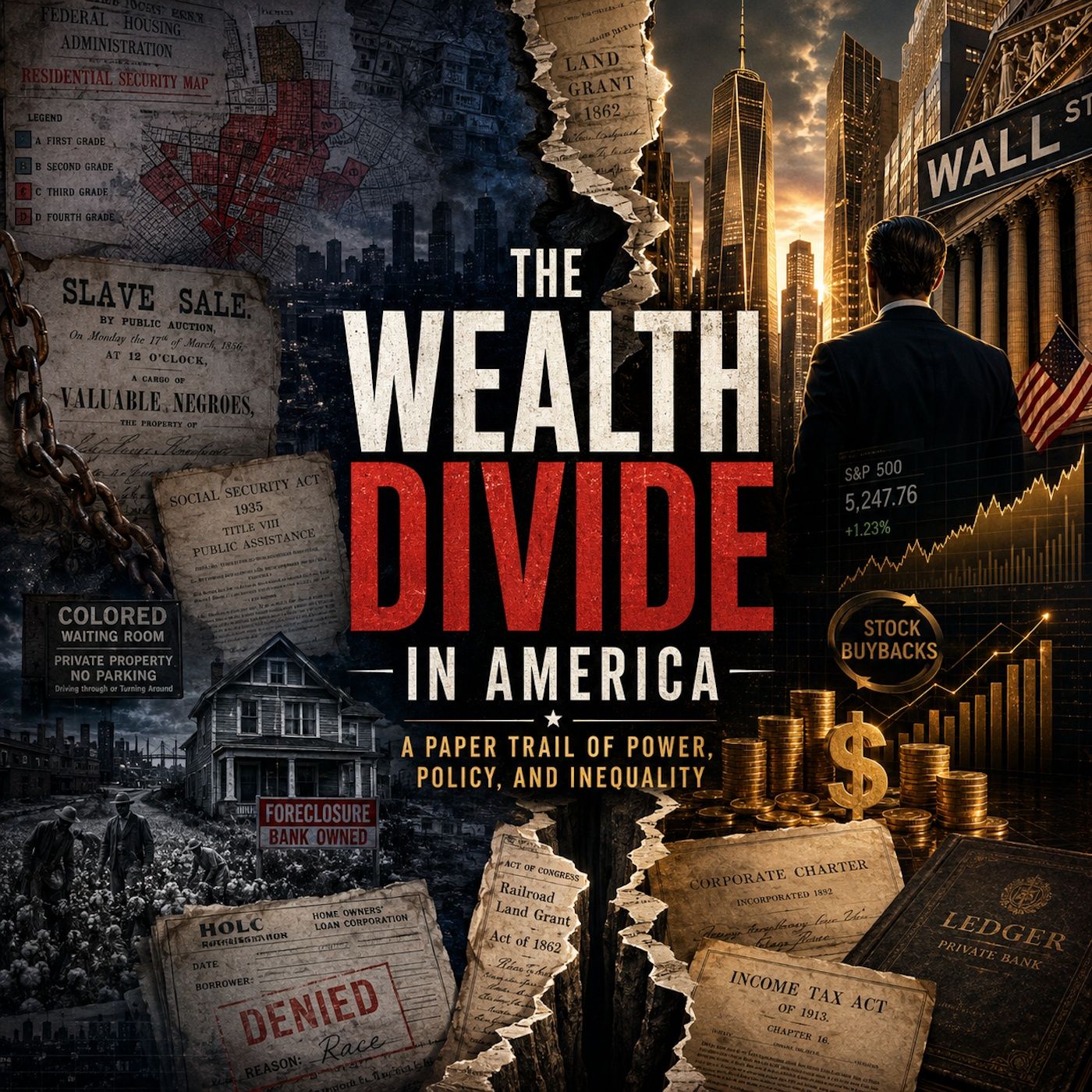
The wealth divide in America did not settle the way sediment settles. It was built, revised, briefly reversed, and then rebuilt with better engineering, and nearly every stage of it can be traced to identifiable people making documented decisions in specific years. Brian follows the paper trail, because in sixteen years of police work he learned that the interview is where people tell you what they want you to believe and the paperwork is where you find out what actually happened.This one is a paper case.It opens in New Orleans in 1839, in the rotunda of the St. Louis Hotel, where estates, paintings, and human beings were auctioned in the same room on the same afternoon for more than twenty years. Brian starts by correcting the famous engraving of that room, because the artist drew it in London from a description and got the building wrong, and the title of the picture turns out to matter more than the picture.From there the story runs backward to the Virginia headright system of 1618, a policy that handed out fifty acres for every passage paid and therefore rewarded the prior possession of money rather than labor, and to the laws Virginia passed after Bacon's Rebellion that built a permanent underclass defined by ancestry and a buffer class above it defined by not being in it. The founding section rests on what the founders said in the room. James Madison told the Constitutional Convention in June of 1787 that the Senate ought to be constituted to protect the minority of the opulent against the majority, and he was not hiding anything. Then comes the first great American transfer, when Alexander Hamilton's funding plan paid Revolutionary War debt at face value after speculators had already bought the certificates from veterans at a fraction of what they said on their face.The middle of the episode is the machinery that turned people into capital. By 1860 roughly four million enslaved people represented something on the order of three billion dollars, more than every railroad and factory in the country combined, and they were not only labor but collateral, which meant the ordinary operation of the credit system produced family separation as a foreclosure rather than as an act of individual cruelty. The insurance was written in Hartford and New York.The credit cleared in New York. Brian walks through the four months in 1865 when forty thousand freedpeople farmed their own land under Sherman's Special Field Order Number Fifteen, and the autumn when Andrew Johnson's pardons took it back and General Oliver Otis Howard was sent to Edisto Island to deliver that news in person. Then the crop lien, convict leasing at seventy-three percent of Alabama's state revenue, the eleven men murdered in Jasper County, Georgia in February of 1921 to destroy a federal peonage case before it could be built, and the collapse of the Freedman's Savings Bank, which took the deposits of sixty-one thousand people and was never made whole.The second half is the modern gap and how it was engineered. Railroad land grants and Credit Mobilier. Homestead and Ludlow. Andrew Mellon cutting the top tax rate from seventy-three percent to twenty-five and the income concentration peak of 1928. The Great Compression that followed, which is the proof that the distribution is a policy variable rather than a law of nature, and the racial exclusions written into Social Security, the Fair Labor Standards Act, federal mortgage insurance, and the G.I. Bill in order to buy Southern votes. Redlining maps that named their reasoning in plain language, Levittown covenants, Chicago contract sales with an average markup of eighty-four percent, and interstate highways routed through neighborhoods the appraisers had already devalued. Then the turn. The Powell Memorandum, the hinge year of 1978, the Volcker shock, the eleven thousand three hundred and forty-five air traffic controllers fired on a single day in August of 1981, the tax cuts, SEC Rule 10b-18 and the birth of the modern stock buyback, the 401(k) that came out of a subsection drafted for executives, and the 1993 pay cap that accidentally created an unlimited deduction for stock options. Deregulation, subprime steering documented in sworn affidavits by the loan officers who did it, millions of foreclosures, and a rescue that stabilized the banks and left the homeowners.And finally the strategy estate planners teach openly, buy, borrow, die, and what it means that the twenty-five wealthiest Americans saw four hundred and one billion dollars in wealth growth across five years and paid thirteen point six billion in federal income tax on it.Brian is careful throughout about what the evidence can and cannot carry. Where historians disagree, he names the disagreement rather than picking the version that sounds better, including the fight over whether the Social Security exclusions were racially motivated or administratively driven.Where the data is thin, such as the wealth concentration estimates from the 1890s, he says so on air. He corrects a famous Andrew Jackson quotation that Jackson never actually said, gives the strongest counterargument to the most attackable statistic in the modern half, and declines to claim more than the record supports.The episode closes at fifteen hundred Pennsylvania Avenue, in a building the Treasury Department named after a bank it never repaid, and in the surviving ledgers of that bank, which are now among the most valuable genealogical records in existence for African American families precisely because of what the clerks wrote down and what the institution then did with the money.Have a forgotten historical mystery, disturbing event, unsolved crime, or hidden conspiracy you think deserves investigation?Send your suggestions to [email protected] History is a dark history podcast exploring unsolved mysteries, secret societies, historical conspiracies, lost civilizations, and the shadowy stories buried beneath the surface of the past.Follow the show and enable automatic downloads so you never miss a deep dive into history’s most unsettling secrets.Because sometimes the truth is darker than fiction.
Embed this episode
What this episode covers
The wealth divide in America did not settle the way sediment settles. It was built, revised, briefly reversed, and then rebuilt with better engineering, and nearly every stage of it can be traced to identifiable people making documented decisions in specific years. Brian follows the paper trail, because in sixteen years of police work he learned that the interview is where people tell you what they want you to believe and the paperwork is where you find out what actually happened. This one is a paper case.It opens in New Orleans in 1839, in the rotunda of the St. Louis Hotel, where estates, paintings, and human beings were auctioned in the same room on the same afternoon for more than twenty years. Brian starts by correcting the famous engraving of that room, because the artist drew it in London from a description and got the building wrong, and the title of the picture turns out to matter more than the picture. From there the story runs backward to the Virginia headright system of 1618, a policy that handed out fifty acres for every passage paid and therefore rewarded the prior possession of money rather than labor, and to the laws Virginia passed after Bacon's Rebellion that built a permanent underclass defined by ancestry and a buffer class above it defined by not being in it. The founding section rests on what the founders said in the room. James Madison told the Constitutional Convention in June of 1787 that the Senate ought to be constituted to protect the minority of the opulent against the majority, and he was not hiding anything. Then comes the first great American transfer, when Alexander Hamilton's funding plan paid Revolutionary War debt at face value after speculators had already bought the certificates from veterans at a fraction of what they said on their face. The middle of the episode is the machinery that turned people into capital. By 1860 roughly four million enslaved people represented something on the order of three billion dollars, more than every railroad and factory in the country combined, and they were not only labor but collateral, which meant the ordinary operation of the credit system produced family separation as a foreclosure rather than as an act of individual cruelty. The insurance was written in Hartford and New York. The credit cleared in New York. Brian walks through the four months in 1865 when forty thousand freedpeople farmed their own land under Sherman's Special Field Order Number Fifteen, and the autumn when Andrew Johnson's pardons took it back and General Oliver Otis Howard was sent to Edisto Island to deliver that news in person. Then the crop lien, convict leasing at seventy-three percent of Alabama's state revenue, the eleven men murdered in Jasper County, Georgia in February of 1921 to destroy a federal peonage case before it could be built, and the collapse of the Freedman's Savings Bank, which took the deposits of sixty-one thousand people and was never made whole. The second half is the modern gap and how it was engineered. Railroad land grants and Credit Mobilier. Homestead and Ludlow. Andrew Mellon cutting the top tax rate from seventy-three percent to twenty-five and the income concentration peak of 1928. The Great Compression that followed, which is the proof that the distribution is a policy variable rather than a law of nature, and the racial exclusions written into Social Security, the Fair Labor Standards Act, federal mortgage insurance, and the G.I. Bill in order to buy Southern votes. Redlining maps that named their reasoning in plain language, Levittown covenants, Chicago contract sales with an average markup of eighty-four percent, and interstate highways routed through neighborhoods the appraisers had already devalued. Then the turn. The Powell Memorandum, the hinge year of 1978, the Volcker shock, the eleven thousand three hundred and forty-five air traffic controllers fired on a...
Ready to play
The Wealth Divide
No transcript for this episode yet
Similar Episodes
No similar episodes found.