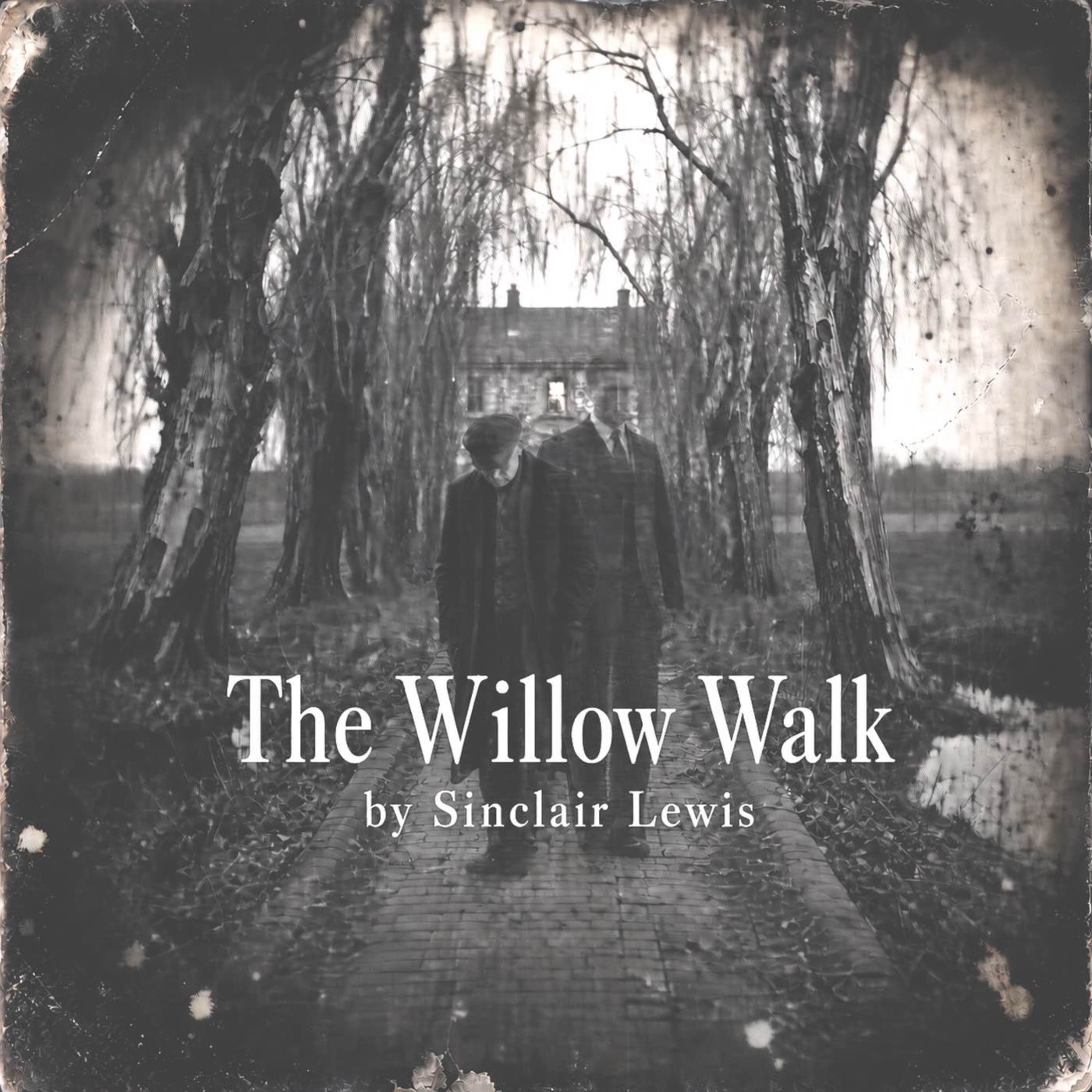
Hi, I'm Don McDonald and this is Lit Reading. A couple of things before we start the story. First, please follow the show. Algorithms are fickle and I need all the friends I can get and it costs you nothing. Second, the ads. Yeah, they're a necessary evil like flossing or small talk at weddings. So we get them over with now. Once the story starts, nobody cuts in. So let's get our flossing done. Hi, I'm Don McDonald.
I hope you enjoy The Willow Walk by Sinclair Lewis. Chapter One. From the drawer of his table desk, Jasper Holt took a pane of window glass. He laid a sheet of paper on the glass and wrote, Now is the time for all good men to come to the aid of the party. He studied his round business college script and rewrote the sentence in a small, finicky hand, that of a studious old man. Ten times he copied the words in that false, pinched writing. He tore up the paper, burned the fragments in his large ashtray, and washed the delicate ashes down his stationary washbowl.
He replaced the paint of glass in the drawer, tapping it with satisfaction. A glass underlay does not retain an impression. Jasper Holt was nearly as respectable as his room, which, with its frilled chairs and pansy-painted pincushion, was the best in the aristocratic boarding house of Mrs. Lyons. He was a wiry, slightly bald, black-haired man of 38, wearing an easy gray flannel suit and a white carnation. His hands were peculiarly compact and nimble. He gave the appearance of being a youngish lawyer or bond salesman. Actually, he was senior paying teller in the Lumber National Bank in the city of Vernon. He looked at a thin, expensive gold watch.
It was 6.30, on Wednesday, toward dusk of a tranquil spring day. He picked up his hooked walking stick and his gray silk gloves and trudged downstairs. He met his landlady in the lower hall and inclined his head. She effusively commented on the weather. I shall not be here for dinner, he said amiably. Very well, Mr. Holt. My, but aren't you always going out with your swell friends, though? I read in the Herald that you were going to be star in another of those society plays at the community theater. I guess you'd be an actor if you wasn't a banker, Mr. Holt.
No, I'm afraid I haven't much temperament. His voice was cordial, but his smile was a mere mechanical sidewise twist of the lip muscles. You're the one that's got the stage presence. Bet you'd be a regular Ethel Barrymore if you didn't have to look out for us. My, but you're such a flatterer. He bowed his way out and walked sedately down the street to a public garage. Nodding to the night attendant but saying nothing, he started his roadster and drove out of the garage, away from the center of Vernon, toward the suburb of Rosebank.
He did not go directly to Rosebank. He went seven blocks out of his way and halted on Fandau Avenue, one of those petty main thoroughfares which, with their motion picture palaces, their groceries, laundries, undertakers' establishments, and lunchrooms serve as local centers for districts of mean residences. He got out of the car and pretended to look at the tires, kicking them to see how much air they had. While he did so, he covertly looked up and down the street. He saw no one whom he knew. He went into the Parthenon confectionery store. The Parthenon store makes a specialty of those ingenious candy boxes that resemble bound books. The back of the box is of imitation leather with a stamping simulating the title of a novel. The edges are apparently the edges of a number of pages of paper. But these pages are hollowed out, and inside is to be filled with candy. Jasper gazed at the collection of book boxes and chose the two whose title had the nearest approach to dignity. Sweets to the Sweet and the Lady's Delight.
He asked the Greek clerk to fill these with the less expensive grade of mixed chocolates and to wrap them. From the candy store, he went to the drugstore that carried an assortment of reprinted novels, and from these picked out two of the same sentimental type as the titles in the book-like boxes. These also he had wrapped. He strolled out of the drugstore, slipped into a lunchroom, got a lettuce sandwich, donuts, and a cup of coffee at the greasy marble counter, took them to a chair with a tablet arm in the dim rear of the lunchroom, and hastily devoured them. As he came out and returned to his car, he again glanced along the street. He fancied that he knew a man who was approaching.
He could not be sure. From the breast up, the man seemed familiar, as did the customers of the bank whom he viewed through the wicket of the teller's window. When he saw them in the street, he could never be sure about them. It seemed extraordinary to find that these persons, whom to him were nothing but faces with attached arms that held out checks and received money, could walk about, had legs and a gait and a manner of their own. He walked to the curb and stared up at the cornice of one of the stores, pockering his lips, giving an impersonation of a man inspecting a building. With the corner of an eye, he followed the approaching man. The man ducked his head as he neared and greeted him.
Hello, Brother Teller, Jasper seemed startled, gave the, oh, how are you, of sudden recognition, and mumbled, looking after a little bank property. Always on the job, eh? The man passed on. Jasper got into his car and drove back to the street that would take him out to the suburb of Rosebank. As he left Vandal Avenue, he peered at his watch. It was five minutes of seven. At a quarter past seven, he passed through the main street of Rosebank and turned into a lane that was but little change since the time when it had been a country road.
A few jerry-built villas of freckled paint did shoulder upon it, but for the most part it ran through swamps spotted with willow groves, the spongy ground covered with scatterings of dry leaves and bark. Opening onto this lane was a dim-rutted, grassy private road, which disappeared into one of the willow groves. Jasper swung his car between the crumbly gateposts and along the bumpy private road. He made an abrupt turn, came into sight of an unpainted shed, and shot the car into it without cutting down his speed, so that he almost hit the back of the shed with his front fenders. He shut off the engine, climbed out quickly, and ran back toward the gate. From the shield of a bank of alder bushes, he peered out. Two chattering women were going down the public road. They stared in through the gate and half halted. That's where the hermit lives, said one of them. Oh, you mean the one that's writing a religious book and never comes out till evening? Some kind of a preacher?
Yes, that's the one. John Holt, I think his name is. I guess he's kind of crazy. He lives in the old Beaudet house, but you can't see it from here. It's clear through the block on the next street. I heard he was crazy, but I just saw an automobile go in there. Oh, that's his rich cousin or brother or something. Lives in the city. They say he's rich and such a nice fellow. The two women ambled on, their chatter blurring with distance. Standing behind the alders, Jasper rubbed the palm of one hand with the fingers of the other. The palm was dry with nervousness, but he grinned.
He returned to the shed and entered a brick paved walk almost a block long, walled and sheltered by overhanging willows. Once it had been a pleasant path, carved wooden benches were placed along it, and it widened to a court with a rock garden, a fountain, and a stone bench. The rock garden had degenerated into a riot of creepers, sprawling over the sharp stones. The paint had peeled from the fountain, leaving its iron cupids and naiads eaten with rust. The bricks of the wall were smeared with lichens and moss and were untidy with windrows of dry leaves and cakes of earth. Many of the bricks were broken. The walk was hilly in its unevenness. From willows and bricks and scuffed earth rose a damp chill. But Jasper did not seem to notice the dampness. He hastened along the walk to the house, a structure of heavy stone which, for this newish Midwestern land, was very ancient.
It had been built by a French fur trader in 1839. The Chippewas had scalped a man in its very dooryard. The heavy back door was guarded by an unexpectedly expensive modern lock. Jasper opened it with a flat key and closed it behind him. It locked on a spring. He was in a crude kitchen, the shades of which were drawn. He passed through the kitchen and dining room into the living room. Dodging chairs and tables in the darkness as though he was used to them, he went to each of the three windows of the living room and made sure that all the shades were down before he lighted the student's lamp on the game-legged table. As the glow crept over the drab walls, Jasper bobbed his head with satisfaction.
Nothing had been touched since his last visit. The room was musty with the smell of old green rep upholstery and leather books. It had not been dusted for months. Dust sheeted the stiff red velvet chairs, the uncomfortable settee, the chill white marble fireplace, the immense glass-fronted bookcase that filled one side of the room. The atmosphere was unnatural to this capable businessman, this Jasper Holt, but Jasper did not seem oppressed. He briskly removed the wrappers from the genuine books and from the candy box imitations of books.
One of the two wrappers he laid on the table and smoothed out. Upon this, he poured the candy from the two boxes. The other wrapper and the strings he stuffed into the fireplace and immediately burned. Crossing to the bookcase, he unlocked one section and placed both the real books and the imitation books on the second shelf. There was a row of rather cheap-looking novels on this shelf, and of these, at least six were actually such candy boxes as he had purchased that evening.
Only one shelf of the bookcase was given over to anything so frivolous as novels. The others were filled with black-covered, speckle-leaved, dismal books of history, theology, biography, the shabby-genteel sort of books you find on the 15-cent shelf at a second-hand bookshop. Over these, Jasper poured for a moment as though he was memorizing their titles. He took down The Life of the Reverend Jeremiah Bodfish and read aloud. In those intimate discourses with his family that followed evening prayers, I once heard Brother Bodfish observe that Philo-Judeus, whose scholarly career always calls to my mind the adumbrations of Melanchthon upon the essence of rationalism, was a mere sophist. Jasper slammed the book shut, remarking contentedly, That'll do. Philo-Judeus. Good name to spring.
He re-locked the bookcase and went upstairs. In a small bedroom at the right of the upper hall, an electric light was burning. Presumably the house had been deserted till Jasper's entrance, but a prowler in the yard might have judged from this ever-burning light that someone was in residence. The bedroom was spartan, an iron bed, one straight chair, a washstand, a heavy oak bureau. Jasper scrambled to unlock the lowest drawer of the bureau, yank it open, take out a wrinkled shiny suit of black, a pair of black shoes, a small black bow tie, a gladstone collar, a white shirt with starched bosom, a speckly brown felt hat, and a wig.
an expensive and excellent wig with artfully unkempt hair of a faded brown. He stripped off his attractive flannel suit, wing collar, blue tie, custom-made silk shirt, and cordovan shoes, and speedily put on the wig in these gloomy garments. As he donned them, the corners of his mouth began to droop. Leaving the light on and his own clothes flung on the bed, he descended the stairs. He was obviously not the same man who had ascended them. As to features, he was like Jasper, but by nature he was evidently less healthy, less practical, less agreeable, and decidedly more aware of the sorrow and long thoughts of the dreamer.
Indeed, it must be understood now that he was not Jasper Holt, but Jasper's twin brother, John Holt, hermit and religious fanatic. Chapter 2 John Holt, twin brother of Jasper Holt, the bank teller, rubbed his eyes as though he had for hours been absorbed in study, and crawled through the living room, through the tiny hall, to the front door. He opened it, picked up a couple of circulars that the postman had dropped through the letter slot of the door, went out, and locked the door behind him. He was facing a narrow front yard, neater than the willow walk at the back, on a suburban street more populous than the straggly back lane. A street arc illuminated the yard and showed that a card was tacked on the door. John touched the card, snapped it with the nail of his little finger to make certain it was securely tacked.
In that light he could not read it, but he knew that it was inscribed in a small, finicky hand. Agents, kindly do not disturb. Bell will not be answered. Occupant of house engaged in literary work. John stood on the doorstep till he made out his neighbor on the right, a large, stolid commuter who was walking before his house, smoking an after-dinner cigar. John poked to the fence and sniffed at the spray of lilac blossoms till the neighbor called over, Nice evening! Yes, it seems to be very pleasant.
John's voice was like Jasper's, but it was more guttural, and his speech had less assurance. How's the book going? It is—it is very, very difficult. Hard to comprehend all the inner meanings of the prophecies. Well, I must be hastening to Soul Hope Hall. I trust we shall see you there some Wednesday or Sunday evening. I bid you good night, sir.
John wavered down the street to a drugstore. He purchased a bottle of ink. In a grocery that kept open evenings, he got two pounds of cornmeal, two pounds of flour, a pound of bacon, a half pound of butter, six eggs, and a can of condensed milk. Shall we deliver them? asked the clerk. John looked at him sharply. He realized that this was a new man who did not know his customs. He said rebukingly, No, I always carry my parcels. I am writing a book. I am never to be disturbed. He paid for the provisions out of a postal money order for thirty-five dollars and received the change.
The cashier of the store was accustomed to cashing these money orders, which were always sent to John from South Vernon by one R.J. Smith. John took the bundle of food and walked out of the store. The fellow's kind of a nut, isn't he? Asked the new clerk. The cashier explained. Yep, doesn't even take fresh milk. Uses condensed for everything. What do you think of that? And they say he burns up all his garbage. Never has anything in the ash can except ashes. If you knock at his door, he never answers it, fellow told me. All the time writing this book of his. Religious crank, I guess. Has a little more income, though. Guess his folks were pretty well fixed. Comes out once in a while in the evening and pokes around town. We used to laugh about him, but we've kind of got used to him. Been here about a year, I guess it is.
John was serenely passing down the main street of Rosebank. At the dingier end of it, he turned in at a hallway marked by a lighted sign announcing in crude house painter's letters, Soul Hope Fraternity Hall, evening meeting, all welcome. It was eight o'clock. The members of the Soul Hope cult had gathered in their hall above the bakery. Theirs was a tiny, tight-minded sect. They asserted that they alone obeyed the scriptural tenets, that they alone were certain to be saved, that all the other denominations were damned by unapostolic luxury, that it was wicked to have organs or ministers or any meeting place to save plain halls. The members themselves conducted the meetings, one after another, rising to give an interpretation of the scriptures, or to rejoice in gathering with the faithful, while the others commented, Hallelujah! And Amen, brother! Amen! They were a plainly dressed, not overfed, rather elderly, and rather happy congregation. The most honored of them all was John Holt.
John had come to Rosebank only six months before. He had bought the Bodette House with the library of the recent occupant, a retired clergyman, and had paid for them in new $100 bills. Already he had gained great credit in the Soul Hope cult. It appeared that he spent almost all his time at home, praying, reading, and writing a book. The Soul Hope fraternity was excited about the book. They had begged him to read it to them. So far he had only read a few pages consisting mostly of quotations from ancient treatises on the prophecies. Nearly every Sunday and Wednesday evening he appeared at the meeting and in a halting but scholarly way lectured on the world of the flesh.
Tonight, he spoke polysyllabically of the fact that one Philo-Judeus had been a mere sophist. The cult were none too clear as to what either a Philo-Judeus or a sophist might be, but with heads all nodding in a row, they murmured, You're right, brother! Hallelujah! John glided into a sad, earnest discourse on his worldly brother, Jasper, and informed them of his struggles with Jasper's itch for money. By his request, the fraternity prayed for Jasper. The meeting was over at nine. John shook hands all round with the elders of the congregation, sighing, Fine meeting tonight, wasn't it? Such a free outpouring of the Spirit! He welcomed a new member.
A servant girl just come from Seattle. Carrying his groceries and the bottle of ink, he poked down the stairs from the hall at seven minutes after nine. At 16 minutes after nine, John was stripping off his brown wig and the funereal clothes in his bedroom. At 28 after, John Holt had again become Jasper Holt, the capable teller of the Lumber National Bank. Jasper Holt left the light burning in his brother's bedroom. He rushed downstairs, tried the fastening of the front door, bolted it, made sure that all the windows were fastened, picked up the bundle of groceries and the pile of candies that he had removed from the book-like candy boxes, blew out the light in the living room, and ran down the willow walk to his car. He threw the groceries and candy into it, backed the car out as though he was accustomed to backing in this bow-scattered yard, and drove off along the lonely road at the rear. When he was passing a swamp, he reached down, picked up the bundle of candies, and steering with one hand, removed the wrapping paper with the other hand, and hurled out the candies. They showered among the weeds beside the road.
The paper which had contained the candies, and upon which was printed the name of the Parthenon Confectionary Store, Jasper tucked into his pocket. He took the groceries item by item from the labeled bag containing them, thrust that bag also into his pocket, and laid the groceries on the seat beside him. On the way from Rosebank to the center of the city of Vernon, he again turned off the main avenue and halted at a goat-infested shack occupied by a crippled Norwegian. He sounded the horn. The Norwegian's grandson ran out. God bless you, sir. I don't know what we'd do if it wasn't for you, cried the old Norwegian from the door. But Jasper did not wait for gratitude. He merely shouted, Bring you some more in a couple of days, as he started away.
At a quarter past ten, he drove up to the hall that housed the latest interest of Vernon society, the community theater. The Boulevard set, the best people in town, belonged to the Community Theater Association, and the leader of it was the daughter of the general manager of the railroad. As a well-bred bachelor, Jasper Holt was welcome among them, despite the fact that no one knew much about him except that he was a good bank teller and had been born in England. But as an actor, he was not merely welcome. He was the best amateur actor in Vernon. His placid face could narrow with tragic emotions or puff out with comedy. His placid manner concealed a dynamo of emotion.
Unlike most amateur actors, he did not try to act. He became the thing itself. He forgot Jasper Holt and turned into a vagrant or a judge, a Bernard Shaw thought, a Lord Dunsany symbol, a Susan Glassbull radical, a Clyde Fitch man about town. The other one-act plays of the next program of the community theater had already been rehearsed. The cast of the play in which Jasper was to star were all waiting for him. So were the worried ladies responsible for the staging. They wanted his advice about the blue curtain for the stage window, about the baby spot that was out of order, about the higher interpretation of the role of the page in the piece, a role consisting of only two lines, but to be played by one of the most popular girls in the younger set. After the discussions, and a most violent quarrel between two members of the play-reading committee, the rehearsal was called. Jasper Holt still wore his flannel suit and a wilt incarnation, but he was not Jasper.
He was the Duke de San Saba, a cynical, gracious, gorgeous old man, easy of gesture, tranquil of voice, and shudderingly evil of desire. If I could get a few more actors like you, cried the professional coach. The rehearsal was over at half past eleven. Jasper drove his car to the public garage in which he kept it and walked home. There he tore up and burned the wrapping paper bearing the name of the Parthenon Confectionary Store and the labeled bag which had contained the groceries. The community theater plays were given on the following Wednesday. Jasper Holt was highly applauded. And at the party at the Lakeside Country Club after the play?
He danced with the prettiest girls in town. He hadn't much to say to them, but he danced fervently, and about him was a halo of artistic success. That night his brother John did not appear at the meeting of the Soul Hope fraternity out in Rosebank. On Monday, five days earlier, while he was in conference with the president and the cashier of the Lumber National Bank, Jasper complained of a headache. The next day he telephoned to the president that he would not come down to work. He would stay home and rest his eyes, sleep, and get rid of the persistent headache.
That was unfortunate, for that very day his twin brother John made one of his infrequent trips into Vernon and called at the bank. The president had seen John only once, and by coincidence it had happened on this occasion also that Jasper had been absent, had been out of town. The president invited John into his private office. Your brother is at home. Poor fellow has a bad headache. Hope he gets over it. We all think a great deal of him here. You ought to be proud of him. Will you have smoke?
As he spoke, the president looked John over. Once or twice when Jasper and the president had been out to lunch, Jasper had spoken of the remarkable resemblance between himself and his twin brother. But the president told himself that he really didn't see much resemblance. The features of the two were alike, but John's expression of chronic spiritual indigestion, his unfriendly manner, and his hair, unkempt and lifeless brown, where Jasper's was sleekly black above a shiny bald spot, made the president dislike John as much as he liked Jasper. And now John was replying, No, I do not smoke. I can't understand how a man can soil this temple with drugs.
I suppose I ought to be glad to hear you praise poor Jasper, but I am more concerned with his lack of respect for the things of the spirit. He sometimes comes to see me at Rosebank, and I argue with him, but somehow I can't make him see his errors and his flippant ways. We don't think he's flippant. We think he's a pretty steady worker. But his play-acting and reading love stories, well, I try to keep in mind this injunction, Judge not, lest ye not be judged, but I am pained to find my own brother giving up immortal promises for mortal amusements. Well, I'll go and call on him. I trust someday we shall see you at Sol Hope Hall in Rosebank. Good day, sir.
Turning back to his work, the president grumbled, I'm not going to tell Jasper that the best compliment I can hand him is that he is not like his brother. And on the following day, another Wednesday, when Jasper reappeared at the bank, the president did make this just in comparison, and Jasper sighed. Oh, John is really a good fellow, but he's always gone in for metaphysics and oriental mysticism and lord knows what all, till he's kind of lost in the fog. But he's a lot better than I am. When I murder my landlady, or say, when I rob the bank, chief, you go get John, and I bet you the best lunch in town that he'll do his best to bring me to justice. That's how blamed square he is. Square, yes. Corners just keep sticking out. Well, when you do rob us, Jasper, I'll look up John. But do try to keep from robbing us as long as you can. I hate to have to associate with a religious detective in a boiled shirt.
Both men laughed, and Jasper went back to his cage. His head continued to hurt, he admitted. The president advised him to lay off for a week. He didn't want to, he said. With the new munition industries due to the war in Europe, there was much increase in factory payrolls, and Jasper took charge of them. Better to take the week off than to get ill, argued the president late that afternoon. Jasper did let himself be persuaded to go away for at least a weekend. He would run up north to Wackham and Lake the coming Friday, he said. He would get some black bass fishing and then be back on Monday or Tuesday. Before he went, he would make up the payrolls for the Saturday payments and turn them over to the other teller.
The President thanked him for his faithfulness, and as was his not infrequent custom, invited Jasper to his house for the evening of the next day, Thursday. That Wednesday evening, Jasper's brother John appeared at the Soul Hope meeting in Rosebank. When he had gone home and had magically turned back into Jasper, this Jasper did not return the wig and garments of John to the Bureau, but packed them into a suitcase, took the suitcase to his room in Vernon, and locked it in his wardrobe. Jasper was amiable at dinner at the president's house on Thursday, but he was rather silent, and as his head still throbbed, he left the house early, at 9.30. Sedately, still carrying his gray silk gloves in one hand and pompously swinging his stick with the other, he walked from the president's house on the fashionable boulevard back to the center of Vernon. He entered the public garage in which his car was stored. He commented to the night attendant, Headaches. Guess I'll take the car out and get some fresh air. He drove away not more than 15 miles an hour. He headed south. When he reached the outskirts of the city, he speeded up to a consistent 25 miles an hour.
He settled down in his seat with the unmoving steadiness of the long-distance driver, his body quiet except for the tiny subtle movements of his foot on the accelerator, of his hands on the steering wheel, his right hand across the wheel, holding it at the top, his left elbow resting easily on the cushioned edge of his seat, and his left hand merely touching the wheel. He drove in that southern direction for fifteen miles, almost to the town of Wanaguchi. Then, by a rather poor side road, he turned sharply to the north and west, and making a huge circle about the city, drove toward the town of St. Clair. The suburb of Rosebank, in which his brother John lived, is also north of Vernon.
These directions were of some importance to him. Wanaguchi, 18 miles south of the mother city of Vernon. Rosebank, on the other hand, 8 miles north of Vernon, and St. Clair, 20 miles north, about as far north of Vernon as Wanaguchi is south. On his way to St. Clair, at a point that was only two miles from Rosebank, Jasper ran the car off the main road into a grove of oaks and maples and stopped it on a long, unused woodland road. He stiffly got out and walked through the woods up a rise of ground to a cliff overlooking a swampy lake. The gravelly farther bank of the cliff rose perpendicularly from the edge of the water. In that wan light distilled by stars and the earth, he made out the reedy expanse of a lake. It was so muddy, so tangled with sedge grass, that it was never used for swimming, and as its only inhabitants were slimy bullheads, few people ever tried to fish there.
Jasper stood reflective. He was remembering the story of the farmer's team which had run away, dashed over this cliff, and sunk out of sight in the mud bottom of the lake. Swishing his stick, he outlined an imaginary road from the top of the cliff back to the sheltered place where his car was standing. Once, he hacked away with a large pocket knife a mass of knotted hazel bushes which had blocked the projected road. When he had traced the road to his car, he smiled. He walked to the edge of the woods and looked up and down the main highway. A car was approaching. He waited till it had passed, ran back to his own car, backed it out on the highway, and went on his northward course towards St. Clair, driving about 30 miles an hour.
At the edge of St. Clair, he halted, took out his kit of tools, unscrewed a spark plug, and sharply tapping the plug on the engine block, deliberately cracked the porcelain jacket. He screwed the plug in again and started the car. It bucked and spit, missing on one cylinder with a short-circuited plug. I guess there must be something wrong with the ignition, he said cheerfully. He managed to run the car into a garage in St. Clair. There was no one in the garage save an old man, the night washer, who was busy over a limousine with sponge and hose. Got a night repairman here? asked Jasper. No, sir. Guess you'll have to leave it till morning. Hang it.
Something's gone wrong with the carburetor or the ignition. Well, I'll have to leave it then. Tell him. Say, will you be here in the morning when the repairman comes in? Yes, sir. Well, tell him I must have the car by tomorrow noon. No, say by tomorrow at nine. Now, don't forget. This will help your memory. He gave a quarter to the old man who grinned and shouted. Yes, sir. That'll help my memory a lot.
As he tied a storage tag on the car, the man said, Name? Uh, my name. Oh, Hanson. Remember now, ready about nine tomorrow. Jasper walked to the railroad station. It was ten minutes of one. Jasper did not ask the night operator about the next train to Vernon. Apparently, he knew that there was a train stopping here at St. Clair at 1.37. He did not sit in the waiting room, but in the darkness outside on a truck behind the baggage room.
When the train came in, he slipped into the last seat of the last car with his soft hat over his eyes and either slept or appeared to sleep. When he reached Vernon, he went the direct route from the station to his boarding house and came to the garage in which he regularly kept his car. He stepped inside. The night attendant was drowsing in a large wooden chair, tilted back against the wall in the narrow runway which formed the entrance to the garage. Jasper jovially shouted to the attendant, Certainly ran into some hard luck. Ignition went wrong. I guess it was the ignition. Had to leave the car down at Wanaguchi. Well, hard luck, all right, assented the attendant.
Yep, so I left it at Wanaguchi, Jasper emphasized as he passed on. He had been inexact in this statement. It was not at Wanaguchi, which is south, but at St. Clair, which is north, that he had left the car. He returned to his boarding house, slept beautifully, hummed in his morning shower bath. Yet at breakfast, he complained to his landlady of his continuous headache and announced that he was going to run up north to walk him in to get some bass fishing and rest his eyes. She urged him to go. Anything I can do to help you get away? She queried. No, thanks. I'm just taking a couple of suitcases with some old clothes and some fishing tackle. In fact, I have them all packed already. I'll probably take the noon train north if I can get away from the bank. Pretty busy now with all these payrolls for the factories that have war contracts with the allies. What's it say in the paper this morning?
Jasper arrived at the bank, carrying the two suitcases and a neat, polite rolled silk umbrella, the silver top of which was engraved with his name. The doorman, who was also the bank guard, helped him to carry the suitcases inside. Careful of that bag! Got my fishing tackle in it, said Jasper to the doorman, apropos of one of the suitcases, which was heavy but apparently not packed full. Well, I think I'll run up to Walkerman today and catch a few bass. Wish I could go along, sir. How is the head this morning? Does it still ache? Asked the doorman. Rather better, but my eyes still feel pretty rocky. I guess I've been using them too much. Say, Connors, I'll try to catch the train north at 11-7. Better have a taxi cab for me here at 11. Or, no, I'll let you know a little before 11. Try to catch the 11-7 north for Walkerman. Very well, sir. The president, the assistant cashier, the chief clerk, all asked Jasper how he felt, and to all of them he repeated the statement that he had been using his eyes too much, and that he would catch a few bass at Walkerman.
The other pain teller from his cage next to that of Jasper called heartily through the steel netting. Pretty soft for some people. You wait. I'm going to have the hay fever this summer, and I'll go fishing for a month. Jasper placed the two suitcases and the umbrella in his cage, and leaving the other teller to pay out current money, he himself made up the payrolls for the next day, Saturday. He casually went into the vault, a narrow, unimpressive, unaired cell with a hard linoleum floor, one unshaded electric bulb, and a black wall composed entirely of steel doors of safes, all painted a sickly blue, very unimpressive, but guarding several million dollars in cash and securities. The upper doors, hung on large steel arms, and each provided with two dials, could be opened only by two officers of the bank, each knowing one of the two combinations. Below these were smaller doors.
one of which Jasper could open as teller. It was the door of an insignificant steel box, which contained $117,000 in bills and $4,000 in gold and silver. Jasper passed back and forth, carrying bundles of currency. In his cage, he was working less than three feet from the other teller, who was divided from him only by the bands of steel netting. While he worked, he exchanged a few words with this other teller. Once as he counted out $19,000, he commented, Big payroll for the Henschel Wagon Works this week. They're making gun carriages and truck bodies for the Allies, I understand. Uh-huh, said the other teller, not much interested.
Mechanically, unobtrusively going about his ordinary routine of business, Jasper counted out bills to amounts agreeing with the items on a type schedule of the payrolls. Apparently, his eyes never lifted from his counting and from his type schedule which lay before him. The bundles of bills he made into packages, fastening each with a paper band. Each bundle he seemed to drop into a small black leather bag which he held beside him, but he did not actually drop the money into these payroll bags. Both the suitcases at his feet were closed and presumably fastened.
but one was not fastened. And though it was heavy, it contained nothing but a lump of pig iron. From time to time, Jasper's hand, holding a bundle of bills, dropped to his side. With a slight movement of his foot, he opened that suitcase, and the bills slipped from his hand down into it. The bottom part of his cage was a solid sheet of stamped steel, and from the front of the bank, no one could see the suspicious gesture. The other teller could have seen it, but Jasper dropped the bills only when the other teller was busy talking to a customer, or when his back was turned. In order to delay for such a favorable moment, Jasper frequently counted packages of bills twice, rubbing his eyes as though they heard him.
After each of these secret disposals of packages of bills, Jasper made much of dropping into the payroll bags the rolls of coin for which the schedule called. It was while he was tossing these blue-wrapped cylinders of coin into the bags that he would chat with the other teller. Then he would lock up the bags and gravely place them at one side. Jasper was so slow in making up the payrolls that it was five minutes of eleven before he finished. He called the doorman to his cage and suggested, Better call my taxi now. He still had one bag to fill. He could plainly be seen dropping packages of money into it while he instructed the assistant teller, I'll stick all the bags in my safe and you can transfer them to yours.
Be sure to lock my safe. Lord, I'd better hurry or I'll miss my train. Be back Tuesday morning at latest. So long. Take care of yourself. He hastened to pile the payroll bags into his safe in the vault. The safe was almost filled with them, and except for the last one, not one of the bags contained anything but a few rolls of coin. Though he had told the other teller to lock his safe, he himself twirled the combination, which was thoughtless of him, as the assistant teller would now have to wait and get the president to unlock it. He picked up his umbrella and the two suitcases, bending over one of the cases for not more than ten seconds.
Waving goodbye to the cashier at his desk down front and hurrying so fast that the doorman did not have a chance to help him carry the suitcases, he rushed through the bank, through the door, into the waiting taxi cab, and loudly enough for the doorman to hear, he cried to the driver, M&T station! At the M&D Railroad Station, refusing offers of red caps to carry his bag, he bought a ticket for Walkman, which is a lake resort town 140 miles northwest of Vernon, hence 120 beyond St. Clair. He had just time to get aboard the 11-7 train. He did not take a chair car, but sat in a day coach near the rear door. He unscrewed the silver top of his umbrella, on which was engraved his name, and dropped it into his pocket.
When the train reached St. Clair, Jasper strolled out to the vestibule, carrying the suitcases but leaving the topless umbrella behind. His face was blank, uninterested. As the train started, he dropped down on the station platform and gravely walked away. For a second, the light of adventure crossed his face and vanished. At the garage at which he had left his car on the evening before, he asked the foreman, Did you get my car fixed? Mercury Roadster, ignition on the bum? Nope, couple of jobs ahead of it. Haven't had time to touch it yet. Ought to get at it early this afternoon.
Jasper curled his tongue round his lips in startled vexation. He dropped his suitcases to the floor of the garage and stood thinking, his bent forefinger against his lower lip. Then, well, I guess I can get her to go. Sorry, can't wait. Gotta make the next down. He grumbled. A lot of you traveling salesmen making your territory by motor now, Mr. Hanson, said the foreman civilly, glancing at the storage check on Jasper's car. Yep, I can make a good many more than I could by train. He paid for overnight storage without complaining, though since his car had not been repaired, this charge was unjust. In fact, he was altogether prosaic and inconspicuous.
He thrust the suitcases into the car and drove off, the motor spitting. At another garage, he bought a new spark plug and screwed it in. When he went on, the motor had ceased spitting. He drove out of St. Clair back in the direction of Vernon and of Rosebank, where his brother lived. He drove out of St. Clair back in the direction of Vernon and of Rosebank, where his brother lived. He ran the car into that thick grove of oaks and maples only two miles from Rosebank, where he had paced off an imaginary road to the cliff overhanging the Reedy Lake.
He parked the car in a grassy space beside the abandoned woodland road. He laid a light robe over the suitcases. From beneath the seat, he took a can of deviled chicken, a box of biscuits, a canister of tea, a folding cooking kit, and a spirit lamp. These he spread on the grass. A picnic lunch. He sat beside that lunch from seven minutes past one in the afternoon, till dark. Once in a while, he made a pretense of eating. He fetched water from a brook, made tea, opened the box of biscuits, and a can of chicken.
But mostly he sat still and smoked cigarette after cigarette. Once a Swede, taking this road as a shortcut to his truck farm, passed by and mumbled, Picnic, eh? Yeah, taking a day off, said Jasper dully. The man went on without looking back. At dusk, Jasper finished a cigarette down to the tip, crushed out the light, and made a cryptic remark. That's probably Jasper Holt's last smoke. I don't suppose you can smoke, John. Damn you. He hid the two suitcases in the bushes, piled the remains of the lunch into the car, took down the top of the car, and crept down to the main road. No one was in sight. He returned. He snatched a hammer and a chisel from his toolkit, and with a few savage cracks, he so defaced the number of the car stamped on the engine block that it could not be made out.
He removed the license numbers from fore and aft and placed them beside the suitcases. Then, when there was just enough light to see the bushes as cloudy masses, he started the car, drove through the woods and up the incline to the top of the cliff, and halted, leaving the engine running. Between the car and the edge of the cliff, which overhung the lake, there was a space of about 130 feet, fairly level and covered with straggly red clover. Jasper paced off this distance, returned to the car, took his seat in a nervous, tentative way, and put her into gear, starting on second speed and slamming her into third. The car bolted toward the edge of the cliff. He instantly swung out on the running board. Standing there, headed directly toward the sharp drop over the cliff, steering with his left hand on the wheel, he shoved the hand throttle up, up, up with his right. He safely leaped down from the running board. Of itself, the car rushed forward, roaring. It shot over the edge of the cliff. It soared 20 feet into the air as though it were a thick-bodied airplane. It turned over and over with a sickening drop toward the lake. The water splashed up in a tremendous noisy circle. In the twilight, the surface of the lake shone like milk. There was no sign of the car on the surface.
The concentric rings died away. The lake was secret and sinister and still. Lord, ejaculated Jasper standing on the cliff, then, well, they won't find that for a couple of years anyway. He returned to the suitcases. Squatting beside them, he took from one the wig and black garments of John Holt. He stripped, put on the clothes of John, and packed those of Jasper in the bag. With the cases and the motor license plates, he walked back toward Rosebank, keeping in various groves of maples and willows until he was within half a mile of the town.
He reached the stone house at the end of the willow walk and sneaked in the back way. He burned Jasper Holt's clothes in the grate, melted down the license plates in the stove, and between two rocks he smashed Jasper's expensive watch and fountain pen into an unpleasant mass of junk, which he dropped into the cistern for rainwater. The silver head of the umbrella he scratched with a chisel till the engraved name was indistinguishable. He unlocked a section of the bookcase, and taking a number of packages of bills in denominations of $1, $5, $10, and $20 from one of the suitcases, he packed them into those empty candy boxes, which, on the shelves, look so much like books. As he stored them, he counted the bills. They came to $97,535. The two suitcases were new. There were no distinguishing marks on them, but taking them out to the kitchen, he kicked them, rubbed them with lumps of blacking, raveled their edges and cut their sides till they gave the appearance of having been long and badly used in traveling. He took them upstairs and tossed them up into the low attic. In his bedroom, he undressed calmly. Once he laughed. I despise those pretentious fools, bank officers and cops. I'm beyond their fool law. No one can catch me. It would take me myself to do that.
He got into bed. With a vexed hang it, he mused. I suppose John would pray no matter how chilly the floor was. He got out of bed, and from the inscrutable lord of the universe he sought forgiveness, not for Jasper Holt, but for the denominations who lack the true faith of soul-hope fraternity. He returned to bed and slept till the middle of the afternoon, lying with his arms behind his head, a smile on his face. Thus did Jasper Holt, without the mysterious pangs of death, yet cease to exist. And thus did John Holt come into being, not merely as an apparition glimpsed on Sunday and Wednesday evenings, but as a living being 24 hours a day, seven days a week.
Chapter 3. The inhabitants of Rosebank were familiar with the occasional appearances of John Holt, the eccentric recluse, and they merely snickered about him when on Saturday evening, following the Friday that had been chronicled, he was seen to come out of his gate and trudge down to a news and stationery shop on Main Street. He purchased an evening paper and said to the clerk, You can have the Morning Herald delivered at my house every morning, 27 Humbert Avenue. Yeah, I know where it is. Thought you had kind of a grouch on newspapers and all those low-brow things, said the clerk pertly. Ah, did you indeed. The Herald every morning, please. I will pay a month in advance.
was all John Holt said, but he looked directly at the clerk, and the man cringed. John attended the meeting at the Soul Hope fraternity the next evening, Sunday, but he was not seen on the streets again for two and a half days. There was no news of the disappearance of Jasper Holt till the following Wednesday, when the whole thing came out in a violent, small-city front-page story headed, Paying Teller, Social Favorite Makes Getaway. The paper stated that Jasper Holt had been missing for four days, and that the officers of the bank, after first denying that there was anything wrong with his accounts, had admitted that he was short $100,000. $200,000, said one report.
He had purchased a ticket for Walkman, this state, on Friday, and a trainman, a customer at the bank, had noticed him on the train, but he had apparently never arrived in Walkman. A woman asserted that on Friday afternoon, she had seen Holt driving an automobile between Vernon and St. Clair. This appearance near St. Clair was supposed to be merely a blind, however. In fact, our able chief of police had proof that Holt was not headed north in the direction of St. Clair, but south, beyond Wanaguchi, probably for Des Moines or St. Louis. It was definitely known that on the previous day, Holt had left his car at Wanaguchi, and with their customary thoroughness and promptness, the police were making search at Wanaguchi.
The chief had already communicated with the police in cities to the south, and the capture of the man could confidently be expected at any moment. As long as the chief, appointed by our popular mayor, was in power, it went ill with those who gave even the appearance of wrongdoing. When asked his opinion of the theory that the alleged fugitive had gone north, the chief declared that, of course, Holt had started in that direction, with the vain hope of throwing pursuers off the scent, but that he had immediately turned south and picked up his car. Though he would not say so definitely, the chief let it be known that he was ready to put his hands on the fellow who had hidden Holt's car at Wanaguchi. When asked if he thought Holt was crazy, the chief laughed and said, Yes, he's crazy $200,000 worth. I'm not making any slams, but there's a lot of fellows among our gentlemanly political opponents who would go a whole lot crazier for a whole lot less. The president of the bank, however, was greatly distressed and strongly declared his belief that Holt, who was a favorite in the most sumptuous residences on the boulevard, besides being well-known in local dramatic circles, and who bore the best of reputations in the bank, was temporarily out of his mind, as if he had been distressed by pains in the head for some time past. Meanwhile, the bonding company...
which had fully covered the employees of the bank by a joint bond of $200,000, had its detectives working with the police on the case. As soon as he read the paper, John took a trolley into Vernon and called on the president of the bank. John's face drooped with the sorrow of the disgrace. The president received him. John staggered into the room, groaning. I have just learned in the newspaper of the terrible news about my brother. I have come. We hope it's just a case of aphasia. We're sure he'll turn up all right, insisted the president. I wish I could believe it. But as I have told you, Jasper is not a good man.
He drinks and smokes and play acts and makes a god of stylish clothes. Good Lord, there's no reason for jumping to the conclusion that he's an embezzler. I pray you may be right. But meanwhile, I wish to give you any assistance I can. I shall make it my sole duty to see that my brother is brought to justice if it proves that he is guilty. Curia, mumbled the president. Despite this example of John's rigid honor, he could not get himself to like the man. John was standing beside him, thrusting his stupid face into his. The president pushed his chair a foot farther away and said disagreeably,
As a matter of fact, we were thinking of searching your house. If I remember, you live in Rosebank. Yes, of course, I shall be glad to have you search every inch of it, or anything else I can do. I feel that I share fully with my twin brother in this unspeakable sin. I'll turn over the key of my house to you at once. There's also a shed in the back where Jasper used to keep his automobile when he came to see me.
He produced a large, rusty, old-fashioned door key and held it out, adding, the address is 27 Humbert Avenue, Rosebank. Oh, it won't be necessary, I guess, said the president, somewhat shamed, irritably waving off the key. But I just want to help somehow. What can I do? Who is, in the language of the newspapers, who is the detective on the case? I'll give him any help. Tell you what you do. Go see Mr. Scanling of the Mercantile Trust and Bonding Company and tell him all you know. I shall. I take my brother's crime on my shoulders. Otherwise, I'd be committing the sin of Cain.
You are giving me a chance to try to expiate our joint sin, and as Brother Jeremiah Bodfish was once to say, it is a blessing to have an opportunity to expiate a sin no matter how painful the punishment may seem to a mere physical being. As I may have told you, I am an accepted member of the Soul Hope Fraternity, and though we are free from canton dogma, it is our firm belief for the next ten dreary minutes John Holt sermonized quoted forgotten books and quaint ungenerous elders twisted bitter pride and clumsy mysticism into a fanatical spiderweb. The president was a churchgoer, an ardent supporter of missionary funds, for forty years a pew holder at St. Simeon's Church. He was alternately bored to a chill shiver and roused to wrath against this self-righteous zealot. When he rather rudely got rid of John Holt, he complained to himself, Curse it!
I oughtn't to, but I must say I prefer Jasper the sinner to John the saint. Oof, what a smell of damp cellars the fellow has. He must spend all his time picking potatoes. Say, by thunder, I remembered that Jasper had the infernal nerve to tell me that once if he ever robbed the bank, I was to call John in. I know why now. John is the kind of egotistical fool that would muddle up any kind of a systematic search. Well, Jasper, sorry, but I'm not going to have anything more to do with John than I can help.
John had gone to the mercantile trust and bonding company, had called on Mr. Scandling, and was now wearying him by a detailed and useful account of Jasper's early years and recent vices. He was turned over to the detective employed by the bonding company to find Jasper. The detective was a hard, noisy man who found John even more tedious. John insisted on his coming out to examine the house in Rosebank, and the detective did so, but sketchily, trying to escape. John spent at least five minutes in showing him the shed where Jasper had sometimes kept his car. He also attempted to interest the detective in his precious but spotty books.
He unlocked one section of the case, dragged down a four-volume set of sermons, and started to read them aloud. The detective interrupted. Yeah, that's great stuff, but I guess we aren't going to find your brother hiding behind those books. The detective got away as soon as possible after insistently explaining to John that if they could use his assistance, they would let him know. If I can only expiate, yeah, sure, that's all right, wailed the detective, fairly running toward the gate. John made one more visit to Vernon that day. He called on the chief of city police. He informed the chief that he had taken the bonding company's detective through his house, but wouldn't the police consent to search it also? He wanted to expiate.
The chief patted John on the back, advised him not to feel responsible for his brother's guilt, and begged, Skip along now, very busy. As John walked to the Soul Hope meeting that evening, dozens of people murmured that it was his brother who had robbed the Lumber National Bank. His head was bowed with the shame. At the meeting, he took Jasper's sin upon himself and prayed that Jasper would be caught and receive the blessed healing of punishment. The others begged John not to feel that he was guilty. Was he not one of the Soul Hope brethren who alone in this wicked and perverse generation were assured of salvation?
On Thursday, on Saturday morning, on Tuesday, and on Friday, John went into the city to call on the president of the bank and the detective. Twice the president saw him and was infinitely bored by his sermons. The third time he sent word that he was out. The fourth time he saw John but curtly explained that if John wanted to help them, the best thing he could do was to stay away. The detective was out all four times. John smiled meekly and ceased to try to help them. Dust began to gather on certain candy boxes on the lower shelf of his bookcase, save for one of them, which he took out now and then.
Always after he had taken it out, a man with faded brown hair and a wrinkled black suit signing himself R.J. Smith would send a fair-sized money order from the post office at South Vernon to John Holt at Rosebank, as he had been doing for more than six months. These money orders could not have amounted to more than $25 a week, but that was even more than an ascetic like John Holt needed. By day, John sometimes cashed these at the Rosebank post office, but usually, as had been his custom, he cashed them at his favorite grocery when he went out in the evening. In conversation with a commuter neighbor who every evening walked about and smoked an after-dinner cigar in the yard at the right, John was frank about the whole lamentable business of his brother's defilcation. He wondered, he said, if he had not shut himself up with his studies too much and neglected his brother. The neighbor ponderously advised John to get out more. John let himself be persuaded, at least to the extent of taking a short walk every afternoon, and of letting his literary solitude be disturbed by the delivery of milk, meat, and groceries.
He also went to the public library and in the reference room glanced at books on Central and South America, as though he was planning to go South someday. But he continued his religious studies. It may be doubted if previous to the embezzlement, John had worked very consistently on his book about Revelation. All that the world had ever seen of it was a jumble of quotations from theological authorities. Presumably, the crime of his brother shocked him into more concentrated study, more patient writing. For during the year after his brother's disappearance, a year in which the bonding company gradually gave up the search and came to believe that Jasper was dead, John became fanatically absorbed in somewhat nebulous work.
The days and nights drifted together in meditation in which he lost sight of realities, and seemed, through the clouds of the flesh, to see flashes from the towered cities of the spirit. It had been asserted that when Jasper Holt acted a role, he veritably lived it. No one could ever determine how great an actor was lost in the smug bank teller. To him were imperial triumphs denied, yet he was not without material reward. For playing his most subtle part, he received $97,000. It may be that he earned it, certainly for the risk entailed it was but a fair payment. Jasper had meddled with the mystery of personality.
and was in peril of losing all consistent purpose, of becoming a wandering Jew of the Spirit, a strangled body walking. Chapter 4. The sharp-pointed willow leaves had twisted and fallen after the dreary rains of October. Bark had peeled from the willow trunks, leaving gashes of bare wood that was a wet and sickly yellow. Through the denuded trees bulked the solid stone back of John Holt's house. The patches of earth were greasy between the tawny knots of grass stems. The bricks of the walk were always damp now. The world was hunched up in this pervading chill. As melancholy as the sick earth seemed the man who in a slaty twilight paced the willow walk. His step was slack. His lips moved with the intensity of his meditation.
Over his wrinkled black suit and bleak shirt bosom was a worn overcoat. The velvet collar turned green. He was considering. There is something to all this. I began to see. I don't know what it is I do see, but there's lights. Supernatural world that makes food and bed seem ridiculous. I am. I really am beyond the law. I made my own law. Why shouldn't I go beyond the laws of vision and see the secrets of life? But I sinned, and I must repent someday. I need not return the money. I see now that it was given to me so I could lead this life of contemplation.
But the ingratitude to the President, the people who trusted me. Am I but the most miserable of sinners, and as the blind? Voices. I hear conflicting voices. Some praising me for my courage. Some rebuking. He knelt on the slimy black surface of a wooden bench beneath the willows, and as dusk clothed him round about, he prayed. It seemed to him that he prayed not in words, but in vast, confusing dreams. The words of a language larger than human tongues. When he had exhausted himself, he slowly entered the house. He locked the door. There was nothing definite of which he was afraid, but he was never comfortable with the door unlocked. By candlelight he prepared his austere supper. Dry toast. An egg. Cheap green tea with thin milk.
As always, as it had happened after every meal now for eighteen months, he wanted a cigarette when he had eaten but did not take one. He paced into the living room, and through the long still hours of the evening, he read an ancient book, all footnotes and cross-references about the numerology of the prophetic books and the number of the beast. He tried to make notes for his own book on Revelation, that scant pile of sheets covered with writing in a small, finicky hand. Thousands of other sheets he had covered, through whole nights he had written, but always he seemed with tardy pen to be racing after thoughts that he could never quite catch, and most of which he had written he had savagely burned. But someday he would make a masterpiece. He was feeling toward the greatest discovery that mortal men had encountered.
Everything he had determined was a symbol, not just this holy sign and that, but all physical manifestations. With frightening exultation he tried his new power of divination. The hanging lamp swung tinily. He ventured, if the arc of that moving radiance touches the edges of the bookcase, then it will be a sign that I am going to South America under an entirely new disguise and spend my money. He shuddered. He watched the lamp's unbearably slow swing. The moving light almost touched the bookcase. He gasped. Then it receded. It was a warning, he quaked. He would never leave this place of brooding and of fear which he had thought so clever a refuge. He suddenly saw it all.
I ran away and hid in a prison. Man isn't caught by justice. He catches himself. Again he tried. He speculated as to whether the number of pencils on the table was greater or less than five. If greater, then he had sinned. If less, then he was veritably above the law. He began to lift books and papers looking for pencils. He was coldly sweating with the suspense of the test. Suddenly he cried, Am I going crazy? He fled to his prosaic bedroom. He could not sleep. His brain was smoldering with confused inklings of mythic numbers and hidden warnings. He woke from a half-sleep more vision-haunted than any walking thought and cried,
I must go back and confess. But I can't. I can't when I was too clever for them. I can't go back and let them win. I won't let those fools sit tight and still catch me. It was a year and a half since Jasper had disappeared. Sometimes it seemed a month and a half, sometimes gray centuries. John's willpower had been shrouded with curious, puttering studies, long, heavy-breathing sittings with the Ouija board on his lap.
midnight hours when he had fancied that tables had tapped and crackling coals had spoken. Now that the second autumn of his seclusion was creeping into winter, he was conscious that he had not enough initiative to carry out his plans for going to South America. The summer before, he had boasted to himself that he would come out of hiding and go south, leaving such a twisty trail as only he could make. But oh, it was too much trouble. He hadn't the joy in play-acting, which had carried his brother Jasper through his preparations for flight. He had killed Jasper Holt, and for a miserable little pile of paper money, he had become a moldy recluse.
He hated his loneliness, but still more did he hate his only companions, the members of the soul-hope fraternity, that pious, shrill seamstress, that surly carpenter, that tight-lipped housekeeper, that old shouting man with the unseemly freeze of whiskers. They were so unimaginative. Their meetings were all the same. The same persons rose in the same order and made the same intimate announcements to the deity that they alone were his elect. At first it had been an amusing triumph to be accepted as the most eloquent among them, but that had become commonplace.
And he resented their daring to be familiar with him, who was, he felt, the only man of all men living, who beyond the illusions of the world saw the strange beatitude of higher souls. During a Wednesday meeting at which a red-faced man had for a half hour maintained that he couldn't possibly sin, that the cumulative ennui burst in John Bolt's brain. He sprang up. He snarled. You make me sick, all of you. You think you're so certain of sanctification that you can't do wrong? So did I once. Now I know that we are all miserable sinners. Really are. You all say you are, but you don't believe it.
I tell you that you there, who have just been yammering, and you, brother Judkins with the long, twitching nose, and I, I, I, most unhappy of men, we must repent, confess, expiate our sins, and I will confess right now. I stole— Terrified, he darted out of the hall, and hatless, cultless, tumbled through the main street of Rosebank, nor ceased till he had locked himself in his house. He was frightened because he had almost betrayed his secret, yet agonized because he had not gone on, really confessed, and gained the only peace he would ever know now, the peace of punishment. He never returned to Soul Hope Hall. Indeed, for a week he did not leave his house save for midnight prowling in the willow walk. Quite suddenly he became desperate with the silence. He flung out of the house, not stopping to lock or even close the front door. He raced uptown, no topcoat over his rotting garments, only an old gardener's cap on his thick brown hair. People stared at him. He bore it with a resigned fury. He entered a lunchroom, hoping to sit inconspicuously and hear men talking normally about him. The attendant at the counter gaped. John heard a mutter from the cashier's desk. There's that crazy hermit. All of the half-dozen young men loafing in the place were looking at him.
was so uncomfortable that he could not eat even the milk and sandwich he had ordered. He pushed them away and fled, a failure in the first attempt to dine out that he had made in 18 months, a lamentable failure to revive that Jasper Holt whom he had coldly killed. He entered a cigar store and bought a box of cigarettes. He took joy out of throwing away his asceticism. But when, on the street, he lighted a cigarette it made him so dizzy that he was afraid he was going to fall. He had to sit down on the curb. People gathered. He staggered to his feet and up an alley. For hours he walked, making and discarding the most contradictory plans, to go to the bank and confess.
to spend money riotously and never confess. It was midnight when he returned to his house. Before it, he gasped. The front door was open. He chuckled with relief as he remembered that he had not closed it. He sauntered in. He was passing the door of the living room going directly up to his bedroom when his foot struck an object about the size of a book, but hollow-sounding. He picked it up. It was one of the book-like candy boxes, and it was quite empty. Frightened, he listened. There was no sound. He crept into the living room and lighted the lamp.
The doors of the bookcase had been wrenched open. Every book had been pulled out on the floor. All of the candy boxes, which that evening had contained almost $96,000, were in a pile, and all of them were empty. He searched for 10 minutes, but the only money he found was one $5 bill, which had fluttered under the table. In his pocket, he had $1.16. John Holt had $6.16. No job, no friends, and no identity. Chapter 5
When the president of the Lumber National Bank was informed that John Holt was waiting to see him, he scowled. Lord, I'd forgotten that minor plague. Must be a year since he's been here. Oh, let him... No, hanged if I will. Tell him I'm too busy to see him. That is, unless he's got some news about Jasper. Pump him and find out. The president's secretary sweetly confided to John. I'm so sorry, but the president is in conference just now. What was it you wanted to see him about? Is there any news about, uh, about your brother? There is not, miss. I am here to see the president on the business of the Lord. Oh, if that's all, I'm afraid I can't disturb him. I will wait.
Wait, he did, through all the morning, through the lunch hour, when the president hastened out past him, then into the afternoon, till the president was unable to work with the thought of that scarecrow out there and sent for him. Well, well, what is it this time, John? I'm pretty busy. No news about Jasper, eh? No news, sir, but Jasper himself.
I am Jasper Holt. His sin is my sin. Yes, yes, I know all that stuff. Twin brothers, twin souls share responsibility. You don't understand. There isn't any twin brother. There isn't any John Holt. I am Jasper. I invented an imaginary brother and disguised myself. Why don't you recognize my voice? While John leaned over the desk, his two hands upon it and smiled wistfully. The president shook his head and soothed. No, I'm afraid I don't. Sounds like good old religious John to me. Jasper was a cheerful, efficient sort of crook. Why, his laugh, but I can laugh.
The dreadful croak which John uttered was the cry of an evil bird of the swamps. The president shuddered. Under the edge of the desk, his fingers crept toward the buzzer by which he summoned his secretary. They stopped as John urged, Look, this wig! It's a wig! See, I am Jasper! He had snatched off the brown thatch. He stood expectant, a little afraid. The president was startled, but he shook his head inside. You poor devil! Wig, all right! But I wouldn't say that hair was much like Jasper's. He motioned toward the mirror at the corner of the room.
John wavered to it, and indeed he saw that day by slow day his hair had turned from Jasper's thin, sleek blackness to a straggle of damp gray locks writhing over a yellow skull. He begged pitifully, oh, can't you see I am Jasper? I stole $97,000 from the bank. I want to be punished. I want to do anything to prove why I've been at your house. Your wife's name is Evelyn. My salary here was my dear boy. Don't you suppose that Jasper might have told you all these interesting facts? I'm afraid the worry of this has, pardon me if I'm frank, but I'm afraid it's turned your head a little, John.
There isn't any John. There isn't. There isn't. I'd believe that a little more easily if I hadn't met you before Jasper disappeared. Give me a piece of paper. You know my writing. With clutching claws, John seized a sheet of bank stationery and tried to write in the round script of Jasper. During the past year, he had filled thousands of pages with the small, finicky hand of John. Now, though he tried to prevent it, after he had traced two or three words in large but shaky letters, the writing became smaller, more pinched, less legible. Even while John wrote, the president looked at the sheet and said easily, Afraid it's no use. This isn't Jasper's fist. See here.
I want you to get away from Rosebank. Go to some farm. Work outdoors. Cut out this fuming and fussing. Get some fresh air in your lungs. The president rose and purred. Now I'm afraid I have some work to do. He paused, waiting for John to go. John fiercely crumpled the sheet and hurled it away. Tears were in his weary eyes. He wailed. Is there nothing I can do to prove I am Jasper? Why, certainly. You can produce what's left of the $97,000. John took from his ragged waistcoat pocket a $5 bill and some change. Here's all there is. $96,000 of it was stolen from my house last night.
Sorry though he was for the madman, the president could not help laughing. Then he tried to look sympathetic and he comforted. Well, that's hard luck, old man. Uh, let's see. You might produce some parents or relatives or somebody to prove that Jasper never did have a twin brother. My parents are dead and I've lost track of their kin. I was born in England. Father came over when I was six. There might be some cousins or some old neighbors, but I don't know. Probably impossible to find out in these war times without going over there. Well, I guess I'll have to let you go, old man. The president was pressing the buzzer for his secretary and gently bidding her. Show Mr. Holt out, please.
From the door, John desperately tried to add, You will find my car so— The door had closed behind him. The president had not listened. The president gave orders that never, for any reason, was John Holt to be admitted to his office again. He telephoned to the bonding company that John Holt had now gone crazy, and they would save trouble by refusing to admit him. John did not try to see them. He went to the county jail. He entered the keeper's office and said quietly, I have stolen a lot of money, but I can't prove it. Will you put me in jail? The keeper shouted, Get out of here! You hobos always spring that when you want a good warm lodging for the winter.
Why the devil don't you go to work with a shovel in the sand pits? They're paying $2.75 a day. Yes, sir, John said timorously. Where are they? In addition to winning a Pulitzer Prize, Sinclair Lewis was the first American to win the Nobel Prize for Literature in 1930. Like many great artists, he burst into greatness in the 1920s, after which the quality of his work fizzled out.
If you enjoyed this story, there are universes of short stories at shortstoryversus.com. All kinds of stories, all kinds of genres. Check it out, shortstoryversus.com. And if you really like the story, tell a friend or two. Or maybe leave a review on Apple Podcasts or a rating on Spotify. Thanks so much for listening. I'm Don McDonald.
Well, that's all there is for this story. Oh, wait, I almost forgot. Your homework. Please follow the show. If you enjoyed the story, leave five stars on Spotify or five stars and a few kind words on Apple Podcasts. Raving is encouraged. Mild gushing, it's acceptable. Then find the share button and send lit reading to a friend who says they don't have time to read. Now they don't have to. Oh, and thanks for listening.