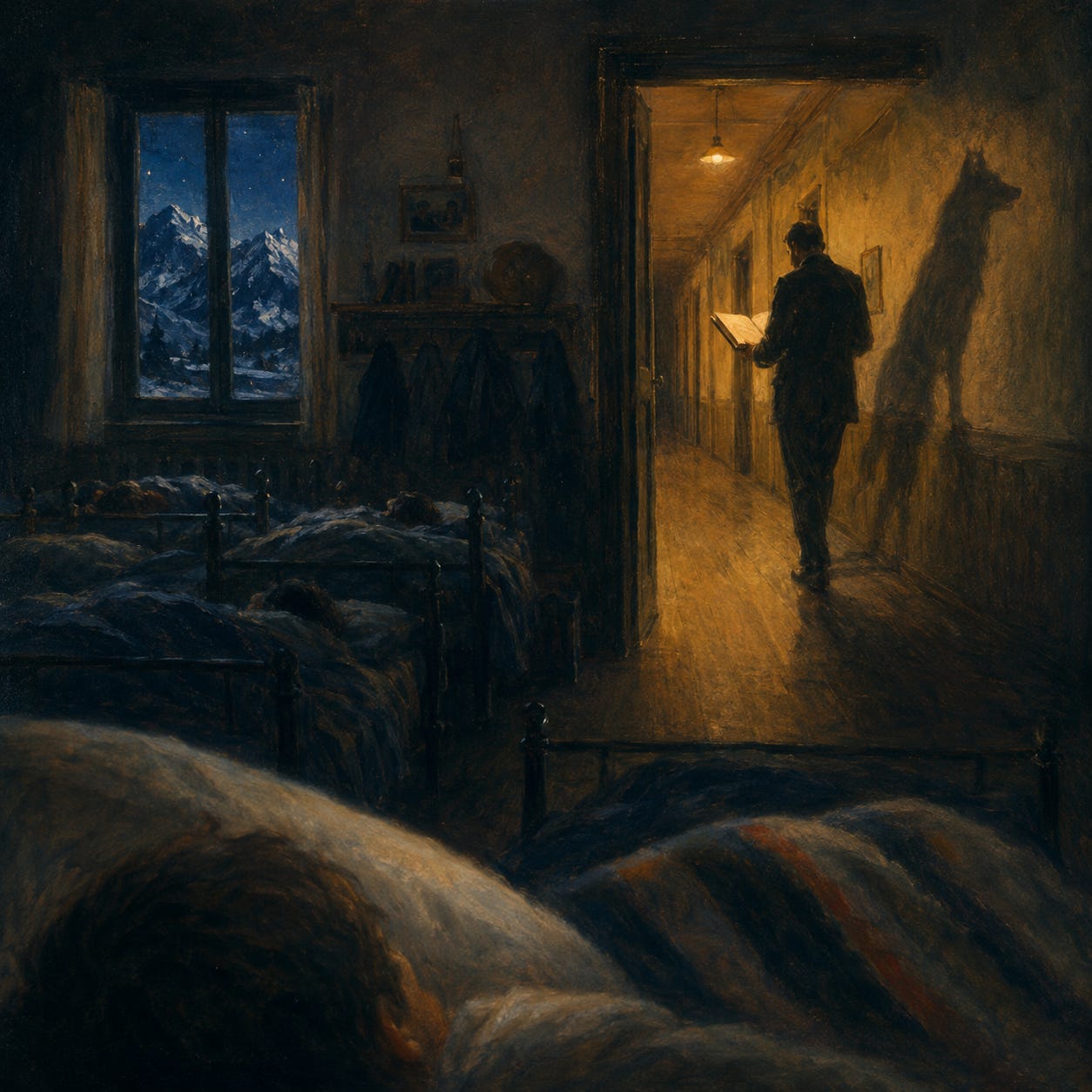
The Wolf-Dog in the Dormitory
from Language Matters by Elias Winter Hosted by Elias Winter
The Men Who Walk Upright Sometimes the strangest thing about being human is that nobody else seems to find being human strange. A man walks past me in Austin wearing a fitted shirt. He has spent years manufacturing his shoulders. He has fed them protein, lifted iron against gravity, denied himself certain foods, repeated the same movements until the body answered. His chest presses against cotton. His thighs move beneath trousers. He smells faintly of soap or deodorant or whatever modern chemistry has devised to conceal from the other animals the fact that he is an animal. And everyone behaves as if this is perfectly ordinary. He checks his phone. He waits for the elevator. He asks whether the table is available. He probably has meetings tomorrow. He may be worried about his mortgage. He may be married. He may be straight. He may be thinking about absolutely nothing. Meanwhile another mammal is watching him. I have been thinking lately that civilization is largely the art of pretending not to notice what the body notices immediately. We cover ourselves, perfume ourselves, schedule ourselves, give ourselves titles, carry leather bags, make reservations, shake hands. We build offices in which an animal with magnificent shoulders spends nine hours manipulating symbols on a glowing rectangle. We surround appetite with procedure. The body is unimpressed. It sees the neck before the résumé. It sees the forearm below the rolled sleeve. It notices the distribution of hair, the width of a hand, the architecture of a back. It wants to move closer. It would like information that manners have forbidden it from collecting: the smell beneath the deodorant, the warmth beneath the shirt, the texture of the skin beneath the carefully assembled public person. This has become almost comical to me. Men in Austin work very hard to become delicious and then walk around behaving as if nobody should be hungry. Perhaps this thought returned me to France. Or perhaps France had already returned and the thought merely gave it language. Because suddenly I began seeing faces I had not seen for more than thirty years. Not photographs. Faces. Boys. And the unsettling thing was that I still knew which ones were beautiful. The Faces I Never Forgot I went to École Rouget de Lisle in Courbevoie for CP, then later CE2 and CM1. If the arithmetic is right, these were the early 1990s, when I was six, eight, nine. Long enough ago that much of what supposedly constituted my education has disappeared entirely. I cannot tell you what arithmetic exercise we did on a particular Tuesday. I do not remember the handwriting worksheets. I have forgotten entire teachers. Thousands of lunches are gone. The contents of notebooks that once seemed important enough to carry carefully home have vanished more completely than civilizations. But certain boys survived. That is what interests me. A face across a playground. Black hair. A particular pair of eyes. The shape of someone’s mouth when he laughed. A boy who seemed somehow more complete than the others, although I would not have known that word then. Did I love them? I don’t know. Memory becomes dishonest when certainty is demanded of it. An adult man can easily travel backward carrying adult desire like a lantern and illuminate things that were once much dimmer. Perhaps I merely admired them. Perhaps I wanted to look like them. Perhaps I wanted them to choose me as a friend. Perhaps I was already experiencing the primitive beginning of what would later become unmistakable attraction. Children possess intensities before they possess explanations. A child does not say: I am experiencing erotic fixation complicated by identification and the desire for social belonging. A child looks. And then, inexplicably, thirty years later, he still remembers the face. This is what has begun troubling me—not troubling in the sense of frightening me, but in the older sense, as water is troubled when something beneath it begins to rise. Why these faces? Why not the teacher explaining multiplication? Why not the blackboard? Why not the lunch tray? Why the boys? I have spent much of adulthood thinking desire began when it became legible. Perhaps that is one of the lies language tells us. We assume that a thing begins when we acquire the noun for it. But the body may have been writing much earlier. Perhaps childhood does not preserve meanings. Perhaps it preserves intensities and waits for the adult to return with names. The Black-Haired Boy The school sometimes took us swimming. Before we went into the pool, older boys would help younger boys change. I don’t know whether this was common practice then, whether it would happen now, or whether I remember the arrangement precisely. Childhood institutional life contained a great deal more bodily practicality than adult life does. Children were moved, dressed, washed, lined up, fed, corrected. Adults and older children handled the logistics of small bodies without turning every gesture into an existential event. There was an older boy who helped me change. I still remember his face. Black hair. French. Beautiful. That adjective belongs to me now. I cannot swear that I possessed it in exactly the same way then. But I remember him as beautiful. At some point he removed either my underwear to put on my swimming suit or my swimming suit to put my underwear back on. And before covering me, he looked at my penis for what memory reports as a strangely long time. That is the whole event. Nothing happened. No touch beyond what was necessary to change me. No proposition. No secret afterward. No story except the stare. And because the mind hates an unanswered question, I have occasionally tried to solve it. Was he attracted? Was he simply curious? I was circumcised. Perhaps he had never seen a circumcised boy before. In France, among boys who were neither Muslim nor Jewish, that would hardly have been impossible. Perhaps he was simply registering anatomical difference with the shameless curiosity children possess before they learn to disguise curiosity as indifference. Perhaps he wasn’t even staring as long as I remember. Memory stretches certain seconds. What I know is not what he felt. What I know is that I remember being looked at. And that I remember who was looking. There is something almost unbearably intimate about being seen by someone one is already looking at. Adult life teaches us how much desire consists of this reciprocity. I can look at a beautiful man for an hour and remain alone inside my looking. Then he looks back and suddenly the entire structure changes. The gaze returns carrying possibility. I cannot impose that adult meaning onto a child. But perhaps the primitive architecture was already there. Not sex. Recognition. The astonishing discovery that the beautiful creature has eyes too, and for a moment those eyes are on you. The Republic of Boys Then there were the Alps. The school took us away for weeks to learn skiing. I remember the place not as geography but as regime. Morning. Clothes. Equipment. Instructions. Cold. Order. Male teachers. Discipline. There was a strictness to those days that remains in my body more clearly than whatever lessons the strictness was supposed to teach. Children were expected to move together, prepare together, eat together, sleep when told, wake when told, ski when told. There were rules whose logic we did not necessarily understand because children rarely understand the architecture into which adults have placed them. You obey first. Meaning comes later. The teachers frightened me. Not because they beat us. They did not. The fear was institutional: the possibility of being corrected, singled out, found unserious, discovered doing something one was not supposed to do. And yet there was also an extraordinary physical intimacy to the life. We showered in groups. I remember perhaps ten boys, naked, two to a shower. That sentence sounds almost exotic from the privacy of adult American life, where each body is assigned its own door, its own towel, its own carefully defended p… This is a public episode. If you would like to discuss this with other subscribers or get access to bonus episodes, visit eliaswinter.substack.com
Embed this episode
No transcript yet.