
EPISODE · May 15, 2025 · 13 MIN
🐺 The Wolf Reads AI — Day 21: "Pointer Networks."
from Deep Learning With The Wolf · host Diana Wolf Torres
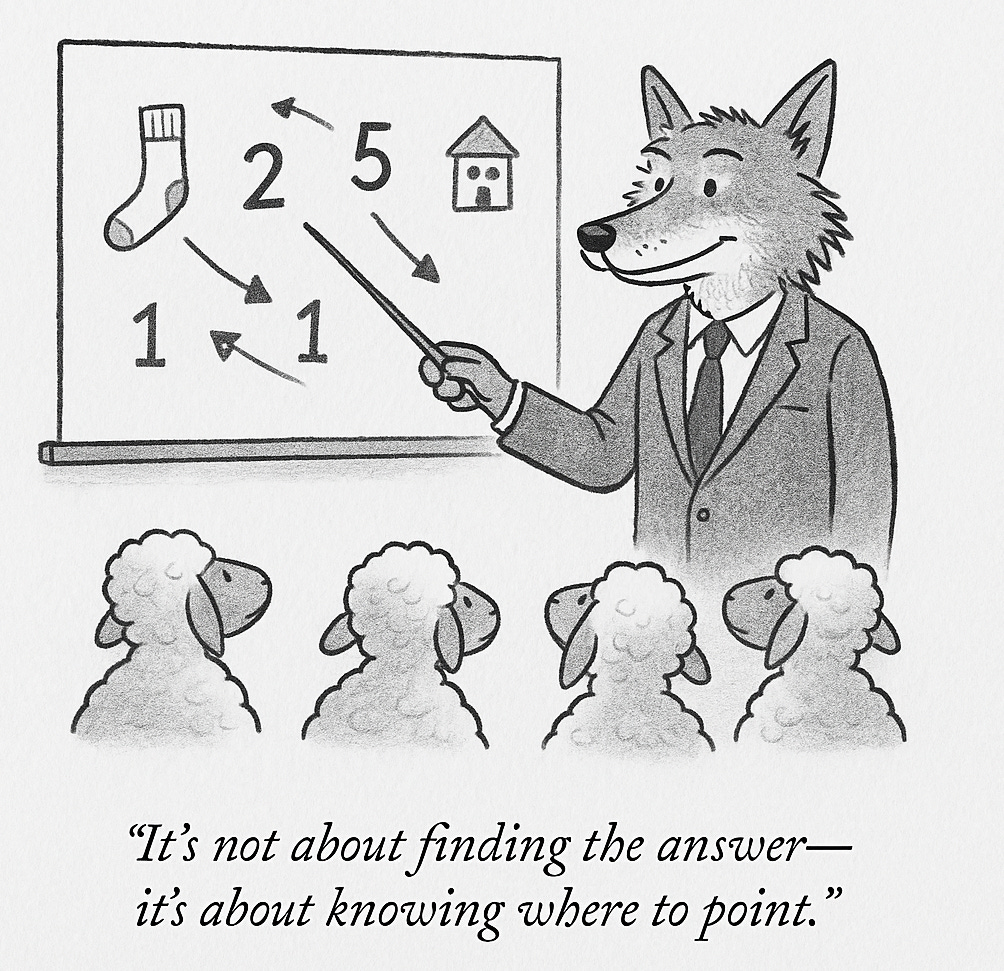
Paper: Pointer NetworksAuthors: Oriol Vinyals, Meire Fortunato, Navdeep Jaitly Published by: Google Brain (2015)Link: https://arxiv.org/abs/1506.03134What This Paper is AboutNeural networks are great at producing outputs from fixed sets (like classifying images into categories). But what if the “correct” output depends on the input itself?Enter Pointer Networks—a neural architecture that learns to output positions in the input sequence. It’s like telling a model: “Don’t generate the answer—point to it.”This idea is perfect for tasks like:* Sorting numbers* Finding shortest paths (TSP)* Picking elements from a list (e.g., top scoring word, best move, closest object)The model uses attention mechanisms to “point” at the correct part of the input—rather than generating symbols from a fixed vocabulary.Why It Still MattersPointer Networks were among the first to combine:* Sequence-to-sequence modeling with* Dynamic output spaces, using* Attention not just for context, but as a direct pointer mechanismThis paved the way for architectures where structure matters more than symbols—like program synthesis, routing, combinatorics, and modern tool-using LLMs.It’s also a spiritual ancestor to transformer pointer models, retrieval-based generation, and even in-context learning tricks where models identify answers embedded in prompts.How It WorksPointer Networks are built on seq2seq models (with encoder-decoder LSTMs), but with a twist:* Instead of predicting a token from a vocabulary, the decoder uses attention to select an input position.* So if your input is a list of numbers, the output might be: “3rd element, 1st element, 4th element” → a sorted order.Think of it like turning a neural network into a clickable highlighter—it doesn’t write answers, it finds them.Memorable Quote from the Paper“We present a novel neural network architecture that uses attention to learn the conditional probability of an output sequence whose elements are discrete tokens corresponding to positions in an input sequence.”Read the original paper here.Podcast Note: 🎧 Google NotebookLM generated today’s podcast. The sources fed into the “Notebook” to develop the “audio overview” include this article and the “Additional Resources” listed below. The two perky AI hosts do a fantastic job, but sometimes trip over names. (Other times, they bleep random bits of sound, although this is increasingly rare.) NotebookLM- a free tool from Google- is an incredible asset for anyone who does research and writing. You can find it here.Coming Tomorrow🧪 Neural Message Passing for Quantum Chemistry — the crossover episode between deep learning and molecules. You don’t need a chemistry degree to follow along—just curiosity and maybe a cartoon atom or two.Additional Resources for Inquisitive Minds:Aman’s AI Journal: “Pointer Networks.”Papers with Code. Pointers Networks.Hyperscience. The Power of Pointer Networks. (2021.)The Head Gym. Understanding Pointer Networks: A Deep Dive into Architecture and Applications.#PointerNetworks #AttentionMechanisms #NeuralNetworks #WolfReadsAI #SequenceModeling #DeepMind #Combinatorics #AIExplained #NeuralSorting This is a public episode. If you would like to discuss this with other subscribers or get access to bonus episodes, visit dianawolftorres.substack.com
Embed this episode
NOW PLAYING
🐺 The Wolf Reads AI — Day 21: "Pointer Networks."
No transcript for this episode yet
Similar Episodes
No similar episodes found.
Similar Podcasts
No similar podcasts found.