
EPISODE · May 16, 2025 · 7 MIN
🐺 The Wolf Reads AI — Day 22: “Neural Message Passing for Quantum Chemistry”
from Deep Learning With The Wolf · host Diana Wolf Torres
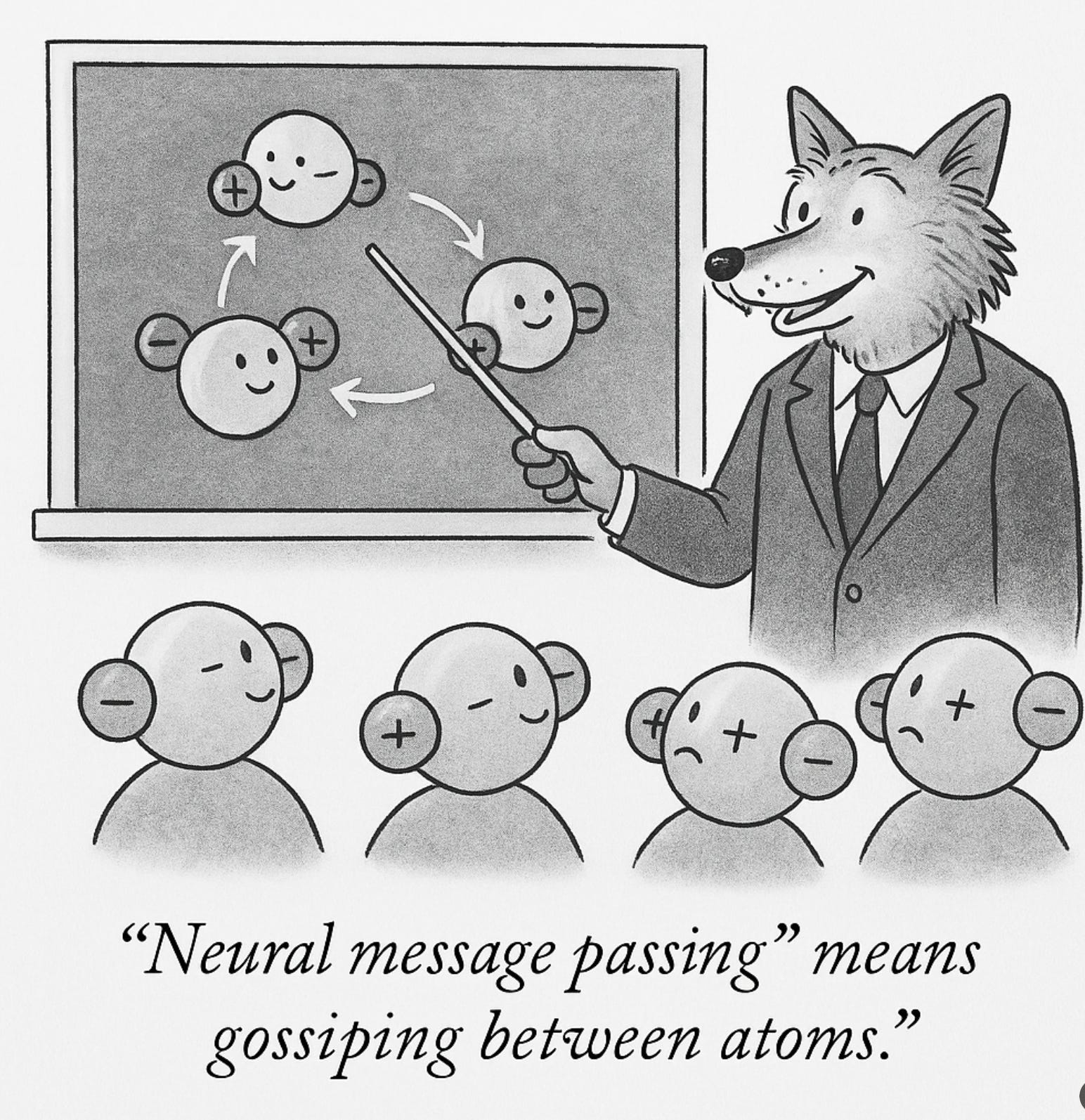
Paper: Neural Message Passing for Quantum ChemistryAuthors: Justin Gilmer, Samuel S. Schoenholz, Patrick F. Riley, Oriol Vinyals, George E. Dahl Published by: Google Brain & DeepMindDate: 2017What This Paper is AboutBefore this paper, machine learning models treated molecules like feature vectors—long lists of descriptors hand-engineered by chemists. But molecules are really graphs: atoms (nodes) connected by bonds (edges).This paper proposed a fresh idea: why not use a graph neural network (GNN) that passes messages between atoms to model molecular behavior?The authors introduced a framework now known as the Message Passing Neural Network (MPNN)—a model that lets atoms communicate with their neighbors over multiple rounds, learning to represent the molecule as a whole.It changed how we do chemistry with AI.Why It Still MattersMPNNs brought graph-based learning into the mainstream, especially for:* Quantum chemistry* Drug discovery* Materials science* Molecular property prediction (e.g. solubility, reactivity, energy levels)This architecture didn’t just outperform older models—it was more interpretable, scalable, and general-purpose, influencing a generation of work in GNNs and graph transformers.Modern tools like Graphormer, MolBERT, and Open Catalyst models trace their roots to this paper.How It WorksThe core idea of the MPNN:* Each atom (node) starts with a feature vector (e.g., element type, charge).* During each step, every atom sends a message to its neighbors via the bond (edge).* Messages are aggregated and used to update the atom’s internal state.* After multiple rounds, a readout function summarizes the entire molecule for prediction.It’s like letting the molecule talk to itself before you ask it to predict a property.The architecture is flexible—you can plug in different message functions, aggregation rules, or readout heads. It’s a framework, not just a single model.Memorable Quote from the Paper“Our message passing framework provides a general and powerful approach for supervised learning on graph-structured inputs.”Podcast Summary🎧 Today’s podcast was generated using Google NotebookLM technology. The two hosts that you hear are AI-generated. They are convincing. One of the AI hosts today says: “Um… hang on… let me find the quote… mmmm… alright.… okay, it’s right here.” My husband has noticed the “female” AI sounds like me. I appear to have a cyber alter-ego.Read the Original Paper:📄 Neural Message Passing for Quantum Chemistry (2017) (arvix)📄Read the original paper at Google Research.Additional Resources:Papers With Code: Neural Message Passing for Quantum ChemistryAman AI Journal: Top 30 Papers. Primers. Neural Message Passing.Editor’s NoteWhat made this paper powerful wasn’t just that it worked—but that it worked in a way aligned with how scientists already think. Instead of flattening structure, it embraced it—and that opened the door for truly intelligent molecular AI.Coming Tomorrow🧠 Machine Super Intelligence — What happens when the machines get smart… like, existentially smart? We’ll explore the paper that launched a thousand debates.#GraphNeuralNetworks #QuantumChemistry #MolecularAI #MPNN #WolfReadsAI #DeepLearning #AI4Science #GNNs #GoogleBrain #NeuralMessagePassing This is a public episode. If you would like to discuss this with other subscribers or get access to bonus episodes, visit dianawolftorres.substack.com
Embed this episode
NOW PLAYING
🐺 The Wolf Reads AI — Day 22: “Neural Message Passing for Quantum Chemistry”
No transcript for this episode yet
Similar Episodes
No similar episodes found.
Similar Podcasts
No similar podcasts found.