
EPISODE · Jul 8, 2026 · 17 MIN
The Women Who Swore at the Television
from Language Matters Podcast · host Elias Winter
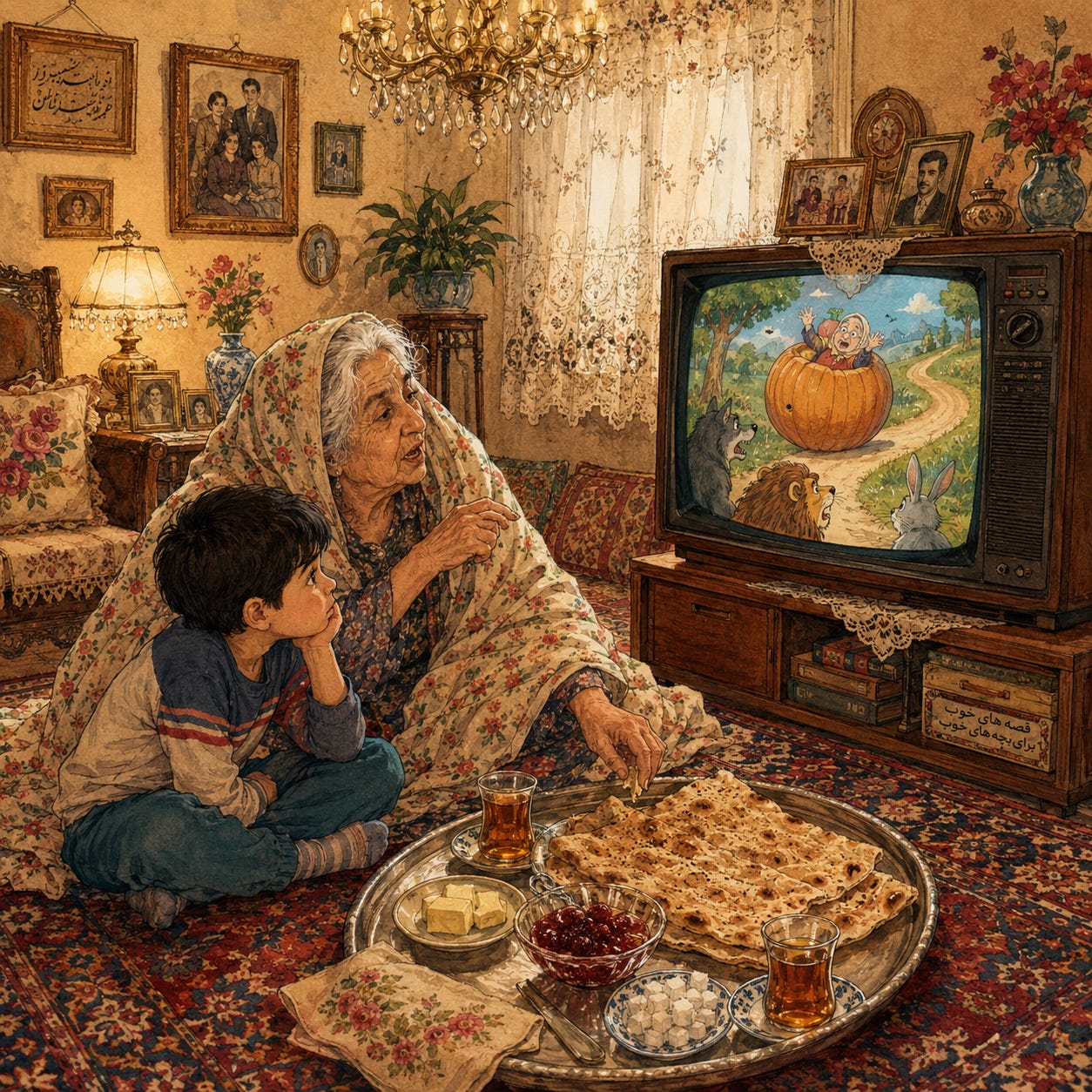
The funeral was a sea of black.Black chadors. Black banners. Black turbans. Black cloth stretched across buildings and avenues. Black gathered into such density that it seemed less like color than atmosphere, as though the state had found a way to manufacture night and march it through the streets.The cameras moved over the crowd slowly, reverently, searching for grief and finding it everywhere. Women stood packed together beneath the weight of the same garment. Men struck their chests. Voices rose in lament. Portraits of the dead towered above the living.I watched and felt revulsion.The word came before I could discipline it.Ugly.The faces looked ugly. The music sounded ugly. The whole spectacle seemed to belong to a civilization that had forgotten color, forgotten pleasure, forgotten the human face except as an instrument of mourning.And then I hated myself for the word.Because something beneath it had begun to break open.I remembered the old women.Not these women, exactly. Or perhaps these women before the state had placed them inside its frame. I remembered women in flowered chadors, pale cotton covered in small red roses, green leaves, blue vines. Chadors worn inside the house, lightly, almost carelessly, drawn around the shoulders when someone entered the room, pulled forward during prayer, dropped back again while tea was poured.They did not look like symbols.They looked like women.They sat against cushions with their knees drawn up, surrounded by daughters, sisters, grandchildren, neighbors, cousins, people entering and leaving without announcement. There were narrow glasses of tea darkened by sugar. Plates of fruit. A knife moving through apple skin in one unbroken spiral. A television speaking too loudly from the corner.And when the television showed the clerics, the speeches, the endless declarations of victory and sacrifice, those women swore at it.They swore with fluency.They cursed the officials, the lies, the pompous voices, the men who spoke of God as if He had appointed them personally to explain hunger to the hungry. They mocked their faces. They called them thieves. They insulted their fathers and mothers. Then they adjusted the chador beneath their chin, poured more tea, and continued the story they had been telling before the propaganda interrupted.That is the Iran I remembered.Not unveiled modernity standing heroically against darkness. Not secular virtue fighting religious backwardness. Not the clean architecture of ideological categories.A woman in a flowered chador calling the Islamic Republic liars.She may have prayed five times a day. She may have believed in saints, dreams, omens, jinn, the evil eye. She may have disapproved of half the modern world. She may have carried the moral severity of generations inside her.And still she knew a fraud when she saw one.She covered her hair and uncovered everything else.Her contempt. Her humor. Her suspicion. Her authority. Her tenderness. Her capacity to say that a man speaking in the name of God was full of s**t.No state had granted her that freedom.It was already hers.This is what ideology cannot understand. It knows only categories because categories are easier to govern than people.Veiled means submissive.Unveiled means liberated.Religious means loyal.Traditional means obedient.Modern means Western.The regime depends on these equations. So do many of its enemies.Both require the woman to become evidence.The Shah wanted her unveiled so that the nation could prove it had entered modernity. The Islamic Republic wanted her veiled so that the nation could prove it had returned to virtue. One exposed her hair for the photograph. The other covered it for the procession.Neither asked who she was.Neither understood that she could pray and rebel, obey and mock, submit in one register and remain sovereign in another. Neither understood that contradiction was not confusion. It was life.The grandmother in the flowered chador had no need to resolve herself into a political thesis.She was devout and vulgar.Tender and severe.Superstitious and shrewd.Bound by custom and capable of seeing straight through power.She did not experience these traits as contradictions because no doctrine had yet forced her to explain herself to history.She simply lived.The Islamic Republic’s great cultural theft was not that it invented the chador.It did something more cunning.It seized an inherited form and claimed ownership of its meaning.It took the chador from the house and placed it on the state.It took mourning from the family and placed it in the street.It took the grief of mothers and used it to sanctify war.It took the dignity of modesty and converted it into compliance.It took the moral authority of old women and placed their silhouette behind men with microphones.It took the garment and turned it into a uniform.The difference is not fabric.The difference is possession.The old woman wore the chador.The regime wants the chador to wear the woman.In the house, the garment moved with her. It slipped from one shoulder. She gathered it with one hand while reaching for tea with the other. A child crawled beneath it. A corner of it became a handkerchief, a blanket, a curtain, a private little tent between grandmother and grandchild.The cloth was not sacred because the state declared it sacred. It was sacred because life had passed through it.It smelled of soap, rosewater, kitchen smoke, prayer, age.It belonged to a body with a name.In the state ceremony, the body disappears.The woman becomes black shape.The black shape becomes crowd.The crowd becomes proof.The proof becomes propaganda.The camera does not ask who she loved, what she feared, which cleric she despised, what joke she told at weddings, what lie she refused to believe.It needs only the silhouette.That is why the sea of black unsettled me.I was not only seeing women.I was seeing the state’s fantasy of women: interchangeable, grieving, pious, politically legible.I was seeing the private civilization of the household stripped of its flowers and conscripted into mourning.And I almost believed the image.I almost let the regime teach me how to look at them.I called them ugly.That was its victory.Because power does not succeed only when it makes people obey. It also succeeds when it teaches the exile to despise what power has stolen.The regime confiscates the grandmother’s garment, parades it before the cameras, and waits for us to recoil from her.It turns inheritance into embarrassment.It makes resistance feel like betrayal.It takes what belonged to the women and makes it resemble the men who rule them.But the old women knew the difference.They knew it without theory.They watched the television and cursed.The television was always there.It spoke in the background through dinners, visits, funerals, afternoon naps. It announced victories no one had seen, enemies no one had met, plots so vast they explained everything and nothing. It narrated scarcity as sacrifice and failure as resistance. It offered martyrs in place of futures.The state entered every home.But it did not become every home.The television declared.The grandmother interpreted.That distinction was the last frontier.They owned the broadcast.She owned the room.And the room was not small.It contained the family, the dead, the neighborhood, the village left behind, the recipes no one had written, the names of relatives no child could keep straight. It contained marriages, betrayals, illnesses, prayers, gossip, warnings, curses.It contained stories.Before I remembered their plots, I remembered the sound of them beginning.Yeki bud, yeki nabud.There was one, there was no one.Apart from God, there was no one.The opening itself was a gate.The room changed when the words were spoken. The old woman became older than herself. The child became quiet. A wolf came to the door. A pumpkin rolled down a road. A clever girl escaped a div. A mouse married a cockroach. A patient stone absorbed a woman’s grief until it shattered.These stories were not clean. They did not teach obedience in the simple way authority prefers.They were full of deception.The wolf disguised its voice.The older brothers betrayed the youngest.The powerful were often fools.The weak survived through cunning.Old women negotiated with animals.Girls crossed thresholds men had warned them not to cross.Monsters were real, but so was wit.The state gave us slogans.The women gave us plots.A slogan closes the world.A story opens it.A slogan tells you who is innocent and who is guilty.A story makes you wait.A slogan announces that history has already been understood.A story says the wolf may return with a different voice.This was the rival sovereignty of the grandmother.She did not need an office, an army, a newspaper, a pulpit.She shaped the moral imagination of the room.She taught children that danger could lie, that authority could be foolish, that kindness might be rewarded, that grief required witness, that survival often belonged to the one who could recognize disguise.The state spoke of enemies.She told us how enemies behaved.The state spoke of sacrifice.She told us what was lost.The state spoke of virtue.She told us which person in the family had actually shown it.Perhaps that is why authoritarian systems fear ungoverned memory.They can tolerate folklore as decoration.They cannot tolerate it as method.A living story refuses the state’s monopoly over meaning.It carries too many voices.It remembers that the oppressor often calls himself father.It remembers that the beast may arrive sounding like the mother.It remembers that the smallest child may be the only one who sees through the door.Now I am crying because I remember the women but not the stories.This is the cruelty of memory.The room remains before the words do.I can see the flowered chador more clearly than I can remember the tale told beneath it. I can see the hand holding the edge of the cloth. I can see the tea. I can see relatives sitting close enough that no one’s body belonged entirely to itself.But the plots have thinned.The names are fading.The old women have become atmosphere.They were archives without institutions.They carried family history, folk religion, lullabies, recipes, insults, warnings, ancient fears, local myths, the memory of winters, births, epidemics, migrations, marriages. They carried all this in bodies history would never record.When they died, libraries burned quietly.No newspaper marked the loss.No university catalogued the disappearance.No ministry declared a day of mourning for the vanished sentence, the forgotten ending, the story no one else knew.A grandmother died.A world lost its narrator.Perhaps that is what the tears know.Not only that the women are gone.That I returned too late to ask what they had been saying.I remember that they told me stories before I can remember the stories themselves.And now the Islamic Republic places another old woman before the camera, covers her in black, points to her grief, and says: This is Iran.The West looks and agrees.One side says: Here is authentic piety.The other says: Here is oppression.Both see the cloth.Neither sees the room.The regime flattens her into devotion.Exile flattens her into victimhood.Modernity looks backward and asks why she did not become someone else.But she was someone.That is the fact every ideology misses.She was not waiting to be interpreted.She was not an unfinished liberal subject.She was not a primitive version of the modern woman.She was not the regime’s obedient mother.She was not the secular exile’s shame.She was a person whose complexity exceeded the vocabulary of those who came to rule her.She could wear the chador and despise the state.She could believe in God and reject His representatives.She could preserve custom and still recognize tyranny.She could frighten children with stories and protect them with the same voice.She could curse the television and then ask whether everyone had eaten.This was not political purity.It was civilization.The civilization did not survive only in books, monuments, dissidents, poets, intellectuals, revolutionaries, or exiles.It survived in women whose names history will never know.Women in flowered chadors.Women who cut fruit.Women who remembered the dead.Women who slept lightly.Women who knew which neighbor had suffered and which official was lying.Women who carried stories from one generation into another without ever calling themselves storytellers.Women who swore at the television.There is an old story of Naneh Sarma, Grandmother Winter.She waits each year for Amu Nowruz.She cleans the house.She prepares food.She dresses carefully.She waits for spring to arrive in the form of an old man she has missed for centuries.But before he comes, she falls asleep.He arrives and finds her sleeping.He does not wake her.He leaves a flower behind and goes.Each year they almost meet.Each year one arrives too late.Perhaps exile is this.A house prepared for return.An old woman waiting.A traveler arriving after sleep has already taken her.The stories are no longer being told.The room is colder.The television still speaks.But somewhere in memory there is a flowered cloth.That is what remains.Not the black of the funeral.Not the banners.Not the portraits.Not the men declaring what Iran is.A flower.Proof that someone came.Proof that someone waited.Proof that beneath the uniform, beneath the mourning, beneath the history written by men, there was once a woman who belonged entirely to herself.And when the state appeared on the television and claimed to speak for God, she pulled the flowers closer around her shoulders and told it exactly what she thought.—Elias WinterAuthor of Language Matters, a space for reflection on language, power, and decline This is a public episode. If you would like to discuss this with other subscribers or get access to bonus episodes, visit eliaswinter.substack.com
Embed this episode
NOW PLAYING
The Women Who Swore at the Television
No transcript for this episode yet
Similar Episodes
No similar episodes found.
Similar Podcasts
No similar podcasts found.