The Worker Still Waiting to Be Drawn
from Language Matters by Elias Winter Hosted by Elias Winter
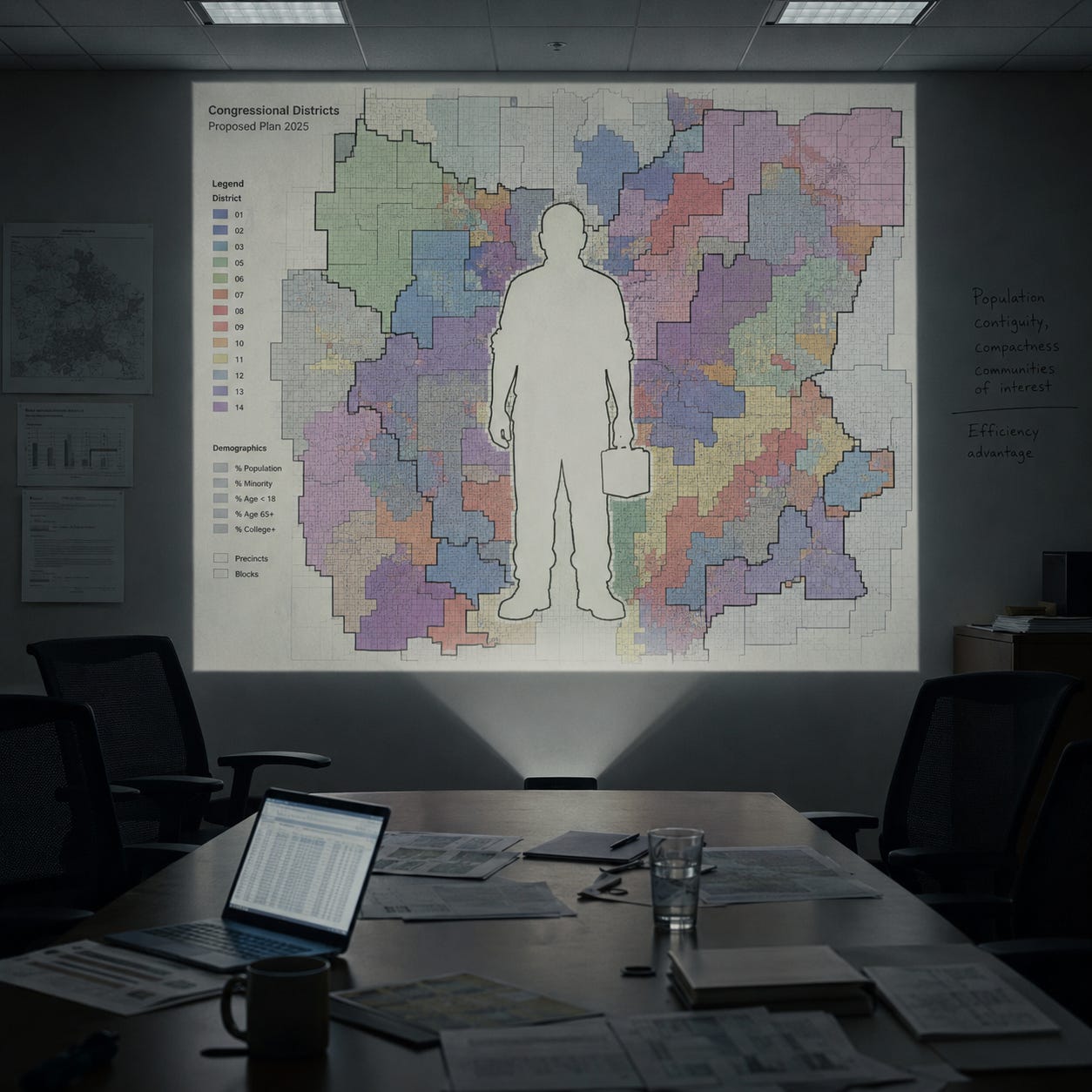
I. The Map Room There is a room somewhere in America where democracy is being handled without ceremony. It is not a battlefield.It is not a church basement.It is not a union hall, not a picket line, not a town square filled with people arguing about wages, rent, medicine, schools, childcare, or the closing of another factory that became a warehouse that became nothing. It is a conference room. The lights are fluorescent. The carpet is commercial gray. There are paper coffee cups on the table, laptops open, a projector humming faintly against the wall. Nobody looks especially evil. Nobody needs to. The modern machinery of power rarely requires theatrical wickedness. It requires credentials, software, deadlines, lawyers, consultants, and a morally dead vocabulary. On the screen is a map. A districting map. The counties are not counties anymore. They are units of performance. The neighborhoods are not neighborhoods. They are turnout assumptions. A Black precinct becomes a number. A Latino subdivision becomes a probability. A white exurb becomes a safeguard. A college town becomes a problem to be split. A working-class county becomes useful only if attached to the right suburb. Someone says “VRA compliance.” Someone says “minority-opportunity district.” Someone says “coalition district.” Someone says “incumbent protection.” Someone says “performance.” Someone says “efficiency gap.” Nobody says worker. Nobody says poor. Nobody asks what would happen if the people being sorted ever discovered that they were being divided from others who needed many of the same things. This is the genius of the American map. It does not merely reflect political reality. It teaches the country how to imagine itself. It tells people which solidarities are visible and which ones are impractical. It makes race legible. It makes class inconvenient. It allows power to be managed through representation while leaving untouched the economic machinery that governs most of life. In that room, the country is not governed. It is sorted. II. The Original Wound The first obligation is honesty. Race-conscious districting did not emerge because some liberal strategist woke up one morning and decided to divide America into ethnic boxes for sport. It emerged from a real wound. Black voters in the American South were not merely ignored. They were terrorized, excluded, fragmented, packed, cracked, intimidated, and legally erased. After Reconstruction, white power built political systems in which Black citizenship could be formal but ineffective. A Black person could, in theory, possess rights while living inside an electoral arrangement designed to ensure those rights never became power. This is why the Voting Rights Act mattered. Section 2 became one of the legal tools for challenging racial vote dilution: systems that may count minority voters while weakening their ability to elect candidates of choice. That distinction matters. A racial vote-dilution claim is not the same thing as a partisan-gerrymandering claim. A racial gerrymander is not the same thing as a majority-minority district. A district drawn with awareness of racial vote dilution is not the same as a district drawn with race as the predominant and unconstitutional purpose. The law itself has lived inside this tension: it has sometimes required states to take race seriously to avoid minority vote dilution, while also limiting how explicitly race may dominate line-drawing. Partisan gerrymandering is different. In Rucho v. Common Cause, the Supreme Court held that partisan-gerrymandering claims present political questions beyond the reach of federal courts. That left extreme partisan mapmaking largely outside federal judicial correction. But racial districting remained legally different, because the Constitution and the Voting Rights Act still place constraints around race, vote dilution, and representation. That tension sharpened again in Louisiana v. Callais. The Court held that the Voting Rights Act did not require Louisiana’s additional majority-minority congressional district and that the state’s race-conscious map was an unconstitutional racial gerrymander. The point here is not to solve election law in a paragraph. The point is simpler. Race had to be recognized because race had already been made into law, land, violence, wealth, housing, schooling, policing, and political power. The problem is not that race was recognized. The problem is that America found a way to recognize racial injury without fully confronting economic power. Civil rights law tried to prevent racial vote dilution. Party strategy later learned to metabolize that protection into coalition management. A remedy born from exclusion became, over time, one component in a larger system of managed representation. If we miss the first half, we become reactionaries pretending race never structured American democracy. If we miss the second half, we become liberals pretending recognition is liberation. Both are evasions. III. The Two Gerrymanders The two parties do not approach districting from identical moral or historical positions. The Republican logic is easier to see because it is more openly nostalgic, though not always more honest. Modern Republican mapmaking often benefits from the fusion of geography, race, property, rural overrepresentation, suburban fear, exurban identity, and anti-urban resentment. It does not always need to say “white power.” In polite legal language, it can say local control, traditional values, election integrity, constitutional order, rural voice, protection from urban machines. But beneath that language lies a moral geography. The city is treated as suspect.The suburb is treated as productive.The rural county is treated as authentic.The Black precinct is treated as machine politics.The white exurb is treated as the republic. This does not mean every Republican voter is a white nationalist. That would be analytically lazy and morally unserious. People vote Republican for many reasons: religion, guns, abortion, taxes, resentment of elite liberal culture, family inheritance, distrust of bureaucracy, fear of crime, hostility to rapid social change. But the machine does not require every passenger to understand the engine. The Republican Party has learned to convert white demographic anxiety into institutional advantage. Sometimes this happens through district lines. Sometimes through voter-access rules. Sometimes through courts. Sometimes through the Senate. Sometimes through the Electoral College. Sometimes through the constitutional romance of a past that becomes sacred precisely when the present becomes too diverse. These mechanisms should not be collapsed into one thing. A partisan gerrymander is not the Senate. Rural overrepresentation is not a voter purge. Racial vote dilution is not identical to the Electoral College. But they can rhyme politically. They can belong to the same project: preserving power for a coalition whose cultural imagination is still organized around an older America. The Democratic logic is harder, because it contains more truth. Democrats do not generally seek permanent white control. Their moral vocabulary is different. Their coalition is different. Their historical relationship to civil rights is different. But that does not make the Democratic relationship to districting innocent. The Democratic Party inherited the moral legitimacy of civil rights and learned to house it inside a neoliberal coalition. That coalition contains real historical victims and real contemporary elites. It contains Black urban voters, Latino workers, public-sector unions, college-educated whites, nonprofit professionals, tech donors, finance donors, teachers, nurses, consultants, civil rights organizations, university administrators, municipal machines, and people who simply understand that the other party may place them in danger. This coalition is morally complicated because America is morally complicated. The Democratic Party needs racial minorities electorally. But many of it… This is a public episode. If you would like to discuss this with other subscribers or get access to bonus episodes, visit eliaswinter.substack.com
Embed this episode
No transcript yet.