
EPISODE · May 3, 2026 · 46 MIN
The World They're Building Toward
from Untangled · host Charley Johnson
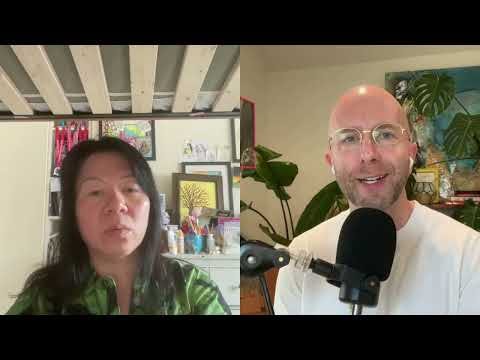
Hi there,This week I’m sharing a conversation I had with Bo Young Lee, CEO of AI4All about Silicon Valley imaginaries, rational refusal, and the futures we haven’t been offered. As always, please send me feedback on today’s post by replying to this email. I read and respond to every note.On to the show!Untangled HQ* Wednesday, May 5: I’m hosting a workshop on how to trace what must stay human when implementing AI responsibly. It will double as a preview of my new course on stewarding AI. * Thursday, May 6: As part of The Facilitators’ Workshop, Kate and I are hosting a workshop on how to turn stuck meetings into breakthrough moments. * Tuesday, May 12: Aarn and I are hosting a workshop on the discipline of holding tension: how to name tension without personalizing it, slow the moment without stalling the meeting, and protect the disagreement that actually matters. Join us!Deep DiveThe World They’re Building TowardStart with the bunkers.In the last several years, a number of Silicon Valley’s most powerful technologists have been quietly building survival infrastructure. Bunkers in New Zealand. Fortified compounds in remote locations. Escape hatches from the civilization their products are shaping.Bo Young Lee noticed this before most people were talking about it, and she asked the obvious question: if these are the imaginaries — the foundational visions of the future — animating the people building our most consequential technologies, what does that tell us about the products they’re building? And how does their imaginary constrain our imagination?An imaginary is not a fantasy. It’s the operative picture of the future that structures present decisions — the unstated assumptions about where the world is going that determine what problems are worth solving, what risks are worth taking, and what populations are worth designing for. Imaginaries are embedded. They show up in product decisions, in hiring, in what gets funded and what gets ignored.Bo argues that the dominant Silicon Valley imaginary is, at its core, a story about inevitability and survival. Civilization is fragile. Disruption is coming. The question isn’t whether things collapse but who gets to build what comes next. If that’s the picture of the future you’re working from — even unconsciously — you’re not going to prioritize safety, privacy, or good governance in the present. Those things just get in the way!As Bo explains, the products that follow are predictable. Why design for women when women don’t figure prominently in survival scenarios? Why prioritize people with disabilities when they’re among the first casualties of disaster-oriented futures? Why hold yourself accountable to the communities your technology harms when they’re not in the imaginary?This isn’t hyperbole. Bo is describing a logical coherence between worldview and product — a through-line from the bunker to the algorithm that becomes visible once you start looking for it. Take the supposed ‘AI gender gap.‘ The narrative goes something like this: women are underrepresented in AI adoption because they lack confidence, access, or awareness. All we need to close the gap is a li’l education, outreach, and encouragement! Bo argues that women’s skepticism about AI is rational. Not because women don’t understand the technology, but because they understand it clearly enough to recognize that it wasn’t built for them, doesn’t work as well for them, and in specific contexts actively harms them.Right, women face systematically harsher professional consequences than men for identical workplace errors — a well-documented asymmetry researchers call the “tighter world” phenomenon. Women are more likely to be fired for mistakes and less likely to find subsequent employment. When a high error rate tool like generative AI enters that context, the risks land differently. Men’s mistakes get absorbed as the cost of experimentation. Women’s mistakes land on a narrower margin. A woman who understands this and proceeds with caution is doing the math. Calling that a confidence problem is its own kind of imaginary!The “AI for good” movement is similarly trapped by the Silicon Valley imaginary, but they don’t see through it in the same way. As Bo argues, the AI for good world has largely accepted the imaginaries it inherited. Its animating question is how to reduce harm within the existing AI paradigm — how to make the technology that’s been built safer, fairer, less biased. For example, Bo describes a philanthropy that funded three separate organizations — at seven-figure grants each — to build AI agents that would coach and tutor low-income, first-generation college students. The goal was equity. But research shows that when you train LLMs to eliminate overt racism, the covert bias doesn’t disappear — it actually increases. Show the same model two pieces of writing, one in standard English and one in African American Vernacular English (AAVE), and the LLM will rate the AAVE writer as less intelligent and less educated. A coaching agent built on that model, deployed to help first-generation students many of whom communicate in AAVE, may well steer those students toward easier majors and less rigorous courses — without anyone noticing, without anyone intending it.This example starts from a present-tense imagination of what AI is and what it’s for, and works forward from there. To free ourselves from these constraints, we have to separate refusal of this AI from refusal of AI altogether. Because when we do that, we can ask the more generative question that rarely gets asked: what futures do we actually want — and what would it take to build toward them?Bo’s organization offers one path forward. AI4All trains the next generation of AI practitioners from underrepresented communities, asking them from the beginning to identify social problems they want to address and work backward to the role AI might play. Because changing the imaginaries requires changing who builds the technology and who gets to define what it’s for. A more diverse AI workforce is an epistemic necessity — different people imagining different futures producing genuinely different technology.We were not given these imaginaries. We don’t have to keep them.Tools for WeaversMy conversation with Bo inspired me to distill a number of the articles I've written about imagination, building alternative AI futures, and mapping backwards from the future -- and turn them into a tool!Your strategy documents already contain a picture of the future. You probably haven’t named it. It’s embedded in your metrics, your hiring plans, your roadmaps — quietly nudging you toward a particular kind of future without anyone actively choosing it.Imagining Otherwise is a practice for naming that picture — and then building a different one. Backcasting, futures in plural, and the question most teams skip: what are we willing to stop?Working canvas included. The last page will make sense when you get there.“Remember to imagine and craft the worlds you cannot live without, just as you dismantle the ones you cannot live within.” - Ruha BenjaminWork With MeHere are 3 ways I can help:* Advising: I can help you navigate uncertainty, make sense of AI, and steward change in your system.* Organizational Training: Everything you and your team need to cut through the tech-hype and implement strategies that catalyze true systems change. (For either Stewarding AI or Systems Change for Tech & Society Leaders)* 1:1 Leadership Coaching: I can help you facilitate change — in yourself, your organization, and the system you work within. This is a public episode. If you would like to discuss this with other subscribers or get access to bonus episodes, visit untangled.substack.com
Embed this episode
NOW PLAYING
The World They're Building Toward
No transcript for this episode yet
Similar Episodes
No similar episodes found.