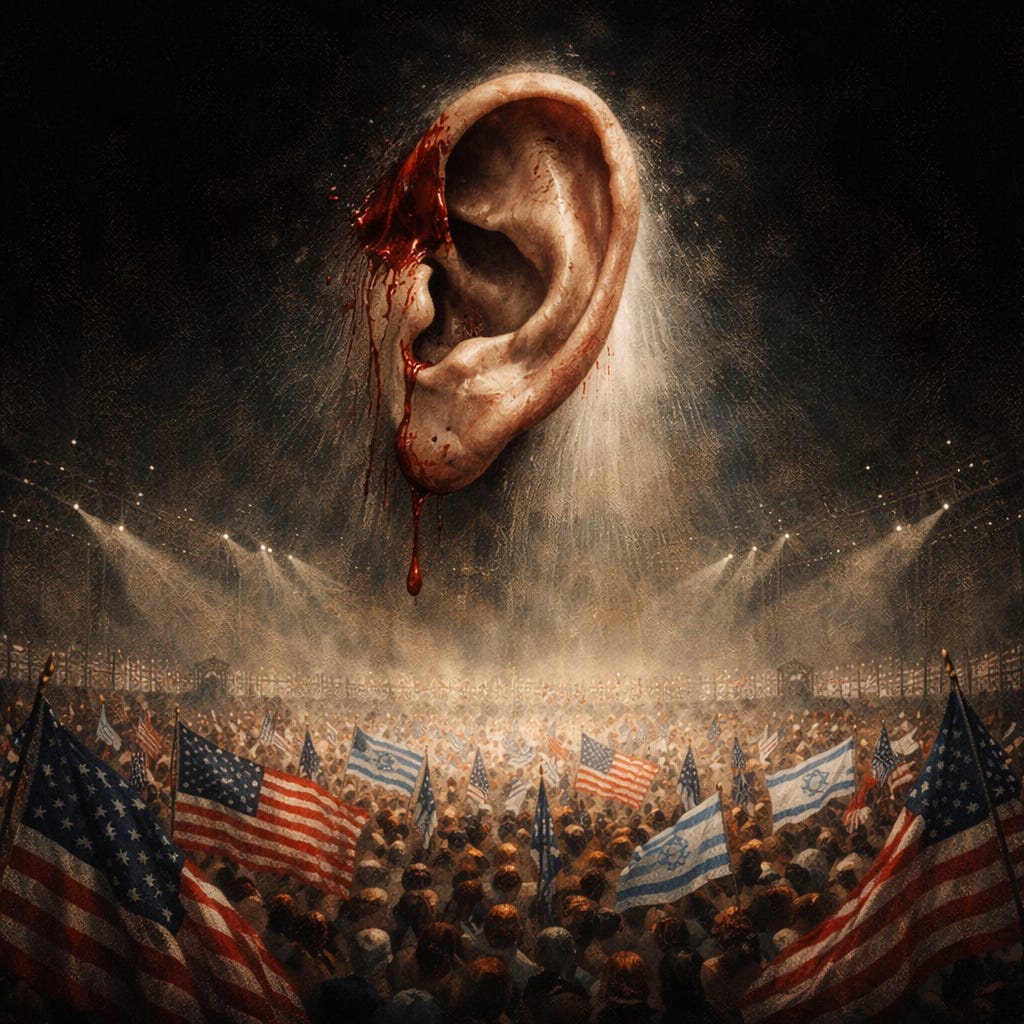
The Wound and the Flags
from Language Matters by Elias Winter Hosted by Elias Winter
I. The Wound There are moments in the life of a republic when blood does not remain blood for very long. It becomes symbol. Then permission. Then law. He stood under the lights as many men before him had stood under lights: swollen with grievance, padded by applause, carried upward by the low mechanical faith of crowds. He had been known for appetites, for vulgarity, for lies worn openly as style. He had been known for the usual vices of aging empires: excess without shame, cruelty without reflection, appetite without limit. No one had mistaken him for a saint. No one had mistaken him for a martyr. Then the wound appeared. Not a mortal wound. Not enough to end him. Not enough to still the body or extinguish the voice. A wound placed where all could see it, bright as insignia, intimate enough to humanize and theatrical enough to transfigure. Blood near the head has always had a genius for rearranging the moral imagination. The ear, of all places: near hearing, near obedience, near the place where men receive commands and call them destiny. And in the instant after, before thought had time to discipline feeling, the metamorphosis was complete. The man of vice rose into half-sacred light. A creature of appetite became a figure of ordeal. The same mouth that had trafficked in resentment was now read as the mouth of one who had endured persecution. A body that had belonged to spectacle was suddenly draped in sacrificial meaning. The republic, stupid with symbols, did what decaying republics do best: it confused survival with anointing. The old stains vanished under new radiance. His vulgarity became authenticity. His malice became courage. His ethical corruption became proof that he was hated by the right enemies. Nothing purifies a compromised man faster than visible injury at the right political hour. Nothing repairs a reputation like blood that arrives on schedule. That is why the question began there, with the wound itself. Not only what happened, but what the wound did. Not only who fired, but who profited. Not only whether the man had been touched by violence, but whether violence had been converted into liturgy with impossible speed. When a wound produces power that quickly, one must ask whether it was only a wound. Because there are accidents that alter history, and there are events that arrive already dressed for coronation. There are injuries that weaken, and injuries that enthrone. There are moments when flesh is pierced, and moments when an empire finds the exact amount of blood it needs to resume believing in itself. The republic looked upon the wound and saw suffering. The movement looked upon the wound and saw authorization. The donors looked upon the wound and saw acceleration. The priests of spectacle looked upon the wound and saw a script so perfect it hardly needed editing. The wound did not merely strike a man. It struck the atmosphere. It rearranged the moral weather. It elevated what had been tawdry into something terrible and half-mythic. It took a figure already inflated by grievance and gave him what grievance alone could never provide: sanctity by abrasion. And so the age entered its next phase not through argument, not through truth, not through democratic consent, but through the old alchemy by which blood becomes story and story becomes power. The wound was small. Its consequences were not. II. The Man Who Was Allowed to Live There is another way to read such moments, and it is the darker way, the more ancient way, the way known to courts and empires long before the republic learned to call itself innocent. A failed killing is not always a failure. Sometimes the point is not death. Sometimes the point is demonstration. To place mortality near a man’s face and then withdraw it is to speak to him in a language older than speech. It is to say: you are penetrable. It is to say: the line between your breath and your absence is thinner than you thought. It is to say: what can be done can be done again. It is to say: live now with the knowledge that your continued life is legible to powers beyond you. In that reading, the spared life becomes a leash. The crowd sees miracle. The man feels proximity. The nation sees providence. The target feels management. Those who chant his name imagine that he has conquered death, when in fact he may only have been introduced to the terms under which he is permitted to postpone it. There is a kind of survival that enlarges a man. There is another kind that enters him like a hook. He rose from the event outwardly enlarged, yes. But what if inwardly he had been reduced? What if the great public ascent concealed a private narrowing? What if the price of surviving the wound was not freedom but obedience to those whose reach had just been exhibited? This is how old systems govern the useful. Not always through explicit command. Sometimes through revelation. They reveal the gap between power and exposure. They remind a ruler that he is not the summit but the instrument, not the sovereign but the bearer of arrangements made elsewhere. He is shown, in one unforgettable gesture, both his indispensability and his replaceability. And once shown, he need not be told much more. The genius of a spared death is that it can produce gratitude where open coercion would produce rebellion. A man who believes he has been delivered may call his handlers saviors. A man who knows he was spared may call his obligations loyalty. A movement that sees resurrection may never notice the chain. So he entered the next stage haloed by injury, crowned by near-loss, wrapped in the mysticism that only danger can provide to men who have already exhausted every lesser form of self-dramatization. He did not emerge merely stronger. He emerged more usable. A man recently acquainted with death is often ready to call necessity by nobler names. And the crowd, as always, mistook theater for transcendence. It never occurred to them that a man can be elevated and captured at the same time. They imagined the wound had liberated him into destiny. They did not consider that it may have bound him more tightly to forces already moving beneath the visible surface of events. That his blood had not freed him from obligation but deepened it. The republic prefers bright myths. It does not enjoy considering that a public miracle may be, from another angle, a private memorandum. That what looked like the birth of a martyr may have been the disciplining of an asset. But power has always understood what crowds refuse to understand: that fear can be more effective when it leaves the body standing. A corpse ends utility. A living man with a vivid memory can still sign papers, appoint zealots, authorize raids, sanctify wars, inflame mobs, and call all of it history. The dead cannot serve. The spared can. And so the great confusion of the age deepened. The man who had been allowed to live was greeted as one chosen by heaven. Yet perhaps he had only been informed, in the most unforgettable way possible, that heaven was not the hand nearest to him. III. The Convention of Flags Then came the convention, which was less a gathering than a rite, less a meeting than an enthronement ceremony for the newly wounded. And there, amid the slogans and the staged patriotism and the rehearsed spontaneity of a movement that had long since forgotten the difference between devotion and production, another image took hold. Not the image on the stage, but the field around it. Not the man, but the symbols through which the atmosphere announced its deeper loyalties. A sea of flags. Not the expected flags alone, though there were plenty of those, draped as always over grievance and nostalgia and the fantasy of violated innocence. No. Intermixed among them, dispersed through the crowd, raised high by hands that had come ostensibly to celebrate the nation, was the iconography of another state. Foreign banners flickering in an American coronation. A nationalist spectacle saturated with borrowed sovereignty. One saw women i… This is a public episode. If you would like to discuss this with other subscribers or get access to bonus episodes, visit eliaswinter.substack.com
Embed this episode
No transcript yet.