
EPISODE · Dec 27, 2018 · 1H 10M
The year in post-quantum crypto (35c3)
from Chaos Computer Club - archive feed (high quality) · host djb, Tanja Lange
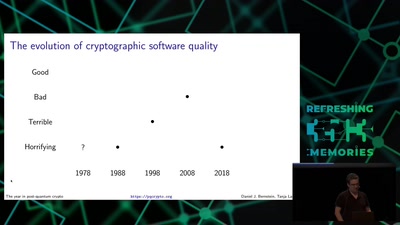
The world is finally catching on to the urgency of deploying post-quantum cryptography: cryptography designed to survive attacks by quantum computers. NIST's post-quantum competition is in full swing, and network protocols are exploring post-quantum extensions. This talk will take the audience on a journey through selected recent highlights from the post-quantum world. Post-quantum cryptography has become one of the most active areas in cryptography, trying to address important questions from potential users. Is post-quantum cryptography secure? In the first ten months of this year we have seen several serious breaks of submissions to the NIST competition. At this point, out of the original 69 submissions, 13 are broken and 8 are partially broken. Are the remaining 48 submissions all secure? Or is this competition a denial-of-service attack against the cryptanalysis community? NIST will select fewer candidates for the 2nd round, but it is not clear whether there is an adequate basis for judging security. Does post-quantum cryptography provide the functionality we expect from cryptography? For example, the original Diffie-Hellman system provides not just encryption but also more advanced features such as non-interactive key exchange (not provided by any NIST submissions) and blinding. The era of post-NIST post-quantum cryptography has begun with the exciting new CSIDH proposal, which has non-interactive key exchange and is smaller than any NIST submission, but uses more CPU time and needs much more study. Is post-quantum cryptography small enough? Even for network protocols that rely purely on encryption, integration remains a major problem because of the bandwidth requirements of most post-quantum systems, especially the post-quantum systems with the strongest security track records. Experiments with integration of post-quantum cryptography into TLS have focused on encryption without post-quantum authentication. A new generation of network protocols has been designed from the ground up for full post-quantum security. Is post-quantum cryptographic software fast enough, and is it safe to use? Adding post-quantum cryptography to the cryptographic software ecosystem has produced a giant step backwards in software quality. Major areas of current activity include software speedups, benchmarking, bug fixes, formal verification, patent avoidance, and development of post-quantum software libraries such as Open Quantum Safe and libpqcrypto. The talk will be given as a joint presentation by Daniel J. Bernstein and Tanja Lange. about this event: https://fahrplan.events.ccc.de/congress/2018/Fahrplan/events/9926.html
Embed this episode
Ready to play
The year in post-quantum crypto (35c3)
No transcript for this episode yet
Similar Episodes
No similar episodes found.
Similar Podcasts
No similar podcasts found.