
EPISODE · Oct 7, 2021 · 3 MIN
The Z Boson
from The Field Guide to Particle Physics · host Sean Downes
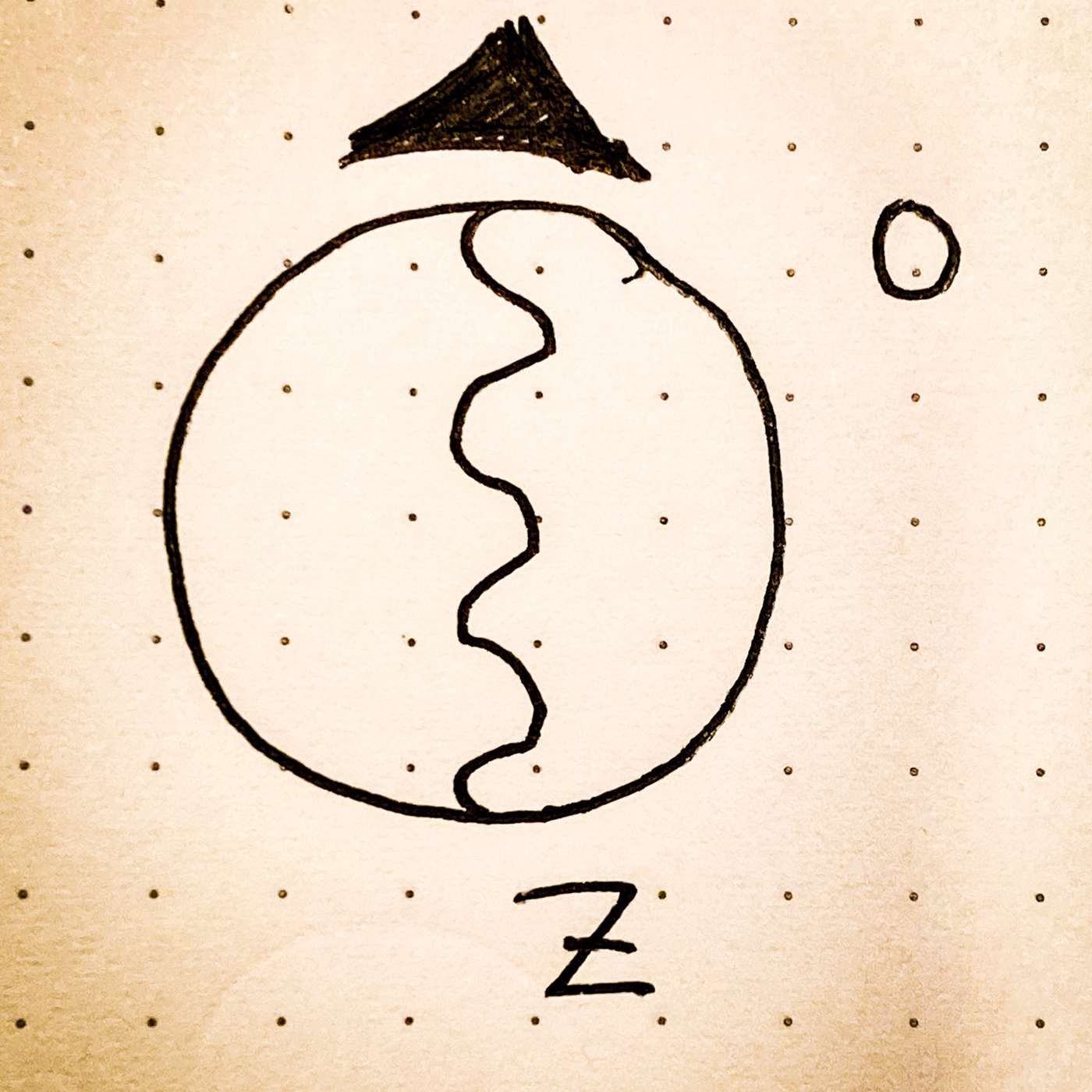
The Field Guide to Particle Physics https://pasayten.org/the-field-guide-to-particle-physics ©2021 The Pasayten Institute cc by-sa-4.0 The definitive resource for all data in particle physics is the Particle Data Group: https://pdg.lbl.gov. The Pasayten Institute is on a mission to build and share physics knowledge, without barriers! Get in touch. The Z Boson Every once in a while, without warning, an electron is accelerated seemingly out of nowhere. Ripped from whatever atom, molecule or metal it had been associated with, it suddenly becomes it’s own ballistic particle. When this happens, a Z-boson has almost certainly been involved. With a mass of 91.2 GeV, the Z boson is the slightly heavier cousin of the W-bosons. Together, W+, W- and Z0 all mediate the weak nuclear force. That is to say, particles with a weak charge toss them back and forth as a way to communicate that force. The W’s are famous for radioactive beta decay. The Z’s presence is more subtle. But all three are strictly left handed. Unlike the W’s, the Z boson has no electric charge. Like the photon, the Z boson is its own antiparticle. In many ways, the Z-boson is very similar to the photon. They share a common origin. They are quite literally mixed up with the Higgs boson. The Z’s don’t hang around very long. Being so heavy, they decay into all kinds of things: quarks, muons, neutrini, you name it! Like the W’s, they appear for something like 3×10^−25 seconds before decaying. A photon can’t even get across a proton that quickly. In principle, the proton and the electron should be able to communicate by sending both photons and Z-bosons. Although the Z-boson’s mass means that the strength of such interactions between particles dissipates quickly with distance, further diluting the already weak, weak nuclear force. That said, the Z can a have dramatic effect on everyday particles. Because the weak force is so weak, the humble neutrino almost never interacts with anything. This is probably good, because there are unfathomably many of them all around us, all the time. Given the sheer number of neutrini, it is a statistically inevitable that one will interact with something. A neutrino can push on an electron by the quick exchange of a Z-boson, a bit like throwing a bowling ball at an ice skater. Since we can’t otherwise see the neutrino, and the Z decays so quickly, from our perspective it will appear that the electron suddenly was accelerated, seemingly out of now here.
Embed this episode
What this episode covers
Every once in a while, without warning, an electron is accelerated seemingly out of nowhere. Ripped from whatever atom, molecule or metal it had been associated with, it suddenly becomes it’s own ballistic particle. When this happens, a Z-boson has almost certainly been involved.
Ready to play
The Z Boson
No transcript for this episode yet
Similar Episodes
No similar episodes found.
Similar Podcasts
No similar podcasts found.