
EPISODE · Nov 15, 2020 · 13 MIN
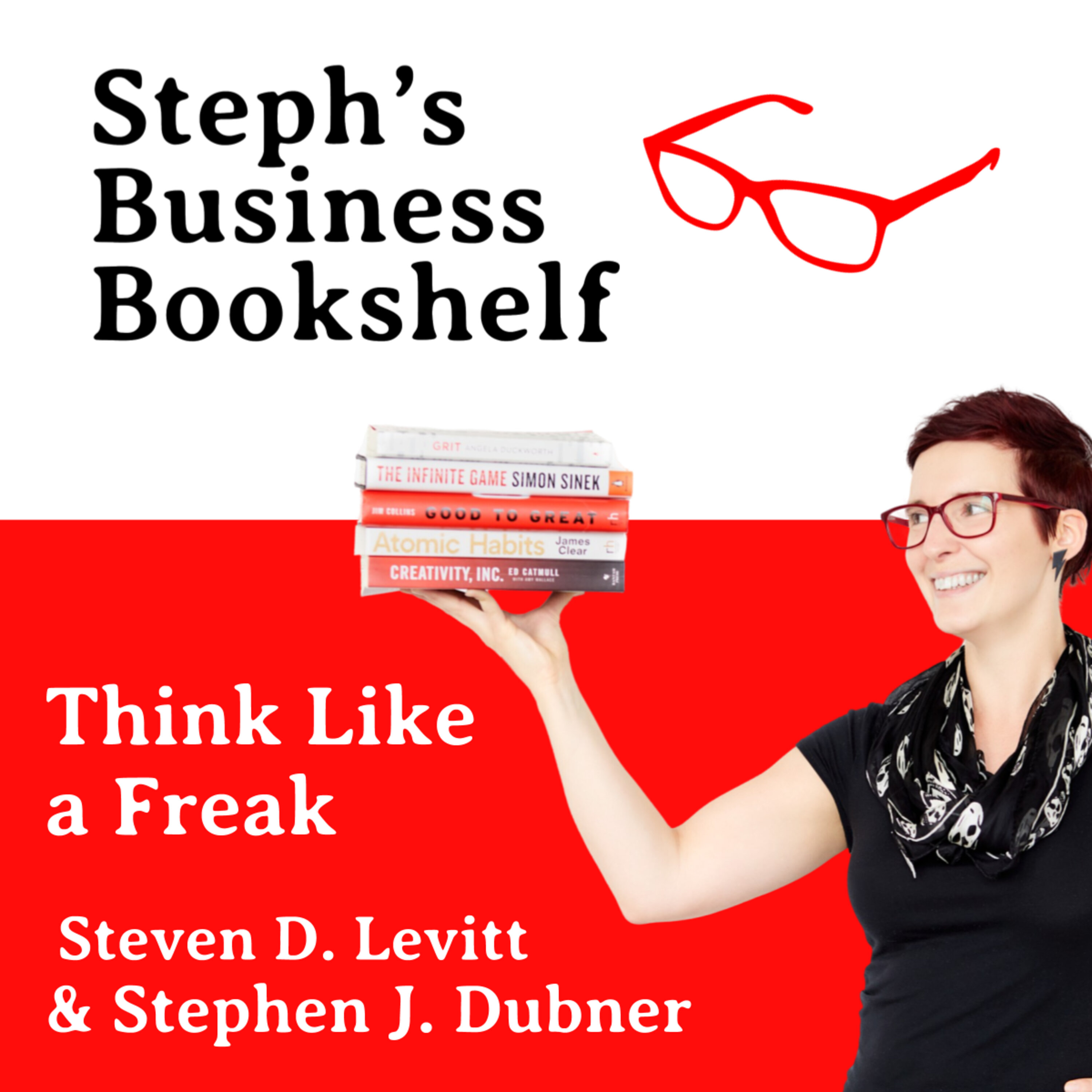
Think Like a Freak by Steven Levitt and Stephen Dubner: Why morals can get in the way of the right answer
from Steph's Business Bookshelf Podcast · host Steph Clarke
About the Book With their trademark blend of captivating storytelling and unconventional analysis, Steven D. Levitt and Stephen J. Dubner take us inside their thought process and teach us all how to think a bit more productively, more creatively, more rationally. In Think Like A Freak, they offer a blueprint for an entirely new way to solve problems, whether your interest lies in minor lifehacks or major global reforms. The topics range from business to philanthropy to sports to politics, all with the goal of retraining your brain. Along the way, you’ll learn the secrets of a Japanese hot-dog-eating champion, the reason an Australian doctor swallowed a batch of dangerous bacteria, and why Nigerian e-mail scammers make a point of saying they’re from Nigeria. Levitt and Dubner plainly see the world like no one else. Now you can too. Never before have such iconoclastic thinkers been so revealing—and so much fun to read.’ Source: https://www.amazon.com/ Buy the book from The Book Depository - https://www.bookdepository.com/Think-Like-Freak-Steven-D-Levitt/9780062295927/?a_aid=stephsbookshelf About the Authors Steven and Stephen are co-authors of the “Freakonomics” book series, which have sold millions of copies in 40 languages, and host of Freakonomics Radio, which gets 15 million global monthly downloads and is heard by millions more on NPR and other radio outlets. Steven D. Levitt is the William B. Ogden Distinguished Service Professor of Economics at the University of Chicago, where he directs the Becker Center on Chicago Price Theory. In 2006, he was named one of Time magazine’s 100 People Who Shape Our World. In addition to his academic and Freakonomics pursuits, he is a founding partner of TGG Group consulting firm. He lives in Chicago with his wife Jeannette and their four children. Stephen J. Dubner is an award-winning author, journalist, and TV and radio personality. Dubner’s journalism has also been published in The New York Times, The New Yorker, Time and elsewhere. He has taught English at Columbia University, played in a rock band and, as a writer, was first published at the age of 11. He lives in New York with his wife, the docu mentary photographer Ellen Binder, and their children. Source: https://freakonomics.com/about/ Would you like to take better notes from the books you read? Get your copy of Archley's beautiful book journal, the Book of Books here: https://www.archleys.com/?ref=JamVyS-U4mVR LINKS Freakonomics podcast No stupid questions podcastDubner and Levitt revisit the abortion research and its challenges: https://freakonomics.com/podcast/abortion/ BIG IDEA 1 (5:27) – Correlation is not oranges. There are many examples in the book around correlation not equaling causation. A lot of things require second order thinking, the question of ‘what else’. One example in the book is the famous connection between falling crime rates and the legalisation of abortion, 18-20 years earlier. This shows that answers might be uncomfortable but it doesn’t mean they should be ignored or unexplored. By digging in a little bit deeper, we make better choices and decisions by using the right information. The authors say that we sometimes need to put away our moral compass when trying to find out what’s really happening. Because we might miss things that we don’t like, but it doesn’t mean they are not true. BIG IDEA 2 (7:46) – Ask the right questions. The right questions might include – what will happen next? There are some examples in the books around unintended consequences as a result of (what seemed like genius) problem solving. We need to ask what else could be causing this, or what else is contributing to this situation. There was an example in the book about children who are having difficulties at school. Initial thoughts were that these kids weren’t very smart or even lazy. Turns out they just couldn’t see the board at the front of the room. A quick and cheap fix of giving them glasses meant they were able to contribute in class and do much better. There was a whole chapter in the book about understanding the root cause of problems. And understanding whether the cause is really the effect, and whether you helped a symptom or cured the actual problem. This requires the ability to say ‘I don’t know’ because if you don’t, you won’t be able to ask better questions. And in turn, won’t get better answers and better solutions. BIG IDEA 3 (9:56) – Quit more. The very core of thinking like a freak is the ability to let go. It is letting go of the system, limits, of saying you don’t know and of first order thinking. This can also involve quitting bigger things like jobs, relationships or alcohol, whatever it happens to be. If in doubt whether to quit something or not, toss a coin. It turns out that tossing a coin on a decision can take away the idea of failure, because *we* didn’t fail and quit, the coin told us to do it. Importantly, by quitting more, we can offset the opportunity of carrying on with things that aren’t serving us anymore and waste time that could be spent on other opportunities, tasks, relationships and activities. Music: Is It Hip-Hop by Lighbeats Support my book habit: https://www.buymeacoffee.com/stephsbookshelfSee omnystudio.com/listener for privacy information.
Embed this episode
NOW PLAYING
Think Like a Freak by Steven Levitt and Stephen Dubner: Why morals can get in the way of the right answer
No transcript for this episode yet
Similar Episodes
No similar episodes found.
Similar Podcasts
No similar podcasts found.