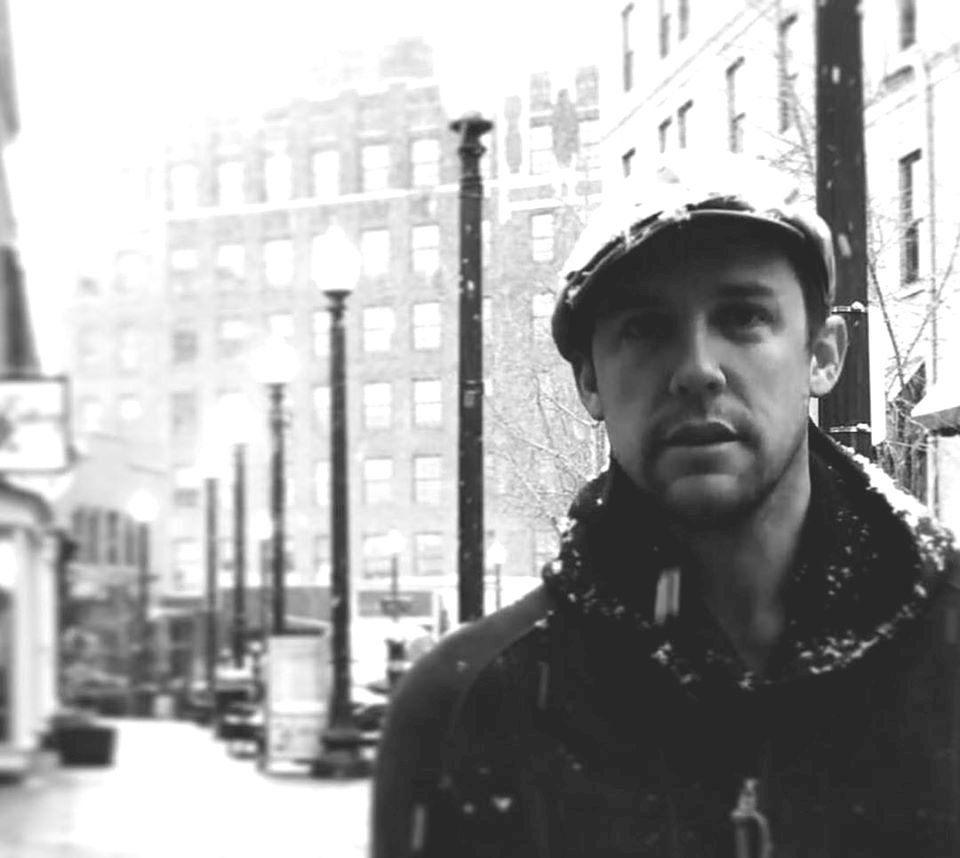
Hi, this is the next in a series of Encore episodes we're doing specifically during the coronavirus outbreak for our musician friends who have seen a sharp decline in their income due to the virus and the subsequent response and closing of a lot of venues. This episode features Threadbear, who is a bin mackerel, and this is his Threadbear project which is kind of a stripped down, almost Spartan version of some of his songs. You might also know Bin from the Blue Eyed Beddies, which is a bluegrass trio and sort of an intranational bluegrass trio as everyone lives in a different state and they get together to practice and play all over the country. You can find Bin performing as Threadbear at Threadbear Songs.com.
You can also find him on Facebook and Instagram on Bandcamp and a lot of other places and we'll put all of those links in the episode description and also on the social media posts. Mainly, if you enjoyed this episode, I would encourage you to go to Bin's tip jar which is actually the donation site for the Band Blue Eyed Beddies and that's www.theblueidbeddies.com here's the episode with Threadbear. Hello and welcome to Western North Carolina Original Music. Today's episode features Bin Mackerel performing his Threadbear, a special one on one episode.
Bin plays all over the country with his band the Blue Eyed Beddies, but for his Threadbear project he takes his music in a strikingly different direction. You could almost say the name is self-explanatory and not be too far off and it's tempting to do that but it's more complex than that. There's interplay between the words and the music, like in all songs, but there's also a percussive tone to Bin's enunciation and his dynamics of his guitar. You'll hear all that and I'm going to let you hear it right now.
Here's Bin Mackerel performing his Threadbear. Catching is about, you know, mornings. I recently discovered mornings. I originally am an actor and a touring musician so my lifestyle has always been late nights and I've recently come into love mornings.
I'm dating this girl, it's a teacher, she wakes up so early and I found that I love it and I love those times that we do get to sleep in together and enjoy a morning together and it's just a simple sweet song expressing how much I love it. My favorite line of this is the phrase feathering voice. I love that and it's the kind of thing where I never heard that phrase before but instantly knows exactly what I'm saying. I don't even know that I've heard it either.
It just kind of came out while I was writing it. A feathering voice, you know, I wanted to describe that early morning, what your voice does when you first wake up but it's still so sweet, you know, to hear the first thing in the morning, a feathering voice. I love it. I like the waking up with the love in my life.
I feel like I get from that and it might be wrong but without even saying it, it feels like it's for the first time or after a long time maybe. Right, yeah. It's like a new thing. You know the feeling but you haven't been there in a long time.
Yeah, it's exactly it. This town's changed. People are rearranging. It's not quite.
Now there's raging at night but the morning's much like you. With its lavender, feelings are rearranging. It's not about raging at night but now it's much past due. All this lavender hue.
So lavender hue is about, again, I drive a lot and think about things. I drive early in the morning sometimes and I was driving on 240, you know, and I still write over right where we're, you know, right where the bridge, over the river and you know, headed south. And I saw though that view of the mountains and it was so early in the morning where I got that perfect purpley kind of lavender hue. And I love it so much that just moment, you know, it only passes, you know, within 15 minutes.
There's a certain window where that color really pops out. And I wanted to write some sort of song about it and, you know, the lyrics in the song are so few, they're so sparse which has been a frequent thing of mine lately. And there's two verses. The first one is how the town has changed.
You know, this is Asheville and it's growing faster than it knows how to deal with and the people are different now. You know, I grew up in Hendersonville, North Carolina and came to Asheville often. And the people were, you know, just all these granola, maybe loving people. And now, you know, the more I don't want to get too political on anything, but like, it just seems like a lot more money is driving the town and a lot more visitors, which I love visitors coming and seeing it, but they're kind of over run it at night, you know, and there's just partying, you know, anyway, I love that side of life.
And I'm not unhappy that it's happening to Asheville, but sometimes I just miss the old, you know, so the first verse is about that and how you still get the sense of what Asheville was and is at heart in the morning. You know, you see that purple haze and I wanted to write something about that. And then I used that as an analogy in the second verse of lost opportunity, the way things change, the way I change. And you know, imagining what could have been.
Yeah. You talked about the, what was the word, did you say, sparseness of lyrics? Yeah. So I guess you have, like I was thinking about the space between the lines, which is really, just from a songwriting perspective, you know, I've heard like, sometimes more like classical composers talk about how a rest is a note, as well as the notes are, you know, you should use the rest and you kind of do that with your lyrics, even though the, you also do that musically as well, like your songs will stop, sort of almost stop and then start again, but it's actually just a rest.
Yeah, just like an art, you know, how important negative space is visual art. I mean, I think it's just as important in a song or in anything else in life, artistically or just in regular day to day life. You need that space. You need a rest so that you can enjoy anything else that comes in.
And I, like I said, earlier I'm an actor by trade and that's what I'm really trained in. All the songwriting stuff is really just a hobby that I'm trying to pursue more and more. And in theater, you know, they teach you, especially musical theater, which is what I, what I, what I foretay is that, you know, you don't, you don't speak unless you need to and then you don't sing unless speaking doesn't cut it. And then you don't dance unless singing and speaking doesn't cut it and stuff like that.
So it heightens each thing. And so I really like to pare down most of what I do to, unless it needs to be said, I don't, I'm not going to say it. That's why my lyrics are so sparse now, which I want to get my idea across in as little lyrically as I need as needs to be. So that those few lyrics do stand out.
And I'm not a verbose kind of fellow. I, you know, I, you can tell how many times I am and, you know, search for words in my regular speech that words just don't speak to me the way the music does. Like I, I, the way I listen to songs, I'll have to listen to some of my favorite songs five, ten times before I hear the lyrics. But I'll know what they're talking about.
I'll get the feeling. And, and, and just a couple lyrics here and there like, we'll sleep in my head and so I'll know exactly what they're trying to say. And that's, that's kind of what I do with my songs. We're with these threadbar songs.
Yeah. That's why the title, the name of this project, Threadbear, I like to just, it's that sense of worn comfort, barely holding on with just what you need to make it fabric. Yeah, it does. You know, I heard your music before I heard that, that name, but it really does fit.
And I think, you know, I hope I'm insightful enough that if I heard that, you know, hey, this guy, Threadbear's playing, I would have some, like, you know, I wouldn't know exactly what kind of music it was, but I would have some, some idea unless it was like ironic and a heavy death metal band, you know, but it was sincere. I would, I would be like, I kind of know that's going to be like a stripped down, like you said, only what you need type of music. Right. Yeah.
And then Mackle, because there's so many different sides of me, you know, Ben Mackle, when I think of a Mackle, I think of an actor, like, you know, I'm going to go see Ben Mackle, he's going to do some show and he's going to sing and dance or whatever. But Threadbear, you know exactly what you're going into. Although it is funny that you mentioned that heavy metal stuff, I looked up bands that are named Threadbear just to see if I, you know, I was going to use it anyway, just because it's what I need to be called, or these songs need to be called. But there is a heavy metal, like, I don't know, heavy metal is the right word, but there's a hard rock, like Threadbear band out there.
And so I figured I can be, I can still be Threadbear and people won't be confused. Yeah. Watching Don realign the dark morning, like, drinking water, just a cool, isn't something straight, just another way to lose control. Mmm.
The in dreamless never felt so. Haven't courage just to tell you what the other side of dark is like. I breathe it in and hope it lasts, oh, don't let it out and let them carry on. Sing along me so.
Mmm. Don't lie. Don't show me round. Don't lie.
Don't show me round. Don't lie. Don't show me round. Don't show me round from a sleeveless.
Watchin' Don realign the dark morning, like, instead of digging me out, just come on in with the pedal on. Sing along me. The morning light I wrote with, with my band or for my band, really, the Blue Eyed Betties. And it was at a point where I was falling in love with this morning, instead of the late night that I'm used to.
And I was getting out of a dark time, you know, this depression a lot happened to me, and it was about, you know, when people know that you're sad, two things generally seem to happen for me. They either want to try to fix you and make you better, or they just want to put you in a hole and say that's all you are and all you're going to be. You're just going to be the sad mess and I don't really want that in my life. And so it's hard to admit to people, the sadness that's consuming you at that moment.
And this is kind of like a song that tells people what they can do, you know, that last verse. I can stand inside my head for days, instead of digging me out, just come on in and put the kettle on. You know, just like come in here, sit with me for a bit, let me be sad. I'm going to get out of it eventually.
I know it. But right now, you just got to like, hunker down with me. And yeah, I saw this meme or some kind of comic strip, I guess, that was going around on the internet, and it described it perfectly. It was just like, is this guy going to blink it?
And his friend was like, what do you need? Do you want to come out? And he said, no. Do you want me to come in there?
And he said, OK. And he said, I don't know. I wish I could show you the picture right now, but he described it perfectly. And that's kind of what this song is.
Very my meat silver from a sky cross, lay it down easy, only for me. Very My Memories is a very intimate song about, you know, how to let go of something. I've got a lot in my past that I need to let go of, but I don't want to. I want to keep those memories and keep them near and dear to me.
But I know that I have to get over a lot of this stuff. So the visual in my head when I was writing this was, there's two ways to describe it. Very My Memories is a silver plated chest. So that could mean in a trunk, a chest of treasure or something, or it could be an armor, like silver plated over your heart, chest of armor, silver plated chest.
So it's either buried in the ground in this beautiful box or inside your chest and your heart, but protected, you know, from anything else. And I love the imagery and how it can spur in either images. Right. And the end of the song, it's one of the threadbare songs, one of the most threadbare I've got.
It's just two little verses and a lot of music in between. If I had, if I had a quartet, a string quartet and pianos and everything behind me, I would just let it sing for three times the amount of what I've played just now. And just to let all of the memories resurface and flow in anybody that's listening to the song, if they've felt like this at all, let them resurface and live in this beautiful music. And then at the end, have it go back and it's time to shut them down for a little bit and keep them safe and let me live without having to deal with it every day.
And the last words are, you know, not until I'm ready. And I hope you can hear the ellipses. That's the one we were talking about earlier. You play that I feel like you can hear the ellipses.
Like the last line trails off and then I'm looking at the written lyric and the written lyric has ellipses. You really do a good job of bringing that out. Exactly what I wanted. Yeah.
There's a line that could come right after that. I almost hope people can hear. I love that some songs I hear that I hear in a melody that like, oh, this lyric would fit perfectly there, but it doesn't need to go because I hear it in that music. It's like the lyric is that melody.
And so I hope that that comes out in some, in people's head. If it doesn't, that's totally fine. But it's there for me. I'm going to have more from Ben in just a few moments.
I want to remind you that you can find his music on Instagram at threadbarrisongs and look for his band, the Blue Eyed Beddies. As I said, find him on Facebook and the internet and all around town and the Eastern Seaboard. Hi. There's a lot of people who are really great at the intro about a couple of ducks.
Yeah. It wasn't just like a couple of ducks. It was interesting. Yeah, it's a true story.
It's great. I was an actor forever at the Barter Theatre in eight years up there. We lived in these actor housing. I don't want to tell a story too much, but these ducks, it's a beautiful story about how they make for life these Mallards.
They are just a heartbreaking tale of one of them having to let go. And it fit perfectly into that song. I did that to try to broaden my horizons about expand. I want to be able to tell stories and underscore myself.
I love that. One of my favorite songwriters, almost like a person I've looked up to when my entire life is David Wilcox. He's in Asheville. I've never met him, which is crazy to think about maybe a Will Sunday.
He has raised me almost in his songwriting. I told him, one of my friends opened for him in Salisbury, North Carolina one time, and I told him to tell him, I have a friend that thinks that if he's any semblance of a good person, it's because of your songwriting. I think that's the biggest compliment I could ever give him. I hope that he really took the heart.
He did tell him. He said, wow, that's a wonderful thing. It's all I could just say. I hope to tell him, one person one day, I'm probably going to pass him on the street.
I just never see him. Anyway, he does this wonderful storytelling in his live shows. I almost listen to his live albums more than his studio albums because I just love hearing his stories so much. I want to be able to do that to interweave stories and song and have morals come out and lessons and feelings just all boom.
I'm raised as an actor and telling stories has always been a big part of my life and doing it through music is really the goal now. That comes out like, if I didn't know that, I wouldn't think this guy's acting. Once you said that, I'm like, okay, he's, you know, because you have a very good presentation when you play live, you know, especially live, you know, engagement with the audience and stuff like that, but it seems sincere. Yeah.
That's very well said. Good. If you can fake sincere, you got it made. No, I really.
I'm really. One of the things about the way you're talking about it is you're using your acting background to sincerely bring out the things that you want to. Sure. Yeah.
Yeah. I really love, it's what I love about the music. I can't hide behind the character in this, you know. This is me.
It's frightening. Like every time I go up on stage, I have the lines that I am going to say memorized. I don't have to come over the end and I'm a different person, almost always, you know. And so I can hide behind that.
Wherever I'm feeling in life, I can hide behind that when I'm up on stage as another person. But now, as telling a story and doing music, it's so intimate, so much me that I'm putting out there in front of people, it's terrifying. So going to these open mics and really trying to conquer that bravery is very important for me. I can feel the pain inside my bones.
The colors gone from here. All I see are solitary ones. I find comfort here. Trapped safe beneath these clouds.
No lockums round that way. Sounds quiet, growing. I was left this way. All I see are solitary ones.
All you want is rain. No water then surrounds me. Feel the breathlessness, swelling. Feel the weightlessness about me.
Too rain. Enjoy the swim. Rain is one of the first songs I ever wrote. I wrote it in college, which was probably about 12 years ago.
It's about, I'm ashamed to say, doing something that is just bad. Being tempted by the time I was with someone and the distance was incredibly hard. I can remember vividly the time I thought of the song. I was walking out of the theater and it was this gray day.
It felt like there was no color anywhere. I was contemplating whether to go see the other girl and in a dorm machine by the middle of the day, all those feelings that are mixed and how do you combat those feelings and do you just go with it and relinquish whatever feeling is making you do that. It's about that. It's about solitary people.
It's over a break, everywhere I looked, it was just single people walking around by themselves in this gray day. I felt like they were all thinking the same thing as me. We're just separated from everybody. Man, we need love too.
What are we going to do? What's that? I was reading through this. I read these lyrics before the song.
This is a situation where the song really adds a dimension of understanding. I read the lyrics. You can see where you said L.S.C. or solitary ones.
I wrote ones. I said, one's what? What's he talking about? I was talking about solitary people.
It's amazing how music informs words. I love that. That's my favorite thing about music is how I informed any idea that could be misconstrued if you didn't have it there. I just write poetry.
Yeah. Here comes Johnny Smell and Brian with the moon and Breeze. Ross and Early in the substance of the song. She's so pretty, we can from her freckles and her golden hair.
Here comes Johnny. Here comes Johnny. Here comes Johnny. Here comes Johnny.
Oh, maybe a bloom. Turn it around into the bile. Oh, it's his burgundy. It's a different type of bloom.
Here comes Johnny. Here comes Johnny. Here comes Johnny. Here comes Johnny.
Here comes Johnny. Oh, oh, oh, oh, oh, oh, oh, oh. So when you love his tail, you're like a vengefulgum. When you're hopeless, drenched in silence, still a drow.
And the panel grips your light, slams it down. All around, where it bound and kept taking you with your two. I know you're going hard as all the flowers in your turn. June will be the end of all your song.
And you're great little Mike and Breeze are rising early in the substance of the sun. She's so pretty, we can from her freckles and her golden hair. Here comes Johnny. Here comes Johnny.
Here comes Johnny. Here comes Johnny. Mmm-hmm-hmm-hmm. Johnny is a song that I wrote for and with my band, the Blue Eyed Betty's.
And again, it's getting out of this funk that I was in, the sadness. I was so sad for so long, and I finally found this thing that really helped me, and it sounds so silly to just say it out loud, but I loved it so much that I wrote a song about it, but it's about the herb, St. John's word. Oh my God, yeah, it's about a flower.
And it really helped me get through and control this ugly darkness inside of me in them. And I just loved it. I looked it up, I looked all the history about it, and how people have been using this for a long, long time, and they'd put it into you, they'd wear it, they'd, like we just take it in a poof farm now, and it helped me so much that I thought it deserved a song, and it's exactly what it is. I kind of wanted to keep it a secret about it, let people guess what you think it's about.
But that's what I love about songs, is that it can mean different things to anybody. If it means something completely different to you, please don't let what I just said inform you otherwise. I'd be glad it does for you. Well, they're just saying, only listen to if you've already formed your opinion.
Good for Thread Bear on Instagram and on Facebook. Ben's going to be going into the studio this year, hopefully, and recording an EPS Thread Bear, so keep an eye out for that. We'll let you know here when that happens. And we'll see you next week.