Hi, this is Sarah Kainig with News About Our Latest Podcast from Serial Productions and The New York Times. It's called Metro. Well, technically it's called Metro with Sarah Kainig because the show is supposed to be by me, but I prefer the name Metro, so let's just go with Metro. Stories about New York City and its most fascinating raw material. New Yorkers.
Each week on Metro we bring you investigations. Don't tell them you're gonna go to jail if every talk about this last night. Personal stories. I don't think this is a weird dump when you're talking about your death session. Essays and interviews.
Are you a fan of them, Mayor? Yeah. I don't hate them. Stories that take a bigness of New York and make it human-scale and relevant, no matter where you live. See, I consider myself a citizen of everywhere.
So come along with me, you two Jersey, and let's hang out with the best talkers in New York City. Metro, wherever you get your podcasts. From New York Times, I'm Michael Balorro. This is A-L-E. Today, the mysterious story of what exactly just happened at an Air Force Base in World England, why it spooked American military officials into emergency action, and what it may reveal about Iran's ambition to attack the United States much closer to home.
My colleague, Pentagon reporter, Eric Schmidt, tells us what he's learned. It's Wednesday, October 7th. Eric, welcome back to the show. Always a pleasure to have you. Thank you very much.
So you have been investigating what's been unfolding in and around an airbase in rural England that has somehow gotten our entire national security apparatus on high alert. So where's that story start? Well, the story starts, Michael, in this bucolic village of Fairford, which is in southern England, as you said, it's in the Cotswolds. It's about two-hour drive or so west of London. It's got a 15th-century church. It's got cattle and farms around.
It's also right next to this decades-old British airbase. Shortly after midnight, on September 27th, a farmer, a woman comes home after a party, and discovers there are three white vans parked in front of her home. And she realizes that there are men running away, masked men running away from these vans. So she does, I guess, any good British woman would do. She calls it emergency services and says something's going on around here.
And within minutes, the police are descending on this woman's home. There are officers there. There are helicopters roaring overhead. There's the bomb squad that showed up at the robot that's going to go through the vans, looking for explosives and weapons. And they round up and arrest these five guys who end up on the side of the street with a grainy photograph showing their shirts off, standing there, seeming like they're the culprits.
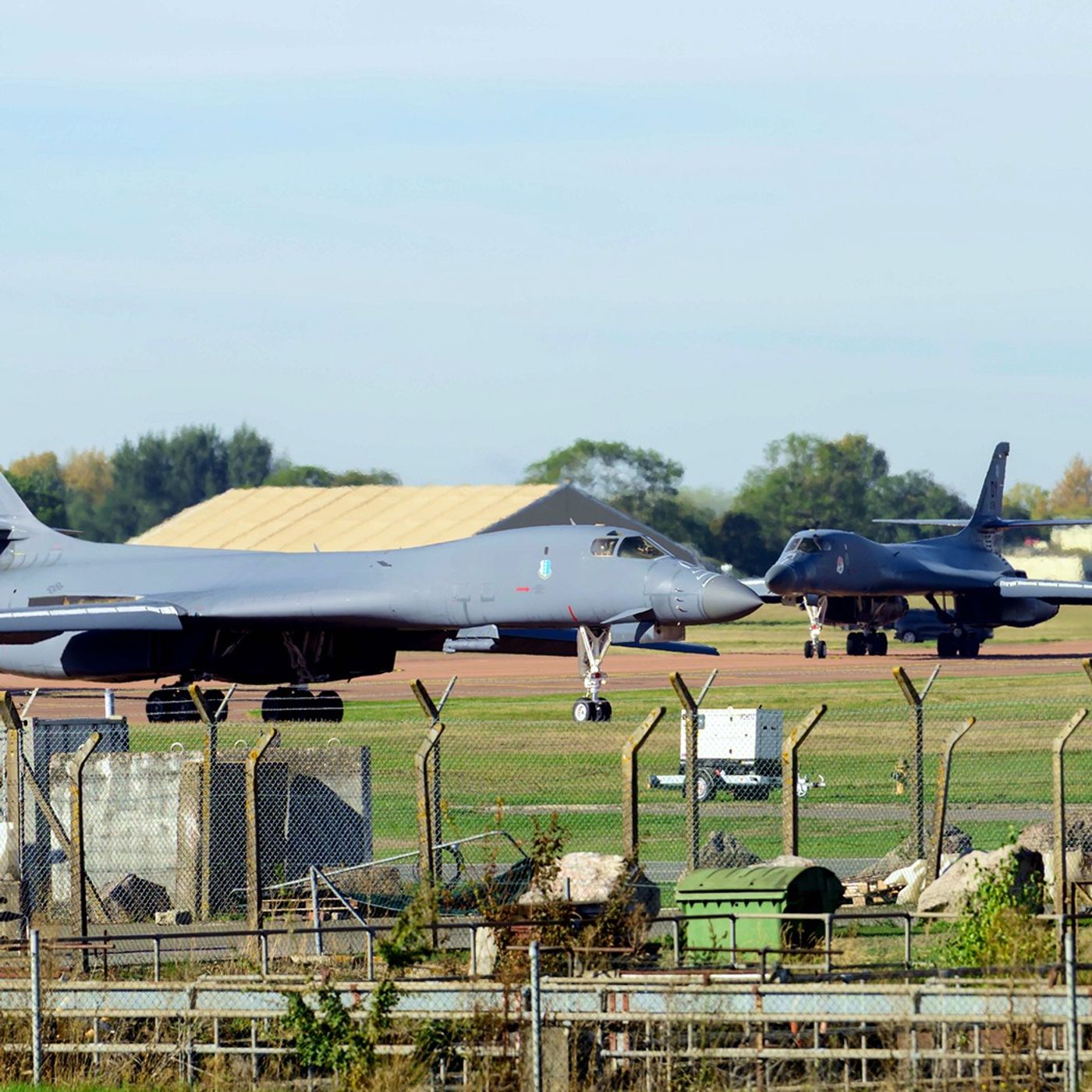
I mean, this seems on its face to be a rather big and maybe disproportionate response to a trio of vans in World England. That's what I was thinking, is I was actually on vacation out of the beach when I'm seeing all these for this reporting command. So I start calling around to some of my military national security sources to see if they've heard anything, if they know what's going on. And what I learn is that this is very serious because this isn't just any airbase. The Fairford base is one that American bombers have used for decades and have been using, most recently, in the Iran War to drop major bombs on targets inside of Iran.
And the concern I'm hearing from my sources is that this response could be some form of retaliation by Iran using proxies inside of England to have an attack on American troops and aircraft at a British base. It's like, holy cow, you know, because I've been covering this war now for over the eight months and we've seen lots of attacks in the Gulf region itself in the Middle East, but for something to be tied to American military personnel in England, this staunch ally a couple thousand miles away from Iran, this was quite dramatic. Well, what exactly are your sources telling you is the nature of their fear?
What do they know in the background and how does it relate to the men in masks who are found in this van? What are you starting to try to put together here? So they take me back to July when Iran's Islamic Revolutionary Guard Corps, which basically controls the security services in that country, threatened to go after bases in England, basically because they're saying that the England is helping participate in the war against Iran. But these threats were very general. They were not specific about time or exactly where in the base they might hit, but what these sources of mine were telling me was that two weeks or so before these vans showed up, American officials, along with some of the British counterparts, got new information.
It was much more specific about the threat to the base itself and who perhaps could be behind it. And suddenly this created a much greater sense of urgency than an attack might be imminent. Around the same time, British officials in the town had been warning people to be aware of anything that looks suspicious. And so there was this sense that something was going on in this town, even before this incident where the vans took place. So there was a general message, if you see something, say something and this woman returning to her farm very much saw something, very much said something.
That's right. And so that leads us to the 27th, where the police show up, obviously with all these helicopters, the bomb squad, they've lined these guys up and they comb through these vans, but they really don't find anything. It's just just some jugs of gasoline. There's no explosives, there's no weapons or anything. And suddenly everybody's like, well, what was this all about?
Kind of like what Iranian plot? That's right. What Iranian plot? So the next day the police released these five men on bail and basically this, it raised the question, well, was this a big nothing burger? Or is it also suggesting that the evidence that they do have about this plot, not what they got from the vans, but they're on the plot is so classified, they can't use it in a simple criminal case.
So I go back to my source and say, well, what happened here? They just let these guys go. And what did your sources say? Well, one of my sources say, well, don't get too hung up on that. This was probably just a diversion.
These guys were chumps in the words of one of my officers. They were just basically a distraction for what might have happened somewhere else on the base. That's one theory. Another theory is that they were on their way to link up with Confederates who did have weapons who did have explosives and were intercepted before that could happen. And as if this whole situation isn't mysterious enough, we get new information at the end of last week that one of the five men from the vans who was arrested actually called the police before the police were arrested.
The police before the police arrived. Wait, he called the police on himself? Apparently. And again, this is something we're still trying to sort out. Was this somebody who was deliberately calling the cops to get everybody pulled over in one direction so that the other plotters might, you know, attack the base from another?
Or was this a guy who thought he, you know, was just out for some kind of criminal job or something like that? Maybe he was going to steal gas and realize he's got in way over his head and he wants out and he calls to say help. But one possibility that it sounds like you contemplate is perhaps this guy is part of a group hired by Iranians. I know I'm in the realm of speculation. And at some point, he realizes he's part of something that he doesn't want to be a part of.
And he's like, get me the heck out of here. I'm calling basically British equivalent 911 to shut this down. That's right. And then we're really left with like, well, wait a minute. If this was such a serious plot, why are the plotters calling in ahead of time and giving up?
It doesn't make sense. But then the plot kind of thickens. There was a sixth man who was arrested and he was a British Iranian citizen. So now just as we thought, well, maybe this wasn't something despite what my sources continue to tell me was quite serious. Now here's another instance where at least the police are saying, you know, there's cause enough to arrest this person. He too was released on bail, however.
And so we have suspects piling up, but there's no clear understanding of kind of where this is going. But then late last week, British Prime Minister Andy Burnham says that there are strong indications that Iran played a part. But the question is a part of what? We still don't know. You know, what is this? Because he's not explaining what's going on.
The police aren't explaining. And my sources are being very cagey. They're saying, this is still live. There's still danger out there. So what you have on your hands at this point is a genuinely confounding and yet urgent mystery surrounding Iran and a British base that has some of America's most expensive and high powered military plans.
That's right. And my sources are still telling me, don't give up on this. Even though these guys look like mopes on the ground and you can't make sense of what's happening here. There's something quite sinister behind all this and you got to stay on it because the authorities are on it as well. And then on Sunday, the United States military does something so unusual, so extraordinary. It underscores how serious they consider this threat still to be.
We'll be right back. I'm right, John. I cover climate and the environment for the New York Times. I recently spent eight weeks on a research ship going to Antarctica, the planets getting warmer, ice is melting away. Sea level rise is going to change our coastal cities. It's one thing to read about what scientists have discovered when they write papers, but it's another thing entirely to be there with them.
This is what we do at the New York Times. We want to bring you closer to the biggest stories that matter for how we all live in the world. If you'd like to support this work, you can become a subscriber at mytimes.com slash subscribe. Eric, explain what the US does that conveys just how frightened it is about the situation and why you come to understand they do it. So the US has about a dozen of these B1 bombers at the Fairford Air Base, and these are bombers that have been used in the war against Iran.
And they haven't been used on emissions lately, but they've been flying on training missions. And during the whole course of this previous week, when all these arrests are being made and everything's going on, the bombers are still flying. But suddenly, on Sunday, breaking news from England, the urgent withdrawal of American B1 bombers. They're moving out. This is a highly unusual move to redeploy these kind of military assets urgently.
They're moving all these bombers back to the United States as fast as they possibly can. Moving a dozen B1 bombers further away from an ongoing conflict is no small decision. So something must have made them generate. And I'm asking why? What's happened? And so we've got new intelligence that shows that threat that we've been worried about all along has become even more acute.
And we are very concerned that the plot could happen at any time. The attack could happen at any time. And we have to get these giant aircraft out of here as soon as possible. But just to underscore how rushed this is and how abrupt this departure is, one of my sources tells me that they don't even have the aerial refueling planes ready for some of these bombers, even if they're starting to take off. It's just like get them out of Fairford for now and we'll figure out how to fuel them to get back out over the Atlantic Ocean and back to the United States.
We'll figure that out later. They don't even have a plan to make sure they have enough fuel to get back to the US. That's right. I mean, they're kind of making up on the fly. The United States Air Force just doesn't work like this unless it's an absolute crisis or they fear it could be a crisis.
And again, this is not the Middle East where you've got Iran raining missiles and drones down on your base. This is in England. More than 2,000 miles away from Iran. And yet the commanders felt strongly enough. And obviously Defense Secretary Pete Haggseth ultimately approved this, felt strongly enough that it's better on an abundance of caution to get the planes out now than it's in the United States.
If they're trying to get the planes out now, then take the chance that they could be struck by some kind of Iranian operative. Well, talk about, Eric, what you learned in the aftermath of that original tip that these bombers were going to be evacuated about what specifically makes the US military so, so worried, so freaked out that it races to yank these planes back to the US. So the specific intelligence they got, very sensitive intelligence that made them so concerned was that somehow these Iranian proxies, whoever they may be, we're going to get their hands on armed drones, launch them at the base and perhaps destroy or damage the aircraft and possibly kill American personnel that are at this base itself. And this, my sources tell me, could be loosely modeled on a plot that Ukraine carried out last year against Russia where they were able to smuggle drones in under the guise of some trucks and then once them deep inside of Russia destroyed over a dozen of these strategic bombers inside of Russia was a huge propaganda win for the Ukrainians and a real blow to Moscow.
So if somehow these Iranian back proxies could get their hands on drones and we know how easy it is to get drones these days, armed them with some kind of munitions or explosives and perhaps launch them just where even this van was, just a quarter mile away from the fence line at the base, this could cause tremendous damage and it would also be a huge win for the Iranians. Well, I'm glad you mentioned the van again, Eric, because that's my natural question. Does that theoretical threat that somehow Iranian proxies or operatives could get their hands on drones and deploy them inside the United Kingdom at these US planes? Does that in any way connect back according to your sources to these men in those vans?
Well, not specifically those vans Michael, but it could be other vans that we haven't seen that's the concern again. Remember, if this was a diversion, perhaps there were other vans at a different part of the base that were loaded with drones. I mean, that didn't happen the other night, but it could. That's the fear that prompted the Air Force to do what they did. Well, all of this suggests that the intelligence folks you're talking to have a pretty high estimation of these Iranian proxies and what they're capable of because I have been talking to you about Iran for years now.
And we've never reached the point where Iran was anywhere near deploying drones in Europe of all places. That's right. But we've seen from the very beginning of the Iran war, basically they understood that when Israel and the United States launched the attack on Iran, that the Iranians were not going to be able to go toe to toe military to military with them. So what they did was a number of things that was the military says use asymmetric advantage. They attacked shipping and the Strait of Hormuz to reflect economic pain.
And did inflict tremendous economic pain. Exactly. And then they attacked civilian infrastructure and oil facilities in neighboring Gulf countries causing more economic turmoil and political disturbance there. They struck American military bases, destroying hundreds of millions, if not billions of dollars worth of bases throughout the Gulf. And then they most recently attacked a base in Jordan, killing three service members there. So they have been able to use what they have left in their arsenal, be it drones or missiles, to inflict pain not only in the United States, but in the international economic community.
According to my sources, this is just an extension of that war, except now they're taking it to a different level. They're basically moving their drones or the drone technology they can get their hands on to a base that's very much participating in the war. And so when we see this kind of a threat materialize, the American officials and those working with them in Britain took this quite seriously. Right. Took it seriously as a potentially entirely new and potentially devastating chapter in Iran's so far quite successful use of asymmetrical attacks where they take kind of what little they have and put it to rather impactful use.
That's right, because Iran, my other things, is very aware of the political environment here in the United States. The Iran war is deeply unpopular. The Republicans are not doing well so far in the midterm election campaigns. And for the Iranians, if they could inflict one more powerful blow, that is inflict damage on an American aircraft, American personnel in England, that would not only deal a huge blow to the United States and perhaps to President Trump. But it would also be a real poo for Tehran.
And so far, of course, that has not happened. But I think it's fair to say that the Iranians have already done something pretty significant here. They have forced the US to pull a dozen other most sophisticated bombers out of the UK and rapidly return them home to the US, which in and of itself does seem like a symbolic blow. Absolutely. They have achieved one of their major objectives. Now, the Pentagon will tell you they can still launch those planes from bases in America, but it's a much more difficult mission, a much lengthier mission all the way back to Iran than it is striking targets from England.
I'm curious, Eric, as a final question, what the British people and the British government make of all of this. Does it make them in any way question, hosting US military bombers that are involved in this war? I mean, Britain is not technically a co-combatant in this conflict. British troops are not involved. British planes are not involved in attacking Iran. But Iran is saying, that's how we now think of you. The people in the community around the space are no doubt pretty smooked by all this. I'm sure elected officials can't be thrilled about it all.
What is your understanding of the viewpoint there? I think there's still so many questions swirling around this spot, Michael, that I think the British people and certainly the people in Fairford are still scratching their heads wondering what exactly has happened or is still yet to come. But to your point, countries in the Gulf region that have sponsored the United States hosted American bases for decades are asking this very question now. They kind of dig out from the rubble, not only of the bases that have been attacked, but some of their cities and some of their energy facilities and say, look, part of the bargain here was you've got to protect us from threats like this. And I think they're coming away now looking at the damage that's been inflicted upon them and they're asking, wow, is this really worth it?
And they're going to rethink that kind of relationship going forward. Obviously, if this were to happen on British soil, I'm sure that these some British residents would wonder the same question. Is it worth it? Yeah, is it worth it? Even though there's a long story history of this base going back to it opening just in time for the D-Day invasion in 1944, and that American bombers B-52s, B-1s and B-2s have used this over the years, but it's also been a source of controversy.
Early in the Iraq war in 2003, there were protests at the base over the British governments allowing the Pentagon to use Fairford for bombing missions into Iraq. And, you know, were there to be an attack at Fairford? It could lead to a reconsideration by the British government. But just how much leeway it gives to allowing the United States to use its bases for America's wars in the Middle East. Well, Eric, thank you very much. Appreciate it. Thank you. We'll be right back.
This week on The Wire Gutter Show, we're talking about face sunscreen. What do you think so far about the ones you have shot at this new ingredient? I think it's sunscreen! And I'm excited it exists! Find out how the new FDA-free ingredient is changing formulations, and whether our experts insist worth it.
The Wire Gutter Show is on the Near Times app, or where you'd like to listen. Here's what else you need to get to the other day. On Tuesday, in an abrupt reversal, White House officials said that there were no plans for campaign groups to reimburse the federal government for a series of unusual TV commercials paid for by U.S. taxpayers that praised President Trump and his presidency ahead of midterm elections. The ads, which have run on major TV stations, have cost taxpayers more than $10 million, could violate federal law, and have brought criticism from members of both parties.
That criticism prompted Trump to say on Monday that his super PAC would repay the government for the ads, but by Tuesday, it appeared that the president had changed his mind. Today's episode was produced by Alex Stern, Rochelle Bonjoe, and Michael Simon-Johnson. It was edited by Patricia Willens, contains music by Mary Elizano, and was engineered by Chris Wood. Our theme music is by Wonderly. That's it for the Daily. I'm Michael Baguaro. See you tomorrow.
I'm Gilbert Cruz. This week on the Book Review Podcast, we have a special Halloween treat, or trick, or treat. Two horror writers recommend some titles that are sure to keep you up at night. I am a big fan of sentient houses in general. I think this is one of the scariest books I've ever read.
Listen to the Book Review, wherever you get your podcasts. That door shouldn't be open. Who left it open?