Timberline Podcast 01: Intro
from Timberline: Lessons from the Mountain Hosted by Jay Allen Ford
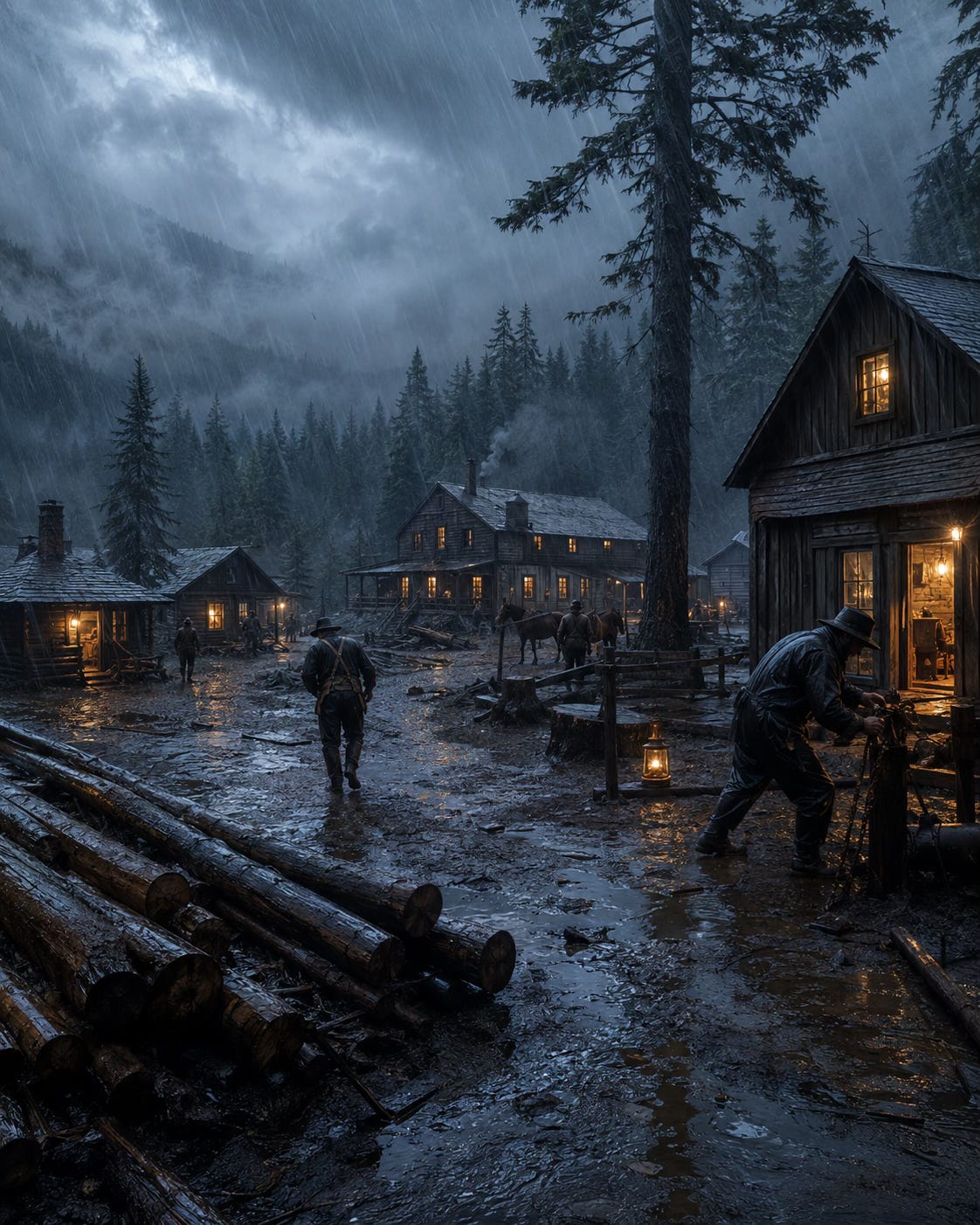
Some stories announce themselves. A gunshot. A storm. A body in the road. Timberline does not start that loud. It starts with rain on the roof. Coffee on the stove. Boots drying near the fire. And a room full of people carrying more than they say. Tonight, Jay Ford opens the door to Timberline. Not as a lecture. Not as a history lesson. More like a place at the table. I’m Duke. Blacksmith by trade. Host of this little campfire conversation by accident. And this is The Timberline Podcast. Jay, good to have you near the forge. Good to be here, Duke. And good evening from Timberline. If you’ve found your way here, pull up a chair. The stove is low. The coffee is strong. The rain has been working on the roof since sundown. That is how many true stories begin here. Not with thunder. Not with speeches. But with tired hands around a table, boots drying near the fire, and someone finally saying the thing he has been carrying all day. That sounds like the right door to open. Now, Jay, we ought to set folks straight early. We are stepping into Timberline in 1892, under the shadow of Mount Rainier. But Timberline did not begin in 1892. It goes back to 1870, when Washington was still a territory, and Elias Everett’s father first carved a camp out of timber, mud, weather, and stubborn hope. Twenty-two years later, Timberline has become something larger than a logging operation. It has a dining hall. Cabins. A schoolroom. Families. Old debts. Old griefs. Men who remember what it cost to build the place. And children who only know it as home. So we are not walking into a new camp. We are walking into a place that already remembers. What does that change for the story? It changes everything, Duke. A new camp has ambition. An older camp has memory. By 1892, Timberline already has roots in the ground. People have lived there. Worked there. Lost there. Hoped there. Made promises there. Broken some too. So when the story opens, Timberline is not just waiting to be built. It is waiting to be tested. And inherited places carry both blessings and burdens. That is what I like about it. It does not feel like a clean little town with mud painted on afterward. It feels lived in. Built by hands. Worn down by weather. Held together by people who may not always know how much they need each other. Yes. That is Timberline to me. A place where work leaves marks. Where silence carries weight. Where a meal can hold a man together. Where the Forest is more than timber. The River is more than water. And the Mountain keeps count. There it is. The Mountain keeps count. That line follows a man around once he hears it. What does it mean to you? It means nothing disappears completely. Not in Timberline. A careless cut matters. A warning ignored matters. A kindness offered when no one is watching matters. The Mountain is not cruel. It is not sentimental either. It simply stands there. Watching. And in a place like Timberline, where men work under danger and families live close to consequence, every choice leaves a mark. Consequence fits. Because Timberline is beautiful, but it is not soft. The rain is real. The mud is real. The work is real. And the danger is real. It is. And that comes from something personal. Logging is part of my family history. My father, grandfather, uncles, and cousins knew timber, danger, hard work, and the kind of men who did not always have words for what they carried. So Timberline is not a memoir. But it is rooted in something real. The danger is real. The pride is real. The silence is real. And so is the tenderness. I’m glad you said tenderness. Because from the outside, people might hear “logging camp” and think only of axes, saws, horses, and falling trees. And yes, Timberline has all of that. But it is also coffee being poured before a man asks for it. A bowl turned upside down for someone who is gone. A teacher keeping hope alive in a rough-built schoolroom. A brother watching another brother too closely because he knows what can happen in the woods. That is the heart of it. Timberline is not only about whether a tree falls. It is about what a man becomes before it does. It is about whether a community can learn to look twice. It is about whether love can grow in a place built for labor. It is about whether judgment can be stronger than pride. And whether mercy can survive under pressure. Pressure. That is a word I understand. Put iron under heat, and it tells you what it can take. Put people under pressure, and they tell you something too. Sometimes courage shows. Sometimes pride. Sometimes fear. Sometimes a crack that was already there. Is that what Timberline is doing? Yes, Duke. Pressure tells the truth. A person can hide plenty when life is easy. You can dress well. Speak well. Shake hands. Make promises. But in the woods, under weather, with an ax in hand and another man’s life depending on judgment, pride has fewer places to hide. The work tells on people. So does fear. So does silence. And sometimes, if a man is lucky, the people around him tell him the truth before the world has to do it harder. That sounds like one of the big questions Timberline keeps asking. What kind of person are you when the work is hard, the weather turns, and no one can afford for you to pretend? That is exactly it. That question stands behind almost every Timberline story. It stands behind Jack Mercer when he has to give an order no one wants to hear. It stands behind Sam Mercer when he wants a life larger than the saw line, but cannot bear the thought of leaving his brother alone in the cut. It stands behind Emma Everett when she teaches children in a logging camp where books, slates, rain, hunger, and hope all sit in the same room. It stands behind Adam Two Cedars and Lena Whitefeather when they remind Timberline that the Forest is not empty just because someone has not written a deed for it. And it stands behind every man and woman in that camp who has to decide whether survival is enough, or whether a place can become something better. Something better. That sounds simple until a person tries to build it. It does. Because Timberline is not a perfect place. That matters. It is muddy. It is dangerous. It is sometimes proud when it should be humble. It is full of men who know how to swing an ax but do not always know how to speak plainly to the people who love them. It is full of women carrying more strength than the world has bothered to name. It is full of children watching everything. And in a place like that, every choice teaches. Every choice teaches. Some lessons come soft. Some come like a hammer. Exactly. And that is one reason I care so much about the people of Timberline. They are not symbols to me. They are not there just to prove a point. Jack carries command. Sam carries longing. Emma carries hope. Adam and Lena carry memory older than the camp itself. Maggie carries people with bread, coffee, and a sharp word when needed. And beyond them are the children, the crew, and the families watching every choice the adults make. Each one carries something. And Timberline asks what they will do with what they carry. That may be why the place feels so full. You can hear the saws, yes. But you can also hear the dining hall. The schoolroom. The rain barrel. The forge. The River. The quiet after bad news. Yes. The world has to breathe. If Timberline were only danger, it would become too hard. If it were only warmth, it would become false. It needs both. The hard work. The humor. The grief. The meals. The prayers. The mistakes. The second chances. The River running beside it all. The Mountain above it all. And the people trying to become worthy of the place they call home. That gives this podcast its purpose. We are going to talk about the story. We are going to talk about the history. And we are going to talk about the tools too, because I refuse to host a Timberline podcast and not get into tools. Fair enough. We will talk about widow-makers. Barber-chaired trees. Springboards. Wedges. Misery-whips. Steam donkeys. Rail spurs. Camp kitchens. Schoolrooms. Rivers. Faith. Fear. And the old hard wisdom of work done close to danger. But more than that, this podcast is an invitation. A lantern in the window. A place to step out of the rain for a while. A place where stories are not rushed. Where grief is allowed to sit down. Where humor still finds its way to the table. Where ordinary people are asked to carry extraordinary weight. And where a quiet act of faithfulness may matter more than a grand speech. That feels like a Timberline welcome to me. Not fancy. Not polished smooth. Just honest. That is what I hope. So if this is your first night in Timberline, welcome. There is coffee on the stove. Rain on the roof. Mud by the door. A chair near the fire. And somewhere beyond the timber wall, the Mountain is hidden in the dark, keeping count. Jack would tell you not to make too much of it. Sam would make too much of it just to bother Jack. Emma would notice whether you looked tired. Maggie would tell you to eat first and explain later. And the camp, if you stayed long enough, would begin to tell you the truth. This is The Timberline Podcast. I’m Jay Ford. And I’m Duke. Blacksmith by trade. Still learning the microphone. Tonight, we opened the door. Next time, we step farther in. Until then, keep the fire banked— The coffee strong— And your eyes on the timber. And remember— The Mountain keeps count. Get full access to Timberline: Lessons by the Campfire at www.timberlinecampfire.com/subscribe
Embed this episode
No transcript yet.