
EPISODE · Nov 17, 2021 · 33 MIN
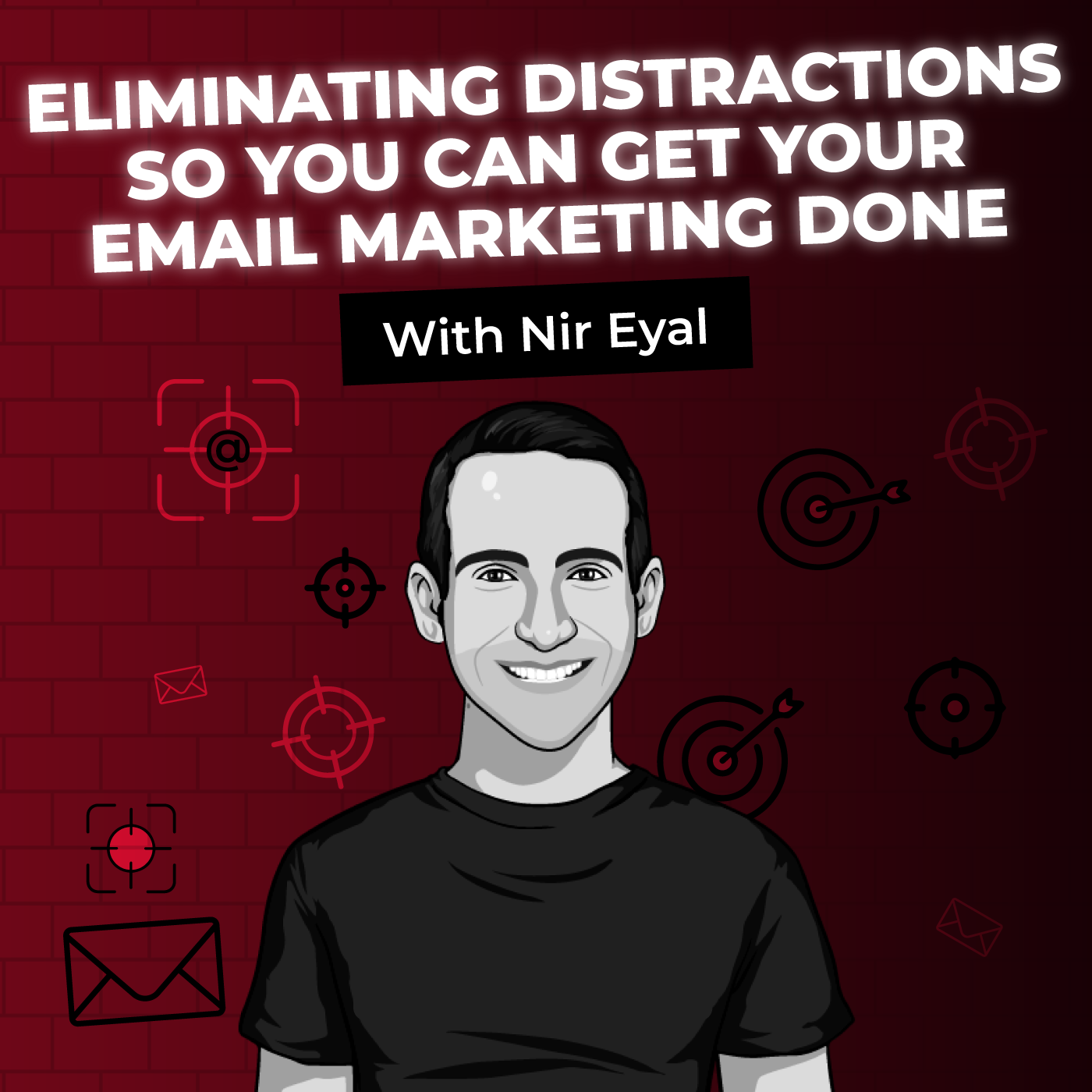
Time-saving tips for email marketing - how to eliminate distraction with Nir Eyal
This week on the podcast we interviewed former Stanford marketing lecturer and best-selling author Nir Eyal. We invited Nir to share his extensive knowledge and some of the research he conducted to write his book, Indistractable, and our conversation led to some incredible time-saving tips for email marketing that you can also apply to your life and business.So if you're struggling to find the time for email marketing (or anything that matters to you) and want to know how to eliminate distraction and finally get it done, THIS. IS.IT.Ready for the penny to finally drop? Because honestly, this is a-mazing stuff! SOME EPISODE HIGHLIGHTS: (3:12) Did a member of the British Royal Family really hold a door open for Nir? (6:41) What even is 'distraction'?(11:38) What are the triggers that drive us to distraction? (13:09) The 4 strategies to becoming indistractable.(13:36) Why recognising and mastering internal triggers is important. (15:42) Taking responsibility of your emotional states.(19:00) Does accountability work?(23:36) Do consequences and incentives matter? (25:49) Why time-boxing is better than running your life on a to-do list. (31:20) Subject line of the week with Nir Eyal.What even is 'distraction'? When it comes to email marketing, one of the biggest things that stop course creators, membership owners, and coaches and consultant from getting it done is time. We say we'll get something done, but then we don't. Why don't we follow through? We claim we get distracted, but what even is 'distraction'?Nir started us off by looking at the word distraction and its opposite, which is the word traction. Traction is any action that pulls you towards the things you do with intent and moves you closer to your values to help you become the kind of person you want to become.So dis-traction is any action that pulls you further away from your values. Anything can be a distraction if it's not what you plan to do with your time. And yes, that includes those work-related things that make us feel we're being productive!And according to Nir, this is the most dangerous form of distraction - the one that tricks you into prioritising the easy and the urgent at the expense of the important work you have to do to move your business, your career, and your life forward.This means that all the things that we typically call 'distracting' (like checking social media or playing a video game) can be traction, as long as we do them according to our values and schedules.What are the triggers that drive us to distraction? Nir explains there are two kinds of triggers:External triggers. These at the 'calls to action' that come from our outside environment - the things that others ask us to do.Internal triggers. These are uncomfortable emotional states that we seek to escape from, like fearfulness, uncertainty, boredom, loneliness, stress, anxiety, etc.People tend to blame external triggers for distraction. But did you know they only account for 10% of the time we get distracted? The other 90% of the time we get distracted because of something that happens inside of us - it's because of our internal triggers. When we experience uncomfortable emotional states we look for distractions to take our minds off them.Mind-blowing, right?The 4 strategies to becoming indistractableNir explained there are 4 steps to becoming indistractable, and all of them need to be in place if you want them to work!The 4 steps are:Mastering internal triggers.Making time for traction.Hacking back the external triggers in our environment.Preventing distraction with pacts. This is where we use a pre-commitment device to stop us from getting distracted.Why recognising and mastering internal triggers is importantSo the first step to becoming indistractable is to master your internal triggers. That's because unless you know what to do when you experience emotional discomfort, you're always going to run away from those emotions and look for some form of distraction!The truth is that social media (or whatever else we blame for getting distracted) isn't the root cause of distraction. The root cause of distraction has and will always be emotional discomfort. Why? Because discomfort is the source of all human motivation. Anything we do is because of our desire to escape discomfort, which is the core driver of every action.And the mind-blowing truth is that there's nothing wrong with you! Getting distracted isn't a character flaw. It just means we haven't learnt to deal with discomfort in a way that moves us towards traction rather than distraction.Taking responsibility of our emotional statesWhen it comes to distraction, people tend to categorise themselves in two different ways - you have the "Blamers" and the "Shamers". The "Blamers" tend to blame stuff outside themselves, like technology or the news. But these things can't really be blamed because distraction existed before them! The "Shamers", on the other hand, think there must be something wrong with them. They'll think they have a short attention span or aren't good at time management, for example. But these are just myths we make up about ourselves. And the more we do this, the more we actually conform to the perception we have of ourselves. The more we think there's something wrong with us, the more shame we feel (which is an uncomfortable emotional state) and the more distraction we go and seek! Frustrating, right?So blaming and shaming don't work. Instead, we need to start taking responsibility for how we feel. We can't control our feelings and urges. They're as natural as sneezing! But what we can control is our we respond to them. It's all about learning what to do when we feel these uncomfortable emotional states, which are perfectly normal and healthy. It's about taking that emotional discomfort and using it as rocket fuel to propel us towards traction, rather than distraction.Does accountability work?We asked Nir about an accountability exercise we started inside our membership, The League, where we share all sorts of time-saving tips for email marketing. And we created a tool to help people stay accountable, but we noticed that not everyone was using it.Nir explained that we used a very effective technique called a "pre-commitment device" to give people social accountability. This basically allows people to declare they’re going to do something so the other people in the group can hold them accountable. It’s a pact (a pre-commitment) - the one we used was a social one, but Nir explained that monetary ones are also very effective. (You might want to tune in and listen to the inspiring story of how Nir has been using a monetary pact to get himself into shape).However, the reason our accountability exercise didn't work for each and every one of our members is that using pacts to stop us from getting distracted is only the last step in becoming indistractable. Essentially, we can't stop ourselves from getting distracted unless we know what it distracted us from.In other words, if something isn't in the calendar, we can't blame distraction if it doesn't get done! The right way to do this is to put a task in your diary (make time for traction) and then remove the external triggers in your environment. Only then, the social pact will work.Do consequences and incentives matter? Following on from Nir's explanation about pacts and how they work to keep people accountable, we asked about the correlation between the consequences of not doing something and the likelihood someone has of actually following through with the action. And Nir explained that the consequences you put in place have to be something that 'hurts you' (not in a physical way, of course!). And for him, that's burning money!So the incentive has to be big enough. And to find an incentive that's big enough, you need to ask yourself if you really want this thing you said you're going to do? Do you really want to do email marketing? Do you really want to grow your email list and make money out of email marketing? Because if you do (if the stakes are high enough) then you will. And you'll be open to implementing any time-saving tips for email marketing we throw your way too!Why time-boxing is better than following to-do listsShould you do the things with the biggest impact first, like a lot of people recommend? Nir said it's a technique that works for a lot of people, and if it works for you, then great. But if it doesn't, Nir recommends a technique called time-boxing, which works by setting a schedule in advance to make sure you have dedicated time for a specific activity (like your email marketing!).To-do lists are great if you use them to write down stuff that's in your head. But, Nir says, you can't run your life on a to-do list. That's one of the worst things...
Embed this episode
Ready to play
Time-saving tips for email marketing - how to eliminate distraction with Nir Eyal
No transcript for this episode yet
Similar Episodes
No similar episodes found.
Similar Podcasts
No similar podcasts found.