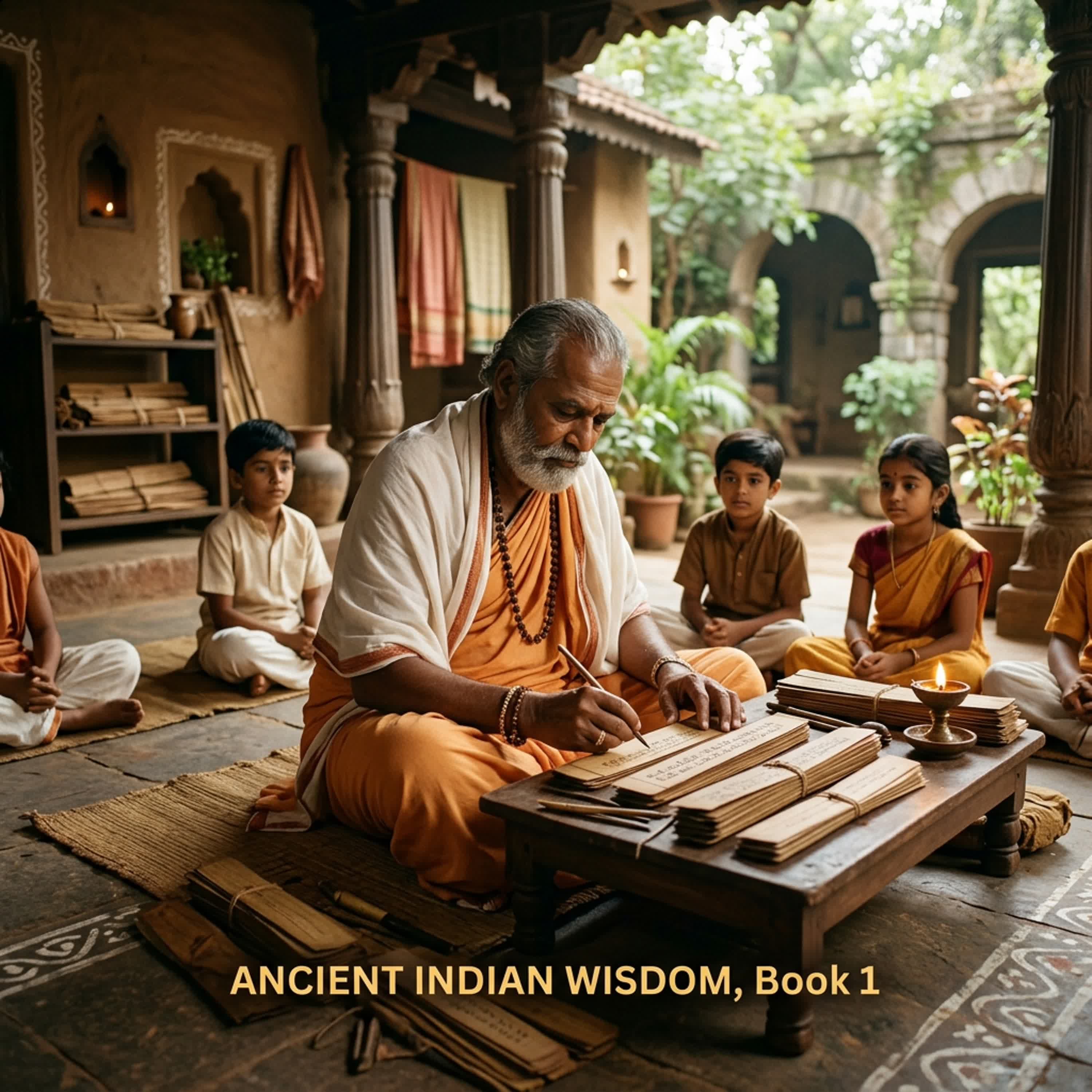
Tirukkural - 1 - Book 1
from Wisdom for the Present: Eastern Wisdom Literature Hosted by Kanu Emeruwa
While some might mistake the title for a newly discovered Shakespearean drama, the Tirukkural is in fact an ancient Tamil masterpiece of wisdom and ethics authored by the sage Thiruvalluvar—and its teachings on human character hold profound relevance for modern psychology and our hectic daily lives. The episode explores the revolutionary idea that spiritual mastery is not found by escaping our earthly duties to meditate in a remote mountain cave, but in the micro-interactions of our daily grind—how we respond to an annoying colleague or the tone of voice we use when greeting our spouse after a long commute. It challenges our deep-seated cultural assumption that the sacred is separate from the mundane, proving that the kitchen table, the marketplace, and the front door are the ultimate arenas for spiritual development. Rather than dramatic conflict, this classical Tamil treatise establishes reality on a foundation of cosmic and environmental harmony. It begins with a linguistic metaphor, asserting that just as the letter "A" is the foundational breath of all speech, the Primal Deity is the bedrock of the entire universe. From there, the text grounds itself in the physical world by extolling the absolute necessity of rain, which it calls "ambrosia". This ecological interdependence leads directly to the central tension of Book 1: the householder versus the ascetic. The author argues that domestic life lived in love and virtue actually shines brighter than the sternest asceticism, as the householder acts as the economic and moral anchor that sustains all of society. Moving deeper into the human psyche, we analyze character, ego, and the modern "algorithms" of distraction. The Tirukkural uses the visceral metaphor of a "bony framework clad with skin" to describe a life devoid of love—a functional biological machine operating purely on utility or cold logic, yet fundamentally dead inside. This mechanical existence mirrors our modern struggle with attention-monetizing digital algorithms that pull our senses in a million directions and deplete our minds. By dismantling the ego (the pride of "I" and "mine") and cultivating outward-flowing affection, we escape the trap of becoming mere "skeletons in suits" and instead live as active, loving souls. In discussing the chaotic storms of life, we examine how our desperate urge for control and security leads to psychological breakdown. Our brains possess an evolutionary negativity bias, keeping us obsessed with grievances as a misguided survival instinct. The Tirukkural offers a radical cognitive counter-measure: we must artificially magnify a tiny benefit, viewing it as vast as a towering palm tree, while instantly deleting injuries in the very moment they are inflicted. This challenging mandate forces us to override our biological survival mechanisms and drop toxic grudges before they burn holes in our peace of mind. To reclaim our agency and navigate this world with true discernment, we must cultivate internal self-restraint. Using the striking metaphor of the tortoise pulling its head and limbs into its shell, the text advocates for what we now call digital minimalism—the power to pull our senses inward to protect our peace and regain our cognitive equilibrium. Furthermore, we must learn to evaluate character by function rather than outward form: just as a straight arrow is deadly and a crooked lute produces beautiful, uplifting music, we must look past performative "tiger skins" or shiny berries to see a person's actual moral output. The episode concludes with the ultimate paradigm shift: putting maximum human effort into our character while radically detaching our peace of mind from fate's uncontrollable outcomes. In This Episode * The Sacred in the Mundane: True virtue is not found by escaping society, but is forged right in the middle of our daily routines and relationships. * Ecological Interdependence: Our moral and societal systems rely on the natural world, beginning with the foundational "ambrosia" of rain. * The Householder's Path: A family life lived in love and virtue is a higher spiritual calling than ascetic withdrawal, serving as the economic anchor of society. * The Walking Skeleton: Living a life of pure utility or cold logic without active, outward-flowing love reduces us to hollow biological machines. * Instant Forgiveness: Overriding our negativity bias requires instantly deleting injuries while artificially magnifying small acts of kindness. * The Tortoise Shell of Restraint: Regaining mental focus in an era of digital overload requires pulling our senses inward like a tortoise. * Function Over Form: True discernment means evaluating others by their actual moral deeds and helpfulness, rather than their polished outward appearances. Practical Reflection If you were to treat a lingering grievance like a highly toxic radioactive substance, how quickly would you drop it to protect your own peace of mind? In your daily routines, are you acting as a living soul imbued with love, or are you operating as a cold, mechanical "skeleton in a suit" simply checking boxes? What would your life look like tomorrow if you put maximum effort into your character but completely dropped the desperate need for a specific, guaranteed outcome? Suggested Substack Excerpt Discover how the ancient Tamil masterpiece Tirukkural challenges modern hustle culture, digital overload, and our relationship with control. Learn why true spiritual mastery isn't found in a quiet cave, but right in the messy friction of your daily grind. AI Disclosure This episode was created using Google NotebookLM Audio Overview, based on human-curated source material, structured guidance, and editorial review. AI is used as a tool for clarity and delivery, not as a replacement for thoughtful study or engagement with the original texts. Copyright © 2026 Wisdom for the Present / Kamashcu Production Studios. All rights reserved. This is a public episode. If you would like to discuss this with other subscribers or get access to bonus episodes, visit wisdomforthepresent.substack.com
Embed this episode
No transcript yet.