KPBS On Demand is supported by San Diego County Toyota dealers. The Toyota Tundra offers a full-size pickup capability with power of up to 437 horsepower and 583 pound-feet of torque. Visit your Toyota dealer or toyota.com. We make it easy. Welcome to another edition of listener-supported KPBS Cinema Junkie Podcast. I'm Beth Accomando.
As you already know, I love movies, but I also love Shakespeare. When I was little, my parents had a Shakespeare board game and I would cheat by memorizing lines from the plays so I could answer all the questions on the game cards. My parents believed in games where if we cheated, we'd at least learn something. And I did. And I also fell in love with Shakespeare's plays. The Old Globe Theater has a bold new production of Hamlet on stage right now. It's directed by Barry Edelstein and it made me see the play with new eyes. So for this podcast, I get to combine two things I love, the bard and film. This episode is dedicated to Shakespeare's Hamlet in particular and to understanding it better through film and an interview I did with Barry Edelstein.
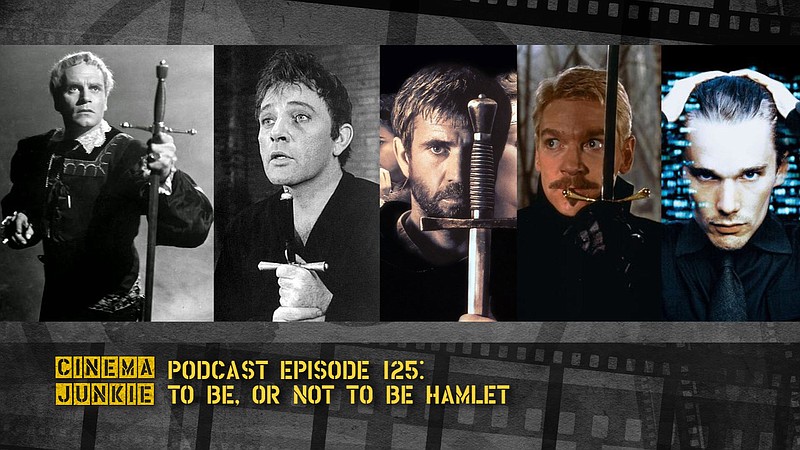
Okay, I want to quote Humphrey Bogart right now, because in regards to the Oscars, he once said, the only way to find the best actor would be to let everyone play Hamlet and let the best man win. It's no accident that he chose Hamlet for his example. That role is the yardstick by which many actors have been measuring themselves for centuries. On film, we've not gone a decade without an actor tackling the role since the 1900s. That's right, even in the silent era, we had Hamlet on screen. Cinematic Hamlets have ranged from Laurence Olivier's classical interpretation that emphasized some uncomfortable intimacy between Hamlet and his mom, to Ethan Hawke's modern dress stain in Michael Almareda's contemporary take on the play.
Today, I hesitate to label any of the film Hamlets as classic or definitive, but each illuminates the play in different ways, and each will live on for future generations to ponder and enjoy. The current stage production of Hamlet at the Globe, however, is of a more transitory nature. Once the production ends on September 22nd, it's essentially gone forever. The production benefits from the fact that director Barry Edelstein is not just an inspired artist with a vision, but a Shakespeare scholar who studied the play. The event that finally spurred Edelstein onto tackling the play was the death of his father last summer. But before I play his full interview, part of that interview ran on Midday Edition last month, let's run through some of the key film versions of Hamlet to highlight what each one does well, and sometimes what they did badly, and then let Edelstein shed additional insights on the play and on the various texts that exist. Let's begin with Laurence Olivier's 1948 film adaptation that won Best Picture and Best Actor Oscars. The film showcases Olivier's penchant for changing his appearance. Here he dyes his hair blonde to be the melancholy Dane. As director and star...
He reveals how the medium was still trying to figure out how to translate Shakespeare from stage to screen. What could be the cinematic language for something like a soliloquy on stage? So as Hamlet's about to begin his famous-to-be-or-not-to-be speech, the camera literally zooms into his head, into his mind, to let viewers know that what they were about to hear were his innermost thoughts. But note the vigorous score that accompanies the images of rough seas hitting the shore. Again, it's an attempt to use cinematic techniques, such as editing and cinematography, to help clarify what Shakespeare is trying to convey. In this case, Hamlet's inner turmoil. Or not to be. That is the question.
Whether it is nobler in the mind to suffer the slings and arrows of outrageous fortune, or to take arms against a sea of troubles, and by opposing, end them. Olivier's performance, especially in the soliloquies, reflects a particular school of acting and playing Shakespeare. There's an emphasis on clear recitation that reflects a certain reverence for the text itself. In 1964, there was no attempt to turn a stage production into something more cinematic when filming John Gildgood's Broadway production of Hamlet, starring a young, vigorous Richard Burton. Here's the trailer for it, and it's very conscious of bringing a stage production to life for a movie audience. The year was 1602. Place, London, England. Scene, the Globe Theatre. The occasion was a premiere.
Over 1,000 excited theatre buffs jammed into the stalls and pit. Lords, ladies, merchants, craftsmen, peddlers. They had come to see a new play by one of the city's most popular playwrights. The play, Hamlet. The playwright, William Shakespeare. Since that performance three and a half centuries ago, Hamlet has become the most talked about, written about, wondered about, and widely produced play of all time. The first Hamlet was Richard Burbage. There have been many other Hamlets. David Garrick, Edmund Keane, Edwin Booth, Sir Henry Irving, John Barrymore, Sir John Giewood.
In the past few months, it has been my privilege to play my interpretation of Hamlet on the New York stage. Now, through a new technical process called electronivision, the entire stage production has been electronically recorded and will be presented in its entirety in 1,000 theatres throughout the country for four performances only on September the 23rd and 24th of this year. This has never happened before. The immediacy, the sense of being there is unlike any experience you have ever known. The production tried to speak to a modern audience by staging it as if it were a dress rehearsal, but done in front of a live audience. Burton's performance feels more fluid and physical than Olivier's was, and the humor is more overt.
And the performance felt more physically active, as in this scene with Ophelia. that the doors be shut upon him, that he may pay the fool and know of it in his own house. Farewell. Help him, you sweet heaven! We let us marry, and give thee this play for thy dowry. We let us chaste as ice, as pure as snow. Thou shalt not escape currently. Yet thee, go and unnery, go and pick thee too. Farewell. Only though we need marry. Marry a fool! The wise men know when and not what monsters you make of them. Go and unnery, go and pick thee too. Farewell.
Also, compare his soliloquy to Olivier's more reserved one.
End it. To die. To sleep. No more. And by a sleep you say we end the heartache and the fouls and natural shocks that flesh is air to. It is a consummation devoutly to be wished to die. To sleep.
Then, in 2002, Peter Brook filmed his stage production, which also had a lean look in terms of production design. But Brook sets the play in some vaguely modern time and eastern setting. As with Edelstein's current Globe production, Brook goes for a multi-ethnic cast and a black Hamlet. Adrian Lester is Brook's Hamlet, and he's a more intellectual, contemplative Hamlet, less like Burton and more like Olivier, but also very excitable when he catches the conscience of the king. Another casting innovation Brooke experiments with is having the same actor play Claudius and his murderous brother. On a certain level, this makes Gertrude's actions more understandable. After all, the two men look the same. Brooke severely cuts the text of the play. He even leaves out the character Fortinbras entirely, and most noticeably, from the end. So in Brooke's production, the rest really is silence.
In stark contrast to Brooks' abridged Hamlet is Kenneth Branagh's completely uncut text that he uses for his 1996 film.
Castle Rock Entertainment proudly presents Hamlet, the most celebrated drama in the English language, seen in glorious 70-millimeter format, adapted for the screen and directed by Kenneth Branagh. The trailer makes an epic out of Shakespeare's intensely intimate portrait of a young man in emotional turmoil. Branagh has a 70-millimeter frame that he fills with opulent palace proceedings and battles, and both offer a contrast to Hamlet's inward ruminations. To sleep, a chance to dream. Aye, there's the rubber. For in that sleep of death, what dreams may come.
When we have shuffled off, this mortal coil must give us pause. There's the respect that makes calamity of so long life. It's definitely worth seeing the play uncut at least once, if only for comparison to other versions you may see. The play in its entirety reveals themes that are more richly developed, especially about fathers and sons, with Hamlet and his father set in contrast to Laertes and Polonius and to young Fortinbras and his father. But intimacy is precisely what Michael Almereda plays up in his 2000 film with Ethan Hawke in the lead.
Hawk is a millennial Hamlet who videotapes his musings so he can edit them and play them back repeatedly. And Al Moreta chooses to have Hawk deliver Hamlet's famous soliloquy in the action aisle of a blockbuster video store.
and lose the name of action. As with Baz Luhrmann's Romeo and Juliet, Almereta's film is all about finding visual ways to make Shakespeare's language more accessible to a modern audience that's not used to hearing it. Almereta's Hamlet is an uneven production, but with flashes of brilliance, most notably with Julia Stiles' Ophelia, who's convinced by her father and the king to wear a wire so they can spy on Hamlet. It is most true, and he beseeched me to entreat your majesties to hear and see the matter. With all my heart, and it doth content me much to hear him so inclined. And for your part, Ophelia, I do wish that your good beauties be the happy cause of Hamlet's wildness.
So shall I hope that your virtues will bring him to his wanted way again. Almereda uses camcorders, security cameras, and other modern technology to convey how people are constantly watching each other. So when Ophelia wears the wire and Hamlet discovers it, we feel what a betrayal that is for Hamlet. Where is the father? Let the doors be shut upon him that he may play the fool nowhere but in his own house. Get thee to a nunnery. And again, as with Lerman, Almereda uses a news report to help convey expository information to his audience. This quarry cries on havoc.
And the final film Hamlet I want to mention is Franco Zeffirelli's 1990 version with Mel Gibson. Zeffirelli has done gorgeous adaptations of Shakespeare's Romeo and Juliet and Taming of the Shrew. He understands how to film Shakespeare to make it feel immediate and cinematic for a modern audience. In Gibson, he gives us a playful, energetic, and athletic Hamlet. One effective choice he makes is to let him deliver the famous soliloquy in the family tomb amidst his dead relatives. It's a great way to make the content of his speech readily apparent to a contemporary mainstream audience. Listen to these words and think about Gibson walking among the graves of his dead family members.
But one of the real strengths of this production is Helena Bonham Carter's Ophelia. Her mad scenes are great, and they reveal an anger in her character that we don't usually see.
There are many, many more Hamlets committed to film, including Kevin Kline, Benedict Cumberbatch, David Tennant, Nicole Williamson, as well as comic versions with Jack Benny and Mel Brooks. Each film sheds light on different aspects of the play, and each is worth checking out with that in mind. After seeing more than a dozen versions of Hamlet on stage and screen, I didn't think I could still find something new. But Barry Edelstein's Hamlet has made me see the play with new eyes. He draws on a number of the same aspects that Brooks' Hamlet did. A black lead, a multi-ethnic cast, and a fearlessness in tackling the text and cutting it. But Edelstein eschews Brooks' attempt at both a modern setting and a stark set design. Edelstein's Hamlet is definitely period, but the chord is gaudy and opulent, and a harsh contrast to the somber grief of Hamlet. The music, though, feels modern and experimental, and it prompts you to listen with fresh ears.
I spoke with Barry Edelstein just before the play opened, and we discussed his casting, the cutting of the text, and some of his creative choices that helped make the production feel vivid and fresh. Barry, the new production of Hamlet just opened here at the Old Globe. And I have to say, I think I've seen about 12 productions of Hamlet. And when I saw this one, I felt like I was seeing it fresh with new eyes. And in reading some of the notes that you put in the program, I see that there's a reason why it felt so new. So you looked at some different...
versions of the text of Hamlet. So explain exactly what you did to kind of craft this version of Hamlet. Sure. Well, first of all, thanks for those kind words. You know your Shakespeare, so it's meaningful to me to hear that you enjoyed it and appreciated it. Thank you for that. Well, the play is, the textual history of the play is complicated. Most of us think that when you go to a library or a bookstore and you grab a copy of Hamlet, that's the play. But in fact, that volume that we buy someplace, Masks,
400 years of complicated transmission of that text from Shakespeare's quill pen to today. And many, many people have been part of it. People in Shakespeare's period and editors who over centuries have made decisions about what words ought to be in that play and ought not. Now, in the case of half of Shakespeare's plays, they were only printed once during his period in the famous first folio of 1623, the first complete works of Shakespeare, seven years after Shakespeare's death. And for that half of Shakespeare's output, we only have one authoritative text.
So that's easy. When you do Macbeth, there's really only one text of the play because it was printed once. In the other half of Shakespeare's plays, there are multiple printings in his day. They were printed during his lifetime and then again in 1623. And the tough part is that there are differences. We don't know what accounts for those differences. Shakespeare might have revised the play in between its first printing and the time of his death. Shakespeare's theater company, who printed the first folio, might have made revisions reflecting stage practice or ideas that they knew Shakespeare had. So in half the plays, there are at least two versions of the play from Shakespeare's period. Hamlet has three. The play was printed once in 1603. Once again, the following year in 1604.
and then again in 1623. So there's no such thing as Hamlet. There are only three Hamlets. And any modern production has to make a decision about which one of those texts to do. Now that book that you buy at the bookstore or take out at the library is called a conflation because some editor has conflated those three texts and will say, gee, I like this word from 1623 and these 10 lines are in 1604 but not in 1623 but I kind of like them so I'll stick them together. And then there's this one idea from the 1603 printing about the order of the scenes that seems to make better sense. So you get this amalgamation of these three texts but then it's called William Shakespeare's Hamlet when it should actually be called Hamlet.
Hamlet by William Shakespeare and others. So contemporary productions, and the Globe is not alone in this, there's a production running in the west end of London, very acclaimed production at the moment, that also takes this kind of magpie approach to which text we should use. Now scholars have arguments. Some say the only authoritative text is 1623, because that's the one that Shakespeare's own actors printed, and therefore it would have most closely represented Shakespeare's mind. In that version, Hamlet's famous death line, which is the rest is silence, one of the most famous death speeches in world literature, is followed by four groans of O. So it says in 1623, the rest is silence period, O, O, O, O, O, the strangest, most melodramatic and also not silent death for a guy who says the rest is silence to say.
No production of Hamlet does the rest of silence. Oh, oh, oh, oh. Even though that's the theoretically authoritative 1623 version, right? The 1623 version lacks Hamlet's fourth soliloquy. How all occasions do inform against me and spur my dull revenge. It's in 1604, not in 1623. We're using that because it's such an important statement of his psyche at that point. The 1603 version is called the bad version of Hamlet. It's about half the length. There you get to be or not to be. Aye, there's the point. And all these strange, clearly mistakes in the text. The theory is that an actor in the company was secretly paid.
to write down the play so that a rival publisher could rush it into print because there was a market in Shakespeare's period not just to see plays but to read them and money to be made if you could sell the play in a bookstore, at a bookstall. So there are these bootleg versions of three or four of Shakespeare's plays, Romeo and Juliet, Taming of the Shrew, Hamlet, where we think that an actor was paid off to write the play down. The following year, Shakespeare's official printing house puts out in 1604, Hamlet, and on the title page it says, much corrected and much expanded, meaning don't trust that previous one. But in the 1603 quote-unquote bad version, there are a bunch of interesting things. First, the stage directions are extremely long in narrative.
So they really tell you how the play was actually done in the period. Shakespeare in the subsequent versions will say Enterophilia. But in the 1603 version, it'll say, enter Ophelia with her hair down carrying a lute singing. So really get, oh, wow, she had a little lute, the guitar that she was playing when she was singing her mad songs, right? Really interesting insight. Second thing is that the order of scenes is different in the written down version. And the to be or not to be speech comes much earlier in the play than it does in subsequent versions, which is really interesting. And third, the character of Gertrude, Hamlet's mother, is rendered completely differently in the 1603 version than in the subsequent versions. In the 1603 version of the text, she very explicitly says, I had no idea that the king murdered my former husband. Whereas in subsequent versions of...
the play, she doesn't come out and say that. And so it's much more mysterious and strange and unaccounted, her weird behavior toward her new husband. And we don't know whether she knew or didn't know that a murder had taken place. So scholars now argue that the theory that the 1603 version was written down by an actor may not be right. Some say it was an early draft of the play. And the most important thing to keep in mind is that we in our culture now think that a published text should reflect the stage version.
So the Globe just did Picasso at the Lapin Agile. Steve Martin made some changes, and he's issuing a new published script to reflect those changes because he wants the stage version and the printed version to match. In Shakespeare's period, there was no such expectation. It was widely understood that the version that you saw in the theater and the version you read at home could be vastly different. So, for example, the play uncut is four hours long. Nobody in Shakespeare's period would have expected a four-hour Hamlet. It would have been instinctively understood that the players were going to cut the play significantly because, for one thing, you're standing outside and, you know, standing there watching the play, right, in the open air. Nobody would have expected people to stay there for four hours. So we, too, have cut the play.
four hours down to about three and have used the complicated textual history to try and make the play feel a little fresher and a little more new. So in making the decisions as to which parts of which text you're going to use, what was kind of your vision for this Hamlet that you wanted to present to a modern audience today? Well, the answer is completely idiosyncratic. You know, I went into this knowing, as you said, you've seen 12 Hamlets, right? I've seen this one as my 23rd that I've seen, right?
we know how it ends. You know, why do we keep going? Why do we keep going back? Why do you need to see Hamlet a 13th time? Because you want to know what this particular group of artists is going to find in this masterpiece of world literature that is so open to interpretation. So really, our thinking at the Globe was, we'll do Hamlet in the summer of 2017, and we'll gather the most talented people we can, and the result will be our own idiosyncratic Hamlet for this moment, and not in any way definitive or perfect. There's going to be another one in San Francisco two months from now at one of the country's great theaters with one of the great classical actors in the country playing Hamlet. There's one running in the West End. There's about to be a second one in London. The play is going through a real vogue. There's one playing at the
Public Theater in New York at the moment. The play is very, very much in vogue right now. And each company brings its own particular point of view. So I went into this with just my own taste, you know, where I am in my life. I've spoken very publicly about the fact that I decided to do the play when my father passed away last summer. The play is one of the great works about what happens to a son when his father dies. And I was immediately drawn to it, read it.
in hospice next to my father's deathbed and thought about it a lot. And I thought, well, that's telling me something. I really ought to work on that. I felt like having been at the Globe for five years, it was time for me to do something huge and big and ambitious and really rally the theater around a vision of an enormously challenging piece. So we did Hamlet for that reason. So a lot of different things. I don't have some unified field theory of the play. I just have my own instincts right now and my own taste and the taste of the 20 actors and five designers and hundreds of craftspeople who have worked on it to get this wonderful production going.
Well, two of the kind of cliches that people, I think, think of with Hamlet, and this is based on a lot of people possibly not seeing it, but seeing it spoofed in the To Be or Not To Be films with Jack Benny and Mel Brooks. But two things that people tend to think of with Hamlet is the melancholy Dane. He's this sad, grief-stricken young man. And the fact that he doesn't act quickly enough on... the notion of revenge, so this indecisiveness. So in your production, those two things feel like they fade to the background and we get something new and different. So talk a little bit about how that kind of plays out. Both of those ideas of Hamlet are carryovers from the Victorian era. These extraordinarily, this kind of romantic vision of a lone person disenchanted with a fallen world and sort of sadly brooding over it. And the indecisive Hamlet is frankly very much a consequence of this weird textual history that I just talked about because
In the 1623 version, a lot of Hamlet's ruminations about whether or not he ought to go do anything just are cut. He's actually a far more decisive fellow in the 1623 version of the play than he is in the 1604 or the 1603 version. So these things take on lives of their own that don't have to do with anything actually in the text of the play itself. I guess the one thing I knew I wanted to do, though, was to cast a young Hamlet. For one thing, you know, at the end of the play, we have a bunch of dead people on stage. The king and queen, of course, are dead, but also Hamlet, Laertes, and Ophelia. And they're people in their 20s. And in this production, all three are played by people in their 20s. And every death is, of course, tragic. But the death of a young person, the early premature and unnecessary death of a young person, is exceedingly painful and tragic. So I knew that I wanted to do that.
When you cast a young Hamlet, a couple of other things come along with it, which is physical vitality, impulsiveness, quick to anger, quick to response, emotional volatility. That when you see a 45-year-old man play Hamlet, which of course we've all seen, you know, one of the most important experiences in my artistic life. was when I worked with Kevin Kline on his second Hamlet, and he was in his early 40s at the time. And he was magnificent and wonderful. And yet on the other hand, you go, well, gee, at 44, how upset are you that your mother remarried? You know, it's just harder to process why a middle-aged man would have that kind of strange obsession that, oh, my mom kisses people, you know. But a young guy in his 20s, that just seems a little bit more available, a guy who's earlier in his emotional development, you know, that idea seems more available. So the active Hamlet and the decisive Hamlet and the muscular Hamlet and the athletic Hamlet, that really stems from a commitment that has a young guy in the role, I think, more than anything else.
And I think his kind of playfulness with the language and with things that happen during the course of the action of the play make more sense with a young man. I mean, he seems like he is goading people and is... kind of making a game of certain things that with an older character doesn't make as much sense. When my wife saw the play, she said, my God, he's difficult to be around. And that's really true. My oldest kid is 10, and so teenage years are upon us. And I know my friends who have teenagers in the house, wow, that's tough. That's a lot. And you do get that from him. You think, oh my God, this guy is so difficult. And all these people around him are struggling to just kind of deal with him. They can't criticize him because he's the prince. So that strange provocation, that...
goading, that kind of millennial sense of entitlement and this sort of millennial idea that my own truth is superior to everybody else's is very much at play. Now, you know, all credit to Grantham Coleman, the amazing young actor who is, you know, 26 years old and giving the performance of a guy who's been doing Shakespeare for 30 years. His technical achievement, his absolutely brilliant work with the text is so extraordinary. Plus, he's this six foot one inch. athletic, gorgeous, handsome guy. And it is, in a way, a kind of throwback to the Laurence Olivier hamlet, swashbuckling hamlet, leaping off of things and running around, which I love. That's a hamlet that's been out of fashion for many decades now. And it's wonderful to have an actor who is so fabulously energetic and so funny and so willing, because he is a millennial, to go right to that place of millennial entitlement and emotional sort of chaos in some ways. Another thing that makes this production feel fresh is...
Visually, the style of the production design, and especially the costumes. A lot of times you think of Hamlet, you think of Denmark, and again, the notion of melancholy. They're grieving after a death. You expect him in black. The colors in the costume in the set, there's a lot of gold, and it leaps out at you, and the women look like almost these gorgeous butterflies in their costumes. What was your thinking in putting that part of it together? Well, that's the work of Kate O'Connor, our brilliant costume designer, who's just a genius and did incredible things here, plus the Globe's world-famous costume shop, which can do anything with such sumptuousness and splendor.
The design goes from extremely colorful at the beginning to very, very dark and somber at the end. Hamlet moves in the other direction. He's wearing black at the beginning, and at the end he's wearing sort of cardinal red. So you see over the course of three hours this kind of chromatic shift that takes place. I knew that I wanted to do the play set in its period. I think many Shakespeare plays benefit from being updated. Hamlet I don't think is one. It's very, very steeped in the moors and customs of a Renaissance court. It's one of Shakespeare's plays that is deeply rooted in the period in which Shakespeare wrote it. So I knew I wanted to do that, but I wanted it to nonetheless feel contemporary because I knew it was going to be young people. I knew that I wanted to find that muscularity and energy.
in it. So Kate has found a way to do period clothing in this very fresh and contemporary way. I think it's a real coup. It is a beautiful period costume design that nonetheless feels modern around it. The second thing is all that gold in the set. You know, Shakespeare wrote the play for an outdoor theater, so we're glad to be able to do it in an outdoor theater. He wrote it for a non-scenic theater. The Globe just didn't have any scenery on it. It just was the background, which they had. And you'd go anywhere you needed, a battlefield, a castle, a bedroom, simply because the language now says, here's where we are. We're in a bedroom. We're in a battlefield. It's a place of imagination, not literal representation. And for my entire career, I've been trying to figure out a modern way to do that.
The idea that we landed on had two components. I said to the set designer, the great Timothy McAbee, in the 60s at Shakespeare in the Park in New York City, there was a great set designer named Ming Cho Lee, now a man in his... 80s probably, and a great design teacher at Yale University. And he did all these Shakespeare plays for the great outdoor Shakespeare in the Park Theater in Central Park, the New York Shakespeare Festival, where he built these scaffold sets that just became kind of playgrounds for the play to take place on. And they had an emotional character. Some of them would be rough-hewn wood, some of them would be sleek steel, some of them would have a kind of strange medieval aspect to the lines or design, but basically a non-descriptive scaffolding rig that would allow the whole play to kind of just unfold with a suggestion of place, but an emotional temperature that was conveyed to the audience rather than realism. So I went to Timothy Maccabee, who was a student of Ming-Cho Lee at Yale.
And I said, let's figure out a way to do a 21st century version of those famous Ming-Cho Li sets from the Delacorte in the 1960s. And that's what he did. So the question was, what emotional temperature should it have? And that's when we went to the idea of the Claudius, the wicked king in the play. Some productions want to make Claudius a very credible figure. And I thought, no, that never really makes sense to me. He's a bad guy who kills his brother for power.
He is a libertine. He's a drinker. All that stuff is in the play. And Hamlet is this sober-minded, intense intellectual who finds himself living in this world of Versailles-like extravagance. And the image that came to us was, frankly, Trump Tower, this golden place of excessive decoration, right? And so we came up with this idea of making these big sort of panels that looked like a contemporary gold.
tower. And it's got a kind of ancientness about it. On the other hand, it functions as a kind of playground on which all these period costumes can unfold. And I'm super proud of it. I think it works just great. I want to ask you a little bit about casting. In particular, one actor, you have Michael Genet, who plays three roles. And the choice you've made here is he's playing the ghost of Hamlet's father, he's playing the player king, and he's playing the gravedigger. And in doing that, I think it's a really nice way to kind of...
keep the audience thinking about the death of Hamlet's father and that thread. And it seems like it's a really nice, subtle way to help the audience kind of carry through a theme. Well, thank you. Well done. That's exactly right. I have nothing to add. That's precisely why we did that. Yeah, again, you know, the initiating impulse for the production was my father's passing. And so I thought throughout the night, the presence of the dead father needs to be there. There's this giant statue of this suit of armor that's there that represents the memory of old King Hamlet. And then Hamlet runs into three people over the course of the play that become kind of surrogate fathers for him. One is the ghost, of course, who's literally his father or the spirit of his father. Then there's this actor who sort of takes Hamlet through an emotional experience that...
gives him the idea of how he's going to go about exacting his revenge. And then at the end, there's this grave digger who offers to Hamlet a perspective on ways to think about death that Hamlet didn't really understand. So all three are kind of father figures. And I'm not the first director to do this. You're likely to get a better actor for all three parts when you can offer him all three, right? Because that's a great night for Michael Genet, gets to play all three of these parts. I've also given the ghost two entrances in addition to what Shakespeare gives him. So the ghost is very, very present in the play. And we decided to not attempt to disguise him, knowing that the audience would know it's him anyway. So there he is. And you're right. You get this thematic connection about Hamlet's obsession with his lost father. And if you notice, Grantham, each time he meets him again, has a moment where he just stops for a second and stares at him as if to ask,
Do I know you? Are you my father? How could you possibly be here? And so I find it a really neat way to connect up the central thematic problem of Hamlet being haunted by his father throughout the entire night. And I have a question about the actors in terms of their delivery of lines. One thing that stood out to me is Polonius' family. So Polonius and Ophelia and Laertes seem to have a different tone. And I don't know how to describe it in terms of my ear, but it almost sounded more like American compared to everyone else. And I didn't know if there was a reason for kind of separating them out.
No, that's interesting to me. No, I mean, it might be just that those three particular actors have a certain approach to it. Patrick Kerr, who plays Polonius, is a Globe regular. Johnny Orsini, who plays Laertes, is a former student of mine. Tally Beth Gale is in our MFA program here. I think it's just the luck of the draw if they have a more American sound than everybody else. I would say to my ear, everybody in the piece sounds...
tremendously American. And it's one of my favorite things about the show because I've devoted 30 years of my life to the idea that there is such a thing as American Shakespeare. It's a hugely important idea to me because those of us who do Shakespeare in this country labor under constant comparison to the Brits who do Shakespeare brilliantly. But they do Shakespeare for their culture and their audience and their traditions. We have a native Shakespeare tradition of which California has a huge part and of which the Old Globe in particular has a huge part of this long approach to Shakespeare as a native thing that belongs to us.
There are 20 actors in our production of Hamlet. 11 of them are actors of color from all kinds of backgrounds. Everybody has been trained. I think almost every single person in the play is a graduate of one of our country's great training programs. So this is as American as Shakespeare gets, and I'm completely thrilled with that.
In choosing Grantham, what was it about him that particularly appealed to you in terms of how you thought he was going to bring kind of that youth and energy to Hamlet's lines? Well, I knew Grantham. Grantham was in the company of one of the Shakespeare plays at the Delacorte in Central Park that I produced while I was at the public theater. He's also a Juilliard student, and, you know, some number of years ago I went and taught a master class there while he was there. He's, you know...
a hugely talented guy with a meteoric film and television career in the process of taking off. And he came in and read for me. He came in, he lives in L.A., and he came down. We spent a couple of hours together. And so many things about him just knocked me out. One, his technical facility with the language is, you know, as I said earlier, that of somebody who's been doing Shakespeare for decades, not just for a handful of years. So that's, you know, hugely important and powerful. He's an actor of deep emotional reserve. You know, one of the scenes that we worked on in his audition was his confrontation with his mother. And he brought such a ferocity and bravery and willingness to go to deep and dark and pain.
places so easily that that was extremely impressive. And he's funny, which Hamlet has to be. The play is actually one of the surprises of this process for me has been to discover how funny it is. It's very, very funny on the way to being harrowing, which I think disarms the audience and opens them to being moved so powerfully at the end. And Grantham's funny. He's just a guy with tremendous wit and charm. And then on top of that, he's always wanted to play Hamlet. It's been a dream of his for a long time.
That meant that he took it seriously in a way that I think was really important, and he became for the company the leading man, not just because he was playing the title role, but the way he approached the work had a kind of serious purpose and almost a kind of moral dimension to it that really made him the leader of this group of 20 actors in the most beautiful way. It was a very special thing to watch happen in rehearsal. So during the course of rehearsal, if he's someone who is so invested in this role, was there any point with some of these key scenes where you felt you made a distinct change from what you had originally intended or thought about doing? We had a really wonderful collaboration. Grantham was extremely open to my ideas, and I hope vice versa.
I told him early on, here are some of the things I want to try and do. I'm thinking about you should be in bed when you do to be or not to be, and it should be the bed that your mother and stepfather were just cavorting in. You should do a lot of writing over the course of the evening, which he does. You should have availability to real impulses of violence and a certain kind of quicksilverness, which we talked about a lot. And so we really were together able to forge all of those ideas through his imagination into that wonderful performance that you see him give.
You mentioned the bed, and one thing that kind of changes the tone or the way you hear lines is where you've set something. So you do have a choice where you have Gertrude and Claudius in their bed, having been frolicking around, and then they entertain some of the people from the court talking to them. So by placing it there, you've kind of changed how we see the scene a bit. That idea came from Lyndon Johnson. I was reading that Robert Caro biography. He used to have meetings while he was in the bathroom, and he would literally be sitting on the toilet, excuse me, and invite advisors in to talk to him while he was sitting there. And I just find that so crazy and so funny. And I thought, wow, if that isn't an emblem of power, I don't know what is. And I thought, wouldn't it be great if Claudius, who is Johnsonian, Claudius in our production is this...
big man of appetite and vigor and energy, and he's profane in a certain kind of way. And so we talked a lot, Cornel Womack, who's the great actor, another former student of mine who plays that role. We talked about these great leaders that we remember in American history who were men of appetite, men of excess appetite, you know, Bill Clinton and Johnson, people like that. So we thought, wow, wouldn't it be great if he's just in bed with his wife and summoning people in to do official business? Seemed like a tremendous emblem of who this guy is, this voracious spirit, this guy who just eats, there's food in the bed with him.
free to grab people and just embrace people and throw them around. He's constant. He's very handsy with all the women in the play. You know, there are five or six times where he just feels free to touch women in the play, grab them by the hand, pull them a little bit too close. Just seemed a beautiful expression of this slightly corrupt, strangely avaricious guy who's running the country and the perfect foil for Hamlet, who says...
Of course, in one of the most famous lines in the play, the time is out of joint. No cursed spite that ever I was born to set it right. That idea, the time is out of joint, I think is what's making the play so very resonant because, hey, the time is out of joint. Everything that we thought we knew is now truly up for grabs. And the idea of a young black man in the center of it all saying, wow, it's on me to fix this just seems exceedingly provocative and wonderful in our America right now.
And this isn't the first time you've directed Hamlet, is it? It is. First time I've directed Hamlet. Yeah, I directed when I was a student, when I was an undergraduate at Tufts, and I first started taking directing classes. I directed the gravedigger scene. So, you know, then I assisted. I assisted Kevin Kline on Hamlet. I was on the producing team for Oscar Eustace's Hamlet in Central Park with Michael Stuhlbark in the title role. I've taught the play many, many times. But no, this is my first time directing it.
And what do you think it is about the play that makes it this kind of iconic piece that people want to do, that an actor doesn't feel like their career is defined until they've tackled that particular Shakespeare role or a director wants to tackle that? Is there something in particular you see in Hamlet? I think the thing that captures our imagination about the play, oddly, is the fact that it is so unexplained and in some ways kind of flawed. I did a lot of reading around it for the past year. There's this wonderful essay by T.S. Eliot, famous, famous essay about the play, in which he just catalogs all the things about the play that don't work. Now, part of that is Eliot's crazy arrogance and narcissism, but part of it also is the fact that, yeah, there's strange things in it. There's this whole thread in the play of Denmark and Norway invading each other that just sort of pops up for a second, then goes away, pops up again for a second, then goes away. It's not terribly well resolved over the course of the evening. There's this thing that happens where Laertes, whose father Polonius is murdered, tries to get revenge.
He seems to be running a political rebellion, and you hear outside the walls of the castle this kind of Occupy Wall Street chaos that proclaiming him king doesn't go anywhere. Most important of all, there's this deep, deep thread of misogyny and of disgust at female sexuality that Hamlet talks about again and again and again that is unexplained in the play, that seems to come from somewhere outside the play, that seems to come from Shakespeare's psyche rather than Hamlet's psyche. So there are these things in the play that don't add up, these mysteries and strangenesses, and I think that's what keeps the play enduring. You look at a play like Henry V, equally a masterpiece in Shakespeare's canon, but every T is crossed and every I is dotted. It's a completely successful play in its own terms. It hasn't entered the pantheon of the great works in quite the way that messy, unresolved, unfinished Hamlet has. You know, like War and Peace or something like that. This big, sprawling, giant thing that keeps on drawing us back because it isn't.
tied up. Hamlet talks about, he accuses Rose Grounds Guildenstern of wanting to pluck out the heart of his mystery. And that's it. We come to the play and we want to pluck out the heart of its mystery because it eludes us and seems to make sense for a moment and then it sort of dissolves into the ether. And I think that is what has made it this wellspring for those of us in the theater and this touchstone for people around the world who love literature because it encodes a deep kind of truth that's messy and mysterious and doesn't always add up and yet seems to talk with surpassing eloquence about a recognizable human condition that we can all connect to. All right. Well, thank you very much for speaking with me. Thanks, Beth, as always. That was Old Globe Artistic Director Barry Edelstein. His production of Hamlet runs through September 22nd on the outdoor Lowell Davies Festival stage. Thanks for listening to another edition of the Cinema Junkie podcast. Next up will be a podcast from Horrible Imaginings Film Festival. I'll focus on a San Diego filmmaker who'll be debuting a radio drama at the festival. We'll find out what that's all about on the next episode of Cinema Junkie. So till our next film fix, I'm Beth Accomando, your resident cinema junkie.
KVBS On Demand is supported by Bill Howe Plumbing, Heating, and Air Flood and Restoration Services. Family-owned and operated for over 46 years, Bill Howe has been serving San Diego homeowners with home services since 1980. Bill Howe's full-service team offers heating and air solutions along with dedicated flood and restoration services and an expert plumbing team. Their trained professionals are available 24 hours a day, 7 days a week to respond to both routine needs and unexpected emergencies. Bill Howe is committed to providing excellent communication, transparent pricing, and quality workmanship on every job. Appointments can be scheduled by phone, online, or through live chat at their website. Call 1-800-BILL-HOWE or visit billhowe.com because we know how.