KPBS On Demand is supported by Rug Expo, serving San Diego for over 30 years, family-owned and locally operated, offering rugs sourced from around the world, along with cleaning, repair, and appraisal services to help preserve your investment. Visit rugexposd.com. Welcome back to another edition of listener-supported KPBS Cinema Junkie Podcast. I'm Beth Accomando. I have to confess a particular geeky obsession with J.R.R. Tolkien. For the past eight years, I've been holding an annual Hobbit Meals Marathon, where my friends and I watch all three extended cuts of the Lord of the Rings movies and serve all seven Hobbit Meals, even the ones Aragon doesn't know about.
But at my house, you can count on seven meals. Plus, I throw in dessert, which I can't fathom how Tolkien left that out. That means eating every two hours, except for the dark times between luncheon and afternoon tea, where there are three hours without food. The rallying cry for the event is a quote from Tolkien that says, if more of us valued food and cheer and song above hoarded gold, it would be a merrier world. Well, we try to make it a merrier world, and the event brings my friends from all over the West Coast to come and visit me in San Diego. We joke that it's about the fellowship, but in all honesty, it is. There's something about the world Tolkien created in The Hobbit and Lord of the Rings books that touches the heart with its sense of friendship and camaraderie. What's most memorable about the books and the films is not so much the epic battles and the long journeys, but rather the touching humanity of the characters and their willingness to go to great lengths to help their friends.
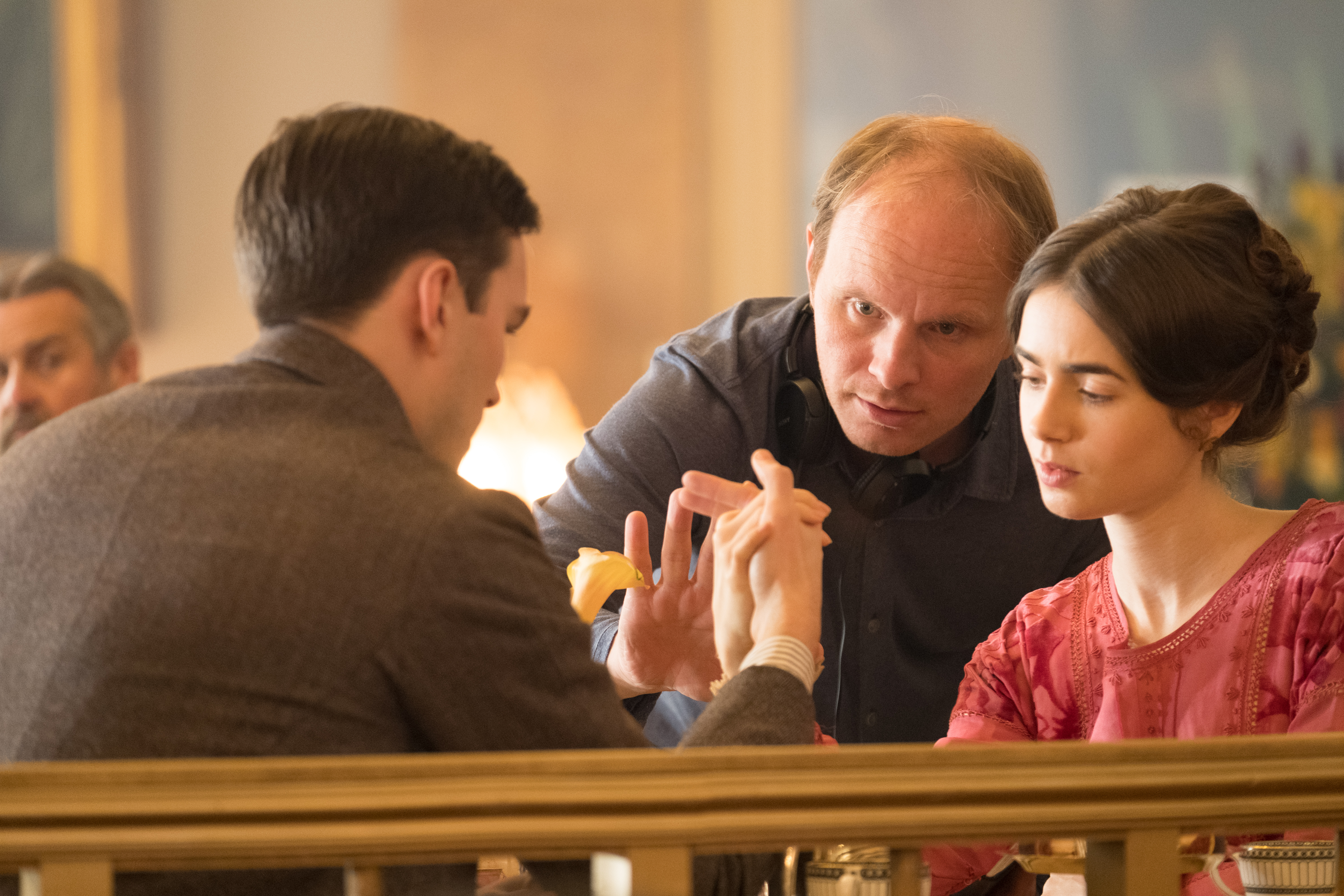
The new film Tolkien looks to tell the story of the life of the writer who created those stories and to convey a sense of what inspired him. Here's a clip from the trailer.
The way you follow the rhythms of language, I have to tell you, Mr. Tolkien, I've never come across anything like it. This is more than just a friendship. It's an alliance. An invincible alliance. A fellowship. If you've enjoyed any of J.R.R. Tolkien's stories, or fell in love with the fellowship vividly brought to life in the Lord of the Rings films, then the new film Tolkien offers a nice introduction to the man himself. Here, Tolkien, played by Nicholas Holt, shares his love of language with the woman he will eventually marry, Edith Bratt, played by Lily Collins. Tell me a story. What? The story of Selador.
No, I can't. Why not? When someone asks me to live with you. That's a different thing altogether. Tell me a story. In any language you want. That'd be ridiculous. The legend of Selador. No, I'm not a performing monkey. It begins with the arrival of a proud and opinionated princess. Yes, you're right about that. She demands entertainment. Princess Selador is bored. Bored of cakes and muffins and exquisite china. She longs for another life. It's not a name. What? Something else. Selador, it's not a princess's name. It can't be. Selador is a place.
it's a place an ancient place impossible to reach except by the most treacherous climb it hangs no no door road road path it's path path through a dense dark forest oh is it now at the heart of celador which is actually a shrine there stands an extraordinary sight is it a proud and opinionated princess it is a place which is revered by all who know of a sacred place marked at its center by By trees. The movie provides some fascinating insights into how Tolkien eventually came to writing. Actor Nicholas Holt talks about his role in the media press kit for the film. I was fairly familiar with his work. I had read The Hobbit after filming about a boy because the Whites brothers, the directors of that film, gave me a copy of that book. And then I'd read a bit of The Lord of the Rings. I'd watched the films and was a big fan of those. And then played the card game after school. I'd stay behind after school and play the card game. So I loved the world and understood that. But then really didn't know anything about the man behind those stories.
And that was what was incredible. I read the script and it was a beautiful story standalone on its own of these friendships and love and this young orphan boy who kind of found his safe place to create and then how that was all torn away from him through World War I. But also as a fan, I was like, oh, this is where all that inspiration came from. The scenes of young Tolkien, especially at school, are what the film does best. And I love any film that finds pleasure in the potential held by books and libraries. The film has some shortcomings, but it manages to leave you with the warm glow of fellowship that so informed Tolkien's writing.
I'm going to take a short break, but don't worry. It's nothing as long as the dark times after luncheon. And then I'll be back with my interview with Domei Korokoski, the director of Tolkien. Here in Southern California, we know all too well the devastation wildfires can cause. That's why our mission is to stop the next one before it starts. I'm Brian D'Agostino, leader of SDG&E's wildfire and climate science team. And we've built one of the most advanced wildfire prevention programs in the country with a team of world-class meteorologists using artificial intelligence and real-time weather data, all to help keep our communities safe. We're also building a stronger grid and using public safety power shut off when necessary, because believe me, I've seen firsthand how unpredictable wildfires can be. But here at SDG&E, we face that uncertainty head on to help keep you safe.
Learn more at sdge.com slash wildfiresafety. Just to begin with, what do you remember as your first introduction to Tolkien? And I remember that, you know, I read it, I read the trilogy, I remember I cried at the end when Sam is back home. And because, partly because for me, at that time was an escape. And then I cried, not just because of a beautiful story, but because the adventure kind of escape ended.
So that actually affected me very highly. It was very instrumental, probably as a storyteller, because then I started making my own fantasy stories. I started playing Dungeons & Dragons board games and creating my own stories and that. So I remember that emotion very well. And at what point did you become aware of the author's story, like his own story, and became interested in him? I think most of us know kind of the C.S. Lewis and the England era, the Oxford era, and that was also my picture of him. You know, in a certain way, I was a very poor kid also, so we didn't have running water. So you look at him as a privileged, almost elitist character in Oxford.
And then when you realize this story that, you know, he came out of poverty, he was orphaned, you know, he had to really struggle and fight to be who he was. In a way, there's a certain appreciation against him even more. You kind of admire him even more after hearing of this specific era that we're depicting the film. And when did you become involved in this project? And what was it that attracted you to trying to tell his story? I had met Fox News a couple of years ago. I think it was 2014. And they had seen some of my older films and kind of liked the voice that I had as a director and expressed that they were very keen on working with me on something. And I would send the script.
And, of course, this script is several drafts ago. And what struck me most is a sense of destiny. So this time that it depicts on his life, he's actually an outsider. He becomes orphaned. He's the need to find friends. And it's so vital, even in a maniac level, that I felt somehow destined that those were the emotions that I had when I was learning about his story. And so it felt like, okay, there's something here. There's something definitely here that I want to make the story. And we started developing, rewriting, reshaping, and several, several script drafts later and shooting, here we are.
of research did you do into his life to try and find out what his childhood was like and what kind of things influenced his writing? Well, the difficulty, of course, is that there's not that much documentation of this era that we're depicting. So I would just read everything. I would listen to all the interviews. I would meet so many Tolkien experts that I could. And what's tricky is that one expert will be saying one thing and the other expert will be saying the other thing. And everybody will have an opinion what should be involved in the film. And when you're doing an iconic character like Tolkien, that's the biggest challenge as a filmmaker.
So what happens to your biggest research is just listening, listening, listening, and then kind of finding through those voices your own interpretation of the character and what you want to tell, what is the main emotion you want to tell about them, their growth. And if you look at this era of life, after reading about it, the more I read about it, the more I researched, it felt it's so instrumental in his mythology. Not necessarily direct inspiration, but more like it really shaped him as an artist. And in making the film, what did you feel was the most important thing that you wanted to convey about him? read the first draft and then, you know, kind of developing, was how do we grow into the mind of a genius? Regardless if you're a Tolkien fan or regardless about that, you want to see, by Tolkien, you want to see how his mind flourishes. So that was something I took very much care of. And the second thing is also the beautiful story of friendship and fellowship and the inspiration that you were accidentally walking and not knowing anything about Tolkien. They could love and feeling this, like, and then, you know, perhaps call a friend.
You mentioned doing research and looking for things about him. One thing Tolkien is famous for having said is that, you know, you shouldn't that the book is just the book. It's nothing more. It's not about war. It's not about politics. How do you kind of take what an artist says about themselves? Can we always believe like what the artist says? Or do you think you have to kind of dig below what they're presenting their work as?
I think he said that that specific line he said in regards to the Nazism at that time, you know, so many people were trying to find, you know, allegories in the Second World War. Of course, I do, but he also said there were several things that inspired him directly, one-on-one, like when Edith's office in the forest that inspired him to write a better movie. And there are different elements that he admitted that were inspirations. I do agree with him that it's not a direct analogy. Although Lord of the Rings is a very Catholic work, you know, it's very religious in its heart and core.
But again, it's not directly coming out of the Bible. It's more of who we are as artists. We use the emotions, the feelings that we have. For instance, you were mentioning the war. It's not Mordor, and I agree that it's not one-on-one war as an inspiration to Mordor. But it's an emotional journey into Mordor, an emotional experience, him as an innocent soul, as innocent men, going to war, and then confronting this turmoil. And that we wanted to show that those emotions that he felt and experienced, and I'm pretty sure he used those emotions in writing his art.
Now, we live in a time of media being everywhere, our computers, our cell phones. And one of the things I really loved about the film was this celebration of books and being in a library and kind of the magic that just the written word can have. I agree. Actually, that's a very personal thing for me. Once I got to know my father.
He loved language. He studied English language in Yale. And, you know, I'm half Finnish, I'm half American. And we would debate about language in his kitchen here in New York, where I'm now. And the passion you can have for language and the beauty of it, and he was a writer also as a poet, is something I really read from Tolkien. And I always thought that, okay, how do you make language intriguing in a film, you know, especially, as you said, given the times. So we approached it so the language can be part of the music of the film, that you can enjoy as music almost. It's very lyrical and political, and you can just sit there in the cinema and just be fulfilled with that.
I think that's something beautiful that art gives us. Sometimes it allows us to be silent. It allows us to either view or hear the beauty of the world. And what we as humans have been able to create is a level of intelligence for ourselves. And it is a homage. The film is also a homage to that. Well, I think some of my favorite scenes are the ones between Nicholas Holt and Derek Jacobi. My class is full, Mr. Jolke, full. With students who can translate old English at least as quickly and skillfully as you. And have already had two terms to establish themselves. Good afternoon. Hello. Professor.
Since childhood, I have been fascinated with language. Obsessed with it. I've invented my own. Full, complete languages. Look, this is, it's everything. From the bravest horde. My heart, the treasure of the breast. And the drawings? I made stories. Legends. After all, what is language for? It's not just the naming of things, is it? It's the lifeblood of a culture, a people. Yeah, exactly. Could you write 5,000 words on the influence of Norse elements in Gawain? Absolutely. When would you like it by? This evening.
That was a scene from the new film Tolkien, featuring actors Nicholas Holt and Derek Jacoby. I'll be right back with more of my interview with director Domei Karukoski. Here in Southern California, we know all too well the devastation wildfires can cause. That's why our mission is to stop the next one before it starts. I'm Brian D'Agostino, leader of SDG&E's wildfire and climate science team, and we've built one of the most advanced wildfire prevention programs in the country with a team of world-class meteorologists using artificial intelligence and real-time weather data, all to help keep our communities safe. We're also building a stronger grid and using public safety power shutoff when necessary, because believe me, I've seen firsthand how unpredictable wildfires can be. But here at SDG&E, we face that uncertainty head-on to help keep you safe.
Learn more at sdge.com slash wildfiresafety. Those scenes at the university are great, and they show how Tolkien's life changes direction because of a professor. Exactly, and Derek Jackson portrays Professor Wright in Oxford, who was a mentor for him. People thought they were very goofy. They would walk around speaking odd languages in Oxford, and it was a very comical scene. And they were so passionate about language, and one of the actual elements I couldn't include in the film, and perhaps it would have been too kind of Oxford to work in the film.
It was difficult, like, the closer the closer you came to World of One, was it because they also loved the German language? So they kind of thought that they're German, they're always like enemies. So they would meet in secret to speak in German language. They would go in the cellar or somewhere to speak the language they really loved. And if you think about that passion, there's something there. You want to be a fly on the wall watching them, and I hope we can deliver that in the film. And talk a little bit about your casting of Nicholas Holt as Tolkien. What did you feel that he had that you felt embodied that author? Well, it's funny because I didn't, you know, Nicholas was top of my list, and the studio had actually worked with him just as a favorite, so, you know, he's really having a moment.
I've seen a lot of his work and I had just seen a Netflix film that he was in and understanding this is a young actor really blossomed, really starting to love the camera. Lily has the same situation. So I met Nicholas when I really didn't have, the script wasn't really finished or he wasn't at that point I didn't want to show him and talk about life without talking about the script and our experiences, how we've grown to be, who we are. And I found out, you know, this young man that is very intelligent. He's very fast, very funny. And he's a bit of a goofy, playful character. There's this one thing that I read that there's so much in him already that I read that Tolkien had. Lily has the same. She's kind of the Ellen Princess.
I was going to go back when I was 13 and imagine, you know, this is time before internet. You can't Google, you read a book and you can't Google what does an Elven princess look like. You have to imagine your own Elven princess and your first crush. So when you talk to Lily, there's this explosive warmth of shine. So for me, it kind of felt like, okay, that's the Tolkien. I mean, that's the Elven princess that Tolkien sees and then inspires to write all those stories about Luthi and other Elven princesses.
You just felt that they have this beautiful shine and energy together, that they would be the ethereal and eternal love story that they are. This isn't the first biopic that you've done, and I'm just curious, what do you feel are the particular challenges of doing a film biography, and what are the particular rewards that you've found? Well, first, you always have to be true to the emotions, but not necessarily facts. So, you know, it's not a documentary. It's not a Wikipedia site.
So I've learned that the best biopics of the best films about real-life characters come when you dig out them and flush out the emotion. If that then needs that you have to rewrite or dramatize some scenes, then it needs to be done. Because then you're actually more true to the character than just factually showing something of them. Because people are going to Google whatever they want to know more. And I think that's what we're also talking about. I want it to be so that it really, really flush out the emotion who Tolkien was, who his characters was, and do it in a way so that the audience can enjoy and be emotional and evocative, and being an evocative film. That is what you learn, that that really good biopic allows you to experience who the character is.
in a good dramatic way. That's what we thought after and I really hope that people feel so. What do you feel is the significance or what do you think about the film coming out at this particular time? What do you think audiences might connect with or what is it about the film that you'd like them to kind of take away? I think there's several things.
In a societal manner, of course, what struck me, I said, is that he was a poor kid and he had to really jump classes to be who he was. So we are, I think, the society is turning into a me society rather than the we society. And I think it's very valuable that we don't create these social classes that, you know, it's difficult to jump from another class to another one. And secondly, I think it's just the need of warmth and inspiration with your friends. We do not connect so much with our friends or we do not, you know, we do not spend that time or debate or the banter that these boys did. And I think that people, when they walk in the cinema, I feel they really hope that when they walk out, they've enjoyed it and they've been inspired and they've been called a friend.
just want to be close to each other. And I think that's something that in 2019 still is needed. All right. Well, I want to thank you very much for taking some time. Thank you very much. That was Domei Korokoski, director of the new film Tolkien and also of the recent Tom of Finland. Thanks for listening to another episode of KPBS Cinema Junkie Podcast. The podcast comes out every other Friday, but I'll have a special podcast next week about John Wick 3. John Wick. The price on your head is now $18 million. And it will continue to rise until you borrow it. Here we go. Mr. Wick wrote the rules.
And yet he lives. I've been looking forward to meeting you for a long time. So far, you haven't disappointed. I'm so looking forward to this film, and I'll have a review to let you know if it disappoints. Plus, I'll feature an archive interview with its director and former stuntman, Chad Stahelski, who talks about how he and star Keanu Reeves worked on the character and the action together. So Keanu can sit in, you know, one of our action meetings and go, John Wick wouldn't run, he'd just ram you with a car. And his mentality is not evasion, it is destruction and collision.
So check out the John Wick kick-ass edition of Cinema Junkie podcast next Friday. If you enjoy what you hear, please subscribe to the podcast on iTunes and leave a review. It's recommendations from people just like you that help the podcast reach a larger audience. And thanks to those of you who've already left reviews and told a friend to take a listen. Till our next film fix, I'm Beth Accomando, your resident cinema junkie.
Here in Southern California, we know all too well the devastation wildfires can cause. That's why our mission is to stop the next one before it starts. I'm Brian D'Agostino, leader of SDG&E's wildfire and climate science team. And we've built one of the most advanced wildfire prevention programs in the country with a team of world-class meteorologists using artificial intelligence and real-time weather data, all to help keep our communities safe. We're also building a stronger grid and using public safety power shutoff when necessary, because believe me, I've seen firsthand how unpredictable wildfires can be. But here at SDG&E, we face that uncertainty head on to help keep you safe. Learn more at sdge.com slash wildfiresafety.