
EPISODE · Mar 25, 2024 · 47 MIN
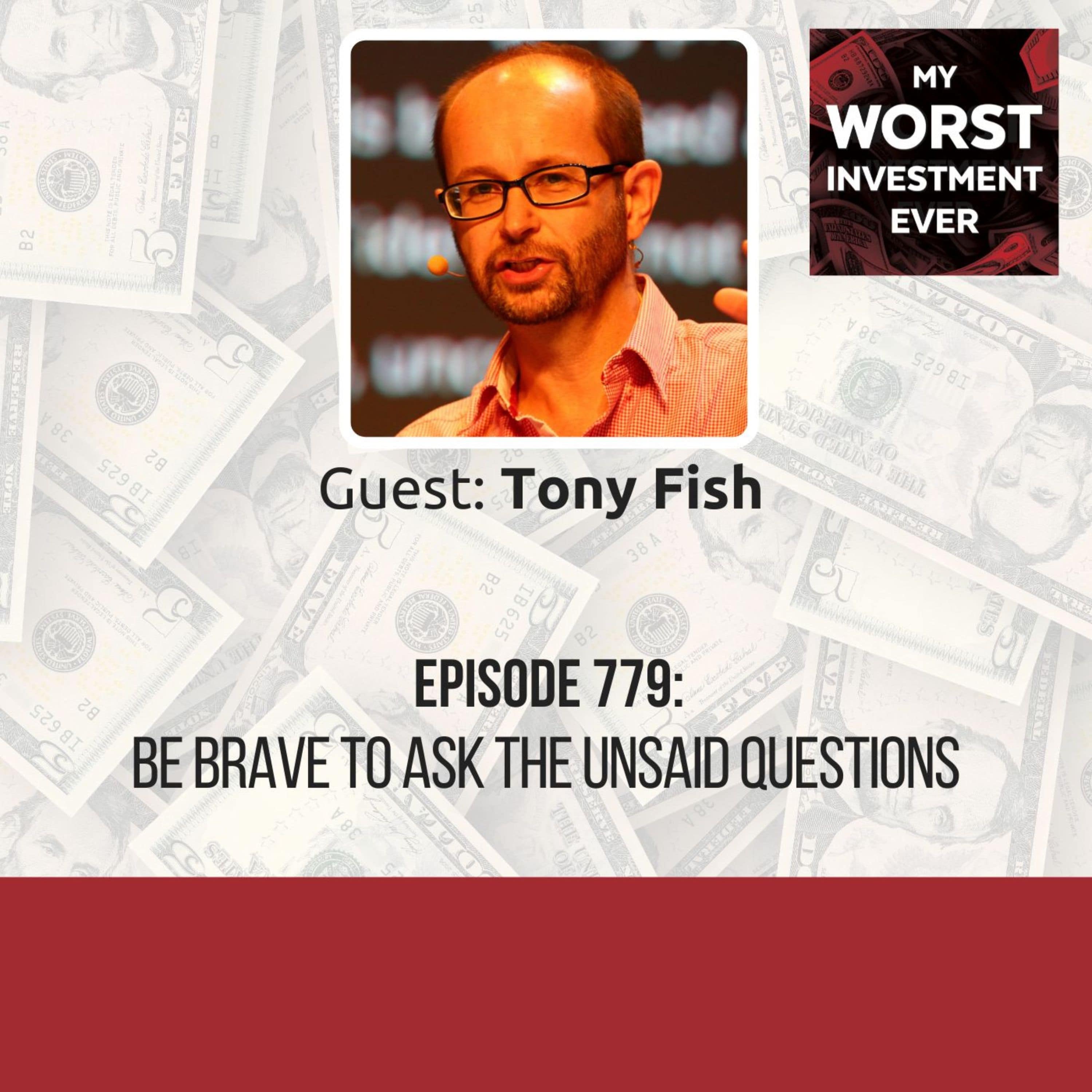
Tony Fish - Be Brave to Ask the Unsaid Questions
from My Worst Investment Ever Podcast
BIO: Tony Fish is a neuro-minority and a leading expert on decision-making, governance, and entrepreneurship in uncertain environments. His 30-year sense-making and foresight track record means he has been ahead on several technical revolutions.STORY: In this episode, Tony talks about his newest book, Decision Making in Uncertain Times. How can we become more aware of the consequences of our actions tomorrow?LEARNING: Ask better questions. “It’s only through conversations with people like you, Andrew, that I can refine my questions. I love all the people you put on the show because they helped me articulate better what I think I’m optimizing for.”Tony Fish Guest profileTony Fish is a neuro-minority and a leading expert on decision-making, governance, and entrepreneurship in uncertain environments. His 30-year sense-making and foresight track record means he has been ahead on several technical revolutions. His enthusiasm and drive are contagious & inspiring, especially for wicked problems. He has written and published six books, remains a visiting Fellow at Henley Business School for Entrepreneurship and Innovation, Entrepreneurs-in-residence (EIR) at Bradford School of Management, teaches at London Business School and the London School of Economics in AI and Ethics, and is a European Commission (EC) expert for Big Data.Tony was a guest on Ep261: CEOs Can Defraud a Business in Very Hard to Detect Ways. In this episode, Tony talks about his newest book, Decision Making in Uncertain Times - How can we become more aware of the consequences of our actions on tomorrow?The unsaid questionsTony struggled with how to ask better questions. He says there are two forms of questions. There are questions that we all ask, such as how are you performing? What are you doing? How are you feeling?Then there’s a pile of what Tony termed the unsaid questions. He says that we don’t ask these questions because, politically, we can’t ask them. We emotionally feel we’re not able to, especially if we don’t know the person well enough or when somebody tells us not to ask that type of question. The trouble with a board is that if members don’t ask the unsaid, they won’t be able to discharge their fiduciary duties. Therefore, we need better frameworks to find questions we didn’t know we needed to ask.So, how do we ask those questions? Tony has a whole book on how he does it. When the book gets shared, other people will read it, and they’ll come up with better questions than he has.Principle versus riskAccording to Tony, when a board starts, it has all these principles outlined and tries to uphold them. But you realize later on as a board that you can’t manage principles. What you can manage is risk frameworks. But you can’t manage risk rating frameworks without rules. So, you create rules that allow you to manage risk. After creating the rules, you become managed against the free-risk framework you believe in because it aligns with your principles.However, over time, the rules stop working, and those rules have to have another rule because there’s an exception to a rule. Tony says that when a new rule is created, or a new procedure or methodology comes along, a board should go back and question if that rule is aligned with its purpose, not whether it is helping the board manage the risk framework better.Over time, you’ll have your purpose clearly and start seeing a massive drift between what you believe you set up and what the risk frameworks and rules allow you to manage. Tony’s challenge to boards is that every time a new rule is created, it should go to the board, and the board should make a judgment call on whether that rule is aligned with its purpose.Role of a boardAccording to Tony, a board needs clarity on the tasks, the processes, the strategy, the purpose, and the North Star. It’s easy for boards to focus on tasks, processes, and strategy, but they find it difficult to focus on purpose and North Star. Most times, people only question whether they’re doing the right thing. He adds that a board has to be guided by data, rules, and regulations. But then it has to be directed by the values it wants and the organization’s values, which then comes back to the principles. The issue most boards face is that others’ values, principles, and behaviors are far more instrumental in a board’s values than they ever realized.Then you’ve got a fundamental issue: Too many people end up on boards without board training. The untrained board members end up replicating management meetings as board meetings, believing that’s what they should be doing.How to set up a boardTony believes that everybody follows an S curve. When you’re in the different phases of going up the S curve, you need other types of governance. However, many people don’t transition as they go up the S curve.When in a particular phase, try to find the board that can do the next part, not the current one. And therein lies the difficulty for so many board members because they want to do what they’re good at and, therefore, stay in their comfort zones. This curtails the ability of the company to scale. What the board should be doing is asking: what do you do? Where are the transitions? How do you go about thinking? What are the processes and procedures? What skills do you need at the different layers as you go up?About the bookTony’s book contains ten short frameworks. The idea is not to explain everything but to help the reader peel back the layers of the falsehood that they think they know what they’re doing, yet they haven’t got a clue. Tony wants you to make better choices and decisions by asking better questions.The book is most accessible on Amazon, where you can purchase it in hardcover, softcover, or Kindle. You can also get a free PDF copy at www.peakparadox.com/book. If you want to reach out to Tony, he’s on LinkedIn. [spp-transcript] Connect with Tony FishLinkedInTwitterWebsiteBlogBookAndrew’s booksHow to Start Building Your Wealth Investing in the Stock MarketMy Worst Investment Ever9 Valuation Mistakes and How to Avoid ThemTransform Your Business with Dr.Deming’s 14 PointsAndrew’s online programsValuation Master ClassThe Become a Better Investor CommunityHow to Start Building Your Wealth Investing in the Stock MarketFinance Made Ridiculously SimpleFVMR Investing: Quantamental Investing Across the WorldBecome a Great Presenter and Increase Your InfluenceTransform Your Business with Dr. Deming’s 14 PointsAchieve Your GoalsConnect with Andrew Stotz:astotz.comLinkedIn<a href="https://www.facebook.com/andrewstotzpage" rel="noopener noreferrer"...
Embed this episode
Ready to play
Tony Fish - Be Brave to Ask the Unsaid Questions
No transcript for this episode yet
Similar Episodes
No similar episodes found.