
EPISODE · Jun 4, 2025 · 34 MIN
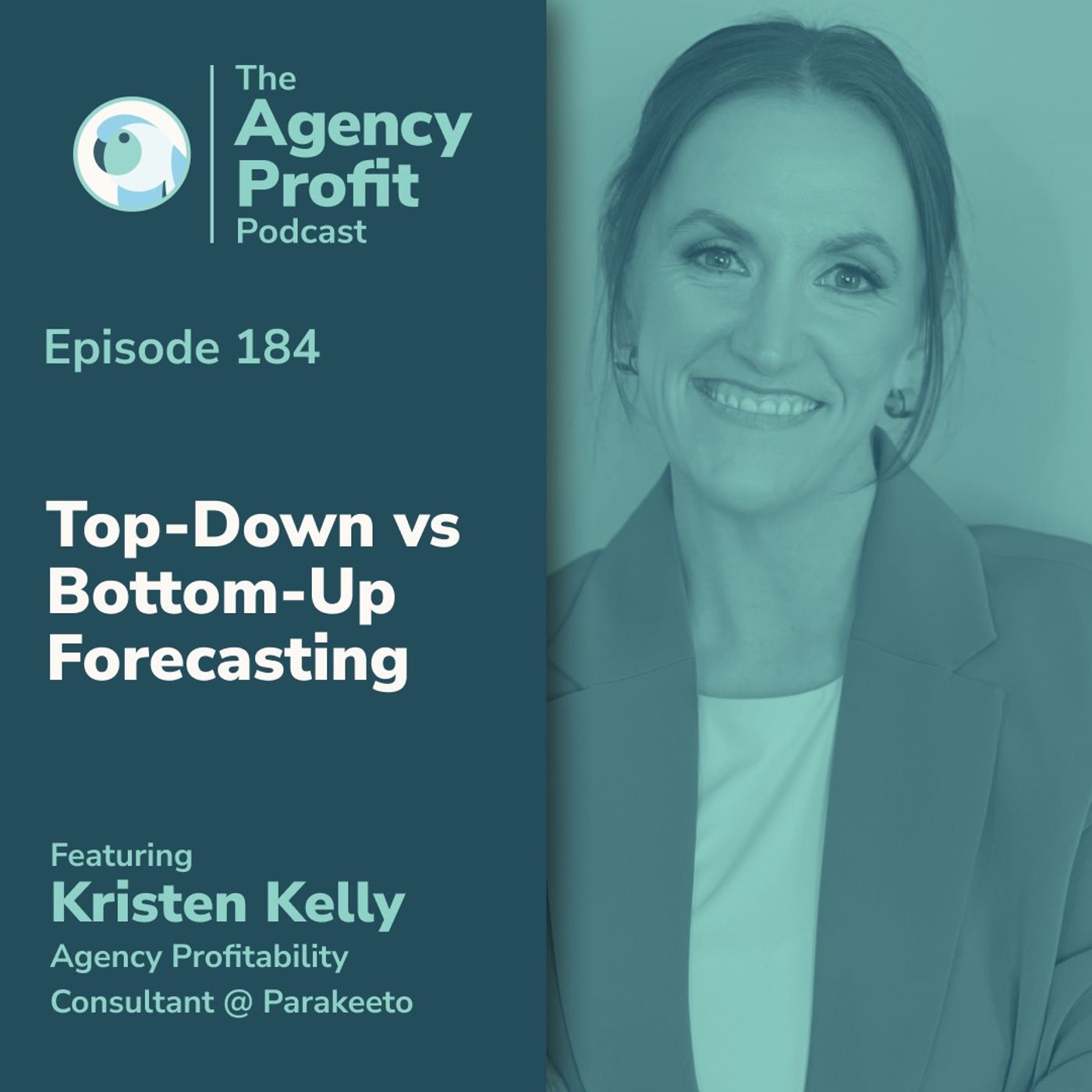
Top-Down vs Bottom-Up Forecasting, With Kristen Kelly
from The Agency Profit Podcast · host Marcel Petitpas
Points of Interest0:00 – 1:00 – Introduction to Forecasting Challenges: Marcel and Kristen set the stage by identifying forecasting as a critical but often misunderstood aspect of agency operations, particularly in scaling businesses.1:06 – 2:30 – Defining Forecasting’s Importance: They explain how forecasting provides the necessary visibility to manage capacity, revenue, and key metrics, forming the foundation for informed decision-making.2:47 – 3:48 – Forecasting as a Management Function: Marcel discusses how balancing workload and staffing is a core leadership task, becoming more complex and high-stakes as agencies grow in size.5:05 – 6:17 – Bottom-Up Forecasting Explained: Marcel describes the traditional method of forecasting via detailed task-level planning, often used by project managers to allocate resources with precision.6:32 – 7:52 – Limitations of Bottom-Up Approaches: Kristen and Marcel highlight how bottom-up forecasting becomes difficult to scale due to its complexity and sensitivity to frequent changes in scope or staffing.7:59 – 9:39 – Top-Down Forecasting Defined: The conversation shifts to top-down forecasting, which simplifies inputs by modeling at the role or department level, enabling faster, strategic scenario planning.11:00 – 12:20 – Embracing Uncertainty in Leadership Planning: Marcel explains how top-down methods are better suited to leadership conversations, which often require evaluating multiple uncertain scenarios quickly.13:04 – 14:27 – Statistical Logic Behind Simplicity: Marcel introduces the concept of reliability block diagrams, illustrating why less granular systems can actually offer more consistent accuracy over time.17:00 – 17:45 – Precision vs. Accuracy in Uncertain Contexts: The hosts explore how broader, less precise estimates (e.g., ranges) are often more accurate and actionable when future outcomes are unknown.20:31 – 23:01 – Keeping Systems Separate for Efficiency: Marcel warns against tightly coupling bottom-up and top-down systems, advocating for independent but aligned processes to avoid maintenance burdens.26:15 – 27:02 – Material Discrepancies and Process Discipline: They stress that small mismatches between forecasting systems aren’t necessarily problems and underscore the importance of scope-driven planning.30:57 – 34:20 – Getting Started with Top-Down Forecasting: The episode closes with advice on how agencies can start building simple top-down models using team capacity and project estimates to guide executive decisions.Show NotesBook a call and learn more about our Forecasting systemLinkedIn Post on Bottom-Up vs Top-Down MathRequest demo videos of our reporting platform Hosted by Simplecast, an AdsWizz company. See pcm.adswizz.com for information about our collection and use of personal data for advertising.
Embed this episode
What this episode covers
About this Episode In this episode of the Agency Profit Podcast, Marcel sits down with Parakeeto’s own Kristen Kelly to tackle the often misunderstood and overly complex topic of forecasting in service businesses. They break down the difference between bottom-up and top-down forecasting, explaining how each serves a different purpose, from granular project planning to high-level leadership decision-making. The duo highlights how many agencies get stuck trying to force detailed project data to answer broader strategic questions, and why simplifying your forecasting system might actually yield more accurate, actionable insights. Listeners will walk away with a clearer understanding of how to create forecasting systems that balance precision and usability, especially in the face of uncertainty, and why decoupling operational and executive forecasting tools can save time, reduce stress, and improve decision-making across the board.
NOW PLAYING
Top-Down vs Bottom-Up Forecasting, With Kristen Kelly
No transcript for this episode yet
Similar Episodes
Similar Podcasts
No similar podcasts found.