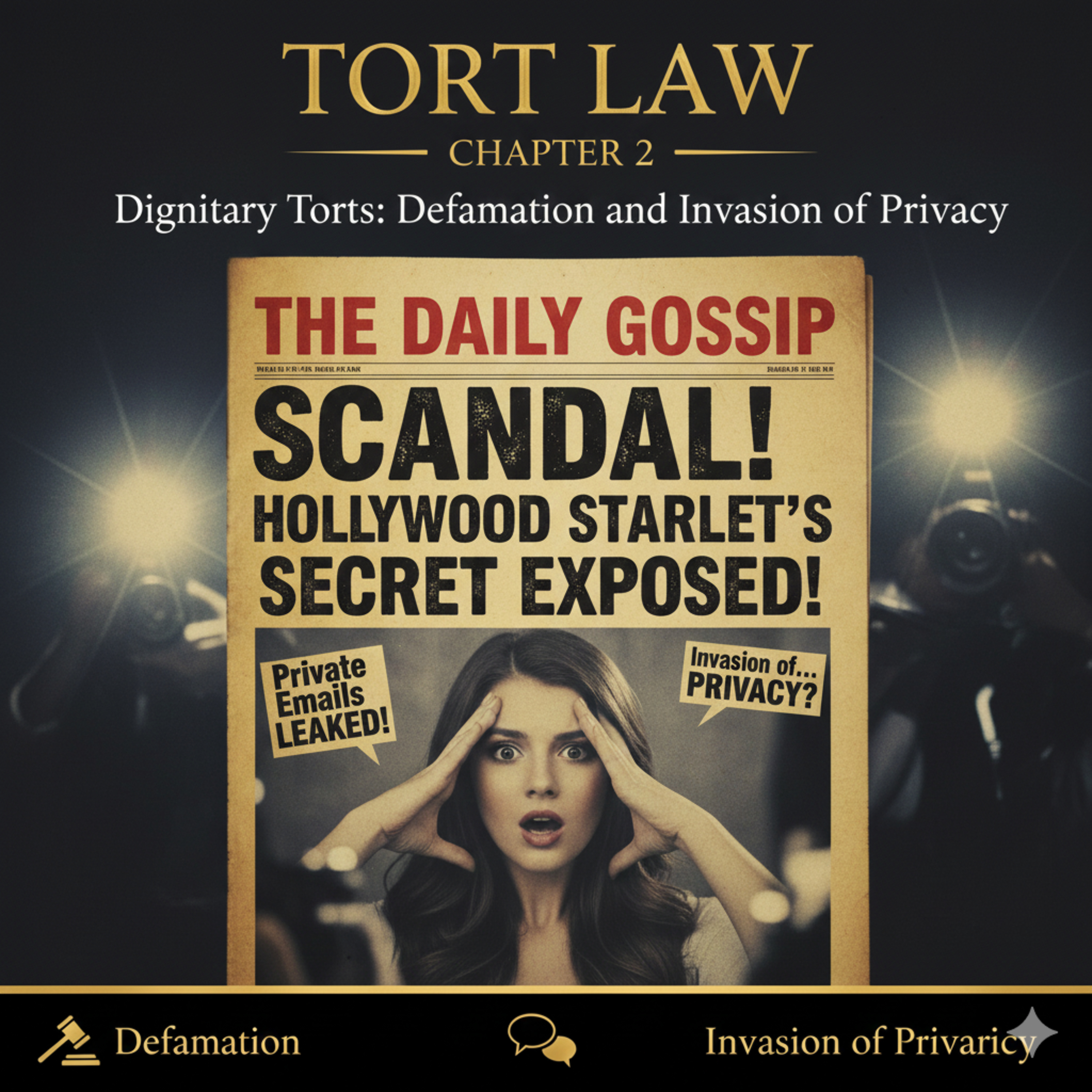
Tort Law Chapter 2: Dignitary Torts: Defamation and Invasion of Privacy episode artwork

EPISODE · Dec 16, 2025 · 39 MIN

Tort Law Chapter 2: Dignitary Torts: Defamation and Invasion of Privacy

from Law School · host The Law School of America

Notes: Torts UnleashedUnderstanding Dignitary Torts: Malice and ForeseeabilityThis conversation delves into the complexities of tort law, specifically focusing on dignitary torts such as defamation and invasion of privacy. The discussion covers foundational concepts, the evolution of privacy law, the distinction between false light and defamation, and the impact of constitutional law on these torts. It also explores the differences between public and private figures in legal contexts, the implications of Section 230 on online speech, and a comparative analysis of U.S. and European privacy laws. The conversation concludes with key takeaways and strategies for mastering these concepts in legal examinations.In the complex realm of tort law, dignitary torts stand out as a critical area of study, especially for those preparing for exams. These torts, which include defamation and invasion of privacy, are not just about understanding the rules but also the constitutional overlays that can turn common law principles into traps.The Four Pillars of Privacy TortsThe foundation of privacy law is built on four distinct torts: intrusion upon seclusion, misappropriation of name or likeness, public disclosure of private facts, and false light. Each of these protects a different aspect of personal dignity, from the act of gathering information to the misuse of one's identity for commercial gain.False Light vs. DefamationA classic exam question often revolves around the subtle differences between false light and defamation. While both involve false statements, defamation focuses on harm to reputation, whereas false light is about the offense to one's dignity. The key distinction lies in the malice standard, which is crucial for a false-light claim.Constitutional Revolution and Actual MaliceThe landmark case of New York Times v. Sullivan introduced the actual malice standard, a pivotal point in dignitary torts. This standard requires public officials to prove that a false statement was made with knowledge of its falsity or with reckless disregard for the truth. This constitutional overlay extends to related torts, ensuring that free speech is protected even in the face of potential reputational harm.Foreseeability in Negligence CasesIn negligence cases, particularly in Illinois, the concept of foreseeability plays a crucial role. Courts differentiate between general and narrow senses of foreseeability, which can determine whether a duty is owed. This distinction often masks policy decisions, reflecting the court's concern about opening the floodgates to litigation.As we navigate the evolving landscape of tort law, understanding the nuances of dignitary torts and the constitutional protections that overlay them is essential. These principles are continually challenged by new technologies and social media, making it imperative for the next generation of lawyers to adapt and innovate.Subscribe now to stay updated on the latest legal insights and prepare for your exams with confidence.TakeawaysUnderstanding dignitary torts is crucial for exam success.The right to privacy is fundamentally about being let alone.False light torts focus on emotional well-being, not reputation.Actual malice is a key standard for public figures.Private figures have more protection under the law.False light is often used as a procedural escape hatch.Section 230 provides immunity for online platforms.tort law, dignitary torts, defamation, invasion of privacy, false light, constitutional law, actual malice, negligence, foreseeability, privacy rights

Notes: Torts UnleashedUnderstanding Dignitary Torts: Malice and ForeseeabilityThis conversation delves into the complexities of tort law, specifically focusing on dignitary torts such as defamation and invasion of privacy. The discussion covers foundational concepts, the evolution of privacy law, the distinction between false light and defamation, and the impact of constitutional law on these torts. It also explores the differences between public and private figures in legal contexts, the implications of Section 230 on online speech, and a comparative analysis of U.S. and European privacy laws. The conversation concludes with key takeaways and strategies for mastering these concepts in legal examinations.In the complex realm of tort law, dignitary torts stand out as a critical area of study, especially for those preparing for exams. These torts, which include defamation and invasion of privacy, are not just about understanding the rules but also the constitutional overlays that can turn common law principles into traps.The Four Pillars of Privacy TortsThe foundation of privacy law is built on four distinct torts: intrusion upon seclusion, misappropriation of name or likeness, public disclosure of private facts, and false light. Each of these protects a different aspect of personal dignity, from the act of gathering information to the misuse of one's identity for commercial gain.False Light vs. DefamationA classic exam question often revolves around the subtle differences between false light and defamation. While both involve false statements, defamation focuses on harm to reputation, whereas false light is about the offense to one's dignity. The key distinction lies in the malice standard, which is crucial for a false-light claim.Constitutional Revolution and Actual MaliceThe landmark case of New York Times v. Sullivan introduced the actual malice standard, a pivotal point in dignitary torts. This standard requires public officials to prove that a false statement was made with knowledge of its falsity or with reckless disregard for the truth. This constitutional overlay extends to related torts, ensuring that free speech is protected even in the face of potential reputational harm.Foreseeability in Negligence CasesIn negligence cases, particularly in Illinois, the concept of foreseeability plays a crucial role. Courts differentiate between general and narrow senses of foreseeability, which can determine whether a duty is owed. This distinction often masks policy decisions, reflecting the court's concern about opening the floodgates to litigation.As we navigate the evolving landscape of tort law, understanding the nuances of dignitary torts and the constitutional protections that overlay them is essential. These principles are continually challenged by new technologies and social media, making it imperative for the next generation of lawyers to adapt and innovate.Subscribe now to stay updated on the latest legal insights and prepare for your exams with confidence.TakeawaysUnderstanding dignitary torts is crucial for exam success.The right to privacy is fundamentally about being let alone.False light torts focus on emotional well-being, not reputation.Actual malice is a key standard for public figures.Private figures have more protection under the law.False light is often used as a procedural escape hatch.Section 230 provides immunity for online platforms.tort law, dignitary torts, defamation, invasion of privacy, false light, constitutional law, actual malice, negligence, foreseeability, privacy rights

NOW PLAYING

Tort Law Chapter 2: Dignitary Torts: Defamation and Invasion of Privacy

0:00 39:54

No transcript for this episode yet

We transcribe on demand. Request one and we'll notify you when it's ready — usually under 10 minutes.

The Small Business Startup School – Business Notes | Financial Literacy | Retail Psychology – For Professionals & Entrepreneurs The Small Business Startup School Inc. Starting or buying a small business? While personal circumstances may vary, business patterns remain timeless. On The Small Business Startup School, we explore strategies, insights, and practical solutions to help entrepreneurs confidently navigate their journey.Hosted by Ola Williams—a retail entrepreneur, fintech founder, and financial coach with over two decades of experience—this podcast marries financial awareness and retail psychology with optimism to deliver actionable takeaways.Join us to learn, grow, and connect as we uncover the keys to business success.Let’s continue to learn together and be encouraged to keep on connecting! The 48 Laws of Power by Robert Greene (Full Audiobook) Robert Greene Amoral, cunning, ruthless, and instructive, this multi-million-copy New York Times bestseller is the definitive manual for anyone interested in gaining, observing, or defending against ultimate control – from the author of The Laws of Human Nature.In the book that People magazine proclaimed “beguiling” and “fascinating,” Robert Greene and Joost Elffers have distilled three thousand years of the history of power into 48 essential laws by drawing from the philosophies of Machiavelli, Sun Tzu, and Carl Von Clausewitz and also from the lives of figures ranging from Henry Kissinger to P.T. Barnum.Some laws teach the need for prudence (“Law 1: Never Outshine the Master”), others teach the value of confidence (“Law 28: Enter Action with Boldness”), and many recommend absolute self-preservation (“Law 15: Crush Your Enemy Totally”). Every law, though, has one thing in common: an interest in t Guardians Of Innocence Guardians Of Innocence Guardians of Innocence is a powerful and informative podcast designed to equip parents, teachers, and communities with the knowledge and tools needed to protect children from the growing threat of trafficking. Each episode dives deep into the tactics traffickers use to target vulnerable children—both online and in real life—and provides actionable advice on how to recognize the warning signs.Through expert interviews with cyber safety professionals, law enforcement, and survivors, we uncover the latest grooming methods, share real-world stories, and empower listeners to become vigilant guardians of innocence in their own families and communities.Guardians of Innocence is more than just a podcast; it’s a call to action to safeguard our children, raise awareness, and foster a united front against trafficking.Listen. Learn. Protect. The Laura Ingraham Show Laura Ingraham The most-watched woman in the history of cable news brings her no-holds-barred political and cultural commentary to podcasting with The Laura Ingraham Show. A bestselling author, breast cancer survivor, and mother of three internationally adopted children, Laura was the most listened-to woman in talk radio before launching her own podcast. A trailblazer across media platforms, she brings a unique perspective to this twice-weekly show, drawing on her experience as a white-collar criminal defense litigator and a Supreme Court law clerk.New episodes drop twice a week—delivering the clarity, courage, and common sense America needs.

Frequently Asked Questions

How long is this episode of Law School?

This episode is 39 minutes long.

When was this Law School episode published?

This episode was published on December 16, 2025.

What is this episode about?

Notes: Torts UnleashedUnderstanding Dignitary Torts: Malice and ForeseeabilityThis conversation delves into the complexities of tort law, specifically focusing on dignitary torts such as defamation and invasion of privacy. The discussion covers...

Can I download this Law School episode?

Yes, you can download this episode by clicking the download button on the episode player, or subscribe to the podcast in your preferred podcast app for automatic downloads.
URL copied to clipboard!