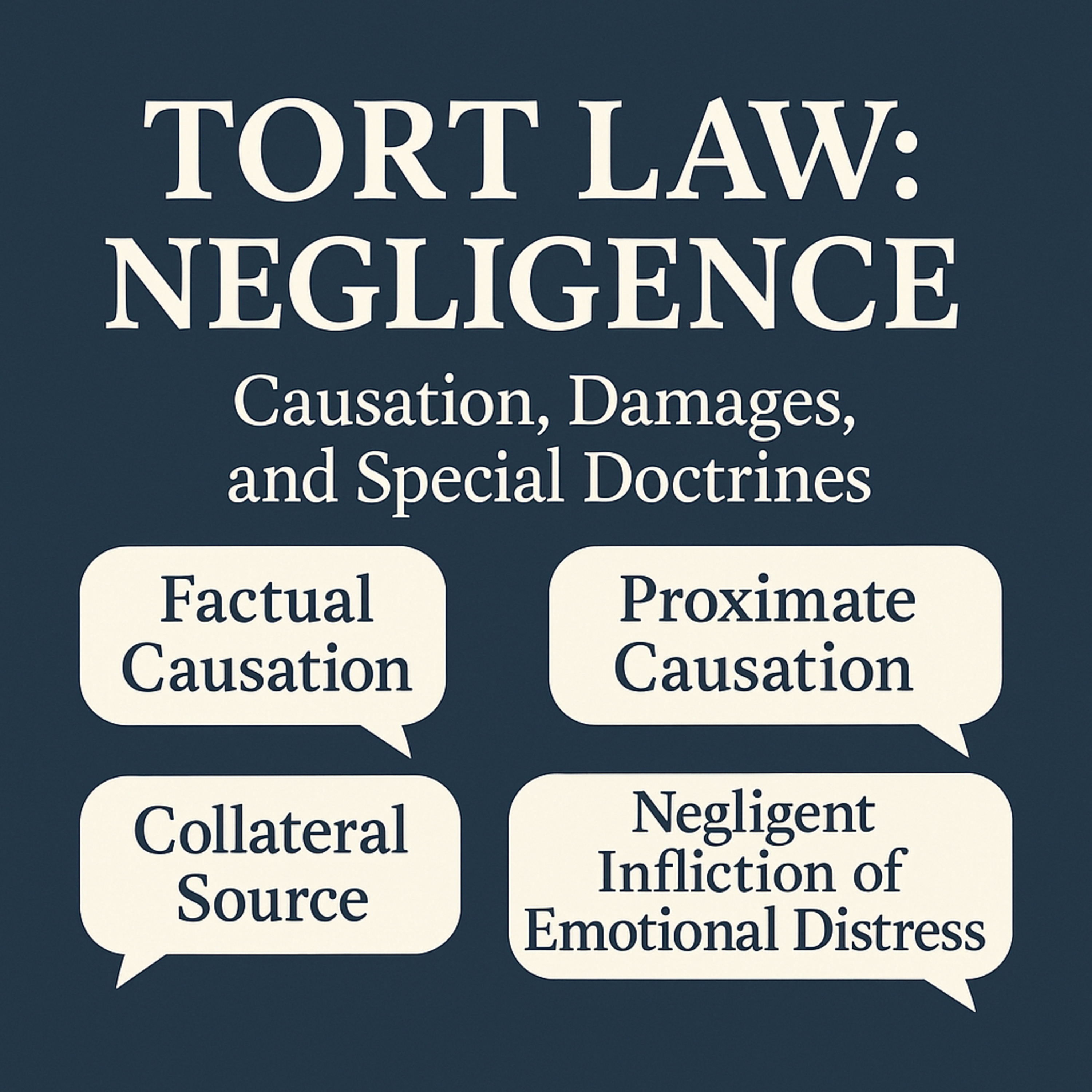
Tort Law Chapter 5: Negligence: Causation, Damages, and Special Doctrines episode artwork

EPISODE · Dec 19, 2025 · 35 MIN

Tort Law Chapter 5: Negligence: Causation, Damages, and Special Doctrines

from Law School · host The Law School of America

Understanding Negligence Causation in Tort Law: A Deep DiveThis conversation provides a comprehensive breakdown of tort law, focusing on negligence analysis, causation, damages, and special doctrines. It emphasizes the importance of understanding the policy choices behind legal rules and the complexities involved in establishing liability. Key topics include factual and proximate causation, the collateral source rule, emotional distress claims, and the challenges of mass tort litigation. The discussion aims to clarify these concepts for law students and practitioners, highlighting the critical elements necessary for successful legal analysis.In the intricate world of tort law, negligence causation stands as a cornerstone concept, pivotal for both law students and practitioners. This blog post unravels the complexities of causation, offering a clear roadmap through its two main components: factual causation and proximate causation.Factual Causation: The 'But For' TestAt the heart of factual causation lies the 'but for' test, a fundamental principle asking whether the injury would have occurred 'but for' the defendant's actions. This test, while straightforward, can sometimes lead to infinite causal chains, necessitating alternative approaches like the Substantial Factor Test (SFT) in cases with concurrent causes.Proximate Causation: The Scope of LiabilityProximate causation, or legal causation, introduces a policy-driven filter to limit liability. It asks whether the harm was a foreseeable result of the defendant's actions, a concept famously illustrated in the Palsgraf v. Long Island Railroad case. This shift from 'proximate cause' to 'scope of liability' sharpens legal analysis, focusing on the specific risks created by the defendant's conduct.Special Doctrines and Modern ChallengesThe blog also explores special doctrines like alternative liability and market share liability, which address evidential uncertainties in complex cases. Additionally, it delves into the controversial collateral source rule, highlighting its impact on damages and the ongoing debate over its fairness and economic implications.The Bigger PictureUltimately, understanding negligence causation in tort law is not just about mastering legal tests and doctrines. It's about recognizing the legal system's broader goal of achieving social fairness, balancing factual findings with equitable outcomes.Subscribe now to stay updated on the latest insights in tort law and beyond.TakeawaysThe goal here is clarity.Causation is the link itself.Proximate cause is the policy-driven filter.The collateral source rule is deeply controversial.Negligent infliction of emotional distress is evolving.Mass torts are a different beast altogether.The harm must match the risk.The single most common mistake on a torts exam is mixing up causation types.Tort law is about achieving social fairness.Understanding policy choices is key to tort law.tort law, negligence, causation, damages, collateral source rule, emotional distress, mass torts, legal responsibility, liability, law education

Understanding Negligence Causation in Tort Law: A Deep DiveThis conversation provides a comprehensive breakdown of tort law, focusing on negligence analysis, causation, damages, and special doctrines. It emphasizes the importance of understanding the policy choices behind legal rules and the complexities involved in establishing liability. Key topics include factual and proximate causation, the collateral source rule, emotional distress claims, and the challenges of mass tort litigation. The discussion aims to clarify these concepts for law students and practitioners, highlighting the critical elements necessary for successful legal analysis.In the intricate world of tort law, negligence causation stands as a cornerstone concept, pivotal for both law students and practitioners. This blog post unravels the complexities of causation, offering a clear roadmap through its two main components: factual causation and proximate causation.Factual Causation: The 'But For' TestAt the heart of factual causation lies the 'but for' test, a fundamental principle asking whether the injury would have occurred 'but for' the defendant's actions. This test, while straightforward, can sometimes lead to infinite causal chains, necessitating alternative approaches like the Substantial Factor Test (SFT) in cases with concurrent causes.Proximate Causation: The Scope of LiabilityProximate causation, or legal causation, introduces a policy-driven filter to limit liability. It asks whether the harm was a foreseeable result of the defendant's actions, a concept famously illustrated in the Palsgraf v. Long Island Railroad case. This shift from 'proximate cause' to 'scope of liability' sharpens legal analysis, focusing on the specific risks created by the defendant's conduct.Special Doctrines and Modern ChallengesThe blog also explores special doctrines like alternative liability and market share liability, which address evidential uncertainties in complex cases. Additionally, it delves into the controversial collateral source rule, highlighting its impact on damages and the ongoing debate over its fairness and economic implications.The Bigger PictureUltimately, understanding negligence causation in tort law is not just about mastering legal tests and doctrines. It's about recognizing the legal system's broader goal of achieving social fairness, balancing factual findings with equitable outcomes.Subscribe now to stay updated on the latest insights in tort law and beyond.TakeawaysThe goal here is clarity.Causation is the link itself.Proximate cause is the policy-driven filter.The collateral source rule is deeply controversial.Negligent infliction of emotional distress is evolving.Mass torts are a different beast altogether.The harm must match the risk.The single most common mistake on a torts exam is mixing up causation types.Tort law is about achieving social fairness.Understanding policy choices is key to tort law.tort law, negligence, causation, damages, collateral source rule, emotional distress, mass torts, legal responsibility, liability, law education

NOW PLAYING

Tort Law Chapter 5: Negligence: Causation, Damages, and Special Doctrines

0:00 35:09

No transcript for this episode yet

We transcribe on demand. Request one and we'll notify you when it's ready — usually under 10 minutes.

The Small Business Startup School – Business Notes | Financial Literacy | Retail Psychology – For Professionals & Entrepreneurs The Small Business Startup School Inc. Starting or buying a small business? While personal circumstances may vary, business patterns remain timeless. On The Small Business Startup School, we explore strategies, insights, and practical solutions to help entrepreneurs confidently navigate their journey.Hosted by Ola Williams—a retail entrepreneur, fintech founder, and financial coach with over two decades of experience—this podcast marries financial awareness and retail psychology with optimism to deliver actionable takeaways.Join us to learn, grow, and connect as we uncover the keys to business success.Let’s continue to learn together and be encouraged to keep on connecting! The 48 Laws of Power by Robert Greene (Full Audiobook) Robert Greene Amoral, cunning, ruthless, and instructive, this multi-million-copy New York Times bestseller is the definitive manual for anyone interested in gaining, observing, or defending against ultimate control – from the author of The Laws of Human Nature.In the book that People magazine proclaimed “beguiling” and “fascinating,” Robert Greene and Joost Elffers have distilled three thousand years of the history of power into 48 essential laws by drawing from the philosophies of Machiavelli, Sun Tzu, and Carl Von Clausewitz and also from the lives of figures ranging from Henry Kissinger to P.T. Barnum.Some laws teach the need for prudence (“Law 1: Never Outshine the Master”), others teach the value of confidence (“Law 28: Enter Action with Boldness”), and many recommend absolute self-preservation (“Law 15: Crush Your Enemy Totally”). Every law, though, has one thing in common: an interest in t Guardians Of Innocence Guardians Of Innocence Guardians of Innocence is a powerful and informative podcast designed to equip parents, teachers, and communities with the knowledge and tools needed to protect children from the growing threat of trafficking. Each episode dives deep into the tactics traffickers use to target vulnerable children—both online and in real life—and provides actionable advice on how to recognize the warning signs.Through expert interviews with cyber safety professionals, law enforcement, and survivors, we uncover the latest grooming methods, share real-world stories, and empower listeners to become vigilant guardians of innocence in their own families and communities.Guardians of Innocence is more than just a podcast; it’s a call to action to safeguard our children, raise awareness, and foster a united front against trafficking.Listen. Learn. Protect. The Laura Ingraham Show Laura Ingraham The most-watched woman in the history of cable news brings her no-holds-barred political and cultural commentary to podcasting with The Laura Ingraham Show. A bestselling author, breast cancer survivor, and mother of three internationally adopted children, Laura was the most listened-to woman in talk radio before launching her own podcast. A trailblazer across media platforms, she brings a unique perspective to this twice-weekly show, drawing on her experience as a white-collar criminal defense litigator and a Supreme Court law clerk.New episodes drop twice a week—delivering the clarity, courage, and common sense America needs.

Frequently Asked Questions

How long is this episode of Law School?

This episode is 35 minutes long.

When was this Law School episode published?

This episode was published on December 19, 2025.

What is this episode about?

Understanding Negligence Causation in Tort Law: A Deep DiveThis conversation provides a comprehensive breakdown of tort law, focusing on negligence analysis, causation, damages, and special doctrines. It emphasizes the importance of understanding...

Can I download this Law School episode?

Yes, you can download this episode by clicking the download button on the episode player, or subscribe to the podcast in your preferred podcast app for automatic downloads.
URL copied to clipboard!