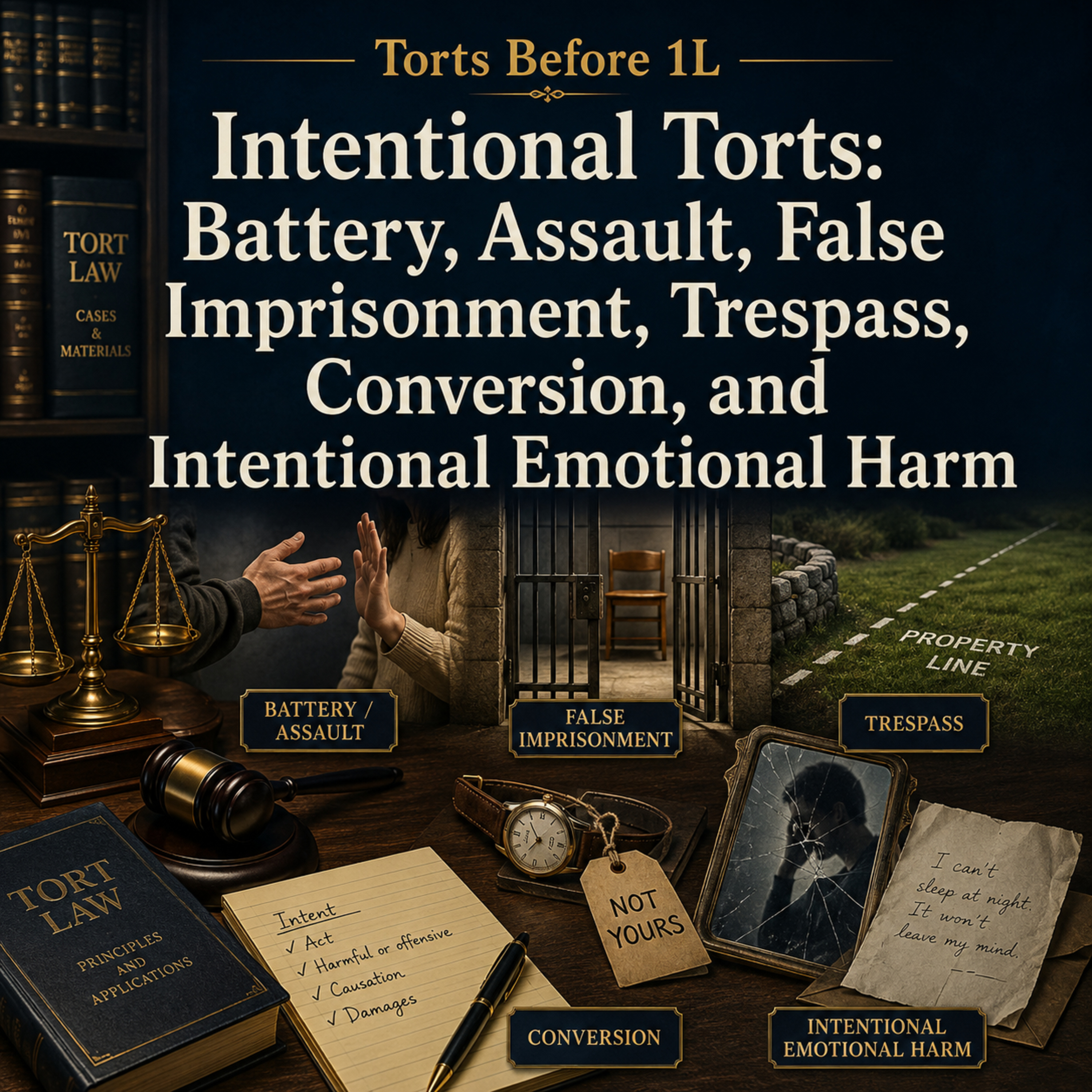
Torts Before 1L: Intentional Torts - Battery, Assault, False Imprisonment, Trespass, Conversion, and Intentional Emotional Harm episode artwork

EPISODE · Jun 2, 2026 · 1H 9M

Torts Before 1L: Intentional Torts - Battery, Assault, False Imprisonment, Trespass, Conversion, and Intentional Emotional Harm

from Law School · host The Law School of America

.spotify-style-link { display: inline-flex; align-items: center; background-color: #1e293b; /* Deep Slate for authority */ color: #ffffff !important; text-decoration: none; font-family: -apple-system, BlinkMacSystemFont, "Segoe UI", Roboto, Helvetica, Arial, sans-serif; font-size: 14px; font-weight: 800; text-transform: uppercase; letter-spacing: 0.5px; border-radius: 4px; border: 1px solid #334155; transition: background 0.2s; padding: 2px 16px; } .spotify-style-link:hover { background-color: #0f172a; border-color: #fbbf24; /* Amber highlight on hover */ } .icon { margin-right: 8px; color: #fbbf24; } 📘 View Study Guide Mastering Intent and Fundamental Torts in Civil LiabilityIn this episode, we dissect the core principles of intentional torts, emphasizing how legal intent differs from everyday notions and the significance of precise analysis during exams. You'll learn to identify protected interests, navigate doctrinal traps, and understand defenses—skills essential for law school exams and the bar.Most tort law defenses are about controlling what is legal and what isn't — but one defense stands out as a masterclass in defending the unexpected. Consent isn't just about permission; it’s about understanding the deeply subjective boundary of what society considers acceptable contact, and when that boundary is crossed, liability follows. If you want to excel in legal exams and truly grasp how liability can be shifted or avoided, this episode reveals the precise frameworks, common traps, and subtle nuances you must master.Dive into the complex landscape of intentional torts, where the law’s focus isn't just on harm but on the underlying protected interests: bodily integrity, personal dignity, and emotional security. You’ll discover how intentionality works—clarifying the purpose prong versus the knowledge prong—and learn why transferred intent applies strictly to classic torts like battery and trespass, but seriously not to modern claims like IIED.We break down:The objective standard for offensive contact and the fascinating extended personality doctrine demonstrated in landmark cases like Fisher v. Carousel.How assault is about creating a reasonable apprehension of imminent contact—not fear—and how verbal threats can become actionable assault depending on context, proximity, and social dynamic.The precise parameters of false imprisonment, including the crucial role of awareness and reasonable escape routes, plus how the shopkeeper's privilege can shield stores from liability when detaining suspected shoplifters.The stark difference between trespass to land, trespass to chattels, and the extreme remedy of conversion, highlighting why a small scratch results in different liabilities than full theft.Critical property defenses like private necessity, where the law balances individual survival against property damage, and the famous case of Vincent v. Lake Erie, illustrating why pushing property rights past the point of human safety is simply illegal.And the key to mastery? A meticulous, element-by-element analytical approach that ignores emotional reactions or notions of fairness. Focus on what the law protects, the intent behind actions, and when privileges apply—ensuring you’re prepared for the trap-filled multiple-choice questions that decide your exam score.Whether you’re preparing for law school exams, the bar, or just want to think differently about how the law values human life over property (and how those principles are evolving in the digital and AI age), this episode arms you with the insights and frameworks to dominate the law with clarity and confidence.Perfect for law students, paralegals, or anyone interested in how legal principles shape our rights—and how they might adapt to the future of technology and virtual spaces. Hit play and elevate your understanding of the most fundamental yet nuanced areas of intentional tort law.Key insights:The distinction between legal intent and colloquial malicious intent; intent is satisfied by purpose or substantial certaintyThe concept of transferred intent, its scope, and critical limitations (not applicable to IIED)The mental state requirements across different torts, including objective tests for offensive contact and imminence for assaultHow physical boundaries—such as the extended personality in Fisher v. Carousel—expand protection beyond skin contactThe importance of contextual factors in defining whether conduct is unlawful or outrageousThe crucial role of defenses like consent, privileges (self-defense, necessit

.spotify-style-link { display: inline-flex; align-items: center; background-color: #1e293b; /* Deep Slate for authority */ color: #ffffff !important; text-decoration: none; font-family: -apple-system, BlinkMacSystemFont, "Segoe UI", Roboto, Helvetica, Arial, sans-serif; font-size: 14px; font-weight: 800; text-transform: uppercase; letter-spacing: 0.5px; border-radius: 4px; border: 1px solid #334155; transition: background 0.2s; padding: 2px 16px; } .spotify-style-link:hover { background-color: #0f172a; border-color: #fbbf24; /* Amber highlight on hover */ } .icon { margin-right: 8px; color: #fbbf24; } 📘 View Study Guide Mastering Intent and Fundamental Torts in Civil LiabilityIn this episode, we dissect the core principles of intentional torts, emphasizing how legal intent differs from everyday notions and the significance of precise analysis during exams. You'll learn to identify protected interests, navigate doctrinal traps, and understand defenses—skills essential for law school exams and the bar.Most tort law defenses are about controlling what is legal and what isn't — but one defense stands out as a masterclass in defending the unexpected. Consent isn't just about permission; it’s about understanding the deeply subjective boundary of what society considers acceptable contact, and when that boundary is crossed, liability follows. If you want to excel in legal exams and truly grasp how liability can be shifted or avoided, this episode reveals the precise frameworks, common traps, and subtle nuances you must master.Dive into the complex landscape of intentional torts, where the law’s focus isn't just on harm but on the underlying protected interests: bodily integrity, personal dignity, and emotional security. You’ll discover how intentionality works—clarifying the purpose prong versus the knowledge prong—and learn why transferred intent applies strictly to classic torts like battery and trespass, but seriously not to modern claims like IIED.We break down:The objective standard for offensive contact and the fascinating extended personality doctrine demonstrated in landmark cases like Fisher v. Carousel.How assault is about creating a reasonable apprehension of imminent contact—not fear—and how verbal threats can become actionable assault depending on context, proximity, and social dynamic.The precise parameters of false imprisonment, including the crucial role of awareness and reasonable escape routes, plus how the shopkeeper's privilege can shield stores from liability when detaining suspected shoplifters.The stark difference between trespass to land, trespass to chattels, and the extreme remedy of conversion, highlighting why a small scratch results in different liabilities than full theft.Critical property defenses like private necessity, where the law balances individual survival against property damage, and the famous case of Vincent v. Lake Erie, illustrating why pushing property rights past the point of human safety is simply illegal.And the key to mastery? A meticulous, element-by-element analytical approach that ignores emotional reactions or notions of fairness. Focus on what the law protects, the intent behind actions, and when privileges apply—ensuring you’re prepared for the trap-filled multiple-choice questions that decide your exam score.Whether you’re preparing for law school exams, the bar, or just want to think differently about how the law values human life over property (and how those principles are evolving in the digital and AI age), this episode arms you with the insights and frameworks to dominate the law with clarity and confidence.Perfect for law students, paralegals, or anyone interested in how legal principles shape our rights—and how they might adapt to the future of technology and virtual spaces. Hit play and elevate your understanding of the most fundamental yet nuanced areas of intentional tort law.Key insights:The distinction between legal intent and colloquial malicious intent; intent is satisfied by purpose or substantial certaintyThe concept of transferred intent, its scope, and critical limitations (not applicable to IIED)The mental state requirements across different torts, including objective tests for offensive contact and imminence for assaultHow physical boundaries—such as the extended personality in Fisher v. Carousel—expand protection beyond skin contactThe importance of contextual factors in defining whether conduct is unlawful or outrageousThe crucial role of defenses like consent, privileges (self-defense, necessit

NOW PLAYING

Torts Before 1L: Intentional Torts - Battery, Assault, False Imprisonment, Trespass, Conversion, and Intentional Emotional Harm

0:00 1:09:22

No transcript for this episode yet

We transcribe on demand. Request one and we'll notify you when it's ready — usually under 10 minutes.

The Small Business Startup School – Business Notes | Financial Literacy | Retail Psychology – For Professionals & Entrepreneurs The Small Business Startup School Inc. Starting or buying a small business? While personal circumstances may vary, business patterns remain timeless. On The Small Business Startup School, we explore strategies, insights, and practical solutions to help entrepreneurs confidently navigate their journey.Hosted by Ola Williams—a retail entrepreneur, fintech founder, and financial coach with over two decades of experience—this podcast marries financial awareness and retail psychology with optimism to deliver actionable takeaways.Join us to learn, grow, and connect as we uncover the keys to business success.Let’s continue to learn together and be encouraged to keep on connecting! The 48 Laws of Power by Robert Greene (Full Audiobook) Robert Greene Amoral, cunning, ruthless, and instructive, this multi-million-copy New York Times bestseller is the definitive manual for anyone interested in gaining, observing, or defending against ultimate control – from the author of The Laws of Human Nature.In the book that People magazine proclaimed “beguiling” and “fascinating,” Robert Greene and Joost Elffers have distilled three thousand years of the history of power into 48 essential laws by drawing from the philosophies of Machiavelli, Sun Tzu, and Carl Von Clausewitz and also from the lives of figures ranging from Henry Kissinger to P.T. Barnum.Some laws teach the need for prudence (“Law 1: Never Outshine the Master”), others teach the value of confidence (“Law 28: Enter Action with Boldness”), and many recommend absolute self-preservation (“Law 15: Crush Your Enemy Totally”). Every law, though, has one thing in common: an interest in t Guardians Of Innocence Guardians Of Innocence Guardians of Innocence is a powerful and informative podcast designed to equip parents, teachers, and communities with the knowledge and tools needed to protect children from the growing threat of trafficking. Each episode dives deep into the tactics traffickers use to target vulnerable children—both online and in real life—and provides actionable advice on how to recognize the warning signs.Through expert interviews with cyber safety professionals, law enforcement, and survivors, we uncover the latest grooming methods, share real-world stories, and empower listeners to become vigilant guardians of innocence in their own families and communities.Guardians of Innocence is more than just a podcast; it’s a call to action to safeguard our children, raise awareness, and foster a united front against trafficking.Listen. Learn. Protect. The Laura Ingraham Show Laura Ingraham The most-watched woman in the history of cable news brings her no-holds-barred political and cultural commentary to podcasting with The Laura Ingraham Show. A bestselling author, breast cancer survivor, and mother of three internationally adopted children, Laura was the most listened-to woman in talk radio before launching her own podcast. A trailblazer across media platforms, she brings a unique perspective to this twice-weekly show, drawing on her experience as a white-collar criminal defense litigator and a Supreme Court law clerk.New episodes drop twice a week—delivering the clarity, courage, and common sense America needs.

Frequently Asked Questions

How long is this episode of Law School?

This episode is 1 hour and 9 minutes long.

When was this Law School episode published?

This episode was published on June 2, 2026.

What is this episode about?

.spotify-style-link { display: inline-flex; align-items: center; background-color: #1e293b; /* Deep Slate for authority */ color: #ffffff !important; text-decoration: none; ...

Can I download this Law School episode?

Yes, you can download this episode by clicking the download button on the episode player, or subscribe to the podcast in your preferred podcast app for automatic downloads.
URL copied to clipboard!