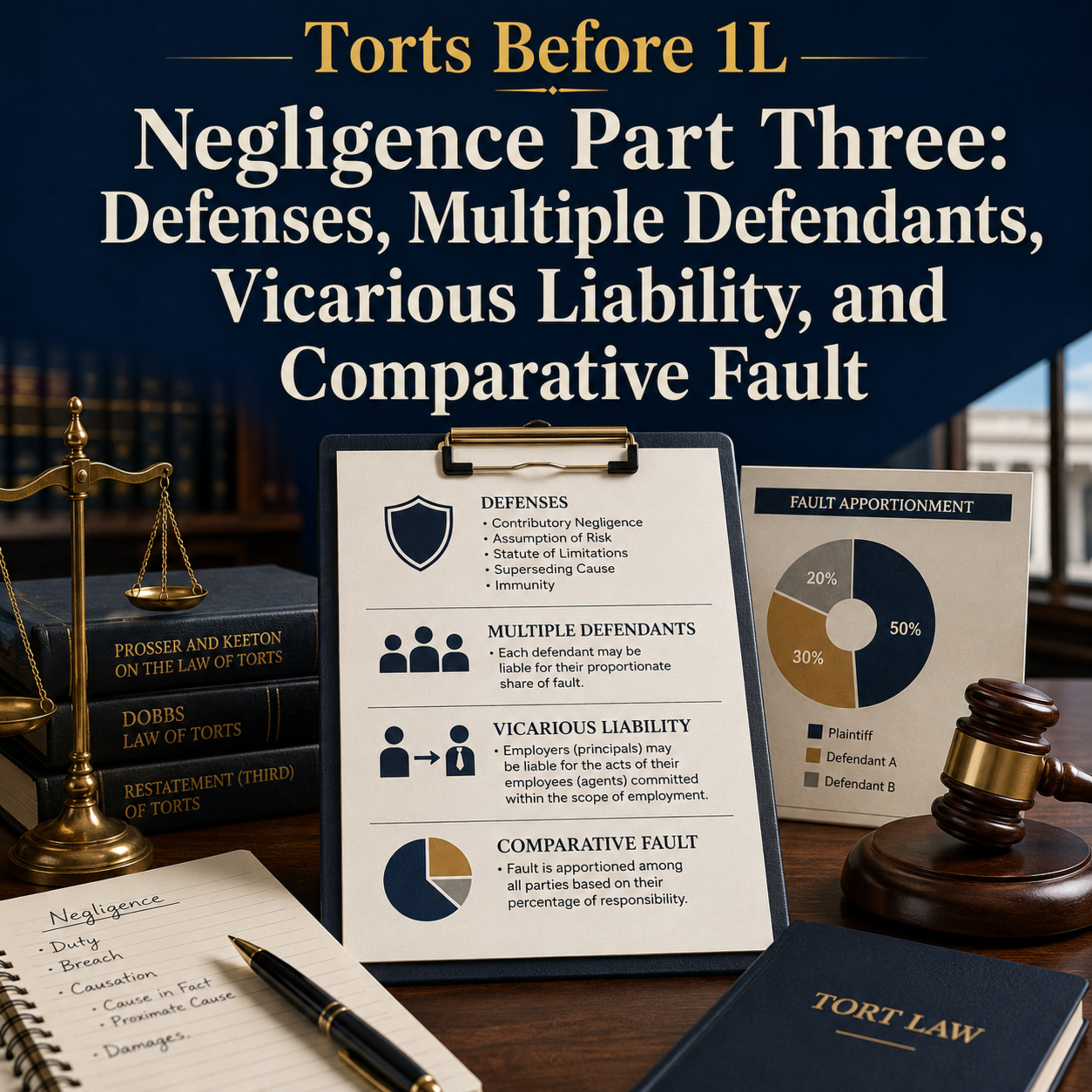
Torts Before 1L: Negligence Part Three - Defenses, Multiple Defendants, Vicarious Liability, and Comparative Fault episode artwork

EPISODE · Jun 5, 2026 · 1H 11M

Torts Before 1L: Negligence Part Three - Defenses, Multiple Defendants, Vicarious Liability, and Comparative Fault

from Law School · host The Law School of America

📘View Study GuideNavigating Tort Law: Defenses, Multiple Defendants, and Vicarious LiabilityThis episode unpacks the complex mechanics of responsibility in tort law, showing how courts allocate blame among multiple parties and the crucial defenses that can shift or bar liability. Whether you're preparing for the bar or seeking clarity on core principles, this detailed breakdown clarifies how to approach these layered issues with precision.Most tort cases hinge on the crucial difference between liability and responsibility—and mastering this distinction can make or break your exam score. In this episode, we peel back the layers of complex tort doctrines — from contributory negligence and comparative fault to vicarious liability and indemnity — revealing the secret frameworks that turn chaos into clarity.Imagine a reckless speeding driver with a documented history of violations, hitting a pedestrian outside a crosswalk. How should the legal system allocate responsibility when multiple parties are involved? You'll discover the nuanced rules of joint and several liability, and how states split the blame between full and proportional liability, dramatically impacting a defendant’s pocketbook. We break down the ins-and-outs of contribution and indemnity, explaining how defendants recover from each other after paying the full damages.In high-stakes scenarios involving multiple defendants, the choice between pure and modified comparative fault, and within that, the exact threshold language—less than or not greater than—can mean the difference between full recovery and complete zero. We clarify how these thresholds work in practice, using crystal-clear numerical examples, and teach you how to spot the exact language needed to get the right outcome on exam day.But it’s not just about the math. You’ll learn how doctrines like assumption of risk, including express waivers and implied consent, modify liability—especially in the gig economy and essential services—and the importance of the control test for distinguishing employees from independent contractors. We reveal how vicarious liability works differently from direct negligence, and when employer immunity turns into liability for wrongful acts like malicious assaults or inherently dangerous activities.This episode is perfect for law students, future lawyers, or anyone serious about cracking the toughest exam questions. If you want your rulebook to be second nature and build exam-ready outlines that are both precise and persuasive, this deep dive is your blueprint for success. Master these doctrines, and you'll unlock the precise control needed to allocate responsibility with confidence — because in tort law, how responsibility is divided is just as important as proving fault itself.Key TopicsThe structure of defenses based on plaintiff’s fault: contributory negligence, comparative fault, assumption of risk, and mitigationHow courts apportion fault among multiple defendants via joint and several liability versus several liabilityThe distinction and application of contribution and indemnity among joint tortfeasorsDeep dive into vicarious liability: scope of employment, detours vs. frolics, and exceptions for intentional tortsThe clear delineation between vicarious liability (respondeat superior) and direct liability for independent negligenceSpecial considerations: non-delegable duties, inherently dangerous activities, and liability in the gig economy

📘View Study GuideNavigating Tort Law: Defenses, Multiple Defendants, and Vicarious LiabilityThis episode unpacks the complex mechanics of responsibility in tort law, showing how courts allocate blame among multiple parties and the crucial defenses that can shift or bar liability. Whether you're preparing for the bar or seeking clarity on core principles, this detailed breakdown clarifies how to approach these layered issues with precision.Most tort cases hinge on the crucial difference between liability and responsibility—and mastering this distinction can make or break your exam score. In this episode, we peel back the layers of complex tort doctrines — from contributory negligence and comparative fault to vicarious liability and indemnity — revealing the secret frameworks that turn chaos into clarity.Imagine a reckless speeding driver with a documented history of violations, hitting a pedestrian outside a crosswalk. How should the legal system allocate responsibility when multiple parties are involved? You'll discover the nuanced rules of joint and several liability, and how states split the blame between full and proportional liability, dramatically impacting a defendant’s pocketbook. We break down the ins-and-outs of contribution and indemnity, explaining how defendants recover from each other after paying the full damages.In high-stakes scenarios involving multiple defendants, the choice between pure and modified comparative fault, and within that, the exact threshold language—less than or not greater than—can mean the difference between full recovery and complete zero. We clarify how these thresholds work in practice, using crystal-clear numerical examples, and teach you how to spot the exact language needed to get the right outcome on exam day.But it’s not just about the math. You’ll learn how doctrines like assumption of risk, including express waivers and implied consent, modify liability—especially in the gig economy and essential services—and the importance of the control test for distinguishing employees from independent contractors. We reveal how vicarious liability works differently from direct negligence, and when employer immunity turns into liability for wrongful acts like malicious assaults or inherently dangerous activities.This episode is perfect for law students, future lawyers, or anyone serious about cracking the toughest exam questions. If you want your rulebook to be second nature and build exam-ready outlines that are both precise and persuasive, this deep dive is your blueprint for success. Master these doctrines, and you'll unlock the precise control needed to allocate responsibility with confidence — because in tort law, how responsibility is divided is just as important as proving fault itself.Key TopicsThe structure of defenses based on plaintiff’s fault: contributory negligence, comparative fault, assumption of risk, and mitigationHow courts apportion fault among multiple defendants via joint and several liability versus several liabilityThe distinction and application of contribution and indemnity among joint tortfeasorsDeep dive into vicarious liability: scope of employment, detours vs. frolics, and exceptions for intentional tortsThe clear delineation between vicarious liability (respondeat superior) and direct liability for independent negligenceSpecial considerations: non-delegable duties, inherently dangerous activities, and liability in the gig economy

NOW PLAYING

Torts Before 1L: Negligence Part Three - Defenses, Multiple Defendants, Vicarious Liability, and Comparative Fault

0:00 1:11:42

No transcript for this episode yet

We transcribe on demand. Request one and we'll notify you when it's ready — usually under 10 minutes.

The Small Business Startup School – Business Notes | Financial Literacy | Retail Psychology – For Professionals & Entrepreneurs The Small Business Startup School Inc. Starting or buying a small business? While personal circumstances may vary, business patterns remain timeless. On The Small Business Startup School, we explore strategies, insights, and practical solutions to help entrepreneurs confidently navigate their journey.Hosted by Ola Williams—a retail entrepreneur, fintech founder, and financial coach with over two decades of experience—this podcast marries financial awareness and retail psychology with optimism to deliver actionable takeaways.Join us to learn, grow, and connect as we uncover the keys to business success.Let’s continue to learn together and be encouraged to keep on connecting! The 48 Laws of Power by Robert Greene (Full Audiobook) Robert Greene Amoral, cunning, ruthless, and instructive, this multi-million-copy New York Times bestseller is the definitive manual for anyone interested in gaining, observing, or defending against ultimate control – from the author of The Laws of Human Nature.In the book that People magazine proclaimed “beguiling” and “fascinating,” Robert Greene and Joost Elffers have distilled three thousand years of the history of power into 48 essential laws by drawing from the philosophies of Machiavelli, Sun Tzu, and Carl Von Clausewitz and also from the lives of figures ranging from Henry Kissinger to P.T. Barnum.Some laws teach the need for prudence (“Law 1: Never Outshine the Master”), others teach the value of confidence (“Law 28: Enter Action with Boldness”), and many recommend absolute self-preservation (“Law 15: Crush Your Enemy Totally”). Every law, though, has one thing in common: an interest in t Guardians Of Innocence Guardians Of Innocence Guardians of Innocence is a powerful and informative podcast designed to equip parents, teachers, and communities with the knowledge and tools needed to protect children from the growing threat of trafficking. Each episode dives deep into the tactics traffickers use to target vulnerable children—both online and in real life—and provides actionable advice on how to recognize the warning signs.Through expert interviews with cyber safety professionals, law enforcement, and survivors, we uncover the latest grooming methods, share real-world stories, and empower listeners to become vigilant guardians of innocence in their own families and communities.Guardians of Innocence is more than just a podcast; it’s a call to action to safeguard our children, raise awareness, and foster a united front against trafficking.Listen. Learn. Protect. The Laura Ingraham Show Laura Ingraham The most-watched woman in the history of cable news brings her no-holds-barred political and cultural commentary to podcasting with The Laura Ingraham Show. A bestselling author, breast cancer survivor, and mother of three internationally adopted children, Laura was the most listened-to woman in talk radio before launching her own podcast. A trailblazer across media platforms, she brings a unique perspective to this twice-weekly show, drawing on her experience as a white-collar criminal defense litigator and a Supreme Court law clerk.New episodes drop twice a week—delivering the clarity, courage, and common sense America needs.

Frequently Asked Questions

How long is this episode of Law School?

This episode is 1 hour and 11 minutes long.

When was this Law School episode published?

This episode was published on June 5, 2026.

What is this episode about?

📘View Study GuideNavigating Tort Law: Defenses, Multiple Defendants, and Vicarious LiabilityThis episode unpacks the complex mechanics of responsibility in tort law, showing how courts allocate blame among multiple parties and the...

Can I download this Law School episode?

Yes, you can download this episode by clicking the download button on the episode player, or subscribe to the podcast in your preferred podcast app for automatic downloads.
URL copied to clipboard!