
EPISODE · Jun 6, 2026 · 1H
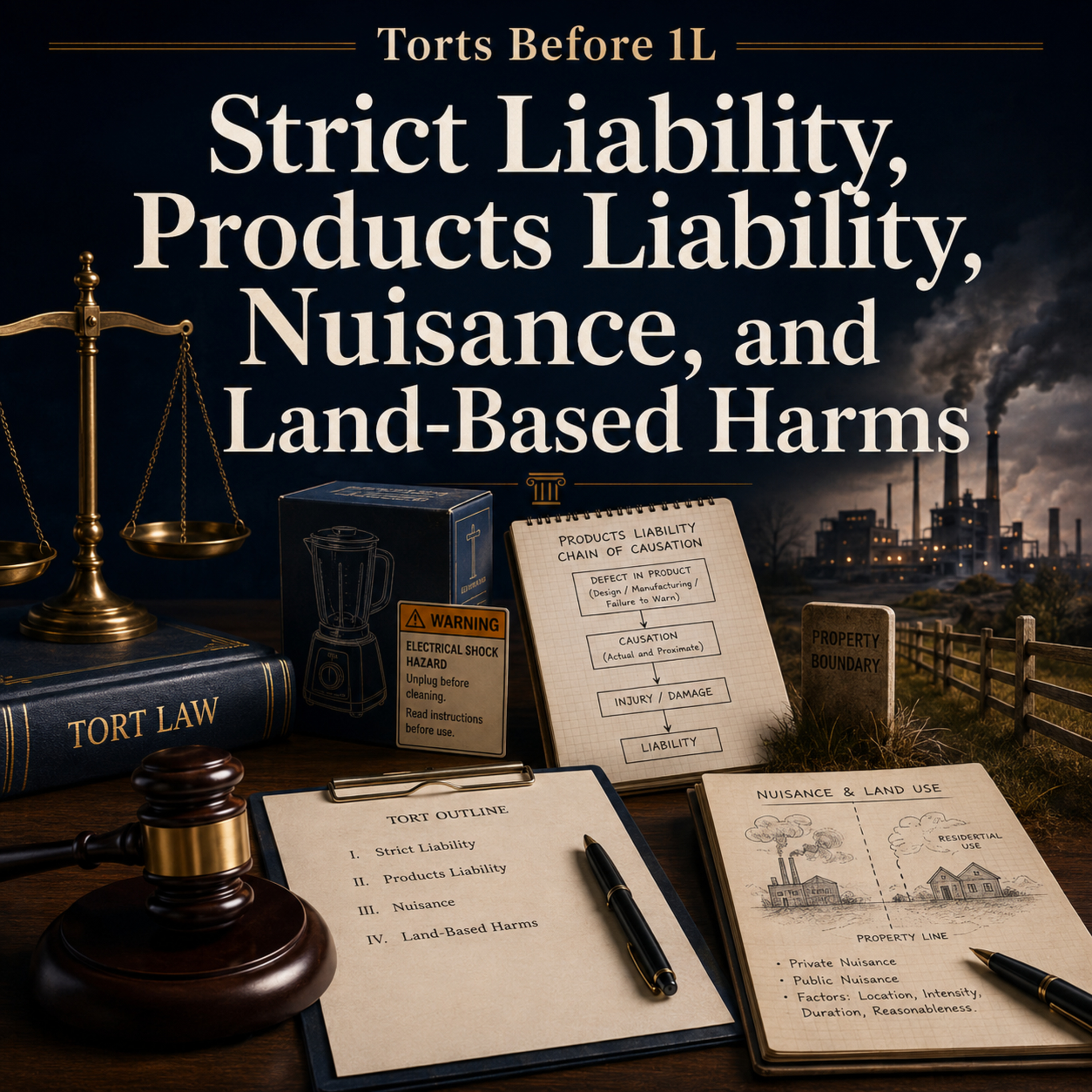
Torts Before 1L: Strict Liability, Products Liability, Nuisance, and Land-Based Harms
from Law School · host The Law School of America
.spotify-style-link { display: inline-flex; align-items: center; background-color: #1e293b; /* Deep Slate for authority */ color: #ffffff !important; text-decoration: none; font-family: -apple-system, BlinkMacSystemFont, "Segoe UI", Roboto, Helvetica, Arial, sans-serif; font-size: 14px; font-weight: 800; text-transform: uppercase; letter-spacing: 0.5px; border-radius: 4px; border: 1px solid #334155; transition: background 0.2s; padding: 2px 16px; } .spotify-style-link:hover { background-color: #0f172a; border-color: #fbbf24; /* Amber highlight on hover */ } .icon { margin-right: 8px; color: #fbbf24; } 📘View Study GuideMastering Tort Law: Beyond Ordinary NegligenceThis episode offers a comprehensive guide to understanding the complex categories of tort liability that go beyond standard negligence. Whether you're preparing for law school exams or the bar, you'll gain clarity on strict liability, product defects, land-based harms, and defenses, equipping you with a structured approach to analyze intricate fact patterns.Most tort claims are built around negligently failing to act carefully. But what happens when society decides that even the most cautious conduct isn't enough to prevent harm? This episode reveals the behind-the-scenes shift in tort law from a focus on fault to a system that emphasizes policy, risk, and economic efficiency. Whether you're prepping for the bar exam or just want a clearer picture of how dangerous activities, wild animals, and defective products are regulated—this is your essential guide.We dive into the core principles of strict liability—the legal framework where acting carefully simply isn’t enough—and explore how courts determine when an activity is so risky that the law imposes responsibility regardless of fault. You’ll discover how landmark cases like Rylands v. Fletcher revolutionized land-based harms and delve into the critical six-factor test from the Restatement Second of Torts that judges use to categorize dangerous activities. Surprising examples—including toxic waste storage, fireworks on city streets, and the risk calculus behind modern industrial hazards—illustrate how courts balance societal benefit against individual harm.The episode charts the classic distinctions between wild and domestic animals, showing how species’ natural propensities trigger strict liability, while owners of domestics benefit from the “one bite” rule (or its statutory variations). We explain the evolution of products liability—from old privity and negligence to the watershed section 402A of the Restatement Third—and unpack how courts impute knowledge of dangerous conditions to manufacturers, even when risks were scientifically unknowable at the time.Why does this matter? Because understanding these frameworks lets you predict how courts will treat environmental harm, industrial accidents, or even innovative tech like autonomous vehicles. You’ll learn to analyze complex fact patterns by systematically applying a structured question framework—identifying interest invaded, defenses, damages, and underlying policy—to craft precise, high-scoring exam answers.This episode is perfect for law students aiming to master the doctrinal terrain of non-fault torts, environmental law, or product liability. With practical insights into land support, nuisance versus trespass, private and public claims, and defenses like public necessity, you'll walk away with a toolkit to approach any complex scenario with clarity and confidence.Key Topics:The paradox of strict liability through microscopic flaws in products, like lawnmower bladesThe evolution from negligence to strict liability, emphasizing economic theory and policyLandmark case Rylands v. Fletcher and the shift to activity-based liabilitySection 520 of Restatement Second on abnormally dangerous activities and practical applicationAnimal liability distinctions: wild vs. domestic, and "scienter" or knowledge of dangerous propensitiesThe seven elements of strict products liability under Section 402A and defect classificationsDesign defects: risk utility vs. consumer expectations testsWarning defects: the importance of non-obvious hazards and adequacy of instructionsDefenses: misuse, assumption of risk, substantial alterations, and statutory modificationsLand-based harms: trespass and nuisance, including microscopic chemical invasionsDifferentiating private and public nuisance, and balancing tests for reasonablenessLand support: lateral and subjacent, and liability distinctions for natural vs. artificial supports
Embed this episode
Ready to play
Torts Before 1L: Strict Liability, Products Liability, Nuisance, and Land-Based Harms
No transcript for this episode yet
Similar Episodes
No similar episodes found.
Similar Podcasts
No similar podcasts found.